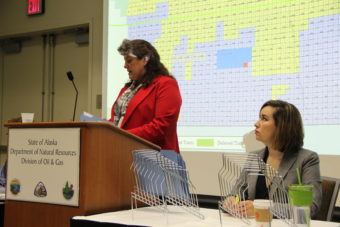
Corri Feige (left) in her previous role as head of the state Department of Natural Resources’ Division of Oil and Gas, reading out bids during the state’s annual North Slope lease sale. Feige will lead the Department of Natural Resources under Gov.-elect Mike Dunleavy. (Photo by Rachel Waldholz/Alaska’s Energy Desk)
Gov.-elect Mike Dunleavy today announced a key member of his cabinet: Corri Feige will be Alaska’s next natural resources commissioner.
Dunleavy made the announcement at an industry conference in Anchorage.
“We’ve had great conversations with her; very intelligent, very knowledgeable, pretty much in line with where we want to go as a state, and that’s creating jobs, creating opportunities,” Dunleavy told reporters after the announcement.
Feige is not new to the agency she will now lead. She was previously the head of the Alaska Department of Natural Resources’ Division of Oil and Gas under Gov. Bill Walker. But she resigned in 2016 during a dispute between the Walker administration and oil companies over marketing North Slope gas.
Feige is a geophysicist and engineer by training and has previously worked for smaller independent oil and mining companies in Alaska. She is married to Eric Feige, a former Republican state representative.
In her new role, Feige will help steer the Dunleavy administration’s policies on issues including the natural gas pipeline project and the proposed Pebble Mine.
Feige will also be a central voice in Alaska’s relationship with the Trump administration as it pushes for more oil development on the state’s federal lands and waters, including in the Arctic National Wildlife Refuge.
The governor-elect also made a policy announcement: Dunleavy said he wants to freeze all new regulations across all state departments and will attempt to retroactively freeze any regulations put forth by the Walker administration after Election Day.
Dunleavy said he is doing this to “assess whether they are needed or will hurt the economy.”
In response, Austin Baird, a spokesman for Gov. Walker, said he didn’t believe this would result in any significant changes, as “there is no plan to implement new regulations that would restrict resource development in any way,” Baird said in an email.
“The Governor-elect is effectively asking the Walker Administration to continue the work we’ve been doing for the past four years,” Baird said.
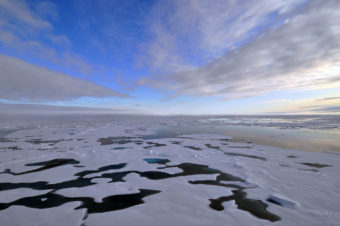
The Trump administration has re-opened large parts of the Arctic Ocean to oil leasing, but environmental groups are challenging that decision in court. (Photo courtesy of the U.S. Geological Survey)
A federal court in Anchorage Friday heard arguments in a case that could close off millions of acres of Arctic waters to oil development.
A few months after taking office, President Donald Trump issued an executive order to re-open large parts of the Beaufort and Chukchi Seas for offshore oil leasing. Former President Barack Obama had withdrawn those areas, citing environmental risks.
Environmental groups are legally challenging President Trump’s ability to undo Obama’s withdrawal.
In court, they argued that Congress gave presidents the power to take offshore areas off the table for oil development, but not the reverse.
Their argument hinges on a single line in the Outer Continental Shelf Lands Act: “The President of the United States may, from time to time, withdraw from disposition any of the unleased lands of the outer Continental Shelf.”
“Congress is precise about the amount of power it delegates,” Earthjustice attorney Erik Grafe said after oral arguments. “It delegated the power to withdraw, but it didn’t in the statute, anywhere, say that a president can revoke withdrawals. That’s a power that’s left to Congress.”
A lawyer for the Trump administration disagreed, arguing that this reading of the law is too narrow and not what Congress intended when it created the legislation in 1953. He argued that if the environmental groups’ reading of the law is correct, the president could hypothetically remove all federal waters from oil development.
“Congress does not hide elephants in mouse holes,” Department of Justice attorney Jeffrey Wood said during oral arguments.
A decision in the case is not expected for months, and no matter the outcome, it’s likely to be appealed. But the outcome could have near-term impacts, because the Trump administration has tentatively proposed holding an oil lease sale in the Beaufort Sea next year.
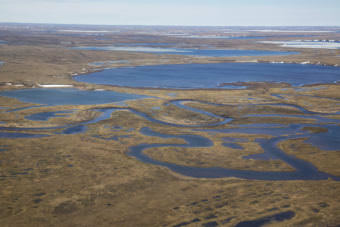
This year’s oil and gas lease sale for NPR-A will see less land offered up for oil leasing compared to last year. (Photo by Bob Wick, courtesy BLM)
The Trump administration is offering substantially less land for oil leasing in the National Petroleum Reserve-Alaska, or NPR-A, than it did last year.
At its annual oil and gas lease sale, the Bureau of Land Management will offer 254 tracts for bid -that’s close to three million acres of the federally managed Reserve, which is west of Prudhoe Bay.
Last year, the Trump administration put 900 tracts up for bid, adding up to over 10 million acres. That was the most land ever offered to oil and gas companies in the Reserve. But last year’s sale attracted little interest — oil companies only bid on seven tracts.
Still, NPR-A is seeing a surge of oil development, led by ConocoPhillips. The company is pursuing several large projects in the northeastern part of the Reserve.
In a statement today, the Center for Biological Diversity said “climate change is already underway in Alaska and this lease-sale will only make it worse.”
This year’s NPR-A oil lease sale will be held on December 12.
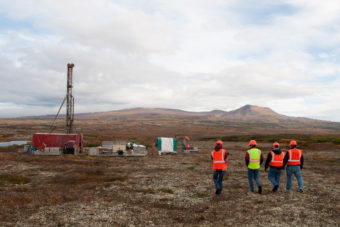
Members of the media walking to an exploratory drill rig at the Pebble Mine Exploratory site. (Photo by Jason Sear/KDLG)
By a significant margin, Alaska voters defeated Ballot Measure 1, commonly known as the Stand for Salmon initiative.
The controversial measure was aimed at increasing protections for Alaska’s most iconic fish. It would have significantly toughened the environmental permitting process for large developments impacting salmon habitat.
The outcome was celebrated by a key figure pressing ahead on another controversial issue: the CEO of the Pebble Limited Partnership.
Pebble CEO Tom Collier said even though his company’s mine proposal wasn’t always at the forefront of the debate, the salmon habitat initiative was, in some ways, all about Pebble.

“It was clear that this initiative was aimed at trying to stop Pebble and to stop any other major significant resource development project in Alaska,” Collier said in an interview Wednesday.
Pebble’s push to develop a copper mine in the Bristol Bay region faces fierce resistance from groups who say it endangers the salmon fishery there, and many of those same groups supported Ballot Measure 1. But Pebble kept a relatively low profile leading up to the election. Although it contributed money to Stand for Alaska – Vote No on 1, the campaign against the initiative, it didn’t play much of a role in the opposition’s messaging.
But Collier said had Ballot Measure 1 passed, it would have posed hurdles for Pebble, both in getting permits and in seeking a new financial partner (the company lost a potential major investor earlier this year.) Collier said with the initiative’s defeat, he’s more confident about the Pebble’s prospects.
“We think that responsible development can now go ahead in the state with the rigorous permitting requirements that the state already has in place. And we’re eager to be part of that as we move forward,” Collier said.
A previous Alaska ballot measure in 2014 that more explicitly targeted Pebble did pass with a significant majority.
But during this campaign, Ballot Measure 1’s supporters were reined in from outright saying it would block Pebble; there’s a legal reason for that. The state challenged the initiative in court, saying it went against the state constitution for a ballot measure to prioritize land for one use – here, salmon – over other uses, like a mine. The Alaska Supreme Court thought some parts of the initiative did just that, and in August, removed those parts, allowing the rest to go on the ballot.
United Tribes of Bristol Bay Executive Director and anti-Pebble advocate Alannah Hurley said she does not think the initiative would have halted the mine. But she believes it would have helped opponents’ cause by putting in place stricter standards.
Hurley also pointed out that the Bristol Bay region voted largely in favor of Ballot Measure 1.
“While those ideals did not prevail at the statewide level, it’s still a really clear indication about our region’s priorities and what we value,” Hurley said.
The Pebble Limited Partnership wasn’t the only mining company happy with the election’s outcome. Donlin Gold spokesman Kurt Parkan, whose company is trying to develop a large gold mine in the Yukon-Kuskokwim Delta, said the measure would have delayed the project’s quest to get its major state permits by early next year.
Parkan said at a mining conference he attended in Anchorage the day after the election, attendees breathed a sigh of relief.
“I think people were surprised at how big the margin was, to win by over 60 percent … was huge, and people were pretty pleased with that,” Parkan said.
Parkan and other Ballot Measure 1 opponents said they could be willing to come to the table and negotiate updates to the state’s salmon habitat protections – but it would have to happen through the legislative process, rather than by ballot initiative.
The initiative’s supporters also said they plan to continue pursuing avenues towards updating Alaska’s laws protecting salmon habitat.
Shortly after the polls closed on election night, Ballot Measure 1 sponsor Stephanie Quinn-Davidson said she felt the campaign had changed the conversation about salmon in Alaska, no matter what the outcome was.
“It’s clear that Alaskans want stronger protections for salmon, but people have different opinions on how we go about doing that, and I’m confident if this doesn’t pass, that we have folks in the legislature that want to work on a bill that is going to get moved forward,” Quinn-Davidson said.
Ballot Measure 1 supporters greet early morning commuters on Election Day, Tuesday, November 6, 2018, in Juneau, Alaska. (Photo by Rashah McChesney/Alaska’s Energy Desk)
Update (11:45 p.m.)— Elizabeth Harball
Following months of intense debate and millions of dollars in campaign spending, Alaska voters defeated Ballot Measure 1 by a wide margin.
Commonly known as the Stand for Salmon initiative, the measure was aimed at increasing protections for Alaska’s most iconic fish. It would have significantly toughened the environmental permitting process for mines, dams and oil developments in salmon habitat.
The initiative faced strong resistance from the resource industry, Alaska Native corporations, unions and other groups. Opponents said it would hinder resource development in the state.
The campaign against the initiative raised over 12 million dollars, far outstripping the initiative’s supporters, who raised over two million dollars.
Update (10:15 p.m.)— Ryan Cunningham
With 38 percent of precincts reporting, “no” voters are leading by a wide margin. Ballot Measure 1 is down 61 percent to 36 percent. If approved, the ballot initiative would add new protections for Alaska’s salmon habitat.
Original story
Alaska’s voters are weighing in today on a question that cuts to the heart of the state’s identity: What’s the right balance between resource development and protections for the state’s most iconic fish?
Ballot Measure 1, commonly known as the Stand for Salmon initiative, is aimed at increasing protections for salmon habitat in Alaska. The eight-page measure includes a number of provisions, including a more stringent permitting process for projects with greater potential impacts to salmon habitat, with more opportunity for the public to comment. Another key element is that the measure limits offsite mitigation, which is the practice of restoring habitat in a different location to compensate for habitat impacted or eliminated by a project.
The measure proved extremely controversial, drawing fierce opposition from oil and mining companies, Alaska Native Corporations, unions and other groups. They argued the initiative was too burdensome and would hinder resource development. Opponents formed a coalition under the name “Stand for Alaska – Vote No on 1” to campaign against it.
Stand for Alaska raised a significant amount of money over the course of the campaign. By election day, Stand for Alaska had brought in over $12 million, with major donations from oil and mining companies like BP Alaska, Donlin Gold and ConocoPhillips Alaska.
The measure’s supporters raised over $2 million. Much of their campaign was organized with support from local environmental groups like Cook Inletkeeper, as well as national groups like the Wild Salmon Center and Trout Unlimited. The campaign in favor of Ballot Measure 1 also received significant donations from John Childs, a Wild Salmon Center board member and private equity firm chairman, and Vulcan Inc., a company controlled by the estate of the late Microsoft co-founder Paul Allen.
Until late this summer, it wasn’t even certain the initiative would end up on the ballot because the state challenged it in court. In August, the Alaska Supreme Court ruled parts of the initiative were unconstitutional because it explicitly barred the state from allowing certain permits in specific situations. After removing those provisions, the Supreme Court allowed the remainder of the initiative to go before voters.
In addition to debating the substance of the measure, supporters and opponents also sparred over campaign transparency, both filing complaints with the Alaska Public Offices Commission. The initiative also became a talking point in other major campaigns this election cycle: Governor Bill Walker and Republican gubernatorial candidate Mike Dunleavy came out against it, while Democratic candidate Mark Begich said he supported the initiative.
This story will be updated as election results come in.
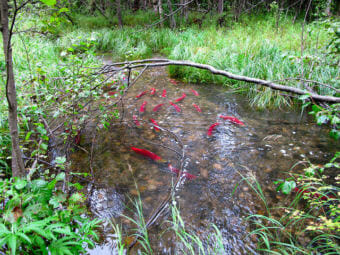
Sockeye salmon migrate up a small stream in Southcentral Alaska. (Photo: Katrina Liebich/USFWS)
Alaskans will soon vote on Ballot Measure 1, the controversial initiative aimed at protecting Alaska’s salmon habitat. Companies behind big proposed mines and oil developments have helped raise millions of dollars to campaign against it.
But beyond big resource development projects, opponents say Ballot Measure 1 could hinder projects like road improvements. Supporters counter that it was specifically written to allow vital infrastructure projects to go forward.
So how will the ballot measure affect mid-sized projects used by everyday Alaskans? The answer isn’t clear-cut.
Part of the uncertainty on how the salmon habitat initiative could affect things like small-scale hydro projects or mom-and-pop placer mines hinges on a single phrase in the ballot measure: “significant adverse effects.”
That’s because if it passes, projects that could cause “significant adverse effects” to salmon habitat will go through a much tougher and more public vetting process to get what’s called a major permit. Projects that impact salmon habitat in less significant ways could get a minor or a general permit, and that process would be less rigorous and time-intensive.
So what counts as a “significant adverse effect” on salmon habitat? Where’s the line between a major and a minor permit?
“We have not made an actual determination about that yet,” said Ron Benkert, a regional supervisor with the Alaska Department of Fish and Game, the agency that would carry out the ballot measure if it passes.
Benkert said the measure does lay out criteria on what counts as “significant adverse effects;” for example, if a project blocks fish from passing through, that’s “significant.” Other criteria on what counts as “significant” are less clear, he said.
“Some of them are kind of difficult to define and it would probably require us to develop some additional regulations to further clarify that,” Benkert said.
So if the measure passes, that’s not the end of the story. Although it will go into effect 90 days after the election results are final, the state will likely write regulations that would try to nail down the distinction between projects in salmon habitat that have to clear a higher bar and projects that won’t. Benkert said that could take several months, if not longer, and would require significant input from the state’s Department of Law.
An attorney who represents companies opposed to the ballot measure said if it passes, Fish and Game will suddenly be under intense scrutiny as it figures out what counts as “significant adverse effects.”
“I’ve been involved in a lot of rulemakings over the years; this one is going to be as hard as anything I have ever seen, just because there’s so much interest in it,” said Eric Fjelstad, an attorney with Perkins Coie, a firm that also has worked for the Stand for Alaska campaign.
The state can likely put little projects like boat ramps under the “minor” category. And a big proposed mine that will displace salmon streams? That will go through the tougher permitting process.
“The clients I represent — everyone just assumes they will be major,” Fjelstad said.
But Fjelstad said the gray area in the middle will be tricky for the state to navigate.
“You have, say, a road that’s 75 yards long with a gravel pad where you want to build a cabin, and it’s through a swampy area that is deemed to be anadromous fish habitat — is that going to be under the minor scheme?” Fjelstad said. “I think those are the questions that are harder, that are right on the line.”
Emily Anderson, an attorney with the Wild Salmon Center who helped write the initiative, pushed back on opponents who have said needed infrastructure projects will be hindered by the ballot measure.
“I think Fish and Game will write regulations that reflect the intent of the law, which is not to overly burden everyday Alaskans or to stop vital infrastructure projects or anything like that,” Anderson said, stressing that the projects would only need permits if they “use, divert, obstruct, pollute, disturb or otherwise alter” habitat for salmon and other, similar fish species.
“It’s really, really premature to say, ‘you’ll never be able to do this,’ or expand your airport in X, Y and Z community,” she added. “That’s ridiculous to say at this point.”
Anderson acknowledged it’s hard to pinpoint exactly what projects will get a minor permit, and what projects will go through the tougher vetting process, because Fish and Game will have discretion on that. She added the measure isn’t focused on how big or small a project is, or what kind of project it is. Instead, the bar is to what extent it could harm salmon habitat.
“You can have a very large project that has very little impact to fish habitat, and therefore could be processed as a minor permit,” Anderson said. “You can have a very small project that the way it’s being proposed can have very high impacts to fish habitat, and that may be proposed as a major project.”
So a project’s size may not be the best indicator of how much it could be impacted by Ballot Measure 1. And even then, when it comes to how the initiative could impact some projects used by everyday Alaskans, a lot rides on how the state writes regulations to implement it.
But before all that, Alaskans will vote to decide whether the ballot measure should go forward at all.
Close
Update notification options
Subscribe to notifications
Subscribe
Get notifications about news related to the topics you care about. You can unsubscribe anytime.