Elizabeth Harball, Alaska's Energy Desk

As administration pursues ANWR drilling, Trump official accuses federal employees of creating ‘road bumps’

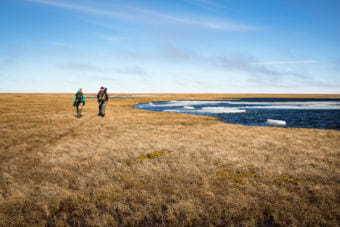
Biologists participating in a U.S. Fish and Wildlife Service research trip in the Canning River area. (Photo by Lisa Hupp/U.S. Fish and Wildlife Service)

Late last year, Congress ordered the federal government to hold oil lease sales in a portion of the Arctic National Wildlife Refuge. Defying opponents who say the land is too ecologically fragile to drill, the Trump administration has prioritized carrying out the new law.

Now, without offering many details, a top Trump administration official is accusing federal employees of making that job more difficult, saying they seem unhappy about the prospect of oil development happening on land they’ve managed as a refuge for decades.

Joe Balash is Assistant Secretary for Land and Minerals Management at the U.S. Department of Interior and a former natural resources commissioner for Alaska. He’s one of the top political appointees at the Interior Department, and he’s overseeing the process to begin oil development in the Arctic National Wildlife refuge.

In an interview last month, Balash described what he called a “really difficult management challenge” with U.S. Fish and Wildlife Service employees. He said during a recent meeting with the agency in Alaska, he felt employees weren’t eager to carry out the new law.

“You could just tell from all of the nonverbal communication going on in the room that they were not happy to see us, they were not happy to talk about this, they still weren’t necessarily prepared to accept this new reality,” Balash said.

Balash is the head of some divisions within the Interior Department, including the Bureau of Land Management, but the Fish and Wildlife Service doesn’t report to him. He accused Fish and Wildlife employees of causing challenges for his agency as it works to pursue oil development in ANWR, creating “some little hiccups and road bumps along the way.”

Balash gave just one specific example: this spring, the Washington Post obtained plans to begin the search for oil in the refuge that were submitted to the Fish and Wildlife Service. Balash thinks those documents were leaked from a Fish and Wildlife Service employee.

“I think that’s evidence that there’s some unhappy campers,” Balash said.

Balash didn’t cite any direct evidence to prove the documents came from the Fish and Wildlife Service. And in the story, it’s not clear exactly where they came from — a Washington Post reporter who worked on the piece declined to say.

Still, Balash said he’s asking management at the Fish and Wildlife Service to address what he views as a problem in the agency, “taking steps, every so often, to help remind people that there’s a real need to be professional and not allow those very human feelings to get in the way of doing the job the American Congress has charged us with.”

He said, “I think with each successive month and with each effort that we make, [we will be] able to show these employees that we are taking care to look out for the things that matter here and that are potentially affected if leasing occurs.” But, Balash added, “I wouldn’t say that we’re ever going to get them on board.”

Balash did not threaten retribution over this issue. He said Interior needs the knowledge of longtime Fish and Wildlife Service employees to carry out the oil leasing program.

A spokesperson with the Alaska office of the Fish and Wildlife Service office declined to comment on Balash’s remarks.

But Rosa Meehan, a former longtime Fish and Wildlife Service manager in Alaska, said she’s confident workers at the agency are acting appropriately.

“I absolutely believe in the integrity and professionalism of the Fish and Wildlife Service and all my colleagues in the Service,” Meehan said.

Meehan said she’s concerned about Balash’s words about employees not being “on board” with oil lease sales in the refuge. The federal environmental review process is meant to be an objective, scientific discussion of all potential impacts, she added.

She said that includes impacts that could be viewed as negative, and it’s the Fish and Wildlife Service’s job to point out them out, no matter what.

“It makes it sound as if you don’t really want to that hear anything that could be interpreted as opposing or saying this is really a bad idea – or pointing out significant impacts, or potential impacts,” Meehan said. “And that’s what’s really uncomfortable about this.”

Interior aims to put out a draft environmental review on oil leasing in ANWR in the coming months. Like all environmental reviews, it will present a “no action alternative” — the option to do nothing. But it’s not a real option.

No matter what that analysis says, Congress ordered Interior to hold the first oil lease sale in the refuge by the end of 2021, and the Trump administration wants to get it done even sooner than that.

State fines group opposing salmon habitat initiative for violating naming rule

StandforAlaska
Campaign materials for Stand for Alaska – Vote No on One on display at an Anchorage conference. (photo by Nat Herz/Alaska’s Energy Desk)

The state is fining the main group opposing the salmon habitat ballot initiative $1,925.

The Alaska Public Offices Commission says the group violated a rule that requires an organization fighting an initiative to clearly state its opposition in its name.
The organization is now called “Stand for Alaska – Vote No on One.” But the group was called simply “Stand for Alaska” until June 12, when it changed its name. The group also used “Stand for Alaska” in several campaign videos posted online.

APOC staff said the maximum penalty for all of the violations was $7,700, but the commission opted to reduce the fine because this is the first election cycle it has been active, and also “because the penalty is out of proportion to the degree of harm to the public,” the commission wrote in its decision.

Stand for Salmon, a group campaigning for the initiative, filed the complaint with the commission, arguing the name “Stand for Alaska” confused and misled voters. Ryan Schryver, director of Stand for Salmon, said the original name was “intentionally deceptive.”

The Stand for Alaska — Vote No on One campaign manager said that wasn’t the case.

“As far as the naming error goes, it was honest mistake, but a mistake nonetheless,” said Kati Capozzi of Stand for Alaska. “We will be paying the fine and we’re not going to be contesting it.”

As climate change looms large for the oil industry, what could that mean for Alaska?

Harball_DSC_0090
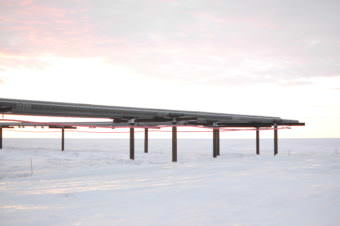
A flow line curves above the horizon on the western North Slope. (Elizabeth Harball/Alaska’s Energy Desk)

This spring, ExxonMobil held a meeting with investors. It didn’t generate many headlines. And that’s a little surprising, considering what the company was there to talk about.

“This was the first time that Exxon had ever held a session devoted entirely to carbon, as they called it, but to the larger issue of climate change,” said Amy Harder, a veteran energy reporter who used to work for the Wall Street Journal and is now with Axios in Washington, D.C.

In Alaska, oil companies are already seeing the consequences of climate change. Shorter winter seasons are impacting the use of ice roads for oil exploration and construction. It’s also forcing the use of more refrigeration technology to keep thawing permafrost stable beneath infrastructure.

But the oil industry is also grappling with the issue on a much higher level — in a way that could eventually affect whether or not they pursue projects in the Arctic.

For Harder, Exxon’s meeting is a key example of how seriously oil companies are strategizing around climate change.

“You had Darren Woods, the CEO of the company, there, talking directly with analysts about this very issue,” said Harder.

Woods discussed what oil companies are calling “the dual challenge” — that is, the rising need for energy in developing nations pitted against the need to reduce planet-warming carbon emissions.

“We believe that we have an obligation to help address this challenge,” Woods said. “We also believe, very strongly, that we’re part of the solution.”

The purpose of the meeting was to explain to Exxon’s investors how the company fits in a world where climate change not only exists, but where people are trying to do something about it. At one point, Woods explained why Exxon could support a carbon tax.

“There is a cost of carbon in society today. It’s an implicit cost. It’s hidden. And so our view with a carbon tax is making it explicit is a much more effective way,” Woods said.

Climate activists didn’t exactly hail Exxon’s meeting as a victory. The company’s take-home message was its oil and gas business is going to be just fine, even in a world that’s trying to confront climate change. Exxon also projected the world will probably blow past the crucial 2 degree Celsius threshold — that’s the amount of warming scientists say will lead to severe impacts across the globe. And that spurred a lot of criticism.

All that aside, though, Harder’s point is this: that Exxon’s meeting even happened is a big deal. That its investors were there, asking tough questions about climate policy and how it could affect Exxon’s business model — and that the CEO was there, taking those questions on — that’s telling.

“They’re accustomed to dealing with what reservoirs around the world have the most oil … all of these other things that really have nothing to do with climate change,” Harder said. “So the fact that they were steeped in it, to me was an indication that climate change is a very big issue from a business perspective for Exxon and other big oil companies.”

Exxon’s climate meeting fits into a larger debate happening in the oil industry right now. For decades, the world’s hunger for oil has generally, steadily ticked upwards. And in response, companies have done what they do best: find and produce more oil to satisfy that growing demand.

But now, thanks to climate change, there’s talk that trend might shift.

“There’s been a real sea change in the last 18 months or so in how the oil industry approaches climate change as a financial issue,” said Andrew Logan of Ceres, a Boston-based nonprofit that works with investors and companies to make the business case for environmentally friendly practices.

“What’s changed … is that the industry now, for the first time in its history, is worried that after a century and a half of growth, global demand for oil may peak and eventually decline,” Logan said. “That is a remarkably fundamental shift for these companies.”

There are a number of factors leading to this discussion. For example, the Trump administration may be pulling back from climate policy, but most of the rest of the world isn’t. Renewables like solar and wind still make up a small fraction of the world’s energy supply, but the sector is growing rapidly. And the world is getting much more efficient in how it uses fossil fuels.

So some big oil companies are talking about a day when the world’s demand for oil stops growing. Companies like BP, which operates Alaska’s biggest oil field, and Shell. This year, another company, Norway’s Statoil, proclaimed to the world it was taking “oil” out of its name. The company is now called Equinor, and it’s reshaping itself as an energy company, not just an oil company. By 2030, Equinor expects up to 20 percent of its business will be in renewable energy and technology to capture carbon emissions.

It’s important to note that all oil companies, including Equinor, agree demand for their product isn’t going to dry up any time soon. The world goes through a mind-boggling amount of oil every day.

For example, ConocoPhillips recently announced a huge oil discovery in the Arctic, called the Willow discovery. Conoco is planning to spend years, and billions of dollars, to develop it. On the high end, Conoco estimates the discovery holds up to 750 million barrels of oil. That’s big for Conoco. Huge for Alaska.

But the world goes through about that much oil in just over a week.

For the world to stop using so much oil would require a massive, fundamental shift for the global economy — that’s one big reason why solving climate change is such a difficult problem. And as giant economies like China and India grow even more, staggering amounts of energy will be needed to power them.

So oil economists looking to the future are trying to balance the world’s insatiable need for energy against its pressing need to deal with climate change.

ConocoPhillips’ Chief Economist Helen Currie is one of those people. In an interview, Currie said Conoco’s position is that the world’s need to drive down emissions doesn’t mean oil demand will decline.

“We see oil demand continuing to grow for decades into the future — and in our view, it can continue to grow inclusive of climate change policies,” Currie said.

While Conoco thinks the rate of growth of oil demand might slow, the company still believes oil demand is going to keep rising for quite some time.

But it’s impossible to know exactly how this will play out — the energy industry is notoriously complex and unpredictable. So today, when it comes to future oil demand, companies are starting to say different things. There’s Conoco’s position, and then there are players like Equinor, the Norwegian company, which is now projecting oil demand could start to decline by 2030.

Logan of Ceres said there’s no doubt the world is going to need a lot more energy.

“I think the real question is what form will that energy take, and will it necessarily be fossil fuels?” Logan said. “And that’s where I think the risk of the industry being wrong is greatest, and, I guess, is the greatest threat to the long-term financial health of these companies.”

So what could that mean for Alaska?

One of the scientific papers that inspired the “Keep It In The Ground” activist movement puts Alaska’s oil industry squarely in the crosshairs of the global push to halt climate change. It says that in a world that keeps warming below 2 degrees Celsius, “all Arctic resources should be classified as unburnable.”

Right now, many companies still see Alaska’s oil as eminently burnable.

But at least one oil company operating in Alaska is publicly weighing potential climate change policies against its future investments on the North Slope. Oil Search, a Papua New Guinea company that has taken over the large Nanushuk oil play, held a briefing this April with investors on “climate risk.” In the company’s presentation, it lays out projections on whether its developments would go forward under several future climate policy scenarios.

In a world that keeps warming under 2 degrees Celsius, Oil Search said while the project’s “value is eroded,” the company still sees Nanushuk as a good investment. If the world takes much more extreme action to curb emissions, keeping future climate warming under 1.5 degrees Celsius, Oil Search’s presentation states, “the project would not be sanctioned.”

So it’s worth asking the question: if the global push to reduce emissions intensifies, what could happen to other future oil developments in the Arctic, perhaps offshore, where drilling is expensive and controversial? Is it possible the industry will decide some of Alaska’s oil isn’t worth drilling?

If the world starts to take more meaningful steps to curb climate change, Harder, the energy reporter with Axios, thinks that at some point, some oil, somewhere is going to get left behind.

“All of these oil companies say that their reserves are the most viable, they can get oil out the cheapest, that they will thrive in a carbon constrained world,” Harder said. “But it’s a little bit like musical chairs — everybody thinks that they are going to get a spot. But by definition, not everybody can succeed.”

For oil companies, climate change is an issue they can’t escape. They’re agreeing with climate activists that climate change is real. They even say they could support policies to do something about it.

But if companies do eventually go one gigantic step further and keep some of their oil in the ground, it probably won’t be because they’ve decided to save the planet — it will be because they’re trying to save themselves.

This story is part of the podcast, Midnight Oil: The Big Thaw, from Alaska’s Energy Desk. To hear more, visit the website or subscribe wherever you get your podcasts.

Two major Arctic oil projects near approval

Harball_CD5
CD5, ConocoPhillips’ first oil development within the boundaries of NPR-A. Conoco may soon get approval for a third development there. (Photo by Elizabeth Harball/Alaska’s Energy Desk)

Two oil developments in the Arctic are likely to get the final go-ahead from the Trump administration this fall.

The federal Bureau of Land Management today released its final environmental review for an oil drill site in the National Petroleum Reserve-Alaska, west of Prudhoe Bay. Called the Greater Mooses Tooth 2 project, it’s being proposed by ConocoPhillips.

The other project nearing approval would be the first offshore oil production in federal Arctic waters.

The federal Bureau of Ocean Energy Management released its final environmental review for the proposed Liberty Project last week. Oil company Hilcorp aims to build the Liberty Project in the Beaufort Sea, just east of Prudhoe Bay.

Before signing off on the oil developments, the Trump administration has to wait 30 days after the final environmental reviews are published.

That means both the Liberty Project and Greater Mooses Tooth 2 could get the green light as soon as Oct. 1.

Company hints North Slope oil field could be larger than first estimated

Harball_DSC_0090
A flow line curves above the horizon on the western North Slope. (Elizabeth Harball/Alaska’s Energy Desk)

A Papua New Guinea company says a North Slope oil field may be a lot bigger than it first estimated.

Oil Search told investors this week that the Pikka development could hold 750 million barrels of oil, increasing its original estimate by 50 percent. The company aims to drill two wells this winter to help confirm the field’s size.

The company also said another area just south of Pikka, called Horseshoe, could hold more than 300 million barrels of oil. Another oil company with a stake in the project said last year that the entire area could hold upwards of a billion barrels of oil.

Pikka is west of Prudhoe Bay, on land owned by the state and Kuukpik Corporation.

Oil Search is relatively new to Alaska. Its other major projects are in Papua New Guinea. The company bought up a significant stake of the Alaska oil field last year from the Denver-based Armstrong Energy.

Oil Search managing director Peter Botten told investors he’s feeling optimistic about the company’s North Slope venture.

“We’re acutely aware we need to walk before we can run in Alaska, and we need to get it right and not drop the ball, but things are really going well there,” Botten said.

Botten added that Oil Search plans to double its Anchorage staff to 100 by the end of the year.

Oil Search’s increased estimate for Pikka was first reported by the Anchorage Daily News.

Site notifications
Update notification options
Subscribe to notifications