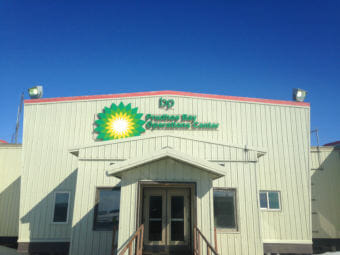
BP’s operations center at Prudhoe Bay. (Photo by Elizabeth Harball/Alaska’s Energy Desk}
A state agency is holding a public hearing and requesting a field-wide review of all of BP’s oil wells at Prudhoe Bay following an accident last month.
According to Alaska Oil and Gas Conservation Commission records, on December 7, BP discovered one of its wells was leaking gas and a small amount of oil. BP reports it stopped the leak two days later. The company estimates two gallons of oil were spilled in the well house.
BP linked the earlier accident to thawing permafrost and the well’s design, which led the well to jump up several feet from the ground, hit the top of the well house, and begin spewing gas and oil.
Following the 2017 incident, the commission ordered oil companies across the North Slope to review thousands of wells. BP reported 14 more at-risk wells, which were later shut in — that means the wells were no longer operational, but they could potentially be used to produce oil again.
BP confirmed the well that began leaking last month was one of the 14 at-risk wells.
The Alaska Oil and Gas Conservation Commission is now requiring BP to plug and abandon those wells, which means they will no longer be able to produce oil.
The Commission is in the process of investigating the December leak and is holding a hearing to address the incident next month.
In a statement, BP spokesperson Megan Baldino said the company is also investigating the accident, and is cooperating with the commission’s request for more information.
“BP is focused on operating Prudhoe Bay in a safe, reliable and compliant manner,” Baldino said.
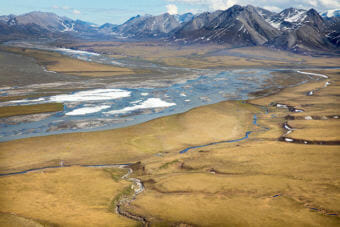
The Canning River, which forms the northwestern border of Arctic National Wildlife Refuge. (Photo: Lisa Hupp/USFWS)
The Interior Department has responded to questions from a Democratic congressman about its continued work to advance oil development in Alaska during the partial government shutdown.
Despite the shutdown, Interior has held public meetings in Alaska communities on potentially expanding oil development in the National Petroleum Reserve-Alaska. And last week, Alaska’s Energy Desk reported that an Interior employee was continuing to email community leaders in Alaska to arrange meetings about oil lease sales in the Arctic National Wildlife Refuge, two weeks into the shutdown.
On Monday, Democratic congressman Raul Grijalva of Arizona wrote a letter to Interior demanding details on how the agency is paying for its continued work, saying it raises legal questions. Grijalva, now chairman of the House Natural Resources Committee, is fiercely opposed to oil development in the Refuge.
“The work for gas and oil continues, despite the shutdown, despite the fact that people are not being paid, despite that our parks are suffering from looting, vandalism and unsanitary conditions,” Grijalva said in an interview.
Interior officials declined to be interviewed. But in its response letter, the agency said after consulting with its solicitor’s office, Interior determined it could legally fund the work using money from the previous fiscal year.
The agency added, “The planning process for both of these efforts are critical to the state of Alaska and the nation. The BLM will continue to ensure opportunities for public engagement are provided in order to allow local community members, governments, and the public at large to weigh in on these important matters.”
Grijalva’s colleagues in the Senate Energy and Natural Resources Committee say they support Interior’s actions. That committee is chaired by Sen. Lisa Murkowski, who championed the legislation that opened a part of ANWR for oil development in 2017.
“One of Interior’s essential missions is producing energy for the good of the country,” a spokeswoman for the committee said in a statement. “What they’re doing to advance development in the NPR-A and 1002 Area is fully legal, a top priority, and we strongly support it.”
The BLM on Wednesday announced it is postponing public meetings related to oil leasing in ANWR, although the agency had not yet made the meeting dates public. The agency said the deadline for public comment — Feb. 11 — remains the same.
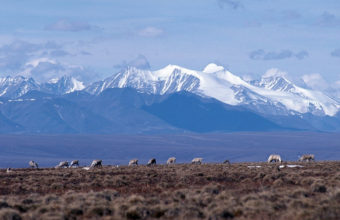
Caribou graze on the coastal plain of the Arctic National Wildlife Refuge, with the Brooks Range as a backdrop in October 2010. (Public domain photo by U.S. Fish and Wildlife Service)
Jan. 7 update:
The new Democratic chairman of the House Natural Resources Committee is demanding details on how the Department of the Interior is continuing its push toward oil lease sales in the Arctic National Wildlife Refuge despite the partial government shutdown.
Congressman Raul Grijalva of Arizona wrote to acting Interior Secretary David Bernhardt questioning whether his department’s work is appropriate during the partial shutdown. Interior is continuing its environmental review for oil lease sales in the Arctic refuge, as well overhauling the management plan to the west of the refuge in the National Petroleum Reserve-Alaska.
Grijalva said it doesn’t make sense for the department to hold public meetings when the shutdown is limiting agency staff’s ability to answer questions.
“Asking people to comment on two major development processes in the Arctic with huge potential environmental and human consequences without anyone in the agency able to answer questions defeats the purpose of the public participation process,” Grijalva wrote.
Grijalva asked for details on how the Bureau of Land Management, an Interior Department agency, has the legal authority to continue the work. He wants to know what account is paying for it and how much money is being spent, in addition to the names of people who participated in the agency’s decision-making process.
The congressman asked for a response by Friday. Even with the department’s reduced staff, he said, “there should be no difficulty having those employees provide responses to these questions,” since department employees are still in the office to work on oil development.
In a previous statement, BLM Alaska said it is using funding from a previous fiscal year to pay for the work. In a bill passed last year, Congress did authorize a pot of money for BLM “to remain available until expended.”
Original post:
As the partial government shutdown drags on, the Trump administration is making sure some Interior Department employees continue work on one of its biggest, most controversial priorities: opening the Arctic National Wildlife Refuge to oil drilling.
Drilling opponents were quick to criticize the move, contrasting it with the overflowing trash cans and unattended public toilets in national parks managed by Interior, which have become a symbol of the continuing stalemate in Washington, D.C.
Emails obtained by Alaska’s Energy Desk show that on Jan. 3 — 13 days into the shutdown — Bureau of Land Management project coordinator Nicole Hayes wrote to community leaders in Alaska to schedule public meetings for the ongoing environmental review process needed to allow oil lease sales in the Arctic refuge.
When contacted Friday by Alaska’s Energy Desk, Hayes’ email account sent an automatic reply: “Due to the lapse in funding of the federal government budget, I am out of the office. I am not authorized to work during this time, but will respond to your email when I return to the office.”
The partial shutdown also isn’t stopping Trump’s Interior Department from pressing ahead with potentially allowing more oil development in another vast, federally managed area in the Arctic, the National Petroleum Reserve-Alaska, or NPR-A.
The Bureau of Land Management confirmed it is going forward with previously scheduled public meetings on overhauling the NPR-A management plan in the North Slope communities of Utqiagvik on Fri., Jan. 4 and Nuiqsut on Sat., Jan. 5, despite many other Interior Department activities remaining frozen.
The agency is using funds left over from the previous fiscal year to pay for the work, according to acting BLM Alaska director Ted Murphy.
“This money will be used for labor and operations for staff and contractors involved. Work may continue on these projects as long as we have appropriated funds remaining,” Murphy said in a statement.
Interior officials declined to comment further.
But groups opposed to expanding oil development in Alaska’s Arctic criticized Interior’s decision to continue its NPR-A and Arctic refuge-related work during the partial shutdown.
One former Interior employee, now working for a law firm that represents environmental organizations that have sued the Trump administration over oil development, said it is “unusual” to press forward with public meetings during a shutdown.
“When I was with the government I never saw anything like that happen — generally, all non-essential work was basically shut down and employees are not even supposed to be checking their emails,” said Bridget Psarianos, a staff attorney with Trustees for Alaska who formerly worked as project manager for BLM’s Alaska office.
Psarianos asserted that the BLM Alaska employees who are continuing work to allow more oil development during the shutdown are acting under the authority of an administration “whose priorities are drilling on our public lands rather than performing essential government services, like picking up trash in National Parks.”
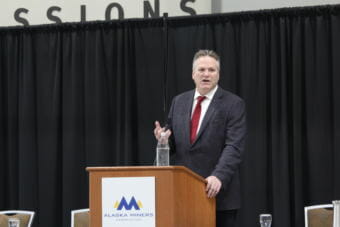
Gov. Mike Dunleavy speaks at the Alaska Miners Association convention on Nov. 8, 2018. (Photo: Wesley Early/Alaska Public Media)
One of the most controversial issues Alaska’s leaders have ever had to wrestle with is the proposed Pebble Mine. The new governor is no exception.
Officially, Gov. Mike Dunleavy is not taking a position on the mine, unlike his predecessor, Gov. Bill Walker, who opposed it.
“So the Pebble Mine project, just like any other natural resource development project, will be subject to an established permitting process,” Gov. Dunleavy said in an emailed statement. “The outcome of this process will determine if the project meets the standards set forth in law and regulation.”
But the new governor is already making moves that have encouraged the mine’s backers and worried its opponents.
One of those statements was made during Dunleavy’s first major public appearance after being elected governor. He was speaking a mining conference in Anchorage, where he proclaimed that “Alaska is open for business.”
The governor gave a shout out to the Red Dog mine, where all three of his daughters work. He spoke about his roots in the mining community of Scranton, Pa., which he called the “anthracite coal capital of the world.”
Gov. Dunleavy also mentioned nearly every other mine or planned mine in the state by name: Donlin, Pogo, Kensington. But the name of the biggest political hot-potato of a mine ever proposed in Alaska — the Pebble Mine — didn’t leave the governor’s lips.
But Pebble-watchers took note of another name Dunleavy specifically took the time to praise:
“I want to recognize somebody else who is sitting here somewhere, I think. Is John here? John Shively? John Shively!” Dunleavy said, to applause.
Shively is former chief executive and current chairman of the board for the Pebble Limited Partnership.
Dunleavy’s call-out to Shively at the miner’s conference is one of several signals he has sent that have caught the attention of people on both sides of the Pebble debate.
Take the newly appointed commissioner of the state’s department of environmental conservation, Jason Brune, who now has the power to issue key permits to the mine. From 2011 to 2014, Brune worked for Anglo American, the mining company that had partnered with Pebble until 2013.
Jason Brune, now Gov. Dunleavy’s environmental conservation commissioner, sent out a series of tweets when the late Pebble foe Bob Gillam was thought to be a candidate for Interior Secretary.
Brune has a history cheering for the controversial mine on social media. Last year, he joked in a tweet that Santa had answered his Christmas wishes when Pebble began the federal permitting process. And when the late Pebble foe Bob Gillam was rumored to be a candidate for the Trump administration’s Secretary of Interior, Brune tweeted, “God help us @realDonaldTrump, I thought we wanted to make America great again?'”
In an emailed statement, Dunleavy chief of staff Tuckerman Babcock says the governor considers Brune’s time at Anglo American “a valuable asset.”
“When and if such projects move to the permitting stage, his insights will greatly assist the department in determining if the Pebble Project, or any other, meets Alaska’s stringent environmental standards and protects all resources,” Babcock said.
Babcock also noted Brune “has no financial interest in the Pebble Project.”
Brune’s tweets remain a concern for Mark Niver with Commercial Fishermen for Bristol Bay, a group that opposes Pebble.
“That’s a definite sign that the Dunleavy administration is pointing towards wanting to push that project forward,” Niver said.
In the past, Dunleavy himself has aired opinions that worry Pebble’s opponents. When Anglo American exited the project in 2013, then-state senator Dunleavy wrote an op-ed lamenting the mining company’s departure and noting the thousands of jobs Pebble is projected to create.
“If I am asked to make an important policy decision such as Pebble, I would base that decision on science and facts rather than rely on innuendo, mass-media advertising or political posturing,” he wrote.
Dunleavy may not say he’s pro-Pebble, but Pebble is definitely pro-Dunleavy. A number of Pebble employees, including Shively and CEO Tom Collier donated to his gubernatorial campaign. The governor’s statements, then and now, are in line with what the mine’s developers want to hear.
In an interview shortly after Dunleavy’s election, Collier pushed back when asked if the political winds were now blowing in Pebble’s favor.
“I think the way you asked the question assumes a premise that I think is an incorrect one, and that is that this process is primarily a political process, and I don’t think it is,” Collier said.
Collier’s long-held public position is that he wants the permitting process to go forward without what he sees as political interference. And because Dunleavy is echoing that message, Collier is happy.
“We’re pleased to see Mike be the next governor, and we think that he will clearly let projects like ours into the permitting process and make sure that process is rigorous and thorough. And then the results will speak for themselves,” said Collier.
Pebble opponents are watching the new governor and his appointees closely. But for now, some key voices against large-scale mining in Bristol Bay are reserving judgement.
“I think we’re still kind of collecting our thoughts,” said Norman Van Vactor, president and CEO of the Bristol Bay Economic Development Corporation, which vehemently opposes Pebble.
While Van Vactor and many other regional leaders have expressed strong criticism of the state and federal permitting process, developing a constructive relationship with Dunleavy and his staff is a priority.
“I don’t want to be too judgmental because we haven’t had that opportunity to meet them in person, and I’d like to give them the benefit of the doubt,” said Van Vactor. “But, again, based upon what we’ve read and what we’ve heard, we definitely have some concerns.”
Pebble will need dozens of state permits if it wants to build the mine. It hasn’t submitted for them yet. It’s not saying when it’s planning on doing that, either. But when it does, state agencies will need to make some important decisions.
For example, Brune, the environmental conservation commissioner who used to work for Anglo American, could be asked to review Pebble’s application for a permit to dispose of the mine’s waste.
But even if Pebble submits for state permits, the process moves quickly and the mining company gets everything it wants from the Dunleavy administration, that’s not the end of the story. Forces beyond the governor’s office will significantly influence whether the Pebble mine gets built.
In addition to state and federal permits, mining within the Bristol Bay Fisheries Reserve requires legislative approval because of a public initiative that voters approved in 2014. And Pebble will need to secure permits and agreements with the Lake and Peninsula Borough and private landowners to build roads and a transportation corridor.
Another key factor is that the Pebble Limited Partnership is still in need of a financial partner.
Analyst Chris Mancini with Gabelli Gold Fund, which is invested in Pebble, said he views Dunleavy’s election as a positive sign for the mine’s future.
But Mancini added there’s a big caveat:
“What’s more important is who is going to be president when the record of decision is made, and who is going to be leading the EPA,” Mancini said.
Perhaps the most significant player looming over the whole process is the U.S. Environmental Protection Agency. That’s the federal agency that proposed placing restrictions on the mine under the Obama administration — restrictions Pebble says would have made the mine impossible to build.
While the Trump administration reached a settlement with Pebble, allowing them to start the permitting process, the EPA will still have to decide whether or not to finalize those restrictions.
The U.S. Army Corps of Engineers is expected to release its final environmental impact statement for the project late next year. If the process continues as scheduled, that’s when EPA can make its decision about finalizing the restrictions.
So whether Dunleavy turns out to be a Pebble ally or not, it is leaders in Washington, D.C. who could decide the fate of the most controversial mine in Alaska.
The Canning River, which forms the northwestern border of Arctic National Wildlife Refuge. (Photo: Lisa Hupp/USFWS)
A year after Congress voted to allow oil development in the Arctic National Wildlife Refuge, the Trump administration is taking another step towards making it happen.
The Interior Department announced Thursday that it’s releasing the draft environmental review for the planned oil leasing sale in the refuge’s Coastal Plain.
“An energy-dominant America starts with an energy-dominant Alaska,” outgoing Interior secretary Ryan Zinke said in a statement.
Alaska leaders celebrated the step, which keeps Interior on track to hold a lease sale next year. But it was immediately condemned by environmental groups, which issued statements blasting the over 700-page draft within minutes of its release. They say it threatens polar bears, migratory birds, the Porcupine caribou herd and other species that live in the Refuge.
When finalized, the environmental review will guide where and how oil leasing should happen in the Coastal Plain, also known as the 1002 area. It makes up 1.6 million acres in the 19-million-acre refuge.
“Alaskans have anticipated the release of the draft environmental statement for decades,” Gov. Mike Dunleavy said in a statement. “We are eager to inform and educate our fellow Americans that it will be done utilizing the highest environmental standards and safeguards to protect its land, waters and wildlife.”
In a call with reporters before the review’s release, top Interior official Joe Balash — a former Alaska commissioner of natural resources — said he is looking forward to the results of an oil lease sale.
“There aren’t many basins on the planet where we have a very high degree of confidence that there’s significant hydrocarbons that haven’t been explored yet,” Balash said. “There’s going to be, we expect, significant industry interest in being a part of finding out what’s there.”
Balash said that the oil leasing options in the draft protect the Porcupine caribou herd’s calving habitat.
He also stressed that Interior consulted with Alaska Native communities while writing the draft. He said he personally met with Gwich’in representatives in the village of Venetie, from whom, he said, “I could not have received a warmer greeting.”
“My message to them was straightforward: that I was not there to convince them, I was not there to change their minds,” Balash said, “But I wanted to know everything they could share to help us craft a better plan than we would without them.”
The vulnerability of the Porcupine caribou herd is one of the main reasons conservation groups and Alaska Native Gwich’in people oppose oil development in the refuge. They argue any oil drilling there threatens the herd.
Those groups expressed immediate alarm about the leasing program spelled out in the draft. Lois Epstein with the Wilderness Society in Anchorage said she was surprised by how much acreage could potentially be put up for oil leasing.
“In no way can we argue that this is going to be protective of the wildlife there,” Epstein said. “The caribou that arrive there every summer after they’ve been calving are going to encounter enormous amounts of infrastructure. It’s devastating.”
Alternatives laid out in the draft envision nearly all of the 1.6 million-acre coastal plain being offered for oil leasing. But at any given time, no more than 2,000 surface acres could contain infrastructure.
Epstein said environmental groups are waiting until the final record of decision on the oil leasing program is released to pursue potential legal action. But Epstein added their ultimate goal is to convince Congress to reverse its decision to allow drilling in the refuge.
“What we’re doing now is trying to limit the damage before that can occur,” Epstein said.
In the 2017 tax cut legislation, Congress required that each lease sale in the Coastal Plain should offer “not fewer than 400,000 acres” up for bid to oil companies.
A 45-day public comment period on the draft starts December 28.
A 3-D rendering of Hilcorp’s proposed Liberty project represented in the Bureau of Ocean Energy Management’s environmental impact statement. (Image courtesy BOEM)
A coalition of environmental groups are suing the Trump administration to challenge what would be the first oil production facility in Arctic federal waters.
The Texas-based oil company Hilcorp aims to build and drill from an artificial gravel island in the Beaufort Sea, east of Prudhoe Bay. The Interior Department issued a key approval for the Liberty Project in October.
Environmental groups are claiming the federal government’s analysis leading to its approval was faulty.
Rebecca Noblin, a staff attorney with Earthjustice, cited a wide range of concerns, including the risk of oil spills, potential impacts to polar bears and climate change.
“We’re concerned about the Liberty infrastructure not being prepared for this new world we’re entering with climate change in the Arctic,” Noblin said.
During the environmental review process, records show Hilcorp did adjust its construction plans to deal with shorter sea-ice seasons. But Noblin claims there are other outstanding issues, like how reduced sea ice could impact the pipeline.
Noblin said the groups are also claiming the federal government didn’t properly account for how oil produced by the Liberty Project worsens climate change.
The Liberty Project would be similar to other oil developments already built in state waters. So far, it hasn’t attracted as much resistance from environmental groups as earlier offshore oil drilling proposals in the Arctic.
But Noblin said the groups she represents took the earliest opportunity to challenge the Liberty Project in court.
“This is the first time a proposal has actually been approved, so this is the first chance to really get in there and litigate on it,” Noblin said.
John Callahan, a spokesman for the Bureau of Ocean Energy Management, said the agency hasn’t yet received the lawsuit and can’t comment on pending litigation.
Hilcorp has not responded to a request for comment.
Close
Update notification options
Subscribe to notifications
Subscribe
Get notifications about news related to the topics you care about. You can unsubscribe anytime.