Elizabeth Harball, Alaska's Energy Desk
Could there be seismic in the Arctic Refuge this winter after all?

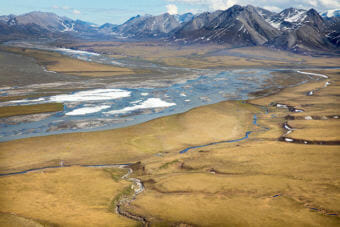
The Canning River, which forms the northwestern border of Arctic National Wildlife Refuge. (Photo: Lisa Hupp/USFWS)

During the final public meeting in Alaska on oil leasing in the Arctic National Wildlife Refuge, a top Interior official said there’s still a possibility that some seismic exploration could be done there this winter.

The statement comes after Interior confirmed last week that the early stage oil exploration effort proposed by company SAExploration was off the table this season. Regulators limit seismic exploration to winter, when snow cover helps protect the tundra. Environmental groups and Gwich’in leaders opposed to oil development in the Refuge celebrated the news — they had raised concerns about seismic exploration’s potential impacts.

But today, the Anchorage Daily News reported that SAExploration is still pursuing work this winter. During a press conference, Interior’s Joe Balash confirmed that there may still be some wiggle room.

“What had been proposed, what a lot of people were talking about in terms of a 1,200 square mile effort, you know, that’s not possible,” Balash said. “And so if that is the term of reference, it’s not happening this year. But is there something that might be salvaged here at the end of the season? Perhaps.”

Balash said SAExploration can’t begin work until it gets a Marine Mammal Protection Act permit from the Fish and Wildlife Service. That process is intended to help protect the Refuge’s polar bear population. Balash said getting the permit involves multiple steps, including a 30-day public comment period that has not yet begun.

The 3-D seismic data SAExploration is pursuing helps oil companies identify the most promising spots to drill. Interior is still hoping to hold an oil lease sale for land in the Arctic Refuge this year, and without seismic data ahead of that lease sale, companies will have less information about where to bid.  

Asked how he thinks the lack of 3-D seismic data could impact the lease sale’s results, Balash responded, “There’s no doubt that there will be some companies who look at the sale differently than others, or than they might have if they had had seismic.”

But, he added, “it’s certainly not a regulatory requirement. We don’t have to have seismic to have a lease sale, and we don’t have to have seismic to hold a successful lease sale. You know, commissioner Tom Kelly held the lease sale at Prudhoe Bay without seismic, and they did alright.”

Balash was referring to the 1969 oil lease sale in Alaska, held after the discovery of Prudhoe Bay. That sale brought the state $900 million.

Hearing concludes regarding French’s fate at head of state oil and gas watchdog agency

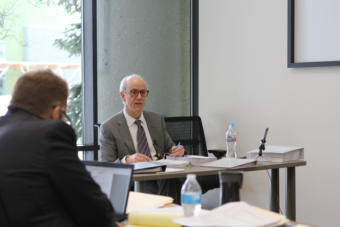
AOGCC chair Hollis French responds to questions at a public hearing on Feb. 8, 2019. (Photo: Elizabeth Harball/Alaska’s Energy Desk.)

A three-day public hearing ended Friday regarding Gov. Mike Dunleavy’s bid to remove Hollis French from his position as chair of the Alaska Oil and Gas Conservation Commission.
According to a letter from the governor’s office obtained Thursday by Alaska Public Media, there are five charges against French, described as follows: “chronic, unexcused absenteeism,” “browbeating fellow commissioners,” “publicly undermining the work of AOGCC,” “security breaches” and “failure to perform routine AOGCC work.”

“Alaskans reasonably expect, and have the right to, commissioners, agency heads and other high-ranking officials that perform the work they are paid to do, and who do not actively undermine agencies they represent,” Dunleavy writes in the letter. “I believe that your conduct, as described herein, falls well short of those standards.”

French disputes the charges. He further claims the current situation was spurred by a disagreement over the limits of the commission’s jurisdiction, precipitated by a gas leak in Cook Inlet two years ago.

During the hearing on Friday, the state’s attorney, Dana Burke, questioned French about the governor’s accusations, including whether French was out of the office too frequently to perform his duties well.

“Being available by text, or email, or phone when you’re at home, say, watching the World Series, that’s not the same thing as being there, is it?” Burke questioned.

“It is not the same thing,” French answered.

Later in the hearing, French’s attorney, Kevin Fitzgerald, asked French whether his time out of the office was spent in service of his role as the commission member representing the public.

“As the public representative commissioner, did you conduct a fair amount of your work on behalf of the agency outside the office, either office hours or outside the confines of the physical building?” Fitzgerald asked.

“Yes, I did,” said French.

“And was that necessary as it related to what you understood to be your role as the public representative commissioner?” Fitzgerald asked.

“I believed it was,” French replied.

Another issue discussed at Friday’s hearing was French’s sharing of the location of data on the one exploratory well drilled in the Arctic National Wildlife Refuge with an Anchorage Daily News reporter, who later wrote a story on the subject. According a story published Friday in the Anchorage Daily News, another commissioner, Cathy Foerster, also shared the location of the ANWR well data with the reporter.

Dunleavy’s letter said French’s disclosure “breached critical AOGCC security protocols.”

Fitzgerald is arguing that sharing the location of the well data isn’t unlawful.

“He never revealed the data,” Fitzgerald said in a phone interview after the hearing, adding he isn’t aware of any document demonstrating that where the well data is kept should be confidential.

In an interview after the hearing, French said he believes the current situation stems from tensions over the limits of the commission’s power, precipitated by a 2017 incident when a pipeline operated by Texas-based oil company Hilcorp leaked gas into Cook Inlet for months.

French thought his agency should have oversight over incidents like the gas leak, putting him at odds with his fellow commissioners. Eventually, he said, he wrote a letter to former Gov. Bill Walker “and asked him for some help.”

“And that provoked my colleagues in a bad way,” French said, adding, “there’s an email in front of me that indicates that after I sent that letter, one of the other commissioners said, ‘we may have a for-cause case,’ meaning, now we have a reason to kick him off the commission.”

“It’s about what we do as a watchdog agency,” said French. “My view is a watchdog has to roam the whole property. And their view is, ‘no, we’re going to put the watchdog on a short chain.’ And I just disagreed with that.”

French is an attorney and former Democratic candidate for lieutenant governor. He was appointed to the commission by Walker in 2016.

Foerster was at Friday’s hearing sitting alongside Burke, the state’s attorney. Foerster declined to comment.

By law, commissioners can only be fired for “cause,” including “incompetence, neglect of duty or misconduct in office.”

Attorney Tim Petumenos presided over the hearing at Dunleavy’s request. Petumenos will prepare a report covering the facts of the case for Dunleavy, which the governor can use to make his decision. Ultimately, he said, it is up to Dunleavy whether French is removed.

Reporter Nathaniel Herz contributed to this story.


Interior: No 3D seismic exploration in Arctic National Wildlife Refuge this winter

Map of northern Alaska showing location of Arctic National Wildlife Refuge, ANWR-en:1002 area, and the National Petroleum Reserve-Alaska (NPRA).
Map of northern Alaska showing location of Arctic National Wildlife Refuge, ANWR-en:1002 area, and the National Petroleum Reserve-Alaska (NPR-A). (Map courtesy USGS)

An Interior official has confirmed that there will be no 3-D seismic exploration in the Arctic National Wildlife Refuge this winter.
Steve Wackowski, Interior’s senior advisor for Alaska affairs, made the announcement at a public meeting held Tuesday in Kaktovik.

That means although Interior still aims to hold an oil lease sale in the Refuge’s coastal plain this year, companies will have less information about where the most promising acreage might be.

Originally, a company called SAExploration, partnered with Native corporations, Arctic Slope Regional Corporation and Kaktovik Inupiat Corporation, had applied to shoot seismic across the Refuge’s entire coastal plain, encompassing 2,600 square miles.

Seismic exploration can only be done in winter, and the company needed approvals from Interior to do the work. Originally, the agency had hoped to get the project permitted last summer.

But in November, top Interior official Joe Balash acknowledged the agency was pressed for time to complete the approvals. Balash said it was taking time for the company to work with the Fish and Wildlife Service on compliance with the Marine Mammal Protection Act.

And according to a report in the Anchorage Daily News, the government shutdown further delayed the work. Before the shutdown started, the Bureau of Land Management had yet to publish a notice on its environmental review on the seismic program, which would have kicked off a weeks-long public comment period before the final approval could be issued.

However, that process is still moving forward.

“The status of the application is still pending,” an Interior spokesperson said in a text message. “The applicant has asked us to amend both permits to reflect a December 2019 start date, and it should be coming out in the coming weeks.”

Like almost everything to do with oil development in the Refuge, the seismic exploration proposal is controversial. A number of environmental groups had raised concerns about seismic exploration in the Refuge’s coastal plain, saying they were concerned it could disturb the population of polar bears that den there. In January, Alaska Native groups and environmentalists staged a protest at SAExploration’s offices in Houston.

Those groups celebrated the news that this winter’s seismic exploration program has been delayed — Sierra Club executive Director Michael Brune called it a “victory.”

“Any oil company foolish enough to ignore the writing on the wall and pursue leasing in the Arctic Refuge will be pursuing a risky investment and drawing the condemnation of both the American public and the financial industry,” Brune said in a statement.

This story has been updated.


Interior delays public comment deadline for ANWR oil leasing

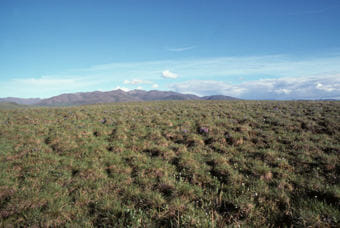
Tussock tundra on Arctic Refuge coastal plain. (Photo courtesy USFWS)

Following the government shutdown, the Interior department is giving the public an additional month to weigh in on its controversial plans to allow oil leasing in the Arctic National Wildlife Refuge.
In a statement, top Interior official Joe Balash said the comment period is being extended from February 11 to March 13, in response to requests from Alaska communities and tribes, as well as nonprofits from across the U.S.

Democrats in Congress who oppose drilling in the Refuge had also written letters urging Interior to extend the comment period, arguing the shutdown limited the agency’s ability to provide information to the public.

During the government shutdown, Interior was continuing to plan meetings about oil leasing in the Refuge, leading to outcry from Democratic lawmakers and environmental groups. The agency later announced it was delaying the meetings, although the dates and locations had never been publicly announced.

Interior finally released the meeting schedule today. The first takes place in Fairbanks on February 4. Other meetings are scheduled in the following days in Kaktovik, Utqiaġvik, Fort Yukon, Arctic Village, Venetie, Anchorage and Washington, D.C.

Native corporations maintaining Alaska forests find a carbon credit buyer: oil company BP

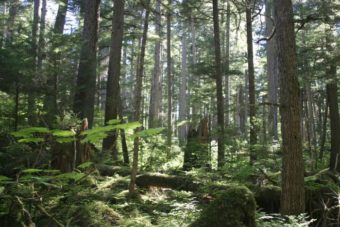
Photo of trees in the Tongass National Forest
Sealaska has previously announced it was setting aside 165,000 acres of forest to use as a carbon bank. (Photo by Henry Hartley/Wikimedia Commons)

To help address climate change, one of the biggest oil companies in Alaska is paying to keep forests standing on land managed by two Native corporations.

At an industry conference held Friday in Anchorage, BP Alaska president Janet Weiss announced the company has developed two carbon credit offset projects with Alaska Native corporations Ahtna and Sealaska.
“We will use offsets as one of the tools to underpin our low-carbon ambitions,” Weiss said.

Carbon offsetting is a mechanism that allows a company like BP to pay a landowner to maintain a forest, to keep it from being logged. Trees take in carbon dioxide as they grow, helping make up for the company’s greenhouse gas emissions.

Weiss said the Native corporations have agreed to maintain the forests they manage for at least 100 years. The deal is verified through California’s cap-and-trade program. California regulates greenhouse gas emissions and allows big emitters to buy carbon credits.

Details on BP’s carbon offset projects are limited — the terms of the agreements are confidential, Weiss said. She didn’t say what percentage of BP Alaska’s greenhouse gas emissions are being offset or how much money is involved.

But, Weiss added, “these credits will amount to significant revenue for Sealalaska and it will benefit their region and its communities for a very long time.”

Sealaska previously announced it has set aside 165,000 acres of forest to use as a carbon bank. According to Sealaska, that allows the company to sell 9.3 million carbon credits, representing 9.3 million metric tons of carbon dioxide.

A Sealaska spokesperson confirmed BP will be the corporation’s main buyer for its carbon bank.

In April 2018,  Sealaska Corporation President and CEO Anthony Mallott described their project as being worth “multiple millions” of dollars.

Weiss said the carbon offset project with Ahtna was completed last October.

Ahtna declined to comment, but Weiss said that deal was “even larger” than Sealaska’s, calling it “the largest carbon credit event in North American history.”

Democrats demand Trump administration stop offshore oil leasing work during shutdown

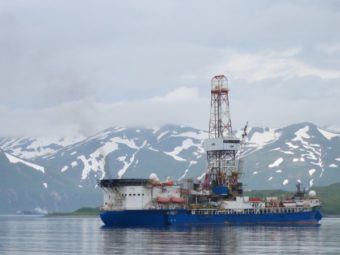
The Noble Discoverer in Unalaska in 2012. (KUCB file photo)
Shell’s Noble Discoverer rig in Unalaska in 2012. (KUCB photo)

Democratic congressman Raul Grijalva of Arizona and two of his colleagues in the House today wrote a letter to the Interior department demanding the agency halt its work on offshore oil leasing and permitting during the partial government shutdown.

It was spurred by Interior’s decision last week to bring in 40 employees to work on the Bureau of Ocean Energy Management’s national offshore oil leasing plan. That plan, as initially drafted, would open up far more of Alaska’s federal waters to oil development.

Grijalva now chairs the House Resources Committee and is often at odds with the Trump administration’s “energy dominance” agenda. He thinks Interior is breaking the law by proceeding with offshore oil work during the shutdown.

“This is an outrageous step,” the letter states, calling Interior’s justifications for the decision, “farcical, and make it clear the administration cares only about the impacts to its favorite industry and not about workers, their families, and ordinary Americans.”

The letter states that if Interior does not stop the work, Democratic lawmakers “insist” that acting Interior Secretary David Bernhardt come to Capitol Hill to explain the agency’s reasoning.

In a statement, Interior spokesperson Faith Vander Voort said, “we are happy to meet with the Committee, as appropriate, and we are confident that we are fully meeting our legal obligations.”

This is not the first time Grijalva and Interior have locked horns over oil development work continuing despite the shutdown in recent weeks. Last Monday, the congressman wrote a letter to Interior demanding answers about the agency’s move to keep advancing work on oil leasing in the Arctic National Wildlife Refuge, in addition to proceeding with public meetings on potentially expanding oil development in the National Petroleum Reserve-Alaska.

The agency wrote back, claiming that work was also legally funded and “critical to the state of Alaska and the nation.”

Democrats and environmental groups are also calling for the Interior department to extend the comment period for its program to hold an oil lease sale in the Arctic National Wildlife Refuge because of the shutdown. The Bureau of Land Management has announced it is postponing public meetings related to that program, but the comment deadline — February 11 — remains the same.

Site notifications
Update notification options
Subscribe to notifications