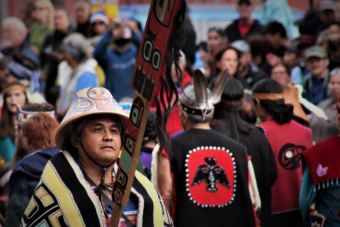
Celebration 2018 grand processional June 6, 2018, Juneau. (Photo by Adelyn Baxter)
Sealaska Heritage Institute is seeking Alaska Native artists to pitch designs for Celebration – the every-other-year gathering of Indigenous people in Southeast Alaska. The multi-day event takes place June 5 through 8.
SHI President Kaaháni Rosita Worl says this year’s theme is “Together we live in balance,” and designs should depict that using Northwest Coast style art. The winning design will appear on all Celebration materials, including t-shirts and the event program.
Worl said creating a balance between the different Southeast Alaska Native people in the region is essential to maintaining lasting relationships for future generations.
“The whole concept of social and spiritual balance is a basic underlying theme or value in our culture,” she said. “We need to have both social and spiritual balance to maintain a healthy society.”
Worl said balance is an important belief in Lingít culture that goes back thousands of years. An example of that can be seen with the Lingít moieties of Raven and Eagle. She said even today, it’s essential that a balance is struck between the moieties during gatherings.
“When we have someone from a Raven clan speak, we have to have balance and so an Eagle has to respond,” Worl said. “If we don’t do that, our belief is that, you know, the spirits can go wandering, and cause harm.
Worl said SHI is asking artists to encapsulate that balance not only between Alaska Native peoples but also in the natural world around Juneau. The sketches of proposed concepts are due Jan. 12 and artists can apply online. The winning artist will receive a cash award.
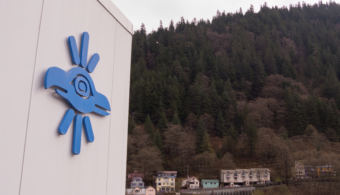
A Sealaska corporate logo adorns the roof of the Southeast Alaska Native corporation’s headquarters in Juneau on May 2, 2018. (Photo by Jeremy Hsieh/KTOO)
Sealaska Corporation shareholders have voted to get rid of the blood quantum requirement for enrollment. The vote was tallied at the annual shareholders meeting in Juneau on June 25.
The change means descendants of original shareholders no longer need to prove they have one–quarter Native blood to become a shareholder, which was a requirement set by the Alaska Native Claims Settlement Act in 1971.
“It was super exciting to see the vote,” said Angela Michaud.
Michaud is a corporation board member and was the first person to enroll after the vote. Previously, she had just one share gifted from her grandmother. This new enrollment gives her 100 more shares, which will last her lifetime.
But she was most excited for her four children, who can also enroll when they come of age.
“When my kids get 18 they’ll also be a part of this,” Michaud said. “It means that you’re able to be part of it and that you’re Native enough. It didn’t matter that your parents or grandparents married somebody who wasn’t Native. You’re still Native.”
ANCSA limited shares to those enrollees born by 1971. After that, descendants had to be gifted original shares or, starting in 2007, get a different class of shares known as descendant shares. But they still had to prove a quarter Native blood.
Board President Joe Nelson says it’s an issue he’s heard a lot about from shareholders, which he understands personally as well. While he was an original shareholder, his sister, born a few years later, wasn’t. He calls the 1971 ANCSA cut-off date arbitrary and the blood-quantum requirement archaic.
“The blood quantum issue itself continues to literally divide families pretty quickly and within a few generations the pool of eligible descendants would be dwindling,” Nelson said.
Now, people just need to prove they are descended from an original shareholder through a birth certificate.
Sealaska Corporation has 23,000 shareholders who are Lingít, Haida, and Tsimshian people with roots in Southeast Alaska. Many now live elsewhere.
Not all of them agree with the change. 40% of shareholders did not support dropping the blood quantum requirement.
Vikki Mata was one of them. She’s a former Sealaska communications vice president. She says the change devalues shareholders’ dividends and voting power.
“If you add more shareholders, then the voting strength of the current shareholders is diluted,” Mata said.
Mata is an administrator of the social media group, Shareholders of Sealaska, that includes 6,000 members. She says many dissenters agreed that the blood quantum issue needed to be talked about. But she says the vote was rushed — shareholders had 6 weeks to consider the question — and the timing was bad.
“Food prices, gas prices, everything is hitting all at once, so every dollar counts when it comes to making ends meet, especially those on fixed income and our elders,” she said.
Sealaska shareholders are paid dividends twice a year. Original shares pay more than those allocated to descendants. That’s due to a formula sharing natural resource earnings among regional Native corporations.
The corporation predicts that approximately 15,000 shareholders over a 20-year period would be eligible to enroll with the loosened requirements.
Sealaska Corporation is the third of Alaska’s 12 regional Native corporations to eliminate the blood quantum requirement.
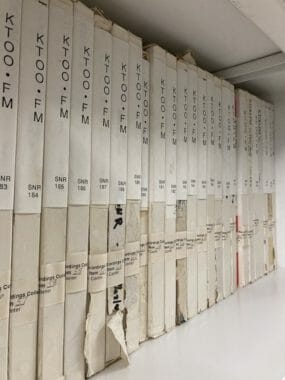
KTOO transferred the Southeast Native Radio tapes to Sealaska Heritage Institute in a ceremony in 2010. The show was produced by a team of volunteers, including Arlene Dangeli, Joaqlin Estus, Cy Peck Jr., Kathy Ruddy, Kim Metcalfe, Andy Hope III, Jayne Dangeli, Laurie Cropley Nix and Rhonda Mann. (Photo courtesy of Sealaska Heritage Institute)
Hundreds of hours of Southeast Native Radio broadcasts are now archived on the internet and available for anyone to listen to.
Southeast Native Radio was broadcast over KTOO in Juneau for 16 years, from 1985 to 2001. The volunteer-produced show played as current affairs at the time, but twenty-one years later it’s become a window into the lives of the people and events that shaped Native culture in the region over the last century.
The Southeast Native Radio collection includes over 400 programs broadcast from 1985-2001. (Photo courtesy of Sealaska Heritage Institute)
The catalog of recordings is lengthy and populated with names that make it a who’s who of Southeast Native culture at the turn of the 21st century.
Nora Marks Dauenhauer, for example, was a leading Lingít language scholar and historian, as well as Alaska’s Poet Laureate. She died in 2017, but her words are now just a click away.
The Southeast Native Radio Recordings collection is available through the Sealaska Heritage Institute, which received the donated DAT tapes, reel-to-reels, and CDs from KTOO in 2010. In all, there are 400 recordings.
Even the most seemingly mundane shows are abuzz with history because the people represent a generational bridge to an even deeper past.
In one of the archived recordings, Roy Peratrovich, husband of Elizabeth Peratrovich, talks about the first of five times he was elected Grand President of the Alaska Native Brotherhood, when he lobbied to bring the Grand Camp to Klawock:
Peratrovich: When you’re young, you do a lot of foolish things…
Host: Was this 1929?
Peratrovich: No, 1939.
Host – 1939, okay.
Peratrovich: So I told the group that if we are going to build up this group, this ANB, we’re going to have to do it big. Pride is going to help us. Not knowing some screwball was going to nominate me for Grand President. So I got elected.
Peratrovich died in 1989, a year after that appearance on Southeast Native Radio.
And there’s basketball, which is a large thread in the cultural fabric of Southeast Alaska. One of the stars of the annual Gold Medal Tournament was Sitkan Herb Didrickson.
He told Southeast Native Radio that the Sitka team had to catch a ride on a seine boat each March for the trip to Juneau.
“As I started to put my gear up in the top bunk, I found this old man was laying up there already,” Didrickson says. “He kind of got on board a little early, and no one knew that he was there. So he was trying to stowaway, you know. So we figured, well, the old fellow wants to go and see some games, and we all couldn’t sleep at the same time.”
Didrickson to this day is considered one of the greatest players produced in Southeast Alaska, whose chances at a pro career were thwarted by WWII. Didrickson died in 2017.
Sealaska Heritage Institute refers to the archive as a “treasure trove,” and that’s not far off. The recordings include a 13-part series produced in 1986 on the history of the ANB. There are also a number of Lingít language segments with fluent speakers like Dauenhauer and Walter Soboleff conversing on a range of subjects.
Note: The Southeast Native Radio Recordings project was supported by a Digitizing Hidden Collections or Recordings at Risk grant from the Council on Library and Information Resources. The grant program is made possible by funding from The Andrew W. Mellon Foundation.
A Sealaska corporate logo adorns the roof of the Southeast Alaska Native corporation’s headquarters in Juneau on May 2, 2018. (Photo by Jeremy Hsieh/KTOO)
Shareholders of Sealaska will vote in June on whether to get rid of a blood quantum requirement for descendant shareholders.
Sealaska is the regional Alaska Native Corporation of Southeast Alaska. When the corporation was formed under the Alaska Native Claims Settlement Act, only Alaska Native people in Southeast Alaska who were already born could be shareholders. Those people are original shareholders.
In 2007, those shareholders voted to allow their descendants to enroll — but only if they had one quarter Alaska Native blood and had proof of it on a Certificate of Indian Blood from the U.S. government.
Sealaska surveyed its shareholders in November 2021 and about 4,000 of the corporation’s 23,000 shareholders responded. Sixty-nine percent of respondents want to get rid of the blood quantum requirement, 23% want to keep it and 8% are neutral.
In the survey, people who want to get rid of the requirement said that it’s keeping their children and grandchildren out of the corporation, and it’s keeping them from learning about their culture. They said that blood quantum is a colonial construct created by the federal government to erase Native people and that it’s not how Native people identify themselves.
People who took the survey also have concerns about letting more shareholders in because it will dilute their stock and dividends will be smaller. And they don’t want smaller dividends to negatively impact elders.
If the requirement is eliminated, Sealaska estimates that about 10,000 more people would be eligible to enroll.
Shareholders will be able to vote online in early May up until Sealaska’s annual meeting on June 25. The meeting will be streamed live and in person at Centennial Hall in Juneau.
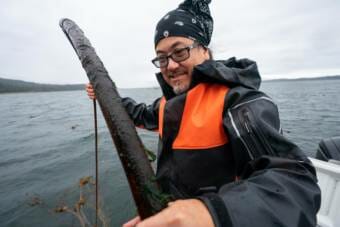
Sealaska Board Chair Joe Nelson pulls bull kelp from Saginaw Channel on Sept. 14, 2021 near Juneau. (Photo by Loren Holmes / ADN)
Joe Nelson floated his boat along a reef just outside Juneau on a drizzly September day.
With his rifle onboard, he eyed the shore for deer as he steered with the tide. But this was a business trip: He was also looking for a new product that could boost the fortunes of the Alaska Native corporation whose board Nelson chairs.
The boat drifted past dark curls in the water. Nelson reached over and grabbed a greenish tendril, hauling it into the boat: bull kelp.
The species is found up and down the Pacific Coast and can grow as long as 100 feet.
It’s also edible, in products like salsa and hot sauce. And Nelson’s corporation, Sealaska, recently bought a stake in a locally grown company, Barnacle Foods, that sells kelp products across the country.
Barnacle Foods co-owner Max Stanley boxes bottles of Bullwhip Kelp and Serrano Hot Sauce at the Barnacle Foods production facility on Tuesday, Sept. 14, 2021 in Juneau. (Photo by Loren Holmes / ADN)
Nelson, who is Lingít, grew up hunting and fishing in the remote Southeast community of Yakutat. He’d harvested seaweed. But not kelp — this was a foreign object to him.
“Like, literally from ‘Aliens,’ the movie,” Nelson said, pondering the kelp’s fronds and rubbery, tubular stalks. “I wouldn’t have thought to eat it.”
While Nelson was new to kelp harvesting, he’s been eating it for years, as an early and avid buyer of Barnacle’s salsa.
Barnacle was founded in 2016 by a Juneau couple with a shared love for Southeast Alaska lands and waters, and their bountiful harvests. The company has grown spectacularly, and is on track this year to sell more than $1 million of its largely kelp-based foods.
Sealaska and its more than 20,000 Indigenous shareholders are now helping to fuel that growth.
The company’s investment in the relatively climate-friendly kelp industry highlights a shift in its business philosophy that’s played out over the past eight years.
Bull kelp bobs near Favorite Reef in Saginaw Channel west of Shelter Island on Sept. 14, 2021 near Juneau. (Photo by Loren Holmes / ADN)
For decades, the Native-owned regional corporation sustained its business with profits from logging old-growth timber from lands it received through the 1971 Alaska Native Claims Settlement Act, which turns 50 years old this month. It also invested in other, far-flung businesses with little relevance to Sealaska shareholders.
The vast majority of Sealaska’s hundreds of millions of dollars in yearly revenue still comes from its comparatively unglamorous holdings in seafood processing and environmental services like maritime drilling and construction.
But its investment in Barnacle, while small, is a potent symbol of the corporation’s new vision. In the past few years, Sealaska has announced that it’s selling its old-growth logging business. It has sold carbon credits on its remaining uncut timber. And it has narrowed the focus of its other businesses around the theme of “ocean health,” an acknowledgment of global warming’s growing impact on Sealaska’s ancestral lands and around the world.
Sealaska is not the only Native corporation to take similar steps into conservation and sustainability. At least two others have gotten into the carbon credits business, and another, in the Bristol Bay region, has struck a nearly $20 million deal with a conservation group to place Native corporate lands out of reach of the proposed Pebble mine.
Sealaska officials are careful not to tout their new ideas as a prescription for other corporations, some of which remain heavily invested in extractive industries like oil and gas and mining.
But Sealaska leaders seem to agree that, after nearly a half-century of struggle to meld Indigenous values with their for-profit business, the corporation has finally hit on a formula that works for them. The corporation, Nelson says, has moved away from what he describes as “false paradigms” embedded in the land settlement — that, as Natives, “we’re going to be Indigenous culture bearers on the weekends, but from Monday to Friday, we’re going to be in the boardroom doing business, capitalists.”
Native people, Nelson said, are “not here all for pure resource extraction or pure conservation. Sustainability is built into our thinking.”
“You really shouldn’t separate those things,” he added. “You get to better outcomes, the world is realizing now, by having some of your groundedness and Indigenous thinking embedded in what you’re doing.”
Barnacle Foods co-owners Matt Kern and Lia Heifetz look over a checklist at their production facility on Tuesday, Sept. 14, 2021 in Juneau. (Loren Holmes / ADN) ONE TIME USE
Polarizing timber harvests
Sealaska was born out of the 1971 Native claims settlement act, which granted the corporation what it says is less than 2% of shareholders’ traditional homelands: 360,000 acres, a tiny slice amid the 17 million-acre Tongass National Forest that stretches across much of Southeast Alaska.
After the act’s passage, Sealaska and Southeast Alaska Native village corporations got into the timber business. Old-growth logginghelped fuel their expansions and programs and, in some cases, generated dividend payments for shareholders that topped $50,000.
Indigenous Alaskans outside the region also benefited, as the land claims settlement requires each regional Native corporation to redistribute 70% of their natural resource revenues to the other corporations.
The harvests were polarizing, pitting the Native corporations against conservationists and tribal groups, and even family members against each other. Critics objected to the damaged salmon streams and threatened deer populations that clear cuts could sometimes leave behind.
But even as some Sealaska officials said they felt conflicted about the harvests, they also said their surveys showed shareholders in support.
A cutter stands back as he fells a Sitka spruce tree inside the Tongass National Forest on Etolin Island in Alaska, Sept. 3, 1993. (Photo by Bill Roth/ADN archive)
Timber cutting “looks like hell,” a former Sealaska chief executive, the late Byron Mallott, told the Anchorage Daily News in 2001. But, he argued, leaving the trees standing would be ”ludicrous” for the business, and the profits bettered shareholders’ lives.
”We can make some harsh judgments now,” Mallott, the father of current Sealaska chief executive Anthony Mallott, said at the time. “But it was done under the existing regulations.”
With a finite amount of timber to cut, Sealaska looked to diversify its business, with investments in industries like limestone mining, gaming and wireless communications. But those efforts produced mixed results.
Anthony Mallott said that in their early decades, Sealaska and other Native corporations had a “heavy mantra” that Indigenous values should be kept at arm’s length from business decisions.
“Your fiduciary duty was just to make money — don’t let the community stuff or the value stuff get in the way,” Mallott said in an interview. “We called it hiding behind the fiduciary shield.”
Sealaska CEO Anthony Mallott sits in the Sealaska boardroom on Monday, Sept. 13, 2021 in Juneau. Two docked cruise ships are visible behind Mallott. (Photo by Loren Holmes/ADN)
Nelson, Sealaska’s chair, arrived on the board in 2003, after Sealaska had invested in a plastics business. The manufacturing enterprise had facilities in Mexico, Alabama and Iowa, making products like Brita water containers and laundry detergent caps.
Nelson grew up spending a month at a time off the grid at fish camp. He lived in Southern California during college and law school, going to the beach and eating organic food. He said he arrived back in Alaska with a “different level of consciousness” that gave him other ideas about Sealaska’s direction.
“All my life, I saw plastic washing up on the beaches, and it didn’t work for me personally. Philosophically, it didn’t fit,” he said. “But I never won any arguments based on my philosophy, really, in the boardroom.”
Ultimately, business imperatives forced Sealaska into a restructuring.In 2013, it reported $35 million in losses, largely attributable to a heavy construction subsidiary in Hawaii that underbid a major project. The plastics investment and others had underperformed, and Sealaska had cut down almost all of its easily accessible timber, said Anthony Mallott.
Sealaska Board Chair Joe Nelson drives his boat through Saginaw Channel on Tuesday, Sept. 14, 2021 near Juneau. (Photo by Loren Holmes/ADN)
Current Sealaska leaders say the corporation’s early decisions are understandable when seen as artifacts of colonization and assimilation.
Some of Sealaska’s original leaders attended government-run boarding schools that U.S. Interior Secretary Deb Haaland, who is Native American, describe as “an effort to eradicate our culture and erase us as a people.” Those early corporate leaders were also testing a capitalist business model with little basis in Native culture.
“They were living an assimilated life, and attempting to uplift that the best that they could,” said Barbara Blake, a Sealaska board member. “This current leadership is more in tune with who we are as Indigenous people, because we’re in a privileged space to be able to reawaken that without fear of being harmed, or being seen as less than.”
A changing model
The financial crisis, Mallott said, gave Sealaska leaders a “full mandate” to change the corporation’s business model.
Mallott said nearby all of the corporation’s other lines of business — roughly a dozen — were sold off, with logging a notable exception.
The board began developing a new vision around Haa Aaní, their ancestral homelands. The “ocean health” theme for Sealaska’s businesses emerged from the threats posed by climate change, and the corporation expanded into seafood, an industry that Mallott describes as “relevant and meaningful” to board members and shareholders — many of whom are fishermen themselves.
The timber business, however, gradually became less viable amid a decline in Southeast Alaska’s logging industry, Mallott said. Instead, over the past few years, Sealaska has been paid more than $100 million to keep its timber unharvested, for use as carbon offsets.
By 2019, a few years into Sealaska’s pivot, the owners of Barnacle, the kelp foods company, had already identified it as their best-case business partner and investor when a chance dinner encounter set off formal discussions.
A shelf of Barnacle Foods products is displayed at Rainbow Foods on Monday, Sept. 13, 2021 in Juneau. (Photo by Loren Holmes/ADN)
Barnacle’s potential
As Nelson searched the Inside Passage for seaweed in September, Barnacle co-founders Lia Heifetz and Matt Kern were on shore a few miles away, making one of their most popular products.
Inside Barnacle’s commercial kitchen, in an anonymous warehouse not far from Juneau’s landfill, employees first scrubbed and sanitized equipment. Then, they used an industrial-sized food processor to chop frozen kelp — collected locally earlier in the year — and mixed it with garlic and fermented serrano pepper in a huge kettle to cook.
In a few hours, they’d bottle it as “bullwhip” hot sauce.
Kern and Heifetz, who are engaged, both grew up in Juneau and left for college. When they returned, they reconnected around locally harvested foods.
“Every food preservation hobby that we did together was always borderline out-of-hand,” Kern said. “We wouldn’t go out to just pick a batch-of-muffins-worth of blueberries. We’re going to hike into the alpine, and we’re not coming back until we’re sweating.”
Barnacle grew out of that enthusiasm. It started with kelp salsa, which Heifetz and Kern first encountered as a distraction from slow fishing: If nothing’s biting, at least you can come home with something else to eat.
Each year, they found themselves bringing larger and larger vessels to fill with more kelp for home cooking parties.
“To the point where we were bringing out Rubbermaid totes and 50-gallon barrels and filling up our kitchen with jars and overflowing the cupboards into cabinets and garages,” Kern said.
Heifetz, Kern and business partner Max Stanley are not Native, and they’re not Sealaska shareholders.
But they’d worked on projects with Southeast Alaska tribal organizations. The vision for their business – elevating Southeast Alaska’s environment and culture through sustainably harvested foods – also seemed to dovetail with Sealaska’s new direction.
Nelson, the Sealaska chair, was one of Barnacle’s first customers at a local food festival. And in its first year operating, Barnacle won a $40,000 economic development grant from a Sealaska-funded group, Spruce Root.
The company’s salsas and pickles made it a quick sensation with locals and Juneau tourists. It has since expanded into larger markets, with attractive labels and wild ingredients that have helped Barnacle’s business double or triple every year after its founding.
Eventually, owners Heifetz, Kern and Max Stanley realized they needed an investor to finance Barnacle’s growth, and Sealaska was at the top of their list. Conversations started after Heifetz ran into the corporation’s chief operating officer at a downtown Juneau pub.
Barnacle’s relatively small size meant that it wasn’t a perfect match for a Sealaska investment. But everything else about it seemed to fit, Nelson said.
The startup came with potential local jobs, out on the water, for Sealaska shareholders. It helps boost Southeast Alaska’s regional economy, aligns with Sealaska’s ocean health theme and taps into a sustainable resource from the ocean, Nelson said.
“If you just contrast this product, which you’ll find in all the stores and my cupboard and my refrigerator, with the products that we were involved in in the late ‘90s — Philly cream cheese cups and Tide bottle caps — I would say there’s a definite contrast and a different sense of affinity,” Nelson said. “And this salsa, this hot sauce is actually pretty darn good.”
Early last year, Sealaska bought a 30% stake in Barnacle for $1.5 million, which the company’s founders say will be invested directly into its growth, and equipment and processing capacity.
While it’s a tiny sum on the scale of Sealaska’s overall operations — it reported $697 million in revenue last year — leaders say it’s an important symbol of the corporation’s direction and vision.
Sealaska still contends with a group of disaffected shareholders, though. And some who fought Sealaska’s logging business are skeptical that the corporation’s transition out of the industry will last.
Asked about Sealaska’s announcement that it’s ending harvests of old-growth timber, Wanda Culp, a longtime critic of the corporation’s logging business, said she remains unconvinced.
“‘Yeah, we’ll see,’ is the way I felt about it,” Culp said in a phone interview. “Because, where’s their approach coming from? Their approach isn’t coming from within — it’s not coming from our Indigenous point of view, or grassroots.”
Sealaska leaders, though, say they don’t envision a return to old-growth timber harvesting any time soon.
Sealaska Board Chair Joe Nelson talks on the phone with Sealaska CEO Anthony Mallott from the Sealaska boardroom on Monday, Sept. 13, 2021 in Juneau. (Photo by Loren Holmes/ADN)
The corporation has opened its shareholder base to younger Natives born after the original December 1971 deadline for receiving stock. And many of those newer shareholders place a higher value on land stewardship and cultural revitalization than they do on corporate profits.
But even as Blake, the board member, largely agreed, she also said she understands shareholder skepticism about the staying power of Sealaska’s shift.
“It’s fully warranted,” she said.
“It took a long time to get to this place of distrust within our shareholder base. And it’s going to take a long time to regain that trust,” Blake added: “But I don’t think we’re going to go back to the way things were any time soon. We’ve still got a long ways to go, but we’re head over feet closer to a better path than we were, even 10 years ago.”
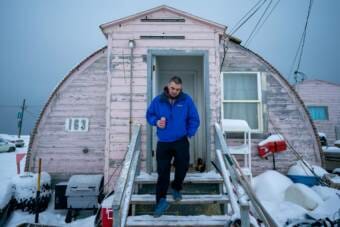
Justin Mitchak Gatten steps out of his home in NARL, a neighborhood on the outskirts of Utqiagvik, Alaska on Nov. 3, 2021. NARL, which stands for the Naval Arctic Research Laboratory, was a research facility established in the 1940s by the federal government and is now owned by the Ukpeagvik Iñupiat Corporation. (Loren Holmes/ADN)
Justin Mitchak Gatten’s Iñupiat ancestors were the original residents of Alaska’s North Slope thousands of years ago, and they once claimed millions of acres of land.
But today, Gatten can’t even find a lot to build a home in the region’s largest community, Utqiagvik. Instead, Gatten, 37, rents an aging quonset hut outside of town. He lives with his wife and four children.
The home is cozy but comes with inconveniences familiar to rural residents across Alaska: A delivery truck must replenish Gatten’s water supply as often as twice a day, and he has to warn his kids away from the septic tank, which sometimes overflows.
The North Slope’s Indigenous people lost most of their ancestral lands long ago, in a landmark settlement with the U.S. government that turns 50 years old this month, the Alaska Native Claims Settlement Act.
But after its passage, the act did transfer 340 square miles in Utqiaġvik’s vicinity to a newly created, locally owned corporation, Ukpeagvik Iñupiat Corp.
Homes in the Browerville neighborhood of Utqiagvik on Nov. 1, 2021. (Loren Holmes/ADN)
In a region long gripped by a housing crisis, where multiple generations often cram into the same home, many younger Utqiagvik residents like Gatten see the corporation’s largely unoccupied land as part of the solution.
That’s because UIC is owned by more than 3,000 Indigenous Alaskans who trace their heritage to the North Slope.
But for now, the owners with the loudest voices are those born before the settlement’s cutoff: Dec. 18, 1971. Those people each received 100 shares in UIC.
Gatten’s generation, and anyone else younger than 50, was left out. The result, he and others say, has denied them a full voice in the elections that set UIC’s leadership and direction, and a stake in their ancestral lands — until or unless they inherit stock from a relative.
UIC has made its original shareholders eligible to receive homesite lots from the corporation. But Gatten, who owns just 10 shares inherited from his mother, doesn’t qualify, and neither do his peers.
While Gatten has inherited two lots from grandparents, both are cut off from roads. And, he said, when he tried to exchange one with UIC for a more accessible lot, the only ones available were next to Utqiagvik’s sewage lagoon.
Utqiagvik, Alaska, photographed on Nov. 1, 2021. (Loren Holmes/ADN)
Alaska Native corporations have the power, if they choose to exercise it, to issue new shares to “descendants” born after ANCSA’s cutoff date.
But only about a dozen of the roughly 200 regional and village corporations statewide have done so. The indecision reflects high stakes that are both cultural and financial, as some Native corporations pay out substantial dividends that could diminish if more shares are issued.
UIC, which paid dividends of some $2,000 this year, has been studying the problem for years. But it has not yet issued new shares, with its board citing the complexity of the issue.
The same dilemma is playing out across the state, with dozens of Native-owned corporations contending with the same dynamics as their original shareholders, and descendants, grow older. And in many cases, the conflict has pitted community members and even family members against each other.
“What good is land if you’re not going to develop it?” Gatten said. “It seems quite selfish to me, for them to hold lands with road access, and we have to live in subpar conditions like this.”
UIC leaders didn’t respond to repeated interview requests.
The Ukpeaġvik Iñupiat Corporation building, photographed on Nov. 3, 2021 in Utqiagvik. (Loren Holmes/ADN)
But in newsletters, the corporation says it’s formed a board committee to explore options for issuing new shares to descendants in response to a successful 2017 shareholder ballot proposal that recommended such a step.
“The board of directors continues to explore this complex and significant step in the evolution of UIC,” Delbert Rexford, the corporation’s chief executive, wrote in a newsletter last year. “However, because descendant enrollment involves many aspects beyond land rights alone, and because the ballot proposal did not address what other rights should or might be included if a new class of stock were issued, these questions still need to be asked and answered.”
Shares and identity
Some Alaska Native leaders say that issuing shares to descendants is an obvious choice to help preserve Native corporations’ Indigenous character and distinguish them from traditional capitalist businesses.
In the early decades after ANCSA’s passage, many Native shareholders looked to their corporations for profits and dividends, and leaders prioritized expansion and growth.
But now, Native leaders say that their younger shareholders place higher value on their culture and see the corporations as a potential source of Indigenous identity and belonging, with responsibilities that extend beyond the fiduciary.
Josiah Patkotak, Utqiagvik’s state representative, drives home after work at the Arctic Slope Regional Corporation on Nov. 2, 2021 in Utqiagvik. Patkotak is a descendant and former Ukpeagvik Iñupiat Corporation board member who has inherited a handful of shares. (Loren Holmes/ADN)
“I think it needs to happen, for that continuation of community feeling,” said Josiah Patkotak, Utqiagvik’s state representative — a descendant and former UIC board member who has inherited a handful of shares. “There needs to be some kind of identity and purpose and meaning.”
Many corporations, though not all, have tried to blunt the divide between shareholders and descendants by making descendants eligible for non-cash benefits like corporate jobs and scholarships.
But economics and politics quickly complicate the discussion about the shares themselves.
One of the biggest obstacles is the potential for “dilution,” or devaluing stock owned by existing shareholders.
It’s a math problem: If there’s a finite amount of profits that a corporation can pay out as a dividend, more shares make those dividends smaller on a per-share basis. Existing shareholders have to approve the issuance of any new shares — meaning that they have to vote against their own economic interest.
There’s also the question of power. Some shareholders, and well-compensated board members, could find themselves in the minority if descendants were granted equal voting power.
The monetary impact is less significant at UIC, where the corporation’s yearly dividends to original shareholders have exceeded $1,000 only twice in the past six years, according to annual reports filed with state regulators.
A person drives a four-wheeler across a frozen lake on Nov. 2, 2021 in Utqiagvik. (Loren Holmes/ADN)
But certain other corporations pay much more, and issuing new stock could cause problems for original, older shareholders. Some of them might depend on dividends to cover their expenses, particularly in areas of rural Alaska that lack high-paying jobs and strong cash economies.
“For dividends to go down, it’s just a scary thing, because you have your budget established,” said Hallie Bissett, executive director of the Alaska Native Village Corporation Association.
Another important dynamic cited by those opposed to enrolling descendants is that original shareholders, in some cases, sacrificed early dividends so that their corporations could reinvest profits in new businesses that only paid dividends later.
Afognak Native Corp., whose shareholders have roots in the Kodiak region, has a huge government contracting business, and those with 100 shares now receive yearly dividends of some $20,000.
But Gerad Godfrey, an Afognak shareholder and former board member, said the contracting business was enabled by original shareholders who decided not to pay out their earnings from early timber harvests — unlike shareholders in a different Native village corporation not far away.
“They’ve got cousins that have a brand new outboard, a down payment on a boat, a brand new four-wheeler across the way there,” Godfrey said. “They sacrificed to get us where we are today.”
Gerad Godfrey at his home on Monday, Nov. 29, 2021 in Eagle River. Godfrey was born in 1972, a year too late to qualify as an original Afognak shareholder, and he grew up watching three of his older siblings receive dividends of thousands of dollars before he inherited some of his grandmother’s shares. (Loren Holmes/ADN)
Godfrey was born in 1972, a year too late to qualify as an original shareholder, and he grew up watching three of his older siblings receive dividends of thousands of dollars before he inherited some of his grandmother’s shares.
In an interview, Godfrey said he remembered returning home from a school event to find his father, who was campaigning for a Native corporation board seat, stuffing envelopes in the kitchen. His father asked him for help, but at that point, Godfrey said, he was feeling “a little resentful.”
“He says, ‘Don’t you want your dad to be elected to your Native corporation?’” Godfrey said. “I said, ‘It’s not my Native corporation. It’s Glenn Jr.’s, it’s Valery’s, it’s Jenna’s, it’s yours. So, I’ll take a pass.’ And I went downstairs and turned on the TV.”
Nonetheless, Godfrey has resisted giving shares to his high school-age children and still opposes issuing new shares to descendants, largely because of the potential for dilution. Descendants will still be able to inherit shares, Godfrey said, and growing up without them, he added, made him appreciate it more when he could finally participate — he’s now served on Native corporation boards and worked for them as an employee.
“I may have been more immersed and involved in Alaska Native corporation activities and engagement because I knew what it was to be without,” he said.
Mitigating dilution
Advocates for issuing new shares, meanwhile, say there are ways to mitigate the dilution problem, and that the focus on it risks distracting from the benefits of bringing younger people into the Native corporations.
“The one big reason not to do it is because it’s going to dilute the stock. And that’s just a very Western, normal corporation way of thinking — and we’re not regular, Western, normal corporations. We’re Native corporations,” said Joe Nelson, board chair of the Southeast Alaska-based Sealaska Corp. “By definition, we should be thinking about the long term, and making decisions that are in the best interests of the next generations.”
When Sealaska Corp. voted to enroll descendants, in 2007, it also approved issuing an extra 100 non-voting shares to elders, said Nelson, who was working as an attorney for the corporation at the time.
The idea was to protect those original shareholders against the effects of diluting their original stock, he added.
Other corporations have also reduced dilution by issuing fewer than 100 shares to descendants. And they can delay its effects by adjusting the timing of when shares are issued.
Sealaska doesn’t allow descendants to enroll until they turn 18, while Interior-based Doyon Ltd. issues 30 shares to descendants when they’re born, then 70 more when they turn 18. Kuukpik Corp., which is tied to the village of Nuiqsut on the North Slope, recently issued 50 shares to descendants and will issue five more every year for the next decade.
Sealaska Board Chair Joe Nelson stands on his boat in Saginaw Channel on Sept. 14, 2021 near Juneau. (Loren Holmes/ADN)
Some corporations, meanwhile, limit how many descendants can receive stock by maintaining a requirement in the original settlement legislation that shareholders be one-fourth Alaska Native.
Corporations have “levers that can be pulled” to address concerns around dilution, said Nathan McCowan, chair of the board of the Alaska Native Village Corporation Association.
One thing that many pro-enrollment corporate leaders say makes dilution less of a problem: Descendants of original shareholders tend to be less focused on dividends and monetary benefits and more interested in a source of identity.
Bissett, the Native village corporation association’s executive director, has inherited just three shares in Cook Inlet Region Inc., and she said sometimes her quarterly dividends amount to just $20.
But owning those shares, she added, has allowed her to win a seat on CIRI’s board and help shape the corporation’s future.
“It is not about the money for me,” she said. “You hear people talk about when they received their shares, and the first time they were able to attend annual meetings for the company — to have a share in taking care of these ancestral lands that were given to us to manage, forever. And that’s just an incredible feeling.”
‘Conquer and divide’
Supporters of enrolling new shareholders say it’s increasingly urgent for Native corporations to address the divide between elders and descendants, since the sooner descendants can become involved with corporate affairs, the more ready they’ll be to take leadership roles as original shareholders age out of them.
Half of Alaska’s 12 larger, regional Native corporations have already issued new shares; others are studying the question. But only a half dozen or so of the more than 150 village corporations, which tend to be smaller, have done so, according to industry leaders.
The relatively small fraction of village corporations to issue new shares is likely a reflection of how technical and expensive the process can be, McCowan said. Shareholder surveys and meetings are involved; consultants, actuaries and attorneys must be hired.
It took six years of debate and discussion before Kuukpik issued its new shares, said Isaac Nukapigak, a board member and former corporate president.
Native corporations’ generational divide was baked into the original 1971 settlement by Congress, which failed to create a mechanism to enroll new shareholders. That decision has since caused so many internal conflicts that some Natives suspect Congress was trying to provoke them.
“That was their intent,” said Gatten. “Conquer and divide.”
Qaiyaan Harcharek holds his phone, displaying a recent photo of his son with a fox, in Utqiagvik on Nov. 2, 2021. (Loren Holmes/ADN)
But today, there’s also broad agreement across the Native corporation world that a statewide, congressional fix to the problem isn’t viable, given the widely varying circumstances at each corporation and, at some, the outright opposition to descendant enrollment.
One suggestion from McCowan: Congress could budget money to support smaller corporations going through the enrollment process, which might otherwise lack the cash to hire the relevant experts.
“We’re byproducts of the public policy process in the United States, governed, like treaties are, by the laws of Congress,” he said. “If there’s a problem that Congress created then, by and large, it’s a problem that Congress has the responsibility to solve.”
But Native groups have not launched any kind of coordinated lobbying effort to push that idea, and no action from Alaska’s congressional delegation appears to be imminent — though U.S. Sen. Lisa Murkowski, whose congressional office was the only one to respond to a question about descendant enrollment, said she’s open to discussion with corporations about how to solve the problem.
“Whatever it is they choose to do, our role here in Congress should be to facilitate the promise of ANCSA, and be responsive to the fact that the world’s changed a little bit in 50 years here,” she said. “If we need to review, we should do that.”
Justin Mitchak Gatten stands in his kitchen in NARL, a neighborhood on the outskirts of Utqiagvik, Alaska on Nov. 3, 2021. NARL, which stands for the Naval Arctic Research Laboratory, was a research facility established in the 1940s by the federal government and is now owned by the Ukpeagvik Iñupiat Corporation. (Loren Holmes/ADN)
In the meantime, Gatten, in Utqiagvik, remains in his quonset hut, as his wife nudges him to try for another land exchange with UIC that wouldn’t put his new house next to the town’s sewage lagoon.
He said he understands that issuing new shares can risk diluting dividends for original shareholders, and that his ancestors made sacrifices and grew up without many of the modern comforts that corporations have helped bring to the North Slope.
But as a parent to his own children, Gatten said, he remains confounded by original shareholders who aren’t eager to share in their corporate wealth with their descendants.
“We’re grateful. I’ll shake every single one of those people’s hands that’s still alive, saying thank you. But do you deserve a dollar amount? I don’t think that’s fair,” he said. “I think everyone should get a piece of the pie.”
This story is part of a reporting collaboration between Alaska Public Media, Indian Country Today and the Anchorage Daily News on the 50th anniversary of the Alaska Native Claims Settlement Act. Funding for the ANCSA project was provided by the Alaska Center for Excellence in Journalism.
Close
Update notification options
Subscribe to notifications
Subscribe
Get notifications about news related to the topics you care about. You can unsubscribe anytime.