Elizabeth Harball, Alaska's Energy Desk

Conoco’s big plans for NPR-A are getting even bigger

Alpine
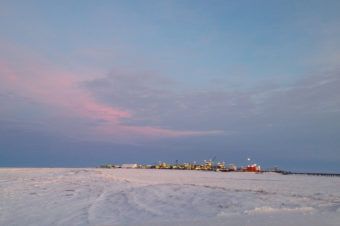
ConocoPhillips’ Alpine facility on the North Slope. Conoco’s Scott Jepsen said a new processing facility in NPR-A would be about the same size. (Photo by Elizabeth Harball/AED)

During an especially upbeat quarterly earnings call this spring, a top ConocoPhillips executive gave a special shout-out to Alaska.

“This was our largest exploration program in Alaska since 2002, and a successful one,” said Al Hirshberg, Conoco’s vice president for production, drilling and projects.

Hirshberg noted that after drilling a half-dozen exploration wells in the National Petroleum Reserve-Alaska area this past winter, Conoco made three new oil discoveries. And, Hirshberg said, the company confirmed the discovery it announced last year, called Willow, holds quite a lot of oil — 300 million barrels.

Then Hirshberg teased investors with this:

“I think we can see from the appraisal work in Willow that it’s looking more and more like it’ll be able to justify a standalone facility,” he said.

Translation? Conoco thinks it’s sitting on so much oil that the company is considering building a major new project in the Reserve, a processing facility. The company’s already big plans for this remote, federally-managed Arctic wilderness are getting even bigger. And environmental groups are watching closely.

A new processing facility would be a major investment for Conoco and a major addition to the landscape. A processing facility is like the nucleus of an oil development: fed by a handful of drill sites, it would be the first stop for oil before it gets sent to the trans-Alaska pipeline. On the North Slope, processing facilities are also like self-contained towns, serving as a home base for a few hundred workers.

Scott Jepsen, Conoco’s vice president for external affairs in Alaska, said if the company built a new processing facility in NPR-A, it would be about the same size as the nearby Alpine facility, located just outside the Reserve. Alpine puts out about 100,000 barrels of oil per day.

But Jepsen said Conoco hasn’t made a final decision on whether to build the project. He said that will come after the federal environmental review process.

“We still have more evaluation work to do. We still have a permitting process to go through,” Jepsen said. “But all the signs that we have seen so far point to the fact that it’s large enough, the rates are going to be high enough, that we can most likely justify a standalone facility out there.”

Conoco has firmly established itself as the dominant oil company in NPR-A. It may be called a “Petroleum Reserve,” but it wasn’t until 2015 that this massive, federally-managed portion of the North Slope first started producing oil. That project was ConocoPhillips’ CD-5 drill site. Since then, Conoco has steadily advanced a series of projects in NPR-A. Its next drill site there, Greater Mooses Tooth 1, is set to start up later this year. The federal permitting process for a third drill site, Greater Mooses Tooth 2, took a major step forward in March.

And in May, Conoco sent a letter to the Bureau of Land Management, the agency that oversees NPR-A, asking to start the environmental review process for what it’s calling the Willow Central Facility.

The Trump administration is eager to help Conoco achieve its goals. During a speech at a recent oil industry conference in Anchorage, top Interior official and former Alaska Department of Natural Resources commissioner Joe Balash said his agency is about to turn its attention to Willow “in a big way.”

Then Balash reiterated one of the Trump administration’s promises to industry: it aims speed up and simplify the environmental review process for projects like Willow.

“As you all know, the process to date has been taking too long, it costs too much money, and it is too complicated,” Balash said.

But environmental groups that keep close tabs on NPR-A see it differently. David Krause with the Wilderness Society in Anchorage said the faster Conoco’s footprint in NPR-A grows, the more difficult it is for them to understand how environmental impacts are adding up in what was, until recently, mostly untouched wilderness.

“We certainly have significant concerns about the rate of development,” Krause said.

Conoco’s processing facility wouldn’t be far from the Teshekpuk Lake Special Area, a biologically rich part of NPR-A the Obama administration put off-limits to oil development. It’s important habitat for migratory bird species and caribou.

But geologists also think there’s significant oil potential there, so the Trump administration is taking a second look at whether the area should be off limits — a move Conoco supports. Krause said that makes his organization nervous about what a big development at Willow could mean in the future.

“The fact that this development is knocking on the door of the Teshekpuk Lake Special Area is very concerning,” Krause said.

But Krause said the Wilderness Society isn’t coming out against the project; Conoco hasn’t released many details at this point.

Those details will become clearer when the Trump administration kicks off the environmental review process, which Conoco anticipates happening later this year.

In gubernatorial debate, Dunleavy and Hawkins grill Walker on gasline

Former State Senator Mike Dunleavy, businessman Scott Hawkins and Gov. Bill Walker at the Alaska Oil and Gas Association’s annual conference in Anchorage. (Photo by Elizabeth Harball/Alaska’s Energy Desk)

Two of Governor Bill Walker’s challengers in the upcoming election are criticizing his policies toward China and the proposed Alaska LNG gasline project.

Walker, former State Senator Mike Dunleavy and businessman Scott Hawkins faced off in a debate Thursday, May 31, at the Alaska Oil and Gas Association’s annual conference in Anchorage.

Dunleavy questioned whether the state is able to handle its lead role in pursuing the gasline. “I’ve got to be honest with you that I don’t have faith in the administration that they are going to be able to pull this off with the folks they have in place and the expertise,” Dunleavy said. “And that greatly concerns me and I think it concerns folks in this room and folks outside this room.”

The Walker Administration is negotiating with Chinese entities to help finance the gasline, and the governor just returned from a trade mission to China. Hawkins said China is a geopolitical rival of the United States and argued the nation shouldn’t get too involved.

“We have to be very careful what role they play in the project,” Hawkins said. “It’s well and good that they buy LNG from us; it’s okay if there’s a small minority role that they play in the project. To give them much control or much influence on the project would be a grave strategic error, I believe.”

Walker defended China’s involvement in the project, saying it will have a minority role in the gasline and noted the nation is the state’s top trading partner. The governor said he’s proud of how his administration has handled the project.

“We’ve made historic progress on the gasline. And I know I get accused of being a little fixated on the gasline,” Walker said. “You know, it’s the opportunity. It’s an incredible opportunity for the state. And if we let that opportunity go by and we don’t monetize that gas, shame on us.”

The wide-ranging debate also touched on topics like crime, education, the opioid epidemic and tax policy. Candidate and state representative Mike Chenault was slated to participate, but did not attend. The Associated Press reports that Chenault has dropped out of the Republican primary race for governor.

Alaska businesses find a niche: helping oil companies cope with climate change

Randy Howard (left) and Brian Shumaker of Beaded Stream, a company that sells technology to monitor permafrost temperatures. (Photo by Elizabeth Harball/Alaska’s Energy Desk)

A few steps outside his warehouse in Anchorage on a chilly, late March day, Brian Shumaker gave a product demonstration that required a little pretending:

“Imagine for a moment you’ve just landed in a helicopter out on the tundra and you’re about a hundred miles from anywhere. And it’s costing you a dollar a second to be here,” Shumaker said.

We pictured ourselves on the remote North Slope, near Alaska’s biggest oil fields. There, every winter, companies build hundreds of miles of ice roads — roads literally made of ice and snow — essential for moving the massive equipment used for oil exploration.

But environmental regulations don’t allow oil companies to build ice roads until the fragile tundra is sufficiently frozen. And scientists say freeze-up is happening up to two months later than it did in the 1980s.

That’s where Shumaker’s startup, called Beaded Stream, comes in. Shumaker has developed technology that monitors when the ground freezes, pinpointing exactly when ice road season can begin.

To show how, Shumaker drilled into the frozen soil and inserted a blue and yellow temperature monitoring cable. He hooked it up to a small, solar-paneled box installed on a nearby pole — a data logger that sends temperature readings to the internet via satellite. Using this device, companies can squeeze the longest possible oil exploration season into steadily shrinking winters. According to state regulators, Shumaker’s technology has actually helped lengthen ice road seasons in recent years.

“Usually with our technology we can get folks out there days to weeks early, so it translates into huge cost savings,” Shumaker said. “But most importantly, sometimes it makes projects that weren’t even doable, doable.”

Beaded Stream isn’t alone. Alaska’s oil industry has specially designed its operations for freezing conditions. But as temperatures rise, companies are starting to pay a price for climate change — and some Alaska businesses are making money off of it. Oil companies now help support a cottage industry of consultants and product manufacturers, all providing workarounds for the fact that the frozen ground they rely on to produce oil isn’t as frozen as it once was.
Although Shumaker said when he talks to customers, he doesn’t bother discussing why temperatures are rising.

“I’m not debating what’s happening,” Shumaker said. “What are we going to do about it.”

For an industry that’s often blamed for climate change, talking about coping with it is an awkward topic. Multiple oil companies contacted for this story turned down interview requests. But climate change is so present in Alaska today that the industry’s top lobbying group acknowledges it’s creating problems. Josh Kindred with the Alaska Oil and Gas Association said there’s a lot of concern about shrinking ice road season. He also noted the industry is having more frequent run-ins with polar bears due to declining sea ice.

“It is ironic, and it’s challenging for a state that is so dependent on resource extraction but is also really feeling the impacts of climate change,” Kindred said.

But for Kindred and many other Alaskans, the idea of stopping the state’s oil production to address climate change is unthinkable.

“It’ll be interesting to see how we navigate this…I don’t want to call it a conundrum, because I do think there’s an opportunity for success here, but what is our role and how do we do it? Those are very difficult questions,” said Kindred.

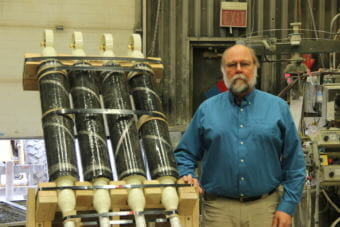
Arctic Foundations President Ed Yarmak in his Anchorage warehouse, next to the thermosyphons his company manufactures. (Photo by Elizabeth Harball/Alaska’s Energy Desk)

Meanwhile, oil companies keep finding ways to adapt.

Ed Yarmak runs a company called Arctic Foundations, which makes devices that literally refrigerate the ground. They’re used across Alaska — for roads, water tanks and schools. But Yarmak says now, about half his business comes from oil companies on the North Slope.

Arctic Foundations was founded in the 1970s — the oil industry has always had to incorporate special engineering to work around permafrost, because infrastructure alone can cause it to warp and thaw. But Yarmak said rising temperatures mean his product is really starting to come in handy.

“To be honest, climate change is pretty good business for our company,” Yarmak said. “Because we’re in the business of making things colder, and climate change is warming things up in Alaska.”

On the North Slope, oil companies have built a vast network of roads, pipelines and buildings on top of permafrost. But permafrost temperatures in the Arctic have been rising for decades. Yarmak said for buildings on the North Slope, thawing ground can start to cause problems.

“The doors start to stick. The sheet rock cracks…the floor isn’t level any more. Things aren’t the way that they planned them,” he said.

Arctic Foundations’ products help protect against these issues. In the company’s Anchorage warehouse, employees in protective glasses manufacture thermosyphons, long metal tubes filled with a refrigerant. When finished, thermosyphons are partially buried in permafrost to keep it frozen.

Yarmak pointed out the top part of a thermosyphon, which is covered with a dense array of tiny fins:

“This part is the condenser…it’s where the heat comes out and goes to the air,” Yarmak explained.

Yarmak said each is custom made, and the ones for use on the North Slope and can cost roughly $10,000. He said oil companies have installed thousands of them across Alaska’s Arctic.

And if the state continues to warm as projected, Yarmak expects to be in business a long time to come.

Interior asking public not ‘if’, but ‘how’ to allow drilling in ANWR

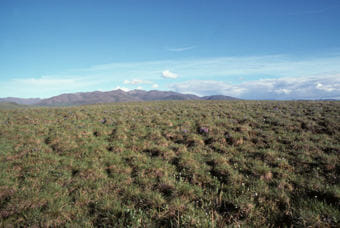
Tussock tundra on Arctic Refuge coastal plain. (Photo courtesy of USFWS)

Public meetings on oil lease sales in the Arctic National Wildlife Refuge are drawing intense interest from Alaskans across the state. Last night over 100 protesters gathered outside the Anchorage meeting, including Samuel Johns, whose mother is from Arctic Village, on the edge of the refuge.

“I was in there just a little bit ago and I got to hear the first guy speak,” Johns said. “And the first guy, no offense to you all, but the first person in there to speak was a white man. In support of ANWR. In support of development. To me that’s a slap in the face to my people.”

At the meeting, officials said the Trump administration must move forward with oil lease sales in ANWR. The Department of Interior’s Joe Balash said that’s because of specific language in the law Congress passed last year allowing drilling in ANWR.

“The statutory provisions say, ‘DOI shall’,” Balash said.

Testimony at the meeting was mixed. Many protesters came inside to speak against development, citing impacts to subsistence, the climate, and the value of untouched wilderness. Others with labor and industry groups spoke in favor of development. Jason Alward was there representing Operating Engineers Local 302.

“The leases, the development, the production of ANWR’s natural resources are vital to our future. And this project can be done responsibly.”

The meeting ran over five hours, but it still wasn’t long enough to accommodate everyone who wanted to testify. The comment period officially ends June 19. However, a Bureau of Land Management spokeswoman says the agency has received many requests to extend it.

BLM is holding another public meeting on development in ANWR today in Utqiagvik. Additional meetings are planned in June in Kaktovik, Venetie and Washington, D.C.

Native Corporations ask to start looking for oil in ANWR

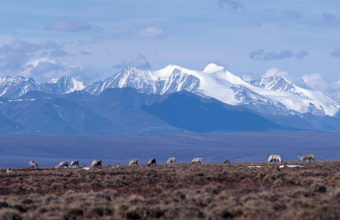
Caribou graze on the coastal plain of the Arctic National Wildlife Refuge, with the Brooks Range as a backdrop in October 2010.
Caribou graze on the coastal plain of the Arctic National Wildlife Refuge, with the Brooks Range as a backdrop in October 2010. (Public domain photo by U.S. Fish and Wildlife Service)

Two Alaska Native corporations are asking the federal government if they can start looking for oil in the Arctic National Wildlife Refuge.

Arctic Slope Regional Corporation (ASRC) and Kaktovik Inupiat Corporation have submitted a 3-D seismic exploration plan for the Coastal Plain, or the 1002 area. They partnered with oil exploration company SAExploration. The companies want to begin a substantial exploration program this winter, encompassing the entirety of the biologically rich coastal plain, potentially involving hundreds of workers.
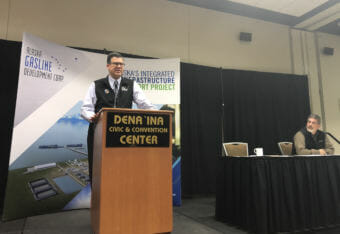
The corporations’ permit application was first reported by the Washington Post. The Post also reports that Interior’s Fish and Wildlife Service responded by saying the plan, as currently submitted, is “not adequate” because it didn’t include proper studies on environmental impacts.

But after speaking at an oil conference in Anchorage on Thursday, top Interior official Joe Balash confirmed the agency is still considering the plan.

“They submitted an application, we’re reviewing it, along with the Fish and Wildlife Service,” Balash said. “And we’ll process that permit application just like any other.”

Balash says a key thing Interior will consider is compliance with Endangered Species Act protections for polar bears. According to the Bureau of Land Management, the agency will make a decision on the application by July.

Regarding Interior’s initial response to the application, BLM spokeswoman Lesli Ellis-Wouters said in an email, “such responses are part of a normal, iterative process whereby we work collaboratively with both the permit applicant and our sister federal agencies to identify shortcomings or gaps in information in the application so that we can fully and appropriately evaluate it.”

ASRC released a statement in response to the Washington Post’s reporting criticizing it for inaccuracies, “whether intentional or inadvertent,” although the corporation did not specify what in the article was incorrect.

ASRC added, “while we cannot comment on the proprietary details, we have always fully expected the seismic permitting and application process through various federal agencies to be very thorough. We welcome a robust review, as a successful seismic program will help to focus leasing to ensure minimal environment impact of future exploration activities in the 1002 Area.”

Environmental groups condemned the news. In a statement, the Alaska Wilderness League said exploration “would cause severe and long-lasting damage to the Arctic Refuge.”

This story has been updated to include a statement from ASRC.

Alaska LNG project president says he’s done ‘preaching to the non-believers’

Meyer
AGDC president Keith Meyer speaks at a public meeting in Anchorage on May 9, 2018. (Photo by Elizabeth Harball/Alaska’s Energy Desk)

Since taking the lead on the gasline project about two years ago, the Walker administration has doggedly pursued its plan for the megaproject. In the process, they’ve chalked up some successes, including interest from China’s president and a tentative agreement with BP.

Now, the president of the state-owned Alaska Gasline Development Corporation says he’s no longer bothering to convince skeptics that the project is real, and it’s moving forward.

AGDC staff has been traveling across Alaska in recent weeks, holding meetings with the public to tell them about the gas line project and answer questions. During the Anchorage meeting yesterday evening, there were moments that felt less like a discussion about a complex infrastructure project, and more like a revival. After watching a promotional video for a project, the crowd of nearly 200 Alaskans erupted into applause.

“All right — who’s feeling inspired?! Let’s go build this!” said AGDC communications manager Jesse Carlstrom.

A lot of clapping and cheering came from a large cluster of people in orange shirts — all union workers. After explaining the project’s progress so far, AGDC president Keith Meyer called out a series of questions:

“You can either tell me ‘yes,’ or you can tell me ‘no.’ Don’t hem and haw, you can say it loud. Will Alaskans have preference in hiring?”

“Yes!” the audience responded.

“Will there be a project labor agreement?” Meyer asked.

“Yes!” the audience replied again, breaking into another round of applause.

Denomie
Christopher Coleman-Denomie (center), a member of Laborers Union Local 341, at the AGDC public meeting. (Photo by Elizabeth Harball/Alaska’s Energy Desk)

AGDC estimates that building the gas line from Prudhoe Bay to Nikiski would result in close to 12,000 jobs at peak construction. They’ll need carpenters, ironworkers, teamsters, welders and more. But despite its economic promise for Alaska, the project has endured a lot of skepticism, from energy analysts to the legislature to, as Meyer has a habit of saying, “the headlines.”

But now, Meyer told the crowd, he’s done “preaching to the non-believers.”

“We’re not doing that any more. Now the message is to the believers, that, ‘hey, we’ve got to get ready,'” Meyer said.

A lot needs to happen before the gas line becomes a reality. Two of the companies that own the North Slope gas haven’t agreed to sell it. The needed environmental permits won’t come through for well over a year. Also, Meyer still needs to pin down investors for the $43 billion proposal.

Still, Meyer told the crowd, “the project’s happening. We’ve got some time, we’ve got some lead time, but that’s going to disappear very, very quickly. And so every person, every small company, every large company in the state has got to get ready.”

Sitting in the audience before the meeting, Christopher Coleman-Denomie said he’s ready to get to work. Coleman-Denomie was one of the guys in the orange shirts — a member of Laborers Union Local 341. He said it took some time, but he’s become one of the gas line “believers.”

“When I first heard about this I was a little skeptical, because my parents had said that this had been talked about for years,” Coleman-Denomie said. “But nothing has been moved forward like it has now, so everything’s falling into place and it’s going to create a lot of jobs for everybody– and I’m going to be a part of that.”

But there are still Alaskans who aren’t entirely sold. Outside the meeting, a lone protester — who refused to give his name — paced the sidewalk with a sign reading, “Alaska’s biggest boondoggle yet” and the words “LNG Gasline” crossed out in red.

During the meeting, some attendees aired concerns about China’s involvement in the project, and questioned whether it can pencil out. That included Stan Porhola. He said he thinks BP’s tentative agreement to sell the gas is encouraging, “but I’m still very skeptical that this project can go through.”

“Who’s going to invest in this project, how much is it going to cost?” Porhola asked.

Porhola said he would like to see the state “move past the letters of intent and actually [get] to actual sales agreements to the different countries.”

Porhola works in the oil and gas industry, and said he’d definitely benefit if the megaproject comes to fruition. But he said Alaskans need to make sure that the project is really a good deal for the state. Before Porhola becomes another gas line “believer,” there’s a long list of questions he wants answered.


Site notifications
Update notification options
Subscribe to notifications