Elizabeth Harball, Alaska's Energy Desk
Inupiat leaders say offshore drilling proposal ‘ignored’ local concerns

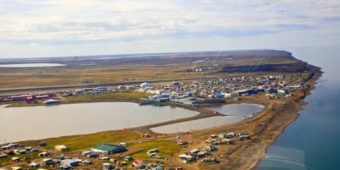
Utqiagvik, the city formally know as Barrow, in 2014.
The City of Utqiagvik is a member of Voice of the Arctic Inupiat, which recently wrote a letter to the Interior Department about the draft offshore drilling proposal. (Creative Commons photo)

Some of the oil industry’s biggest supporters got a lot more than they asked for in the Trump administration’s latest offshore drilling proposal. In early January, the Interior Department proposed opening up the vast majority of Alaska’s offshore areas to oil leasing. Senator Lisa Murkowski, Governor Bill Walker and others are already asking Interior to scale back, limiting oil lease sales to the Beaufort and Chukchi seas and Cook Inlet.

Now, Voice of the Arctic Inupiat (VOICE), an advocacy group of Inupiat leadership organizations across the North Slope, including tribal councils, municipal governments, Alaska Native Corporations and others, is also weighing in.

To be clear, VOICE isn’t against oil development. Last year, the group made a big push to allow drilling in part of the Arctic National Wildlife Refuge. When it comes to offshore oil development in the Arctic, VOICE doesn’t yet have an official position.

But it does have a position on how Interior went about its latest proposal.

In a recent letter to Interior Secretary Ryan Zinke, VOICE wrote, “with respect to the Arctic [Outer Continental Shelf] announcement on the [Draft Proposed Program], we feel the concerns of local organizations were ignored and that deeply disturbs us.”

VOICE chairman and Arctic Slope Regional Corporation president Rex Rock Sr. said,”we expressed our concerns and we felt that we were being ignored, such as the Barrow and Kaktovik whaling areas and the 25-mile Chukchi Sea buffer.”

In the letter, VOICE writes those particular areas are “critical to Northern Alaska food security” — they’re used by local communities for whaling and other subsistence hunting.

Interior’s draft proposal would allow oil drilling in these waters, although the proposal states that excluding the Barrow and Kaktovik whaling areas and the 25-mile Chukchi Sea coastal buffer “may warrant further analysis.”

Rock said North Slope leaders had already made it clear to the federal government that those areas should stay off limits.

“We had already worked this with the past administration and said, ‘here are the areas that we ask that you stay away from,'” Rock said.

He added, “we’ve always said that for us consultation is huge, you need to come in and talk to the people that are here.”

VOICE’s letter concludes that Interior decisions affecting the North Slope “must be based on consultation, coordination and engagement with Alaska Natives.”

The Interior Department has not yet responded to a request for comment on the letter. However, Interior has stressed the plan is not final; it’s still possible to remove many of the areas where offshore drilling is currently proposed.

A public hearing on Interior’s draft offshore drilling plan proposal is set to take place in Anchorage on February 21.

Reporter Ravenna Koenig contributed to this story.

Crude spill at Valdez Terminal under investigation

Valdez_Marine_Terminal
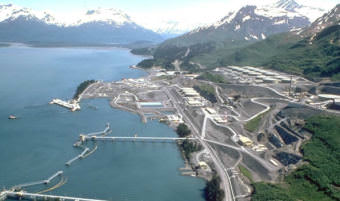
The Valdez Marine Terminal, where a spill was discovered early Saturday morning. At this time, it is thought that most of the oil was contained to the berth. (Photo courtesy U.S. Department of Interior)

Officials are looking in to what caused an oil spill discovered Saturday morning at the Valdez Marine Terminal.

According to Alyeska Pipeline Service Company, which operates the terminal, under 200 gallons of oil leaked from two arms used to load crude onto tankers.
Alyeska reports most of the oil was contained to the berth, and state officials have seen no evidence that oil reached the water. But according to Geoff Merrell with the Alaska Department of Environmental Conservation, due to rough sea conditions, it’s probable some crude escaped containment and then was naturally dispersed.

Alyeska spokesperson Kate Dugan said the spill’s cause is still unknown. She confirmed the leak is not ongoing.

The incident happened at the same berth where a different spill happened last September. Back then, over 140 gallons of crude residue leaked into the Port of Valdez during an annual test of the loading arms, of which nearly 130 gallons was recovered. An investigation later determined that spill was primarily caused by human error.

Brooke Taylor with the Prince William Sound Regional Citizens’ Advisory Council, a watchdog group, said it’s too soon to say if there’s any relationship between the two spills, but she added valve issues may be a common factor. 

“Any time you have two incidents and there is a piece of equipment that is even in part contributing to that situation, that’s then going to highlight this is an area that should be looked at very closely and possibly corrected,” Taylor said.

Icy conditions affecting valves could have contributed to Saturday’s spill, Taylor said. Taylor said Alyeska was already looking at making improvements to the terminal’s valves before this weekend’s spill.

Alyeska reports that Saturday’s incident did not impact the trans-Alaska pipeline’s operations. In addition to the state and Alyeska, the U.S. Coast Guard also responded to the incident.

EPA head reverses course on Pebble, saying it may pose ‘unacceptable’ risk

EPApebblepic
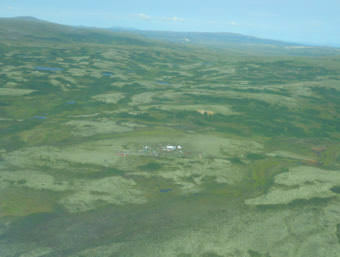
In this 2011 photo, an exploration camp sits on top of the Pebble deposit, one of the largest undeveloped copper, gold and molybdenum deposits in the world. (Photo courtesy U.S. EPA)

In a surprise announcement today, the head of the U.S. Environmental Protection Agency said the proposed Pebble Mine may pose an “unacceptable” risk to Bristol Bay.

EPA administrator Scott Pruitt said the agency is suspending its effort to reverse an Obama-era proposal to put restrictions on the mine — a potential blow to the controversial project, which had been gaining momentum in recent months.

The decision isn’t final. EPA said Pebble Limited Partnership can still move forward with the permitting process for its gold and copper mine. Pebble submitted a permit application to the U.S. Army Corps of Engineers in December, after the company reached a settlement with the Trump administration last spring.

But in a statement, Pruitt said the Bristol Bay fisheries deserve protection.

“It is my judgement at this time that any mining projects in the region likely pose a risk to the abundant natural resources that exist there,” Pruitt said.

Pebble opponent Alannah Hurley of the United Tribes of Bristol Bay called the announcement “huge.”

“We are celebrating this decision in Bristol Bay today,” Hurley said. “This is confirmation that even the Pebble Mine is too toxic for the Trump administration.”

Governor Bill Walker also praised EPA’s decision, saying in a statement he’s conveyed to Pruitt his concerns about the mine “many times.”

Pebble spokesperson Mike Heatwole did not criticize Pruitt’s statement, saying only that EPA’s announcement doesn’t change the company’s plans to keep pushing ahead.

“The EPA confirmed that we have the right to participate in the normal, lawful permitting process under the Clean Water Act, and today’s news doesn’t change our approach,” Heatwole said.

EPA said it will continue gathering information on the mine’s potential impact on Bristol Bay, including more opportunity for public comment.

Following evacuation, Tsunami Warning Center says ‘better safe than sorry’

Sitka5
A Sitka police officer directs traffic departing Sitka High School, as the evacuation ends and residents return home. (Emily Kwong/KCAW photo)

A 7.9 earthquake shook Alaska early this morning and spurred tsunami evacuation warnings for many coastal communities. But in the end, the waves peaked at less than a foot.

That’s according to the National Tsunami Warning Center in Palmer.

Peggy Johnson is a watchstander at the Warning Center. She says the tsunami was so small because of the type of earthquake that occurred. Called a strike-slip earthquake, the faults moved horizontally, not vertically.

“Because there was no vertical motion or very minimal vertical motion there was no significant tsunami generated,” Johnson said.

Johnson said within four minutes of the earthquake, the Warning Center received seismic data about its location and size. That then generated a computer model showing what areas were at risk.

“When it’s this large we have to send out a message that, in this case, for the size of the event and the location, it involved a warning and advisory for basically all the coastline of Alaska,” Johnson said.

Johnson said she is concerned Alaskans might not take the next tsunami warning seriously. But even though the earthquake didn’t lead to a large tsunami, the Warning Center prefers to take a cautious approach.
“We’d rather evacuate more people when we didn’t really have to, but they’re safe, rather than to do the opposite of being conservative and not evacuate when we should have,” Johnson said.

In the future, Johnson said Alaskans in coastal areas shouldn’t wait for official warnings if an earthquake lasts for 30 seconds or more, or if it’s so strong it’s difficult to stand.

“If you felt it and it lasts 30 seconds or more, evacuate,” Johnson said. “Go inland and up as quickly as you can.”

The National Tsunami Hazard Mitigation program advises people to prepare for a tsunami by having an emergency plan in place, to be aware of evacuation routes and to have a disaster supply kit at the ready.

Governor asks Trump administration for more public meetings on offshore drilling proposal

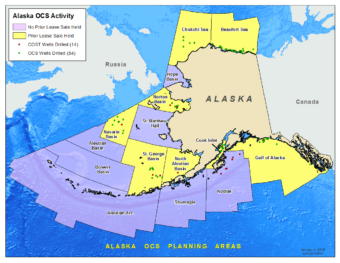
Map showing previous offshore wells drilled in Alaska. (Image courtesy Bureau of Ocean Energy Management)

A public meeting on a Trump administration draft proposal to open up more of Alaska’s waters to oil drilling is being rescheduled, due to the brief government shutdown.

The meeting was originally set to take place tomorrow in Anchorage. The federal Bureau of Ocean Energy Management hasn’t yet settled on a new date.

The Department of Interior is aiming to reverse Obama-era offshore drilling policy, which largely blocked oil development in the Beaufort and Chukchi Seas. Interior’s draft proposal would allow oil lease sales in the Arctic and also off all Alaska’s other coasts, except for the North Aleutian Basin, by Bristol Bay.
Governor Bill Walker advocated for Arctic waters to be included in the federal offshore drilling plan. But Walker says he’s asking Interior to expand its outreach effort in Alaska by holding more than one public meeting.

“We also are asking that the hearings be held, not just one in Anchorage, but in the particular areas where the activity would take place,” Walker said.

Walker was speaking in Washington, D.C., where he was attending a ceremony for the King Cove road deal.

Some groups, like communities across the Bering Strait region, strongly oppose drilling in areas the Trump administration is proposing to open up. Walker didn’t respond directly to a question about whether he will ask Interior to remove some areas included in the proposal. Instead, the governor said he will listen closely to communities that could be affected.

Alaska Public Media Washington, D.C. correspondent Liz Ruskin contributed to this story

Interior aims to sign King Cove road deal Monday, official confirms

Aerial_of_runway_at_Cold_Bay_Izembek_National_Wildlife_Refuge
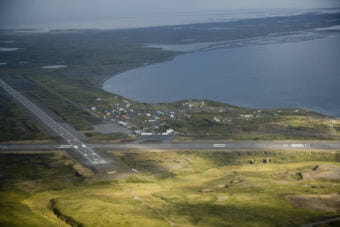
A 2007 photo of the runway at Cold Bay. Interior plans to allow King Cove to build a 12-mile road to Cold Bay to access the airport, through the Izembek National Wildlife Refuge. (Photo courtesy U.S. Fish and Wildlife Service)

A top Interior official in Alaska has confirmed that on Monday, the Trump administration plans to sign a deal to build a controversial road through the Izembek National Wildlife Refuge.

Steve Wackowski, who advises Interior on Alaska issues, said a ceremony is scheduled in Washington, D.C. He says first, former Alaska Department of Natural Resources Commissioner Joe Balash will be sworn in as the agency’s Assistant Secretary for Land and Minerals Management.

“And then right afterwards, we’re signing the King Cove land deal. That’s scheduled,” Wackowski said.

An advisory sent out by Interior on Friday stated that Della Trumble of King Cove, Governor Bill Walker and Alaska’s congressional delegation will join Interior Secretary Ryan Zinke at the ceremony.

However, Wackowski said the potential federal government shutdown could mean the deal-signing needs to be rescheduled.

“I feel confident in saying that if it’s not on Monday, we will get the deal signed in some form or fashion immediately once the government re-opens,” Wackowski said.

The road through the Izembek National Wildlife Refuge is strongly opposed by environmental groups; they say it will have significant environmental impacts. Wackowski argued the community of King Cove needs the 12-mile road to access an airport for emergency services.

“The decision for us, quite frankly, was actually pretty easy — protecting human life. And we don’t think there’s going to be any of the doom and gloom scenarios that some of the folks have talked about,” Wackowski said.

Wackowski was speaking after giving a presentation at an industry conference in Anchorage. There, he told the crowd that Interior is laying the groundwork for oil leasing in the Arctic National Wildlife Refuge. As part of the new tax law passed by Congress, Interior is now required to hold oil and gas lease sales in a section of the Arctic Refuge known as the 10-02 area, or the Coastal Plain.

“Right now, we are actively — we have, literally, a daily call — on how we are going to get to a lease sale, permitting seismic, all those things,” Wackowski said.

Wackowski said to expect Interior to roll out more details on oil lease sales in the Refuge in the coming weeks.

Site notifications
Update notification options
Subscribe to notifications