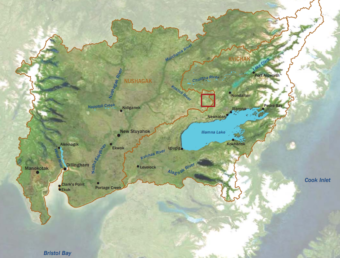
Map of the Bristol Bay region. The Pebble deposit location is indicated by the red box. (Photo courtesy U.S. EPA)
A controversial proposed mine in southwest Alaska is taking another significant step forward. Pebble Limited Partnership has announced that tomorrow, it will apply for a federal Clean Water Act permit from the U.S. Army Corps of Engineers.
It’s the first of many permit applications Pebble needs to file before it can build the proposed copper and gold mine. But it’s still a triumph for its backers.
With this, Pebble will have checked off all three goals it wanted to accomplish this year: a settlement with the Environmental Protection Agency, a new partner and a permit application. Tom Collier is Pebble’s CEO.
“We said we intended to accomplish all three of those this year and we think we’ve got the hat trick here, we think we got all three done and we’re pretty pleased,” said Pebble CEO Tom Collier.
The permit application triggers the federal environmental review process. Agencies will use that process to determine whether the mine should be approved. It also means more detailed plans on the mine’s design will soon be made public.
Collier says he thinks this is a good thing.
“Now we’re going to be able to have a debate about exactly what we’re proposing to do,” Collier said. “And I think that will be pretty healthy for resolving all the various disagreements about the project.”
For environmental groups fighting the mine, it’s a dramatic turn from just a year ago, when the Obama administration had proposed Clean Water Act restrictions that threw the mine’s future into question. Back then, EPA said it was responding to widespread local concern that the mine could harm the Bristol Bay salmon fishery.
Alannah Hurley is executive director of United Tribes of Bristol Bay. She says the mine is harder to fight once the permitting process begins, but not impossible.
“We’re very confident that we’ll be able to defeat the project within the permitting process because you cannot change the fact that this type of development will devastate the Bristol Bay fishery,” Hurley said.
Just this Monday, Pebble announced it secured a new partner for the mine — the Canadian company First Quantum Minerals.
Pebble’s leadership says First Quantum Minerals’ investment in the project will help fund it through the permitting process. Pebble hopes to complete the permitting process in three to five years.
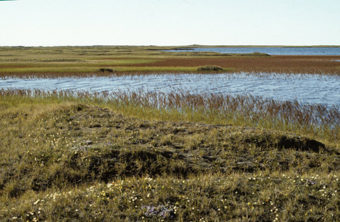
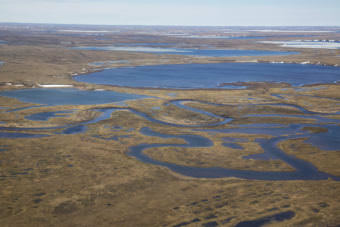
Pond on ANWR coastal plain. Geologists have limited data about how much oil might lie beneath this part of the Arctic refuge. (Photo courtesy of U.S. Fish and Wildlife Service)
Congress has opened a section of the Arctic National Wildlife Refuge to oil development.
Let’s say that one more time, so it sinks in.
Congress has opened a section of the Arctic National Wildlife Refuge to oil development.
Even though oil production there is likely a decade out at least, it’s a pivotal moment for Alaska. It culminates a nearly four-decade battle between environmental groups and the state’s political leaders. For years, they fought over the potential consequences of drilling in the refuge — on caribou, on the economy, on the climate and on nearby communities.
But now, everything that was hypothetical is going to get real. One of the big questions that could finally get answered is this: what oil companies, if any, are actually interested in drilling in the Refuge?
For now Alaska’s top three oil companies are keeping their cards hidden. ExxonMobil declined to comment for this story. ConocoPhillips was noncommittal, saying in a statement it will “consider it against other opportunities in our portfolio, just as we do with exploration opportunities worldwide.” BP referred reporter questions to an industry lobbying group, the Alaska Oil and Gas Association.
And Alaska Oil and Gas Association President Kara Moriarty said she has no idea which companies might bid on leases in the Arctic Refuge.
“They don’t talk about whether they’re participating in a lease sale or not because it’s a highly competitive industry,” Moriarty said.
That said, there are clues that oil companies are pretty curious about the 1002 area — the 1.5 million-acre section of the Arctic Refuge Congress just opened up for development. David Houseknecht with the U.S. Geological Survey is an expert on Alaska’s oil resources. Lately, he’s been getting a lot of calls.
“I’ve been contacted by companies as far away as Australia, asking, ‘well it looks like the legislation might pass that would allow exploration of the 1002 area. We are interested in evaluating whether or not we would like to participate in such a lease sale,’” Houseknecht said.
Houseknecht said oil companies started asking him for information on the 1002 area’s oil potential when Senator Lisa Murkowski’s measure began moving through Congress.
There are good reasons for oil companies to be asking questions. The data on how much oil is actually in the Arctic Refuge is limited — but intriguing. USGS thinks there might be between about 4.3 and 11.8 billion barrels of oil in the 1002 area — those are huge numbers. For comparison, Alaska’s second biggest oil field, Kuparuk, has produced about 2.5 billion barrels of oil.
And that potential lies on shore, in a politically stable country. Those are big pluses for oil companies. Houseknecht said there’s not many other places on the planet like that.
“Those combinations are quite unique when you look around the world for areas where there may be billion-barrel opportunities for discovery,” Houseknecht said.
But there are also some big uncertainties. Wood Mackenzie analyst Cody Rice said thanks to improved technologies like hydraulic fracturing, oil developments in the Lower 48 are often cheaper to pursue than projects in Arctic Alaska.
“It’s clear Alaska needs more development. It’s not as clear to me that oil companies need big, complicated Arctic projects right now when you can see billions of barrels in resource being added on an annual basis in West Texas,” Rice said.
That’s not the only likely hurdle. It’s a safe bet that environmental groups are going keep fighting oil development in the Refuge any way they can — including in court. Erik Grafe, an attorney with EarthJustice, said Congress may have changed one law about drilling in the Refuge, but all other environmental laws haven’t gone away.
“If the Trump administration tries to rubber stamp oil decisions or takes shortcuts, we won’t hesitate to go to court to enforce these environmental laws,” Grafe said.
But Moriarty of the Alaska Oil and Gas Association says dealing with environmental opposition is just part of the job for oil companies.
“Alaska has been the poster child for litigation cases for any type of development on the North Slope. And so I think companies sort of factor that in, in the timing and unfortunately in budgets, to have to plan for that now,” Moriarty said.
Moriarty may be in the dark about which oil companies are interested in bidding on leases in the Refuge’s 1002 area. But just as environmental groups couldn’t stop Congress from allowing oil development in the Arctic Refuge, she’s doubtful the opposition will be able to stop that development from actually happening, either.
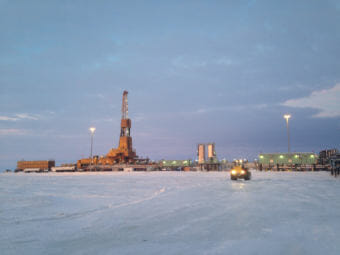
ConocoPhillips’ CD5 drill site is producing far more oil than initially estimated. The company thinks there’s more oil potential west of its current developments. (Photo by Elizabeth Harball/Alaska’s Energy Desk)
Oil development in the federally-managed National Petroleum Reserve-Alaska is now dominated by one company: ConocoPhillips. Conoco now controls over 1,000 square miles of the Reserve. Beyond its current developments, the company sees even more opportunity further west.
But in that direction lies the off-limits Teshekpuk Lake Special Area. Some groups think the whole area should stay protected. But Conoco is asking the federal government to re-draw the map.
Conoco is currently having a lot of success in the Reserve. For example, when the drill site CD5 came online two years ago, the company expected it to produce about 16,000 barrels of oil per day. Now, it’s putting out about 28,000 barrels per day.
CD5, on Alaska Native lands, was the first oil production inside the NPR-A boundary. Conoco is spending billions on two more projects west of CD5, called Greater Mooses Tooth 1 and Greater Mooses Tooth 2. Deeper into the reserve, Conoco sees even more potential. The company announced a massive oil discovery there in January, called the Willow discovery. Conoco thinks Willow could produce more than three times more oil per day than CD5.
This winter, Conoco aims to drill four exploration wells in the Reserve and one just outside it. That, by the way, is a lot.
“That’s big compared to any year — it’s a pretty substantial program we have going on this coming year,” said Scott Jepsen, ConocoPhillips’ vice president of external affairs.
Jepsen said between all the oil exploration and construction happening in the Reserve this winter, Conoco is employing about 1,100 workers.
The Trump administration wants to continue this momentum. This year it offered 900 tracts of NPR-A at its oil and gas lease sale — the most ever.
But out of those 900 tracts, Conoco only bid on seven. That’s because the land that was available wasn’t where Conoco sees the most potential.
“In NPR-A, really, probably the most prospective acreage is due west of where we currently are,” said Jepsen.
And that land is off-limits to drilling, even though geologists see a lot of oil potential there. Conoco’s leases are now pushing up against a boundary set by the Obama administration back in 2013. That line is about 20 miles from Teshekpuk Lake, a huge Arctic lake surrounded by habitat for migratory birds and caribou. Jepsen says Conoco wants the boundary line to shift.
“We’ve been having conversations with the BLM about taking another look at that and seeing if some of that acreage can’t be made available for leasing,” Jepsen said.
Jepsen argued Conoco can pursue oil development near Teshekpuk Lake without putting caribou, bird species and subsistence for nearby communities at risk.
He said some parts of the area are critical habitat and probably should stay off limits.
“But,” he said, “I think there are other areas that don’t fall into that category. And that we could demonstrate that we can safely develop those and develop them in an environmentally sound and sensitive manner.”
The Trump administration seems ready to listen. The Interior Department is re-evaluating the Obama-era decision that more than doubled the size of the protected area around Teshekpuk Lake.
But several environmental groups don’t think that land should be back on the table again. Nicole Whittington-Evans with the Wilderness Society in Anchorage said the boundaries in place now set a good balance between oil development and habitat protection.
“And if you start tinkering with it and shifting it, then you lose that balance,” Whittington-Evans said.
Unlike the Arctic National Wildlife Refuge to the east, the NPR-A is a place where environmental groups have been willing to compromise. Whittington-Evans said her group doesn’t oppose oil drilling in a lot of the Reserve.
“But in places where the ecology is so important and where species really depend on an area, we just don’t think these are appropriate places for the oil industry to be able to develop,” Whittington-Evans said. “And the Teshekpuk Lake Special Area is one of those places.”
Conoco’s ask to open up more of the Reserve to oil development — and environmental groups opposition to it — is being weighed in Washington, D.C. The Department of Interior will make the final decision but hasn’t said yet when that decision will be made.
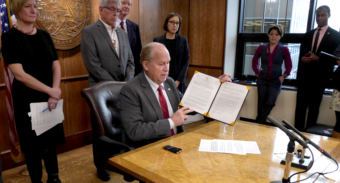
Alaska Gov. Bill Walker shows off the freshly signed Administrative Order 289 in the state Capitol on Oct. 31, 2017. That order established the Alaska Climate Change Strategy and Climate Action for Alaska Leadership Team. (Photo by Skip Gray/360 North)
Governor Bill Walker today announced the 20 members of the state’s new climate change task force.
The team’s job is to come up with recommendations for how Alaska should deal with climate change. It was created by Walker in an administrative order issued this fall. The task force is led by Lt. Governor Byron Mallott.
In a statement, Gov. Walker said announcing the team “is another critical step in advancing meaningful climate policy.”
Alaskans representing a wide range of interests made the list. They include Fran Ulmer, chair of the U.S. Arctic Research Commission, BP Alaska president Janet Weiss and North Slope Borough Assembly chair John Hopson, Jr. The team also includes experts on renewable energy and climate science.
Another notable member is 17-year-old Sam Schimmel from Kenai Peninsula and St. Lawrence Island. Schimmel is Siberian Yupik and Kenaitze Indian.
“The issue of climate change is very important for Native youth because it affects our traditions — our hunting traditions, our fishing traditions, our berry picking traditions,” said Schimmel.
Schimmel wants the team to tackle solutions to problems Alaska Native communities are already dealing with because of climate change so young people can keep taking part in important traditions.
“We must combat climate change and we must try and slow it down, but we must also address the slow-moving emergency that our communities face,” Schimmel said. “We need a definite end result, and that result would be giving aid to communities that allow communities to continue their traditions.”
Six of the team’s members were part of former Governor Sarah Palin’s Sub-Cabinet on Climate Change, including Chris Rose, executive director of the Renewable Energy Alaska Project. Rose hopes the group has more impact this time around.
“About ten years have passed and we’ve seen climate change accelerate. We’ve also seen the price of renewables come down tremendously in that decade, so I’m hoping that this time around, there’s a lot more action rather than recommendations,” said Rose.
Rose hopes a big priority for the team will be working on improving financing for renewable energy and energy efficiency projects in Alaska.
The group will meet for the first time on Dec. 18. The governor’s office wants an early draft of their recommendations by next September.
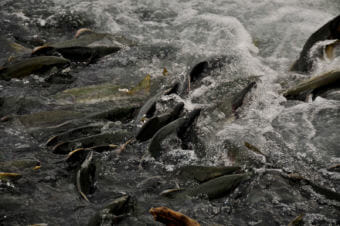
The Stand for Salmon ballot initiative would put in place a much tougher vetting process for projects affecting salmon habitat in Alaska. (Flickr photo by faungg)
A ballot initiative aimed at protecting Alaska’s salmon habitat is kicking up a controversy. Environmental groups call it a needed step to protect Alaska’s most iconic — and lucrative — fish. But the state, many industry groups and several Alaska Native corporations are speaking out against it.
If Alaskans are confused about what the ballot initiative would actually do, that’s understandable. That’s because both sides can’t seem to agree on how it would affect future development in Alaska.
At a Stand for Salmon event held in Anchorage this fall, supporter Arlo Davis collected his first signature from Kevin Illingworth.
As he signed on, Illingworth said like a lot of Alaskans, he thinks protecting salmon should be a priority.
“I know the importance of salmon to our entire state — not just any one group or individual, but to all of us.”
Illingworth’s signature is just one of 32,127 Stand for Salmon’s organizers need to pin down before mid-January to get it on the ballot. That’s not the only hurdle. The state thinks the initiative is unconstitutional and is challenging it in court.
Here are some basics: Salmon habitat in Alaska is extensive, so the initiative assumes all the state’s water bodies are habitat for salmon and other, similar fish species, unless proven otherwise. If a project will significantly impact salmon habitat, it’s put through a much tougher vetting process by the Alaska Department of Fish and Game. Also, the state could require the public to weigh in before permitting a project.
And importantly, the initiative gives the state more power to stop projects altogether.
Industry groups hate the initiative.
“We don’t believe this initiative is standing for salmon at all. We think it’s shutting down the state economy, communities and our way of life,” said Deantha Crockett with the Alaska Miners Association at a recent conference.
Other industries and Native corporations banding against the initiative use similar language, saying it will set “near-impossible new standards” for development.
Take a big proposed mining project like the Pebble Mine or the Donlin Mine. Those mines are in areas with salmon habitat, which isn’t unusual in Alaska.
“Probably most large mines are going to somehow impact fish habitat and that’s unavoidable,” said Richard Mylius, former director of the Alaska Department of Natural Resources’ Division of Mining Land and Water, who is against the initiative.
In some cases, Mylius said, a mine’s impact is permanent. According to legal documents filed by the state, the Donlin mine will eliminate two fish streams — forever.
“When you’re creating a permanent facility that’s always going to be there, you can’t mitigate that specific stream or restore that specific stream, because it’s not there anymore,” Mylius said.
But Mylius added that companies can’t just walk away and do nothing about it. Today, the state makes them compensate by restoring salmon habitat somewhere else, sometimes in a different water body.
The Stand for Salmon initiative would tighten the rules — all restoration, mitigation, or preservation has to be in the same water body that’s damaged. If that’s not possible, then the project can’t go forward.
“Far away projects in other areas can’t compensate for the loss of function to the local community,” Valerie Brown of Trustees for Alaska, a legal organization supporting the initiative, wrote in an email.
Opponents say that’s one reason why Stand for Salmon is designed to block big projects like Donlin, but it will also impede smaller ones, like airstrips and roads.
But Stand for Salmon’s backers say this is an overreaction.
“If you actually do take a hard look at this and keep an open mind, you’ll see that this shift is not going to be dramatic — it’s not going to dramatically impact the way you can and do business,” said Emily Anderson of the Wild Salmon Center, who helped write the initiative.
Anderson argued that in many cases, project builders can avoid permanently damaging salmon streams, like by putting a mine in a slightly different spot or by using different technology. But Anderson also acknowledged that under the initiative, some projects won’t make the cut.
“There’s a standard in here — a standard of care that says, ‘if you’re going to substantially damage Alaska’s fisheries, Fish and Game can say no to your permit.'”
Anderson called this is a paradigm shift for Alaska — but she said it’s an important one.
“There has to be some sort of upper limit or upper threshold and the ability built into the system for the state to say, ‘you know, this isn’t going to work with us,'” Anderson said.
But there’s another significant wrinkle to this controversy — a legal wrinkle. Stand for Salmon’s lawyers and the state’s lawyers fundamentally disagree on whether the initiative goes against the state’s constitution. The question is, does it mean that one state resource — salmon — would take priority over minerals, oil, hydropower and all Alaska’s other resources?
The Alaska Supreme Court will have the final word on that this spring. If the initiative wins in court and gets enough signatures, next year, it will be on the ballot.
An oil lease sale for the National Petroleum Reserve-Alaska saw limited interest, despite more land being offered than ever before. (Photo by Bob Wick, courtesy BLM)
This year, in a move heralded by Interior Secretary Ryan Zinke as “large and unprecedented,” the Trump administration offered the most land ever to oil companies in Alaska’s National Petroleum Reserve. Nine hundred tracts, totaling more than 10 million acres, were up for bid.
But at the annual lease sale held today, oil companies bid on only seven tracts. The sale lasted less than 10 minutes.
In a call with reporters after the sale, Ted Murphy of Bureau of Land Management said there’s never a guarantee that oil companies will be interested.
“We never know exactly how industry is going to react to the number of tracts made available,” Murphy said. “Lease sale interest is unpredictable.”
Oil companies ConocoPhillips and Anadarko jointly bid on all seven tracts that sold. The acreage they bid on is located in the eastern part of the Reserve, near land Conoco is already leasing and developing.
No other companies placed bids at the federal sale. The sum of all bids was just over $1 million — an underwhelming result compared to last year’s sale for the Reserve, which raked in close to $19 million.
Tim Bradner, co-publisher of the Alaska Economic Report and a longtime oil and gas observer in the state, said it’s possible ConocoPhillips is already leasing the lion’s share of the available land in the Reserve with the most oil potential. Bradner said oil companies do see potential in other parts of the Reserve — commonly called NPR-A — but that land is currently off limits.
“The really good stuff in the NPR-A, from a geologic perspective, was not on the table this morning,” Bradner said.
Much of that land surrounds Teshekpuk Lake. The Obama administration decided not to allow oil development there because it’s habitat for migratory birds and caribou. Environmental groups want that land to stay protected, but the Trump administration is considering opening up more of the area to oil development.
There was also lease sale for state land and waters on and near the North Slope today; officials saw that as a big success. The state received over $21 million dollars in high bids. That’s over $3 million more than last year’s sale, which was also considered a success.
“We feel that the competitive nature of today’s bidding is very, very good for the state of Alaska and it rings loudly that people are interested,” said Chantal Walsh, director of the Alaska’s Department of Natural Resources’ Division of Oil and Gas.
The Spanish oil company Repsol was of the most aggressive bidders at the state sale. Repsol is one of the companies behind a 1.2-billion-barrel oil discovery announced on the North Slope this spring. Many of Repsol’s bids were south of that discovery.
Close
Update notification options
Subscribe to notifications
Subscribe
Get notifications about news related to the topics you care about. You can unsubscribe anytime.