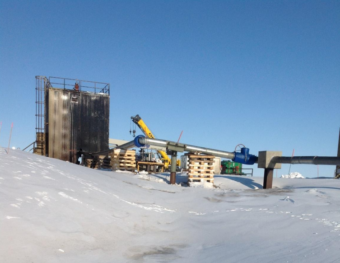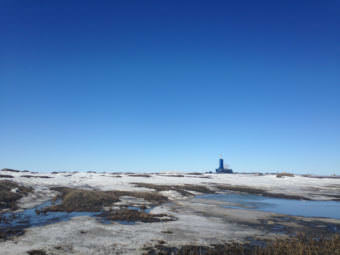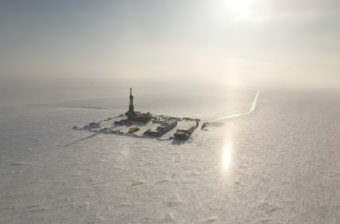
An Armstrong rig on the North Slope. The Denver-based company is selling off a big part of its stake in a promising oil field. (Photo courtesy Armstrong Oil & Gas)
One of the most promising oil discoveries on the North Slope is getting a new owner.
Denver-based Armstrong Energy is selling off a significant chunk of its stake in the Nanushuk oil play to Oil Search, a company based in Papua New Guinea. Oil Search announced Wednesday that it will take over as operator next June.
Estimated at over 1 billion barrels, Nanushuk could be one of the biggest future oil developments in Alaska. It’s on state land west of Prudhoe Bay, near the community of Nuiqsut. If developed, the companies think it could produce up to 120,000 barrels per day — close to a quarter of what’s currently flowing down the trans-Alaska pipeline.
Armstrong is still holding on to a percentage of its ownership in Nanushuk, but Oil Search has the option to buy up all of Armstrong’s stake in the field before next June, according to a presentation the company posted online.
Alison Wolters, an analyst with Wood Mackenzie in Houston, said selling its stake in the oil play isn’t a surprising move from Armstrong.
“It has been Armstrong’s business model to explore, prove up discoveries and then sell them to new operators on the North Slope,” said Wolters.
But Wolters says Oil Search is an unexpected buyer. Oil Search’s biggest investments are in liquefied natural gas projects in its home country.
“They’ve never operated in Alaska before, or on the North Slope, so that definitely took us by surprise,” said Wolters.
The company’s connection to Alaska is through Repsol, a Spanish oil company it partners with in Papua New Guinea, according to a press release announcing the $400 million purchase. Repsol also owns a significant stake in the Nanushuk play.
Oil Search aims to start producing oil by 2023. But because the company is new to the challenges of working in Alaska, Wolters said it could take longer for the oil project to get up and running.
Armstrong has started the permitting process for the Nanushuk project. The U.S. Army Corps of Engineers recently put out a draft Environmental Impact Statement, which is available for public comment until November 14.
Image taken on April 18, 2017, showing the area of light crude spray near BP’s well. (Photo by Jade Gamble, Alaska Department of Environmental Conservation)
BP will likely plug and abandon 13 wells on the North Slope following an accident earlier this year.
That’s according to Cathy Foerster of the Alaska Oil and Gas Conservation Commission. The commission met with BP representatives Thursday for an update on the April incident, during which one of the company’s older wells spewed oil and gas for several days before it could be plugged.
Several months later, BP determined 14 other wells were at risk, five of which were producing oil. Foerster said it’s likely all but one will be shut down for good.
That’s a small number compared to Prudhoe Bay’s roughly 1,800 wells. But state regulators are still making sure BP shares its investigation with other oil companies.
“Anybody that’s got an old well on the North Slope needs to know what the results of their investigation are and look for implications in their fields,” said Foerster.
BP thinks the accident was caused by thawing permafrost deep below the surface, which put uneven stress on the well. Eventually, the well gave out, rising several feet out of the ground and colliding with the top of the well house.
BP hasn’t been calling the incident a “blowout.” Foerster said oil industry engineers wouldn’t call it that because there wasn’t a rig on the well. But, she said, it was definitely an uncontrolled leak
“If that’s how you define it, then yeah, it was a blowout. [But] if you define it in the black-and-white way that engineers tend to define things, no. So it’s semantics. You call it what you call it,” Foerster said. “But what it was was an uncontrolled release of hydrocarbons to the surface, and that’s not a good thing.”
This wasn’t BP’s only accident this year. Last week, Buzzfeed News released documents showing the company forced many employees to halt work for 12 days this month following a series of safety incidents.
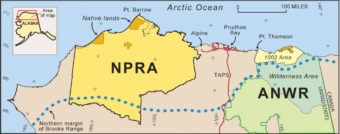
Map of northern Alaska showing location of Arctic National Wildlife Refuge, ANWR-en:1002 area, and the National Petroleum Reserve-Alaska (NPR-A). (Map courtesy USGS)
The Trump administration is making a lot more land in the National Petroleum Reserve-Alaska available for oil exploration this year.
On Wednesday, the Bureau of Land Management announced all 900 tracts set aside for leasing will be up for bid. That compares to just 145 tracts offered last year.
It’s the largest lease sale ever in the National Petroleum Reserve-Alaska, or NPR-A.
In the past, BLM decided which tracts to offer based on industry interest. But this year, Interior Secretary Ryan Zinke signed an order telling BLM to maximize the amount of land available for leasing in the Reserve.
Alaska’s congressional delegation praised the announcement.
“This decision is a testament to our work to spearhead new development and fight back against the status quo that has underserved Alaskan communities and interests for years,” Congressman Don Young said in a statement. “The NPR-A was always intended for development, not to be locked away in perpetuity like the previous administration attempted.”
An environmental group, however, said offering all the leases at once isn’t a good idea.
“Americans should not stand by and allow our public lands to be plundered without restraint,” Nicole Whittington-Evans of the Wilderness Society said in a statement. “We need a thoughtful, careful approach that emphasizes responsible development and recognizes that some places are simply too special to drill.”
Still, just under half of the Indiana-sized Reserve won’t be available at this year’s sale. The Obama administration decided to make that land off-limits to leasing, citing the need to protect important bird and caribou habitat.
The Trump administration is currently reviewing that decision.
The National Petroleum Reserve is seeing a spike in interest from the oil industry. There was a big increase in bids at last year’s BLM lease sale, spurred by a series of major oil discoveries around the northeast part of the Reserve.
This year’s lease sale will be held on December 6.
An oil rig contracting for BP looms on the horizon at Prudhoe Bay this spring. (Photo by Elizabeth Harball, Alaska’s Energy Desk)
An investigation published Friday by Buzzfeed News revealed BP Alaska was responsible for a series of safety incidents on the North Slope this year, some of which put workers at risk.
BP isn’t disputing that the incidents took place. The company has already taken extreme steps to address the issue.

As part of its report, BuzzFeed obtained a recording of Jeff Kilfoyle, health and safety manager for BP Exploration Alaska, talking to workers this September.
“Obviously any gas release is not a good thing. But a gas release of that magnitude inside a structure with people is obviously a major concern to us within Alaska and within the business,” Kilfoyle said. “That’s not a place we want to be.”
Kilfoyle was talking about a previously unreported safety incident that happened on September 10. According to BuzzFeed, two workers were exposed to a gas leak inside a building at one of BP’s drill sites. The workers weren’t injured, but the situation could have led to a deadly explosion. This was one of five spills or leaks — called Tier 1 events — that BP Alaska was responsible for this year, BuzzFeed reports.
It also reports that BP dealt with 27 worker accidents in Alaska as of Sept. 12. Buzzfeed obtained emails showing BP’s leaders were so alarmed by the incidents they forced many of their employees to halt work for the first 12 days of October. BP operates Prudhoe Bay, the biggest oil field in Alaska. All work was halted except operating the field, drilling wells and operations required to meet regulatory and safety standards.
In an email to the company workers, BP Alaska President Janet Weiss said, “I am deeply concerned that with these trends, we are not in a stable state.”
Cathy Foerster, who sits on the Alaska Oil and Gas Conservation Commission, said the incidents described in the report are troubling, but she also thinks BP is taking the right steps to address the situation.
“Of course it’s concerning and you can tell Janet [Weiss] is concerned,” said Foerster. “When you see a trend of either unsafe or un-environmentally sensitive events, then you definitely need to step back and take a time out, take a look at what you’re doing and assess what you need to change. And that’s what BP did.”
Foerster did dispute Buzzfeed’s implication that two of the incidents it described were caused by human error. Foerster said her agency is investigating those incidents and believes they were mechanical failures.
Foerster said because her agency only has jurisdiction over two of the incidents, she couldn’t comment on whether the age of BP’s facilities was a factor.
Richard Sears, a professor of energy resources engineering at Stanford, said the fact that Prudhoe Bay has been online for 40 years could be leading to issues, but that’s likely not the full story.
Sears, who advised the presidential commission that investigated the Deepwater Horizon Oil Spill, thinks BP is right to be worried. But he added that not all five of the leaks outlined in Buzzfeed’s report are equally serious.
“The bottom line: Is BP some kind of a scoundrel because of all this? Not really. Have they possibly let maintenance and good safety practice lapse a little bit in the last few years? That’s very possible,” Sears said. “Does it mean that something really bad is about to happen on the North Slope? I don’t think so. I always think that when a company recognizes they’ve got a problem, that’s the first step, right?”
Lois Epstein of the Wilderness Society said she’s disturbed that the public didn’t know about these incidents before Buzzfeed reported on them.
“There’s a lot of information in this report that says things were going badly for BP, and we didn’t know anything about it — the public didn’t know anything about it,” Epstein said.
In response to the report, BP sent Alaska’s Energy Desk the same written statement it sent to Buzzfeed. According to the statement, safety and protecting the environment are the company’s “top priorities,” and its pipeline assurance program performs close to 300,000 inspections each year.
“BP reports all incidents in accordance with state and federal laws, including two natural gas releases earlier this year at a Prudhoe Bay drill site and Flow Station 3,” spokeswoman Dawn Patience said in the written statement. “While the goal is to have no releases, both of these incidents occurred during planned maintenance and were halted quickly, and neither resulted in injury to workers or impact to the surrounding environment.”
Commissioner Hladick will take over at EPA Region 10 in December. (Photo courtesy Alaska Governor’s Office)
A member of Governor Bill Walker’s cabinet is taking a key position at the Environmental Protection Agency.
The agency confirmed Tuesday that Chris Hladick will become the regional administrator overseeing EPA’s work in Alaska, Idaho, Oregon and Washington.
Hladick is currently commissioner for the department of Commerce, Community and Economic Development. The Walker administration announced that Hladick will step down from that post on November 1. He will take the reins at EPA Region 10 in December.
Before joining Walker’s cabinet, Hladick spent over two decades working for communities in rural Alaska. He was city manager for Dillingham, Unalaska and Galena.
While Hladick was Unalaska’s city manager, he was involved in reaching a settlement with EPA related to Clean Water Act violations from its wastewater treatment facility.
At EPA, Hladick will oversee regulation of a wide range of activities in the Northwest — from superfund sites to the proposed Pebble Mine.
Walker announced that outgoing Kenai Peninsula Borough Mayor Mike Navarre will take Hladick’s place.
EPA officials traveled from Washington, D.C. to Iliamna to hear local input on EPA’s recent settlement with Pebble (Photo by Elizabeth Harball/Alaska’s Energy Desk)
The Environmental Protection Agency was in the remote community of Iliamna on Thursday for the second of two public hearings on whether the agency should roll back its Obama-era proposal to impose restrictions on the Pebble Mine.
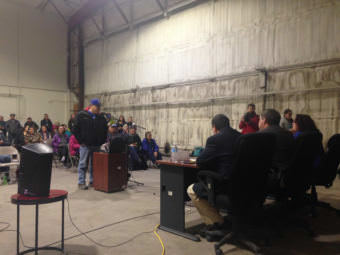
Despite pouring rain, over 50 Alaskans from across the region filled seats in the Old Crowley Hangar at the Iliamna Airport and spoke directly to EPA officials.
Unlike the hearing the day before in Dillingham — where public input was unanimously against the proposed Pebble Mine and EPA’s new course — the reaction in Iliamna was more mixed.
Representatives from Pebble Limited Partnership and the Alaska Miners Association spoke in favor of pulling back from imposing Clean Water Act restrictions on the mine. Several local residents also spoke in support of EPA’s new course, saying they hope for more job opportunities in the region.
That included Iliamna resident Margie Olympic, who has been employed by Pebble for 11 years.
“I take pride from where I come from and what I was taught growing up,” Olympic said. “But I also know the value of having a job and supporting my family at this age. Fishing does not and could not support me and my family 12 months out of the year.”
Olympic and others urged EPA to allow the project to begin the normal permitting process.
But many speakers criticized EPA for considering rolling back the restrictions, voicing fears about the mine’s potential impact on the Bristol Bay salmon fishery.
“The only true economy with longevity is a renewable economy, and we have that,” Everett Thompson, a commercial fisherman from Naknek, told EPA officials. “It is scary to keep investing into the fishery with an ever-looming threat of Pebble Mine. Please do what is right, do not withdraw your Clean Water Act proposed determination.”
Several speakers also criticized EPA administrator Scott Pruitt for making the decision to settle with the Pebble Limited Partnership this spring without public input from local communities.
“I’ve been involved in the Pebble debate since longer than I care to remember,” said Nanci Morris-Lyon, who owns a sport fishing business near King Salmon. “Since the debate began, I have raised a daughter. She became a full-time fly-fishing guide this summer….These things take a very long time. Much longer than it took Director Pruitt to decide that all the time we committed to scientific study proving why Pebble Mine should not happen in Bristol Bay was not worth reviewing.”
EPA will take comment on its proposal until October 17.
Close
Update notification options
Subscribe to notifications
Subscribe
Get notifications about news related to the topics you care about. You can unsubscribe anytime.