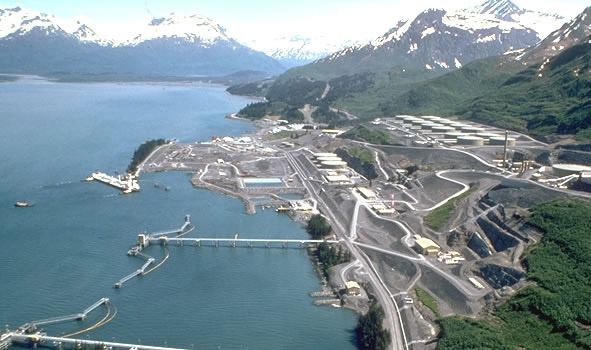
Alyeska Pipeline Service Company is investigating the cause of a spill at the Valdez Marine Terminal. (Photo courtesy U.S. Department of Interior)
The operator of the trans-Alaska pipeline is reporting an oil spill at the Marine Terminal in Valdez.
Alyeska Pipeline Service Company estimates the volume of crude oil spilled to be less than 100 gallons.
Crews reported seeing a sheen on the water late Thursday morning. The spill is not ongoing.
According to Alyeska, the spill happened during yearly maintenance testing of the loading arms at Berth 5.
“During a pause in the testing, oily test water flowed back through hose and piping related to the maintenance, out of the fire system salt water intake piping, and into Port Valdez,” Michelle Egan, a spokeswoman for Alyeska, said in an email.
The spill area has been boomed and teams are skimming the water to try to recover the oil.
Alyeska reports there have been no impacts to wildlife or injuries associated with the incident.
A spokeswoman with the Prince William Sound Regional Citizens’ Advisory Council said her group is monitoring the response to the spill, along with the state Department of Environmental Conservation and the Coast Guard.
On Friday, the Department of Environmental Conservation said it was conducting an overflight to assess the situation.
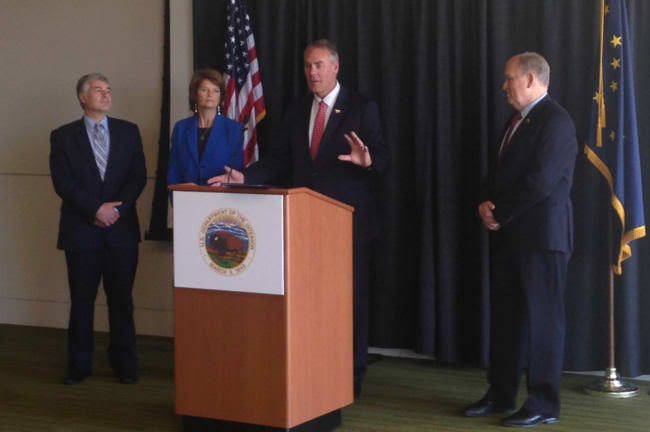
Vincent DeVito (far left) advises Interior Secretary Ryan Zinke (center) on energy issues. In May, Zinke announced he is seeking a new assessment of the Arctic Refuge’s oil potential. (photo by Elizabeth Harball/Alaska’s Energy Desk)
During a speech in Anchorage today, a top Interior Department official said kick-starting oil development in the Arctic National Wildlife Refuge, or ANWR, is a priority for the Trump administration.
“The untapped potential of ANWR is significant. But it is the Trump administration that had the guts to step up to the plate and facilitate production,” Vincent DeVito, the Interior Department’s Counselor for Energy Policy, told a conference for ocean researchers in Anchorage today.
DeVito occupies a new post created by the Trump Administration, advising Interior Secretary Ryan Zinke on developing oil and other resources from federal land and waters.
Last week, the Washington Post reported the Trump administration is pushing to allow seismic testing in the Arctic Refuge. Seismic testing would provide new information on where and how much oil is in the Refuge.
After his speech, DeVito told reporters he thinks the Interior Secretary is on firm legal footing as he pursues a new assessment of the Refuge’s oil potential.
“I’m confident that everything that the Secretary decides can withstand a legal challenge,” DeVito said.
If the Trump administration is challenged in court, it wouldn’t be the first legal battle over the issue. The state of Alaska unsuccessfully sued the Obama administration to allow seismic testing in the Refuge in 2014.
In his speech, DeVito also talked about increasing oil development in a different swath of federal land in the Arctic — the National Petroleum Reserve-Alaska, or NPR-A.
“It is time to use NPR-A how it was originally intended to be used,” DeVito said. “This is land that is supposed to be used for oil production. But many politicians — not Secretary Zinke — and exuberant interest groups basically took it offline.”
Today, just under half of NPR-A is off-limits to oil leasing, but the Trump administration is now reviewing that policy. Environmental groups argue that parts of the Reserve should remain off-limits because they contain critical wildlife habitat.
Correction: An earlier version of this story said “over half” of NPR-A is currently off limits to oil leasing. It is, in fact, just under half.
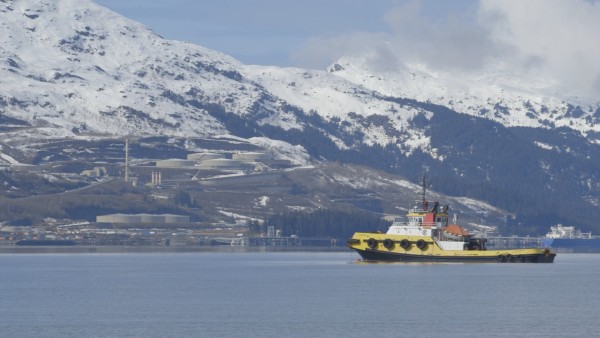
Crowley Marine Services will be turning over its contract to provide oil tanker escorts and spill response and prevention in Prince William Sound next year to Louisiana-based Edison Chouest. (Photo by Eric Keto/APRN)
Next year, a whole new fleet of tugboats and barges will arrive in Prince William Sound with a big responsibility: to prevent another oil spill like the Exxon Valdez in 1989.
But vessels aren’t the only new element arriving next year. At a meeting held last week, the official citizens’ oil spill watchdog group for Prince William Sound raised concerns about how new crews manning the vessels will be trained.
Louisiana-based Edison Chouest Offshore will soon replace Crowley Marine Services as the contractor providing the tugboats, equipment and people ensuring oil tankers move through Prince William Sound safely.
Alyeska Pipeline Service Company, which operates the trans-Alaska pipeline and opted to make the switch to Edison Chouest last year, has already faced pointed questions. Those questions came from state regulators and the Prince William Sound Regional Citizens’ Advisory Council, a watchdog group created by Congress in the wake of the Exxon Valdez spill. Earlier this year, the council commissioned a report that raised concerns about the vessels’ design.
At the Whittier meeting, council members who visited Louisiana to see the new tugs being built said they were impressed.
“I’m not putting on my Edison Chouest hat now, but I do believe these are going to be some good boats,” said Jim Herbert, who sits on the council’s Oil Spill Prevention and Response Committee.
But Brooke Taylor, a spokeswoman for the council, said they’re still waiting on more testing and modeling to see if all their concerns can be put to rest.
Beyond how the tugboats are built, Taylor said a big focus going forward will be making sure new crews are properly trained.
“That questionable factor is always going to be people,” said Taylor. “If they’re not properly trained, if they are not accustomed to a new environment, then you’re going to have a weak link in the system and that’s where most accidents are going to be triggered from.”
But what does proper training look like? Last week, the board discussed a report it commissioned concluding that new crews and equipment should be put to the test in “90th percentile conditions.” In Prince William Sound, the report says that means 22-knot winds and/or 12-foot seas.
The council hasn’t officially decided to back the report’s conclusions. But in 2003, it took the position that if it’s unsafe to train in weather conditions past a certain extreme, Alyeska shouldn’t operate in those conditions. During last week’s meeting, council member Amanda Bauer said she stands by that position.
“I don’t feel personally it’s too much to ask if you’re going to make your money in it, then you need to prove that you can prevent it,” said Bauer.
But Mike Day with Alyeska, who is managing the transition, said training in the more extreme conditions outlined in the report isn’t a good idea because it could put crews at risk.
“We believe that it’s not critical or necessary to train in storms in order to be prepared to operate in storms,” said Day. “We believe we’ve proven that we can do training in — certainly not calm conditions but somewhere in the middle…where folks are comfortable and not put at undue risk, where they develop the skills and the procedures and the techniques and the process to perform these tasks in much worse conditions.”
New tugboats are expected to arrive in Prince William Sound in early 2018. Training for new crew members is expected to begin as early as next month.
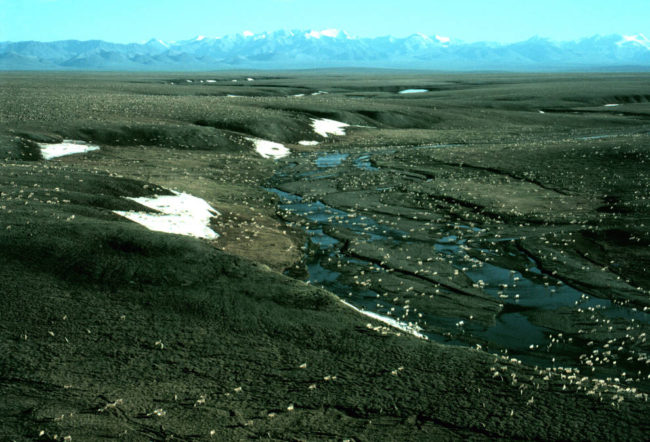
The Porcupine Caribou herd in the Arctic National Wildlife Refuge’s coastal plain. (Photo courtesy U.S. Fish and Wildlife Service)
The Washington Post is reporting that the Trump administration is trying to allow more in-depth studies of the Arctic National Wildlife Refuge’s oil potential.
According to a memo obtained by the Post, the acting director of the U.S. Fish and Wildlife Service is working to update a rule that now bars seismic testing in the refuge.
Seismic testing would give geologists a more accurate sense of how much oil is present, and where.
Currently, it’s estimated there’s somewhere between 4.3 and 11.8 billion barrels of oil in the refuge’s coastal plain, also referred to as the 1002 area. Environmental groups have long fought to keep drilling out of the area.
In 2014, the state of Alaska sued Interior to allow oil exploration in the refuge. That lawsuit was unsuccessful.
Any final decision that would allow companies to drill for oil in the refuge must be made by Congress.
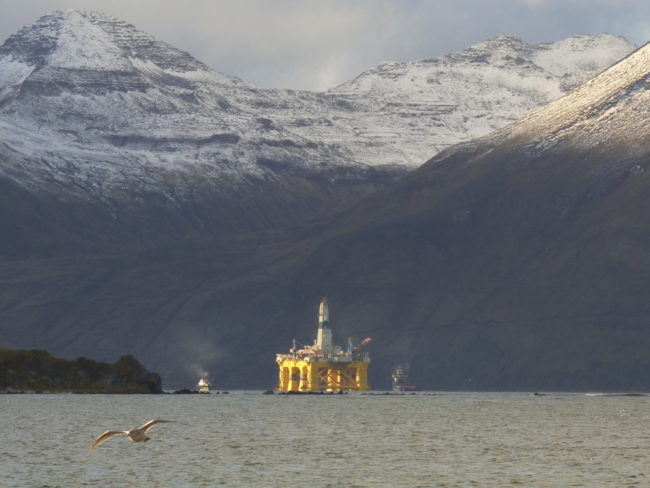
Shell rig leaving Dutch Harbor in October 2015. Shell may have abandoned its efforts to drill in Arctic federal waters, but two other companies are still moving forward with plans to do so. (Photo by John Ryan/KUCB)
Efforts to drill for oil in the Arctic Ocean put Alaska at the center of an international debate. It’s a highly political topic, one both former President Barack Obama and President Donald Trump weighed in on. And to this day, there hasn’t been any oil produced from Arctic waters solely owned by the federal government.
So today, when it comes to drilling for oil in Alaska’s Arctic Ocean, you’d be forgiven for thinking not a lot is happening.
Yes, Shell’s multi-billion dollar effort to find oil in federal Arctic waters is a thing of the past. And yes, the Obama administration then took several steps to cut back on drilling in Arctic waters — actions the Trump administration is now working to undo.
But it turns out there is movement to get oil out of federally-owned parts of the Arctic Ocean. It’s happening slowly, steadily and without a lot of fanfare. Two companies’ efforts to drill for oil in the Beaufort Sea are chugging forward and, at least for now, they’ve largely avoided the national spotlight.
First, the federal Bureau of Ocean Energy Management is reviewing the Texas-based Hilcorp’s Liberty project. The plan calls for producing oil from a man-made, gravel island east of Prudhoe Bay as early as 2020.
The other project, led by Italian company Eni, is at an earlier stage. Eni is working to get the final go-ahead to explore for oil west of Prudhoe this winter, using a gravel island in state waters. They aim to drill thousands of feet down and then tens of thousands of feet horizontally to the north, to see if there’s any oil worth recovering.
Farthest from the finish line, but still of note, is Arctic Slope Regional Corporation. The Native corporation acquired federal leases from Shell late last year, and is now asking the federal government for approval to extend the leases, which are set to expire this year.
Both Eni and Hilcorp had their leases before the Obama administration limited Arctic development, so they’ve slipped past the influence of both Obama’s and Trump’s executive pens.
Another reason the two projects are happening below the national radar? Jim Kendall, regional director for the Bureau of Ocean Energy Management in Alaska, says in many ways, they don’t compare to Shell’s massive Arctic undertaking.
“It’s kind of apples and oranges,” said Kendall.
Shell’s exploration was 70 miles from shore and in waters around 170 feet deep. Hilcorp and Eni’s operations would be closer to land and pipelines, in waters not a lot deeper than an Olympic diving pool.
“And maybe that’s why it just hasn’t caught a lot of attention. I mean — it’s another gravel island, it’s been done before. It’s close to shore; it’s not 70 miles offshore,” said Kendall.
When Kendall said ‘it’s been done before,’ he was referring to a handful of existing man-made gravel islands in the Arctic Ocean companies are already drilling from. The key detail, though, is that these islands are in state waters. If it gets the final go-ahead, Hilcorp’s Liberty Project would be the first to produce oil in solely federally-owned Arctic waters.
It sounds like a big deal — and it is — but Hilcorp also wants to hit home the message that they’re not doing something completely new. In Alaska, the company faces an extra level of public scrutiny after safety incidents like a gas leak from one of its fuel lines in Cook Inlet this spring.
Mike Dunn, Hilcorp’s project manager for Liberty, argued the drilling plan isn’t especially risky.
“From our perspective it’s — I won’t say it’s simple. But it’s been done often enough where we don’t have to come up with some new technology,” said Dunn. “A lot of folks before us have figured this out.”
Michael LeVine, senior Arctic fellow with the Ocean Conservancy in Juneau, acknowledged that compared to what Shell was trying to do, the risks for Hilcorp and Eni’s projects are at least better understood. But, LeVine said, any drilling in Arctic waters is worth paying close attention to.
“They’re still massive industrial undertakings in a risky and remote place,” LeVine said.
But do these projects mean there’s still a promising future for oil drilling in Arctic waters? Oil industry supporters hope so. But beyond politics, Kendall said there are larger forces that have a big influence on that future: oil prices and climate change.
“If we have a longer drilling season, less ice, for some reason oil prices go up again. Then, of course, the market changes,” said Kendall. “And then industry, they have to decide what they would like to pursue.”
Kendall said it’s too early to say if the Eni and Hilcorp projects herald the triumphant return of big-time oil development in the Arctic Ocean.
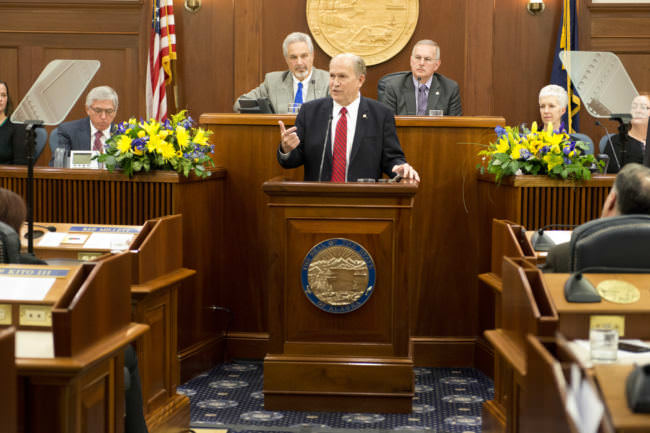
Gov. Bill Walker delivers his State of the State address to the legislature in January 2017. Walker says he won’t be asking lawmakers for more funding for the gas line project. (Photo courtesy Alaska Governor’s Office)
During a Thursday speech to the Resource Development Council in Anchorage, Gov. Bill Walker addressed the status of the Alaska LNG megaproject, a state-led plan to build an 800-mile pipeline to carry gas from the North Slope.
Over the last year, the state has focused on finding buyers. Although no firm agreements have been announced, Walker said he’s encouraged by conversations he’s had with leaders of potential markets like China and South Korea.
But the governor also said he’s not likely to ask the legislature for more money for the project once current funding dries up.
“I don’t allow myself to get optimistic anymore – I’m hopeful, and I am hopeful,” Walker said. “But can we continue on after this funding? I’m doubtful, quite honestly.”
Currently, the state corporation charged with a gasline project is working through a $102 million budget to pursue a gas line; that’s supposed to last through the next fiscal year.
Walker also lauded the Trump administration’s support for oil and gas development in Alaska. The governor said he’s discussed ways to allow drilling in the Arctic Refuge’s 1002 area, or coastal plain, with Interior Secretary Ryan Zinke. Walker also said that during a meeting several months ago, President Donald Trump brought up the proposed Izembek road as a priority.
“Before I could start talking about anything, he immediately brought up the Izembek road,” Walker said. “The President said, ‘we need to build that road. I’ve been talking to Secretary Zinke, we’re going to make sure we build that road.’ I mean, talk about a new day — it’s a new day.”
The Obama administration rejected plans to build a road through Izembek National Wildlife Refuge, citing impacts to habitat. But many Alaska leaders say King Cove residents need the 11-mile road built to nearby Cold Bay for emergency evacuations.
Close
Update notification options
Subscribe to notifications
Subscribe
Get notifications about news related to the topics you care about. You can unsubscribe anytime.