Elizabeth Harball, Alaska's Energy Desk

Effort to recall Gov. Mike Dunleavy working to coalesce around legal grounds

Meda DeWitt, who is volunteering as a spokesperson for the recall effort, speaks to the crowd at the Writer’s Block bookstore in Anchorage on July 15, 2019. (Photo by Elizabeth Harball/Alaska Public Media)

A group of about 100 Alaskans unhappy with Gov. Mike Dunleavy met at an Anchorage bookstore Monday to discuss launching a recall campaign.

“There’s a lot of remorse — buyer’s remorse,” Meda DeWitt, a spokesperson for the effort, said before the event.

The event was originally intended to kick off the signature-gathering effort, which is being organized by a group now calling themselves “Recall Michael J. Dunleavy.”

But organizers put the official recall launch on hold until Aug. 1, due to “overwhelming public interest,” according to the press release. And according to co-organizer Nathaniel Markowitz, they need more time to legally vet the statement in the application describing why they want a recall, which is limited to 200 words.

“We have no doubt that this is going to result in a legal fight, so it’s a matter of winnowing that statement of grounds down to our strongest 200 words,” Markowitz said.

DeWitt said there is also the matter of coming to a consensus.

“Now that we’ve come out in the public, there’s other recall efforts around the state who are coming forward as well, who, as we’re coming together as a group, would like to review it,” DeWitt said.

Under Alaska statute, the grounds for a recall are lack of fitness, incompetence, neglect of duties or corruption.

At the event, organizers said the governor’s budget vetoes are not the sole reason they want to pursue a recall. But the vetoes were cited repeatedly.

“This is a ruinous, economically devastating set of vetoes that this governor has handed down,” Mike Mason, another one of the co-organizers, told the crowd.

A political action committee called Future North registered with the state in February and is backing the recall effort. Its fundraising website reports raising about $6,900.

Aside from needing a solid legal case, organizers must jump through several more hoops before a recall can move forward.

To apply, they must collect 28,501 signatures, or 10% of the number of voters in the last general election. To actually hold a recall, they would then need signatures from 25% of the number of voters in the last general election — that’s 71,252 signatures.

Rep. Harriet Drummond, D-Anchorage. (Photo by Skip Gray/360 North)

Democratic Rep. Harriet Drummond, from Anchorage, attended the event and said she was planning on signing on.

“It’s so frustrating because we’re back to square one, we’re back to where we were on Feb. 13 when he presented his budget for the first time,” Drummond said.

Drummond did not say that she and and other Alaska lawmakers opposed to Dunleavy were discussing assisting the recall effort.

“I haven’t really talked with colleagues about it, but I wouldn’t be surprised if most of them signed up” she said.

‘Who are the 100?’ If budget vetoes stand, Anchorage shelter says it must choose who stays and who leaves.

Brother Francis Shelter near downtown Anchorage. (Photo By Anne Hillman/Alaska Public Media)

On Wednesday, a few hours before the Alaska Legislature’s vote to override Gov. Mike Dunleavy’s budget vetoes would fail, Catholic Social Services executive director Lisa Aquino was all smiles as she greeted volunteers at the St. Francis House Food Pantry in Anchorage.

But alone in a conference room upstairs, it was clear that this was not a good day.

“I don’t have a lot of hope,” Aquino said. “There’s just a real impasse, and I don’t know what our chances are.”

As prospects for a veto override look increasingly slim, organizations that provide aid to low-income, homeless and other needy Alaskans say they have already had to make tough choices. But some of the choices ahead, they say, will be even more difficult.

Catholic Social Services runs Brother Francis Shelter — the biggest homeless shelter for adults in the state — and Clare House, a shelter for women and children. Both face significant funding reductions under the governor’s budget vetoes.

For example, Clare House could lose close to $200,000 in grants. Aquino said that probably means the shelter will only be able to open its doors at night.

“Instead of letting our moms and their children stay in the shelter all day and night, they would need to leave every day,” Aquino said.

Lisa Aquino, executive director of Catholic Social Services
Catholic Social Services executive director Lisa Aquino in the storage area of the St. Francis House Food Pantry. (Photo by Elizabeth Harball/Alaska Public Media)

“So there will be new moms, and moms with little toddlers, out in front of the library waiting for it to open at 10, because there’s nowhere else they can go,” she said. “To me that’s just … it’s monstrous. These are children, and they shouldn’t be outside.”

Dunleavy’s budget vetoed millions in funding that goes to serve Alaska’s needy, including $1.4 million from Human Services Community Matching Grants and $7.2 million from the Alaska Housing Finance Corporation’s homeless assistance program.

Catholic Social Services projects that without state funding for their services alone, homelessness in Anchorage could increase by 48%. In total, the Anchorage Coalition to End Homelessness predicts close to 800 more homeless individuals in Alaska’s biggest city will go without shelter.

In addition to the impact on shelters, Aquino said she is concerned about the reduction in funding for case management services, which help people transition from homelessness to permanent housing.

For many, she said, “that ladder up, that foothold to take that next step, that’s gone with these cuts.”

Other organizations that aid Anchorage’s homeless population are also looking at making drastic changes. Rural Alaska Community Action Program CEO Patrick Anderson said that if the Legislature fails to override the budget vetoes, two supportive housing facilities in Anchorage — Safe Harbor Muldoon and Sitka Place — “absolutely” will have to entirely close their doors.

Anderson said he doesn’t know where the people living there now will go.

“We don’t have the resources to be able to find them alternate housing. In fact, they’re with us because there was no alternate housing for them,” he said.

Anderson said this will impact about 350 people, including families and individuals with mental illnesses.

“We have hundreds of people who have made it off of the street despite their circumstances,” Anderson said. “It is distressing that instead of moving forward, all of a sudden, we are dealing with this huge step backwards.”

Gov. Mike Dunleavy’s Press Secretary Matt Shuckerow answers reporters' questions after a briefing in the governor’s cabinet room in the Capitol in Juneau on March 21, 2019.
Gov. Mike Dunleavy’s Press Secretary Matt Shuckerow answers reporters’ questions after a briefing in the governor’s cabinet room in the Capitol in Juneau on March 21, 2019. (Photo by Skip Gray/360 North)

Matt Shuckerow, Dunleavy’s press secretary, said he recognizes that some of the programs facing cuts have had “meaningful impacts.”

“A lot of times, this isn’t solely an evaluation of whether a program has been successful,” Shuckerow said.

But he maintained the vetoes are vital to addressing the state’s deficit.

“Part of that is evaluating what falls under a core service of the government,” Shuckerow said. “The governor in his office had to make tough decisions based on the fiscal reality that we have today.”

At Catholic Social Services, Aquino said they, too, are making tough decisions.

She said the organization has known for a while what the changes could be, like reducing the number of beds available at Brother Francis, the homeless shelter for adults.

“But now we’re in the point where we are trying to make those real. So having these discussions of, how do you go from 240 to 100 at Brother Francis Shelter?

“Who are the 100? I don’t know,” Aquino said.

Aquino said she has reached out to the governor’s office multiple times and hasn’t heard back. But she said she’s happy to take a call any time.

In Arctic Village, Gwich’in leaders say the fight to stop drilling in the Arctic Refuge isn’t over

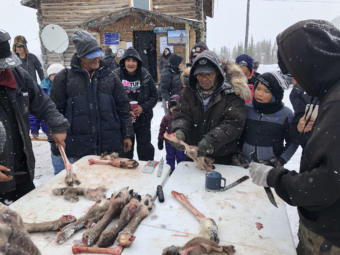
Arctic Village residents and visitors gather for a caribou leg skinning contest during the community’s annual spring carnival in April. (Photo by Elizabeth Harball/Alaska’s Energy Desk)

One thing lies at the heart of Gwich’in tribes’ opposition to oil development in the Arctic National Wildlife Refuge: caribou.

At Arctic Village’s annual spring carnival in April, men gathered around a plastic folding table for a contest to see who could skin a caribou leg the fastest. Their knives worked swiftly from knee to cloven hoof, hands tugging meat, tendon and hide from bone.

Second place went to David Smith Jr., 22. Smith is a leader — the second chief — in Arctic Village. And like most everyone here, Smith believes oil development in the refuge that borders their tribal lands will endanger the caribou his people hunt.

“And that’s going to change our very lifestyle,” Smith said. “The reason we’re here is for the caribou.”

Until recently, the residents of 15 Gwich’in villages scattered across northeast Alaska and northwest Canada were on the winning side of the drawn-out political battle in Washington, D.C., over oil development in the refuge. They helped fight repeated attempts in Congress to legalize drilling in the refuge’s 1.6 million-acre coastal plain.

Then, in late 2017, Congress opened the coastal plain to oil development. So Gwich’in tribes are now taking unprecedented steps to try to protect a resource they call vital to their culture and survival.
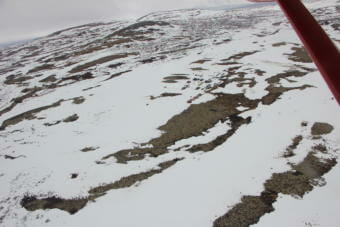
Caribou are a primary source of subsistence food in Arctic Village — more than that, they’re part of the tribes’ cultural identity. And today, some 200,000 caribou in the Porcupine herd travel past Arctic Village and other Gwich’in communities every year.

Smith said the caribou they harvest allow Arctic Village residents to continue their traditional way of life, on their traditional land.

“I would say this is like no other place on earth, so we shouldn’t be treated like any other place on earth,” Smith said. “I can drive in any direction and hunt freely. I can drive in any direction and go trapping.”

David Smith Jr. is the second tribal chief of Arctic Village. Smith, who opposes drilling in the refuge, doesn’t think the fight is over: “I believe everything is going to come out on top for us,” he said. (Photo by Elizabeth Harball/Alaska’s Energy Desk)

Smith, like many other Gwich’in leaders, hasn’t given up on the idea of blocking drilling in the refuge. He recalled a story he heard at a recent meeting, about a prediction made by an Elder in years past:

“They said, ‘Later on in the future, there’s going to be a war between the south and the north — the south being the U.S. government, and us being the north. It’s going to be a war of paper, not of weapons.’ And they said, ‘As long as we stick through, the north will always win.’”

Pro-drilling Alaskans often point out that Arctic Village and the area set aside for oil exploration are separated by about 100 miles and a mountain range. The Gwich’in say their link to the place is the caribou, because the Porcupine herd gives birth in same part of the refuge where drilling is now legal.

Scientists say predicting exactly how oil development will affect the caribou herd’s population or migration patterns is tricky. It’s not yet known what future oil development in the refuge may look like, in terms of size, location or design. And in other parts of Alaska’s Arctic, calving caribou were able to shift their movements away from oil infrastructure and still access similar habitats.

But the calving area in the refuge is narrower, hemmed in by a mountain range and the Arctic Ocean, so some biologists worry the impacts will be greater.

In Arctic Village, those fears are more acute. As she bounced a relative’s baby on her lap, village council member Faith Gemmill said when Congress legalized drilling in the refuge in 2017, it shifted the ground beneath the Gwich’in — and galvanized them, too.

“It’s put our tribe in the position of defense. And we have to work hard – harder than we’ve worked before to try to defeat that,” Gemmill said.

This led to an historic shift. For decades, engagement on the issue of oil development in the refuge was led by the Gwich’in Steering Committee, a nonprofit with members from each of the Gwich’in villages in Alaska and Canada.

Faith Gemmill, a member of the Arctic Village council, looks after a relative’s baby during the community’s annual spring carnival. Gemmill says Congress’ vote to legalize drilling in the Arctic Refuge in 2017 “put our tribe in the position of defense.” (Photo by Elizabeth Harball/Alaska’s Energy Desk)

But now that the federal government is advancing the formal process to open the refuge to oil leasing, the Gwich’in people’s tribal governments have asserted their legal right to be directly involved in that process. Those are separate entities from the steering committee — Arctic Village has its own tribal government, for example, as does the village of Venetie.

Each of those tribal governments are now having regular meetings about the oil leasing plans with the Bureau of Land Management and top Trump administration officials.

But Matt Newman, an attorney with the Native American Rights Fund who represents the tribes, said there are limits to their ability to influence Trump administration policy.

“No one has any blinders on, or any illusions,” Newman said. “There’s no secret that they wish to see oil drilling and this environmental review process completed. On the flip side, the tribes are equally open about the fact that they oppose it.”

Additionally, while some Alaska Native corporations stand to benefit financially from drilling in the refuge, the way the Gwich’in see it, they have nothing to gain, and everything to lose. Gwich’in tribes in Alaska refused to participate in the Alaska Native Claims Settlement Act of 1971, in favor of maintaining ownership of 1.8 million acres of their traditional land. It’s a choice they’re still proud of.

Newman put it this way:

“Even if the state or the federal government somehow said, ‘One percent of oil royalties from the refuge will go to an account for Venetie and Arctic Village,’ that money is going to sit untouched until kingdom come,” Newman said. “Because for the people in these villages, this isn’t about money.”

In addition to the government-to-government process, the Gwich’in continue pushing back every other way they can. Gwich’in activists maintain strong alliances with environmental groups, they give interviews to reporters from all over the world and they regularly make their case before Congress in Washington, D.C., as Arctic Village’s first chief, Galen Gilbert, did in March:

“Development in the coastal plain is a direct attack on our Gwich’in culture. Just the idea of development is causing stress and fear in my village,” Gilbert told a House committee.

This stance has drawn ire from many in Alaska.

“I’ll tell you Mr. Chairman, I want to believe the people. Not the Gwich’in, because they’re not the people. They’re 400 miles away,” Republican U.S. Rep. Don Young said at the same hearing.

Young repeated things often said about the Gwich’in. He accused them of protesting against oil development as a way to make a living, and of stealing the national narrative from other Alaska Native people. Young blasted the introduction of a bill to restore protections to the coastal plain, which made no mention of the Iñupiat people who live in the Refuge — many of whom do support drilling.

Such arguments have been going back and forth for decades. But as drilling moves closer to reality, the edges have gotten sharper.

“Think about that when you say, ‘We want to save the culture,’” Young said, addressing the other members of the committee. “Save the culture of the people! Not those that are foreigners or living away from the area. These are not the Natives directly affected.”

This year’s spring carnival in Arctic Village could be the last before oil companies bid on leases in the Refuge. Still, there were many moments of joy. One evening, families gathered at the community hall for a dance.

Gilbert, the first chief, was there with his family, wearing a baseball cap and occasionally making his way to the dance floor — a very different scene than the month before, when he testified before members of congress. In an interview later that night, Gilbert said being part of the Arctic Refuge controversy is part of being a Gwich’in leader.

Galen Gilbert, first chief of the Arctic Village Council, said even if he wasn’t a leader, he would work to fight oil development in the Arctic Refuge. (Photo by Elizabeth Harball/Alaska’s Energy Desk)

But Gilbert added, “Even if I wasn’t chief, if I had the opportunity to fight against it I would do it — totally.”

Gilbert said while he was in Washington, D.C., to testify, it was hard for him to listen to arguments from oil development supporters.

“I hate it when people say, ‘The caribou will be all right, even if they did open it.’ I heard that multiple times,” Gilbert said. “You know, ‘They’ll be OK.’ No!”

Gilbert has three young daughters. He said they’re growing up the way he did, witnessing caribou wandering near their home.

“I wouldn’t want to lose that,” he said. “Never.”

Read and listen to more stories from our series The Future of the Arctic Refuge: Riches or Ruin?

Rep. Don Young files for reelection once again

Republican Rep. Don Young, Alaska
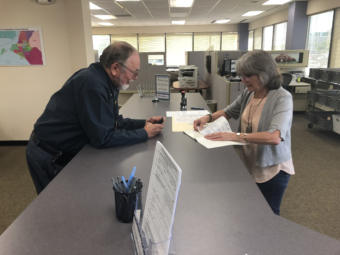
Republican Rep. Don Young, Alaska’s sole congressman, files for re-election at the Division of Elections in Anchorage on June 28, 2019. (Photo by Elizabeth Harball/Alaska’s Energy Desk)

Congressman Don Young, the longest currently serving member of the House of Representatives and the longest-serving Republican in House history, on Friday filed for reelection.

Young turned 86 last month. If reelected in 2020, it would be his 25th term.

Young arrived at the Alaska Division of Elections office in Anchorage with his wife, Anne Garland Walton.

While submitting his paperwork, Young said he was filing to make it clear he is running once again.

“Unless you file, you always have the rumors going around, ‘he’s not running again,’ and I’m not going to tolerate rumors about me not running,” Young said. “I’m going to be running hard in this campaign.”

Young noted many members of Congress “are from urbanized areas which have little knowledge of what faces Alaska — the diversity, the size, the culture, the topography.”

“I want to be there, and try to make sure Alaska is not abused,” Young said, citing “overzealous government agencies or interest groups.”

In the 2018 election, Young beat independent challenger Alyse Galvin with 53 percent of the vote.

Pebble CEO and opponent debate whether mine proposal is ‘the nose under the camel’s tent’

A base camp at the site of the proposed Pebble Mine. (Photo by Isabelle Ross/KDLG)

The CEO of the Pebble Limited Partnership and a prominent Pebble opponent today debated a key point of contention about the proposed mine: its size.
The federal Army Corps of Engineers is currently reviewing Pebble’s most recent mine plan. The company argues this plan is smaller than earlier proposals and better designed to protect the Bristol Bay region’s salmon fishery.

During Alaska Public Media’s weekly call-in show “Talk of Alaska,” former Alaska state Sen. Rick Halford raised a concern shared by many in the anti-Pebble camp — that the new mine proposal is only the beginning.

“You can’t expect stockholders to fund digging a hole halfway down and then refilling the hole and not develop the resource that they have under claim. It is not a reasonable expectation,” Halford said.

In its application, Pebble says it plans to mine 1.4 billion tons of material over 20 years, although it’s estimated that there is much more copper, gold and molybdenum that could potentially be mined in the deposit.

On the show, Pebble CEO Tom Collier said the company currently doesn’t have plans to expand. Collier said before the mine could get bigger, it would have to go through an additional permitting process.

“When the major complaint now about the proposal that Pebble has put forward is that it is ‘the nose under the camel’s tent’ and there may be more coming along, that’s the same thing as saying there really isn’t anything wrong with the current proposal,” Collier said.

The full exchange can be heard on the June 25, 2019, edition of “Talk of Alaska.”

Reached after the call-in show, Halford said he still opposes Pebble’s current proposal, arguing it remains a large project in the same region as the most valuable salmon fishery of its kind in the world.

The Army Corps’ public comment period on Pebble’s proposal ends July 1.

Planning for 2019 NPR-A oil lease sale begins as feds pursue opening more Arctic land to drilling

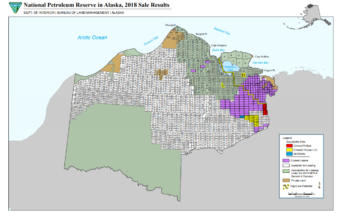
Map of 2018’s oil lease sale results for the National Petroleum Reserve-Alaska. (Map courtesy Bureau of Land Management)

The federal government is issuing its annual request for public input on what land should be available for oil leasing in the National Petroleum Reserve-Alaska.

Led by ConocoPhillips, there are a growing number of oil projects in the federally managed chunk of the western North Slope. Roughly 1.6 million acres of the 22-million acre reserve are leased, according to the Bureau of Land Management, which oversees the area.

But the last two oil lease sales in the reserve didn’t generate much interest.

The U.S. Interior Department is re-evaluating the management plan for the reserve, aiming to open up land that’s currently off-limits to oil leasing.

Some of that land is thought to have high oil potential. But environmental groups are worried because the land overlaps with valuable habitat for migratory birds and other species — namely, the area around Teshekpuk Lake.

This year’s oil lease sale for the reserve will be limited to the acreage that is currently available. The Bureau of Land Management is accepting public comments until July 22.

But another federally managed area slated for oil leasing this year is likely to get a lot more attention.

The Trump administration aims to hold the first oil lease sale for land in the Arctic National Wildlife Refuge before the end of 2019.

Site notifications
Update notification options
Subscribe to notifications