Alcohol & Substance Abuse

Alaska’s first on-site addiction treatment for those who overdose launches with pilot programs

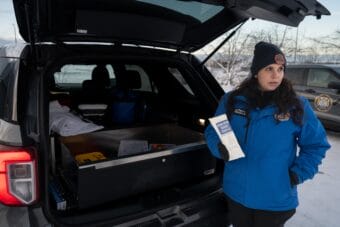
A woman holds up an opioid overdose kit next to a grey SUV with the trunk open.
Dr. Jennifer Pierce with an Anchorage Fire Department vehicle on Jan. 9, 2026. Pierce and the vehicle are part of a new program that will offer addiction treatment to those who overdose. (Matt Faubion/Alaska Public Media)

Stomping through stubborn, crunchy January snow, Dr. Jennifer Pierce made her way recently to a new Anchorage Fire Department vehicle. It might look like a simple SUV, but it’s equipped as a new mobile unit that – for the first time – will allow emergency responders to administer buprenorphine on-site, which can help get patients on the road to recovery.

“We want people to see us as a beacon of help,” Pierce said.

Pierce is on a mission: to treat Anchorage residents who overdose and connect them with care afterwards. After being treated for an overdose, many patients don’t agree to further treatment at the hospital or emergency room. Working out of mobile units allows the team to meet those Alaskans where they are.

“We don’t want people to fall through the cracks,” she said.

Narcan, or naloxone, is used to reverse overdoses. But it puts people into immediate and uncomfortable withdrawal. Research shows that in similar mobile programs, offering that second medication, buprenorphine, makes it more likely patients will enter long-term recovery. Even if people don’t continue treatment, Pierce said, the medication can help them make it through a critical window when overdose survivors are at high risk of dying.
“Even if it’s just one life,” she said. “We’re saving lives out there and preventing individuals, maybe from overdosing the next day or overdosing again later and dying.”

Paramedic Joshua Browning (left) will work with behavioral health clinician Dr. Jennifer Pierce to treat overdose and connect people to medication treatment afterwards. (Matt Faubion/Alaska Public Media)

Pierce visited successful programs in Texas and Washington state for ideas and best practices to replicate in Alaska.

The Anchorage team can get dispatched by 9-1-1 when someone is experiencing an overdose. During slower parts of their shift, they’ll be able to do treatment outreach with people who are at higher risk of overdose, Pierce said.

Offering patients buprenorphine has several benefits, said Seth Workentine, an addiction medicine specialist in Juneau who consulted for the pilot program there.

Buprenorphine lasts much longer than Narcan, at least 24 hours, protecting people from re-entering overdose. It also reduces withdrawal symptoms, which can push people back to opioid use, Workentine said.

“Withdrawal is an extremely uncomfortable experience hated by almost everyone who’s ever experienced it and is often a barrier to people seeking treatment,” he said. “Now they just feel normal and have a much bigger leg up into entering recovery.”

But buprenorphine is an opioid, and Workentine said he’s heard critics of similar programs argue that it’s just swapping one drug for another. That’s not the case, he said, because buprenorphine is different and, over time, it actually helps reverse the brain changes that happen with addiction.

“So it’s not replacing one for the other, even though they’re in the same category,” Workentine said. “It is actually part of healing you.”

And that, he said, is integral to the recovery process.

Dr. Quigley Peterson, an emergency room physician heading Juneau’s pilot program, said he’s also seen the healing benefits of buprenorphine. He’s confident the pilot will do well partly because he’s seen how helpful the medication can be in a different setting: the emergency room.

“We have something that can help engage people, that’s super safe and it’s cheap, and it works,” Peterson said.

The pilot programs will collect data over the year to see what happens to patients after they’re given buprenorphine for an overdose, Peterson said. His hope is that it reduces emergency room visits and calls for emergency medical care. That would be good for the mental health of emergency responders, too, who get burnt out responding to the same patients over and over, he said.

If you can get patients into long-term care, Peterson said, “you won’t need to see them in the future. You won’t have these recurrent EMS calls.”

If the pilot programs are successful, Peterson’s goal is to inspire similar programs in more communities across Alaska.

For many Alaskans seeking addiction treatment, help starts with someone who has been there

A man in a grey jacket offers a plastic box of cookies to a person out of frame.
Josh Engle, manager and peer support specialist at True North Recovery in Wasilla, gives out cookies as part of homeless outreach efforts in Anchorage on Tuesday, Nov. 25, 2025. (Matt Faubion/Alaska Public Media)

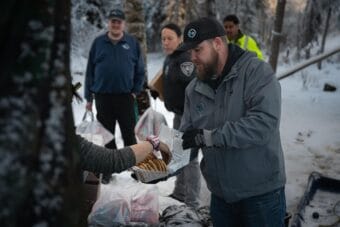
Josh Engle was bundled up on one of the first frigid days in October, walking along a forest path to do outreach in a homeless encampment in Anchorage. He approached a man in a weathered coat near several tents and a makeshift structure.

“How long you been out here on the streets?” Engle asked.

“Too long,” the man said.

“You connected with any resources?” Engle asked. The man described the tarp and blankets he’d been able to get.

Engle, a manager and peer support specialist at True North Recovery in Wasilla, hoped to guide people into recovery, if they showed interest. It’s a path Engle knows well because he’s in long-term recovery himself, so he understands how fleeting the window of opportunity can be when someone decides to seek treatment.

Engle supports people in ways that go well beyond what a more traditional therapist or psychiatrist can do. He may text with clients outside business hours, help them find work or get connected with benefits–anything that might lead to recovery. Peer support specialists like Engle — people in recovery themselves— can help people recover from both serious mental illness and substance use disorders, and can reduce healthcare costs.

“I personally really enjoy being able to connect with them on a personal level (as) someone that has walked their path and been in their shoes and ultimately have struggled the way that they’re currently struggling,” Engle said.

Josh Engle carries bags of food to an encampment for outreach in Anchorage on Tuesday Nov, 25, 2025. He hopes to talk to people who are interested in recovery. (Matt Faubion/Alaska Public Media)

True North Recovery, where Engle works, aims to hire people with lived experience in recovery not just as peer support specialists, but for every role–from receptionists to health care providers. Research shows that when patients interact with workers with lived experience, it aids recovery.

Peers can sometimes say and see things people without lived experience can’t.

Aaron Surma, executive director of the National Alliance on Mental Illness, or NAMI, in Juneau, trains peer support associates. Surma also experiences mental illness himself. He said psychiatrists and mental health professionals play an important role in supporting recovery and treatment, but there is a strong power difference.

“You’re in a small room, you’re making intense eye contact, and the dynamic is that you have the expert and the person who needs help, and the experts are taught to not really share about themselves,” Surma said. “Which makes it feel really one sided. It makes you feel like you’re being judged and evaluated.”

Surma said he was arrested multiple times during high school and was court-ordered to go to Alcoholics and Narcotics Anonymous meetings. He said hearing peers in those groups was awesome, but things felt different when talking with his formal providers.

“When I was a teenager, I was lighting stuff on fire and buying garbage bags of weed,” Surma said. “So then to go into a small room and talk to somebody who- imagine the counselor from South Park who’s saying ‘Drugs are bad, mkay?’ and it’s a million miles from what you know.”

He said it’s easier for peers to bridge those gaps in early recovery. Peer support specialists speak the language of addiction and mental illness and also understand the more traditional language of behavioral health professionals.

He said typically those professionals–like therapists and psychiatrists–dole out care in ways that are convenient for the health care system. But peer support is different.

“Recovery isn’t just supported in small doses from paid professionals, but it can also happen on our own time, in places that are comfortable to us, in settings that feel more accessible and from people who feel more approachable,” Surma said.

He said peer support relationships don’t have to be formal and the role can also be incredibly healing for the person providing the support. The hard times and challenges someone has faced suddenly have value, if those experiences help someone else.

“The sense of purpose is incredible,” Surma said. “I talk openly about having been suicidal and how to address depression, and people come out of the woodwork because they know that the door is open.”

That sense of purpose is also something peer support specialist Engle has felt deeply in his work.

“There is no way you could have convinced me 10 years ago that all of the damage and chaos that I was causing in people’s lives, my loved ones, people I just would cross paths with, that I would be able to use any of that for good,” Engle said. “I thought that was just going to be like a stain on my soul for the rest of my life.”

Instead, now his struggles are a tool to help people and do his job.

At the Anchorage encampment, Engle approached a couple’s tent. They said they were interested in a detox program but wanted to go together.

“It’s gonna be tough,” Engle said. “But what we can do is we can line it up so, like, beds on the same date. They’re just going to be different programs.”

But the couple said they had more to do before committing to detox.

“I swear, every single time we talk: ‘almost there, almost there.’ I know you are,” Engle said, his voice taking on the loving but firm tone of an older brother.

It wasn’t enough to get them into a program, but he’ll be back working to make their next steps in recovery as easy as possible when they’re ready.

Juneau rolls out a new mobile crisis team

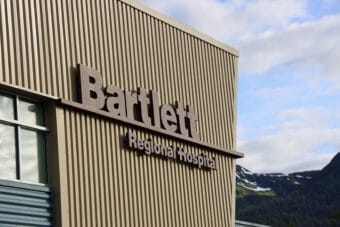
Bartlett Regional Hospital on Tuesday, June 25, 2024. (Clarise Larson/KTOO).

Juneau has a new mobile crisis team dedicated to assisting people with mental health emergencies. 

Bartlett Regional Hospital Chief Nursing Officer Kim McDowell said the city looked at similar models across the country when it developed this program.

“It’s kind of the first window of opportunity to provide de-escalation for somebody in crisis in the field that doesn’t involve EMS or the police department,” she said.

Juneau police dispatch can choose to call the crisis team when an emergency call comes through, based on a list of what situations are appropriate. The team may also be deployed based on calls to the national 988 Suicide and Crisis Lifeline.

McDowell said the team responds in cases when the individual is not in imminent danger of hurting themselves or someone else.

The team is made up of a Capital City Fire Rescue paramedic and a Bartlett Regional Hospital clinician. Crisis care consists of immediate response to a situation or crisis, further assessment of the person undergoing the emergency, stabilization, and follow-up involving other services. That could be case management or checking in with services the person regularly uses.
McDowell said this program allows people to receive care where they are, instead of having to come to the emergency room. 

“There’s nothing like providing them resources where they live, and that gives you the opportunity to wrap in family, if there’s family there,” she said. “And to give them all the resources that they might need to be able to go day by day and without having to come to the hospital unless it’s needed.”

The rollout of this new mobile crisis team began last month. Now, the team is officially responding to calls from 9 a.m. to 6 p.m. daily. McDowell says the city hopes to expand those hours in the future. 


Juneau Assembly OKs $500K grant to local nonprofit for substance misuse services

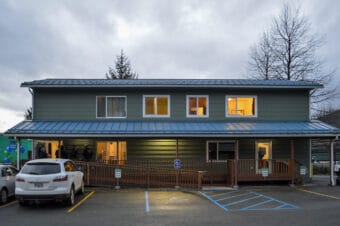
Gastineau Human Services’ new Mount Juneau Counseling and Recovery building on Thursday, Oct. 24, 2024. (Yvonne Krumrey/KTOO)

The Juneau Assembly unanimously approved a $500,000 grant to Gastineau Human Services at a meeting Monday night. The money will help the nonprofit as it expands services for people recovering from substance misuse.

The grant’s approval comes two months after the permanent closure of Bartlett Regional Hospital’s Rainforest Recovery Center. At the time, hospital leaders said Rainforest lacked enough staff to operate and was contributing to a financial crisis that could close the hospital.
Last month, Gastineau Human Services opened its new Mount Juneau Counseling and Recovery building on its campus in Lemon Creek. It opened earlier than originally planned to quickly fill the service gaps left by Rainforest’s closure. 

Along with the new building, Gastineau Human Services also added an additional eight beds for people recovering from substance misuse. That means Gastineau Human Services can now house up to 27 people at a time in its residential treatment program. 

The Assembly’s latest grant is one-time funding that’s meant to help with the cost of expanding care and taking on more patients. 

Earlier this year, the Assembly also approved another grant of $2 million to Gastineau Human Services. That money is to help the nonprofit as it moves forward with plans to construct a 51-bed residential building on its campus for people in recovery.

The nonprofit’s goal is to begin construction next year with housing available in 2026.

Juneau group home for women in reentry and recovery reopens after demolition

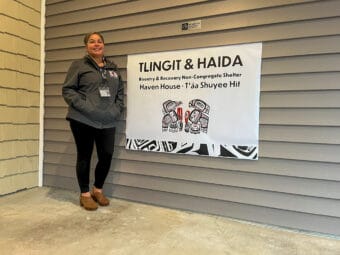
Christina Lee is the operations manager for Tlingit and Haida’s Reentry and Recovery program. She stands at the new T’áa Shuyee Hit Haven House building on Nov. 5, 2024. (Photo by Yvonne Krumrey/KTOO)

A group home in Juneau for women experiencing addiction or leaving incarceration has just reopened after being rebuilt following flood damage. T’áa Shuyee Hit Haven House is now accepting applicants. 

Haven House is run by the Central Council of the Tlingit and Haida Indian Tribes of Alaska. Christina Lee is the operations manager for Tlingit and Haida’s Reentry and Recovery program. She says Haven House is a place for new beginnings. 

“The women in our community, and everywhere, need to know that there’s a safe place to come,” Lee said. “Need to know that there’s an opportunity to start over.”

Up to nine women can live there and it costs $600 a month. Each resident gets their own room and must participate in programs that support mental health and recovery. 

The group home in the Mendenhall Valley originally opened as a nonprofit in 2015. Tlingit and Haida had just taken it over in 2020 when, months later, the entire house flooded and was shut down. 

After rebuilding from the ground up, Tlingit and Haida began accepting applications for residents last month. 

The program doesn’t allow children to live in the house with their parents, but kids can visit. The same goes for romantic partners. 

The program is voluntary and requires participation in programming, so Lee said their applicants tend to be more self-selecting. They’re women committed to their healing and recovery. 

“They have to be able to do chores and be responsible, as long as they can live in a community with other women and be able to hash out any differences that there is,” she said. “That’s kind of what we’re wanting.”

Lee says the program lasts two years, but if life circumstances change, it can be shorter. 

Tlingit and Haida President Chalyee Éesh Richard Peterson says programs like Haven House mean that women can take steps away from old, harmful patterns. 

“We’re excited that it’s a place that’s going to create a supportive environment, hopefully to reduce relapse, reduce recidivism,” Peterson said. “And help our folks break those cycles that have kept them trapped in difficult situations.”

The application process is ongoing. More information can be found on the Tlingit and Haida website, or by calling 907-463-7266. 

ACLU raises concerns as Alaska Department of Corrections works to keep fentanyl out of jails and prisons

Goose Creek Correctional Center
Goose Creek Correctional Center. (Photo by Ellen Lockyer/Alaska Public Media)

The amount of fentanyl it takes to cause an overdose is 2 milligrams, the size of about six grains of salt, and enough fentanyl to kill about 500 people could fit inside a large pill capsule. That makes keeping the powerful drug out of jails and prisons in the state tricky.

Like the rest of Alaska, the Department of Corrections, or DOC, has seen overdoses rise, said Adam Rutherford, the DOC’s health director. He said they know the drug is getting in.

“When you add fentanyl to the mix, and how deadly fentanyl is at very, very, very low doses, I think that created challenges that we weren’t expecting,” Rutherford said.

Rutherford said thankfully, staff have been able to reverse overdoses with Narcan and save lives on a weekly basis. So unlike the rest of the state, he says, the facilities haven’t seen big increases in overdose deaths.

DOC staff have also found small amounts of fentanyl in mailed photographs and counterfeit Amazon packages, according to Arnaldo Hernandez, superintendent for the Anchorage Correctional Center. He said fentanyl was also getting in through legal mail, such as letters from attorneys. That mail is constitutionally protected so in the past, prison staff didn’t open it. But Hernandez said now that’s changed.

“We’ve instituted a process where we copy the legal mail, hand them the copy, because that way they can’t access the contraband that’s laced on them, in the seams or in the pages,” Hernandez said.

But Megan Edge from American Civil Liberties Union Alaska is concerned about those changes. She said people have a right to privileged communication with their attorney.

“Anytime a correctional officer or a staff member is looking at that policy, they’re giving an opportunity to that staff member to read someone’s private legal paperwork,” Edge said.

She said there have been other issues like staff failing to copy the backs of two-sided correspondence. She said the department doesn’t keep track of how many attorney letters had contraband fentanyl in them. And she said if facilities are truly concerned with keeping fentanyl out, they should be looking at other ways it’s brought in, like by staff.

“There have been correctional staff members in the last couple of years that have been criminally charged with bringing contraband into facilities,” Edge said.

In the past few years, several correctional officers have been charged with or found guilty of trafficking drugs in the state’s facilities. A former guard in the Anchorage Correctional Center was allegedly paid between $1000 and $3000 each time he brought drugs in, according to the Anchorage Daily News.

Edge said other states use systems that protect attorney-client confidentiality and keep fentanyl out of prisons, like encrypted email for protected correspondence. And she said she knows the DOC and other groups in the state are working toward introducing technology like that to jails and prisons in Alaska.

Site notifications
Update notification options
Subscribe to notifications