Alcohol & Substance Abuse

How The Prescription Painkiller Fentanyl Became A Street Drug

Fentanyl, a synthetic opioid, has been used for decades as a painkiller in the operating room. Joe Amon/The Denver Post/Getty Images
Fentanyl, a synthetic opioid, has been used for decades as a painkiller in the operating room.
Joe Amon/The Denver Post/Getty Images

If you’ve ever had surgery, you may have been given an analgesic named fentanyl.

Fentanyl is a favored painkiller because it acts fast. But it’s also 80 to 100 times more potent than morphine. The powerful drug has made its way to the streets and increasingly is being used to cut heroin — resulting in a deadly combination.

Fentanyl abuse first became a problem some 25 to 30 years ago, way before it started being mixed with heroin, says Dr. Neil Capretto, an addiction physician at the Gateway Rehabilitation Center in Aliquippa, Pa.

Fentanyl, Capretto explains, was originally invented to relieve pain and is often injected in patients prior to surgical procedures. The synthetic opioid can also be prescribed in a lozenge or patch to treat the severe pain associated with metastatic, colon and pancreatic cancer.

“Patterns of abuse actually began with hospital workers, anesthesiologists and nurses,” Capretto says. “There were a rash of [health specialists] dying from overdose. You’d hear of them getting it in the operating rooms by drawing out fentanyl from vials and putting saline in its place.”

Later, when take-home fentanyl patches were invented, patients began abusing the painkiller, too.

“There were occasional cases of people eating [the patches] or steeping them like tea,” he says. “And because fentanyl is so powerful, we started seeing more drug overdoses and death.”

Today, drug dealers are adding fentanyl to heroin because it creates an intense high. Between 2005 and 2007, more than 1,000 U.S. deaths were caused by fentanyl-heroin overdoses, according to the Drug Enforcement Administration. Seizures of drugs containing the painkiller jumped from 942 to 3,334 between 2013 and 2014. In March, the DEA issued a warning on fentanyl as a “threat to public health and safety.”

The combination of the two drugs makes users feel drowsy, nauseated and confused, but also euphoric.

The euphoria probably hits a lot faster when fentanyl is mixed with heroin, says Dr. J.P. Abenstein, president of the American Society of Anesthesiologists. It’s that super-quick potency of fentanyl that makes it dangerous; a little can go a long way.

“What happens is that people stop breathing on it,” Abenstein explains. “The more narcotic you take, the less your body has an urge to breathe. And it makes sense that a lot of people are overdosing on it because they aren’t sure how much to take.”

Capretto agrees. The rehab physician recently treated a heroin addict who tried fentanyl for the first time and overdosed. “Before he even took the needle out of his arm, he was unconscious.”

Paramedics administered Naloxone, a drug that can reverse opioids overdoses, just in time to save the man’s life.

Illegal drug labs are concocting fentanyl from scratch, according to the National Institute on Drug Abuse. Authorities have raided several labs in Mexico that were receiving chemicals from China and Japan to create the drug, according to the DEA.

But Capretto thinks there are labs in the U.S. making fentanyl, too.

“Drug dealers are in the business of making money and I’ve heard it’s very easy to make, so that means they can save money [by doing it themselves],” he says. “I wouldn’t be surprised if there were real Walter Whites out there. Chemists and pharmacologists can turn to the dark side, just like in Breaking Bad.”

Nadia Whitehead is a freelance journalist based in El Paso, Texas.

Copyright 2015 NPR. To see more, visit http://www.npr.org/.
Read Original Article – Published AUGUST 26, 2015 2:43 PM ET

When A Budget Motel Is ‘Home,’ There’s Little Room For Childhood

Ian opens the door to the motel room he shares with his mother, Karen. Their living situation has exposed the 5-year-old to conditions most students his age don't have to confront. "He saw way too much in the last few weeks," Karen says. Tess Vigeland/NPR
Ian opens the door to the motel room he shares with his mother, Karen. Their living situation has exposed the 5-year-old to conditions most students his age don’t have to confront. “He saw way too much in the last few weeks,” Karen says.
Tess Vigeland/NPR

Just a couple of blocks off the 210 Freeway in San Bernardino, Calif., about an hour east of LA, rest a whole row of cheap, run-down motels. Some people stay for a night or two, others just by the hour.

But some rooms house families with kids — and they’re not just stopping in.

This is home for them, at least for now. They’ve run out of other options for a roof over their heads.

California ranks third in the U.S. — behind only Kentucky and New York — in the percentage of children who don’t have a home, according to the National Center on Family Homelessness. And the evidence of this is clear in San Bernardino, which is littered with dilapidated neighborhoods and abandoned blocks, even in the city’s center.

Here, budget motels have become a last refuge for desperate people with nowhere else to go. Joe Mozingo, the Los Angeles Times staff writer behind the series San Bernardino: Broken City, says that kids who live in these motels get exposed to some troubling conditions.

“Drug addicts and prostitutes, people with severe mental illness,” he explains. “It’s just kind of a crazy place for a child to grow up in.”

For instance, Eddie, the 14-year-old at the heart of one of Mozingo’s pieces, had to cope with bullying, the death of his cousin and a mother who was usually strung out on meth — before she got arrested.

The Golden Star Inn, in San Bernardino, Calif. Karen and her son moved in here after they left the last motel they were living in --€” a place she says was "like summer camp for meth addicts." Tess Vigeland/NPR
The Golden Star Inn, in San Bernardino, Calif. Karen and her son moved in here after they left the last motel they were living in –€” a place she says was “like summer camp for meth addicts.”
Tess Vigeland/NPR

“So he was just totally left alone with his mom’s boyfriend, who’s also a meth user,” Mozingo says. “And he just didn’t know what to do. I’ve just never seen a kid look so lost and in need of guidance.”

At the Golden Star Inn, one of the motels just off a juncture in San Bernardino, Karen lives with her 5-year-old son, Ian. (She asked that we not use her last name to protect her and her son.) The morning Mozingo and I spoke with her, she had just filed a restraining order against her husband; she says he’s addicted to meth. She and Ian have lived in a shabby, dimly lit room for nearly three months.

In the room, there are signs of an effort to create something resembling a home. Stuffed animals and Disney pillows lie strewn on the bed, and laundry is hanging out to dry on a closet wall.

Karen, a phone psychic, pays $300 dollars a week to live at the motel.

“Normally it’s not a problem to pay rent here every week,” Karen says. “The last couple of weeks, because the situation with my husband, I’ve been at court so much, and running around so much, trying to take care of stuff, I haven’t been able to work a lot the last couple weeks. Last week was really pinchy-tight, we think we’ve got this week covered and I have no idea what the hell I’m going to do next week.”

Before the motel, they had their own apartment. But when she didn’t get enough work, she says they missed a month of rent and got kicked out the day before New Years. They stayed with a friend for a while, then got a room at a motel a few miles down the road from this one.

That place, she says, was a nightmare.

“It was like summer camp for meth addicts. Because everybody was bouncing between rooms and chit-chatting and it was this social drama that was going on all the time — all day and all night,” she says. “It was too much for the little one. And so my husband just started hitting all the motels and this one had a space, so …”

Even here, it’s far from an ideal community for Ian.

“You’ll have probation [officers] come through, because they’re doing probation sweeps … or you’ll have random naked people screaming, running through. It gets bizarre,” she says.

“And how do you explain that to a 5-year-old?”

With a restraining order filed against her husband and no home beyond the motel, Karen's financial and legal situation is such that she says, "I have no idea what the hell I'm going to do next week." But she and Ian are not alone: In San Bernardino County, over 9 percent of public school students are identified as homeless. Tess Vigeland/NPR
With a restraining order filed against her husband and no home beyond the motel, Karen’s financial and legal situation is such that she says, “I have no idea what the hell I’m going to do next week.” But she and Ian are not alone: In San Bernardino County, over 9 percent of public school students are identified as homeless.
Tess Vigeland/NPR

San Bernardino is poorer than any other American city of its size besides Detroit. And in San Bernardino County, just shy of 10 percent of public school students are identified as homeless — twice the rate of nearby Los Angeles County.

“The recession hit this community especially hard,” says Dr. Kennon Mitchell, the assistant superintendent of student services for the San Bernardino City Unified School District. “Close to 50 percent of our residents receive some sort of public assistance. And close to 97 percent of our students are eligible for free and reduced lunch, which means that they’re below the poverty line.”

One prime example is Juanita Blakely Jones Elementary School, just a block away from the Golden Star Inn. Mitchell says 1 in 5 of the students enrolled there live in motels.

“And of course it causes that school to have a high turnover. They’re close to a 55 percent turnover rate over there,” he says. “So sometimes we’ll have kids drop and re-enroll two or three times in the same school year.”

The school district provides outreach. There’s a Homeless Student Program, counseling, health services, clothing and school supply donation and transportation to and from school. But the school system can only do so much.

“We can’t eliminate some of those real life circumstances that families are going through as it relates to the economy and jobs,” Mitchell says. “So what we just try to do is just try to mitigate the impact on kid’s education because we believe that the better we can educate the youth, the youth will provide a pathway for their families to success.”

As for Ian, back at the Golden Star Inn, he’s enrolled at California Virtual Academy — a tuition-free online public charter school. It’s a mix of home schooling and one-on-one lessons with a teacher.

Karen says that with Ian’s behavioral problems, that’s exactly what he needs.

“We just got his shipment actually of all of his books and stuff for this year. And they’re real supportive of what we’re going through,” she says. “His teacher is awesome.”

Karen says while they may be “technically homeless,” she strives to create a stable environment for Ian. But it’s “gone crazy” since her husband left, she says.

She hopes for a permanent place someday, with a room for Ian — his own private space. “He saw way too much in the last few weeks,” she says.

Meanwhile, she tries to protect him by keeping him inside the motel room, which holds two beds, a desk, a TV and a makeshift kitchen — just a toaster oven on top of a minifridge. They go to the park, too. But this place is not a home.

And they have no idea when they might finally get a real one.

Copyright 2015 NPR. To see more, visit http://www.npr.org/.
Read Original Article – Published AUGUST 16, 2015 5:47 PM ET

Vets deliver fiery testimony to VA secretary during Mat-Su visit

Dozens of people lined up during Thursday’s listening session to speak on concerns and experiences with the VA. Though overwhelmingly critical, many laid out positive experiences receiving care in Alaska. (Photo by Jillian Rogers)

A listening session held Thursday night in Wasilla by the head of the Department of Veterans Affairs was dominated by complaints about the healthcare system for veterans. The VA is struggling in Alaska to rebuild trust as policy changes unfold from Washington, D.C. all the way to the state’s most remote clinics.
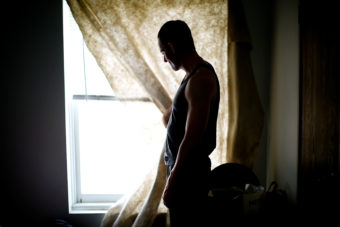
On the green AstroTurf soccer field at Wasilla’s Menard Sports Center, a crowd of hundreds — mostly older — turned out to talk about the VA.

“Obviously the Department of Veterans Affairs had a crisis,” said Secretary Robert McDonald from a stage, not using notes or a script as he gave an overview of the massive problems hampering service in recent years. “The primary reason, as I looked at this situation, was the aging of the American Veteran population.”

There are more veterans coming on the rolls, and also more recognition of ailments like post-traumatic stress, Agent Orange exposure and Hepatitis C from Vietnam-era blood transfusions. Just as needs are ballooning, there’s a compounding shortage of staff.

“We didn’t have enough doctors or nurses,” McDonald said of when he took over. “When I first testified in front of Congress I said ‘I need to hire 28,000 medical professionals nationally.’”

Staffing concerns have been an issue in Alaska–particularly at the nearby Mat-Su Valley outpatient clinic.

At the heart of the crisis, according to McDonald, are Congressional budgets that cap spending on veteran health. But where to lay blame for such enormous problems was one of the many things the crowd pushed back against.

“One hour, with all of us? Come on, let’s get real,” said retired Air Force Sergeant Mike Kuntz ahead of a heated exchange with McDonald.

“I thank Dan Sullivan for making you come up here,” Kuntz said.

“Wait, wait, wait, let’s be clear: nobody made me come here,” McDonald shot back.

“Dan Sullivan had a lot to do with it,” Kuntz replied.

“No he didn’t. He had nothing to do with it,” McDonald said, before the subject moved on.

Testimony was overwhelmingly critical of the VA, filled with stories of personal misfortune and professional misconduct — some stretching back decades.

James Perkins is a recent vet from the 10th Mountain Division, and drove up from his home on the Kenai Peninsula to explain that in spite of efforts to overhaul the system in Alaska and across the country, it’s still vastly inadequate measured against the need.

“I’ve lost over six brothers that I’ve served with, in less than a year, to suicide. And I’ve almost been a victim of veteran suicide myself,” Perkins said. “The struggle is real.”

Stories of suicide, over-medication, and VA staffers too overworked or indifferent to help received cheers of agreement from the audience.

Army veteran Joe Oswald Jr. began his fiery remarks noting that many local veterans are afraid to raise problems they’ve experienced.

“Me speaking here is going to get me retaliation from VA,” Oswald said. “And VA is part of the reason veterans commit suicide — because they suggest suicide. And nobody is addressing it, sir, everybody is just passing the buck and hoping you go away.”

As Secretary McDonald listened, he would periodically refer people to VA staffers set up at tables in the back of the event.

Scott Harrison is a Marine Corp vet who lost his home from spiraling health problems. He doesn’t expect any one person to solve all his health issues, but believes the frustration for many, himself included, is wrangling complex paperwork just to get plugged in to their benefits.

“Nobody knows who I’m supposed to talk to,” Harrison said, emotion creeping into his voice. “They cannot find my records. I was at so many different duty stations, so many different bases, so many different operations — there’s absolutely no way that every record along the path is lost.”

McDonald interrupted him to flag down a staffer to get the marine’s info. Harrison spent about 15 minutes talking with a VA employee as she scribbled down notes.

Afterward, Harrison explained that in spite of struggling to find enough care, he does see folks trying hard to help within a flawed system.

“I think people are emotional on all this, and I think maybe people are maybe wanted to blame the secretary or hold him to task,” Harrison said, pausing to add, “The man’s doing a job.”

“We follow up on everything,” the Secretary said during an interview after the event. He stayed late taking questions, and had to hustle out the door in order to make his flight, but called from the road. He insists the listening sessions are more than a show. His staffers take notes during testimony and follow up with every individual case to see if it’s valid, and if so what can be done.

Asked whether that was a general goal or a literal protocol, McDonald replied quickly, “Every single thing.”

The Secretary’s visit also included a trip to Kotzebue, and a headstone ceremony on Wednesday in Point Hope.

The U.S. Declared War On Veteran Homelessness — And It Actually Could Win

This is a tale of two cities. In New Orleans, there are signs of hope that veteran homelessness can be solved. But Los Angeles presents a very different picture.

Daniel Harmon, a veteran of the wars in both Afghanistan and Iraq, looks out the window of his room at the Hollywood Veterans Center in Los Angeles. The facility provides housing to homeless vets. David Gilkey/NPR
Daniel Harmon, a veteran of the wars in both Afghanistan and Iraq, looks out the window of his room at the Hollywood Veterans Center in Los Angeles. The facility provides housing to homeless vets.
David Gilkey/NPR

Under the deafening highway noise of the Pontchartrain Expressway in central city New Orleans, Ronald Engberson, 54, beds down for the night. Engberson got out of the Marines in 1979, plagued even back then by problems with drugs and alcohol. He says that’s mostly the reason he’s been homeless the past 10 years.

“My longest stretch sober was 14 months,” he says. “Being out there on the streets, it’s tough.”

About 50,000 vets are homeless in America. In 2009, then-Veterans Affairs Secretary Eric Shinseki declared that all of them would have housing by this year. At the time, even inside the VA that goal was considered aspirational at best. But last year, cities across the country said it was looking achievable. New Orleans was the first to declare, in January, that the city had done it. (Jump to the bottom to see how your state stacks up.)

So if New Orleans has zero homeless vets, why was there a Marine sleeping under the expressway?

It’s called “functional zero,” according to Melissa Haley, director of supportive services at Volunteers of America in New Orleans.

“Homelessness is a continuous process. There’s a veteran right now who is in a home who could very well be homeless tomorrow,” she says. “Functional zero is defined as having a process and the resources in place where we can immediately house a veteran.”

Marine Corps veteran Ronald Engberson says alcoholism had made it hard to keep a job and an apartment. His new apartment has few possessions, but he is clean and sober. David Gilkey/NPR
Marine Corps veteran Ronald Engberson says alcoholism had made it hard to keep a job and an apartment. His new apartment has few possessions, but he is clean and sober.
David Gilkey/NPR

So if a vet loses a job today, misses the rent and gets evicted in New Orleans, the city can get him or her housed within a month. Haley says it’s often faster; they got Marine Corps veteran Ronald Engberson housed in one day.

A Volunteers of America caseworker, DaVaughn Phillips, met Engberson under the expressway and started asking him questions from a survey. When he heard Engberson’s name, he looked down at a list on his clipboard.

“Mr. Engberson, we’ve been looking for you!” Phillips said. “When you said Ronald Engberson, I’m almost about to get up and shout!”

Nonprofits, the New Orleans VA and the mayor’s office now coordinate to keep one constantly updated list of homeless veterans. Because Engberson was on the list, his military record had already been confirmed, and Phillips could get him into an apartment.

The next morning Phillips met Engberson by the expressway overpass and took him to a modest, clean apartment. First thing Engberson did was shave off his ragged beard.

Engberson served a short stint in the Marines in 1979. Until recently, he had been homeless the past 10 years. David Gilkey/NPR
Engberson served a short stint in the Marines in 1979. Until recently, he had been homeless the past 10 years.
David Gilkey/NPR

“Last night I was under the bridge,” Engberson said. “I’m thankful I’m inside. I have AC, don’t have to deal with the rain, the lightning, people walking up on you all the time.”

New Orleans went from 470 homeless vets in 2011 to functional zero today, using what are now considered best practices — such as the master list — and powered by a huge cash injection from Washington.

Nationwide, spending on homeless vets is up 300 percent since President Obama took office, hitting near $1.5 billion last year. That tracks with a reduction in homeless vets by about a third.

homeless vets graphic“We’ve been able to house more vets in the last five years than at any point in our history … 30-plus years,” Vince Kane, special assistant to the VA secretary, says of the agency’s housing programs. “In the past, both inside and outside of VA, we were focused on models more about managing homeless than on ending homelessness,” Kane says.

Part of that shift is to embrace a philosophy called “housing first.”

“It’s about getting guys in housing first and then treating whatever ails them afterwards,” says Kevin Kincey, who does outreach for the group U.S. Vets in Los Angeles.

“Back in 2005, to come into a program … you needed to be sober,” Kincey says. “[Now] once you get in housing, if you need substance abuse treatment, mental health treatment, they’ll wrap that around you.”

Kevin Kincey looks for homeless veterans on Los Angeles' Skid Row and helps them get off the streets. David Gilkey/NPR
Kevin Kincey looks for homeless veterans on Los Angeles’ Skid Row and helps them get off the streets.
David Gilkey/NPR

Kincey says he’s seen housing-first programs arrive just recently in Los Angeles — which VA officials acknowledge is lagging behind many other cities in the race toward the goal.

LA has the most homeless vets in the country. It also has a housing shortage that makes it hard to find places even with the funding available. And there were other problems — the Los Angeles VA was embroiled in a lawsuit about misuse of resources. Kane was sent this year from headquarters to get the Los Angeles VA back on track.

Still, LA would need to house 3,000 more homeless vets by the end of the year to reach zero, and no one expects it to happen on schedule. Angelenos say it’s not fair to compare the scale of their homeless problem to smaller cities like Houston or New Orleans.

“They’ve all done great work, but no one has done as much as Los Angeles has done in total volume,” says Greg Spiegel, who advises the mayor of Los Angeles on homelessness.

For perspective, New Orleans housed 227 vets last year to reach zero. Los Angeles housed about that many last month and the month before that. LA has found homes for about 4,000 veterans since January 2014. But Spiegel says as fast as they can house them, about seven more veterans become homeless every day in LA.

“That inflow of vets becoming homeless is so big, it essentially neutralized the incredible progress we made. That had never been done before and is more than anywhere else in the country,” Spiegel says.

Greg Spiegel (left) advises the mayor of Los Angeles on homelessness. Jim Zenner (in hat, at right), runs the Hollywood Veterans Center. David Gilkey/NPR
Greg Spiegel (left) advises the mayor of Los Angeles on homelessness. Jim Zenner (in hat, at right), runs the Hollywood Veterans Center.
David Gilkey/NPR

Many of the vets becoming newly homeless are from recent wars, raising fears of another generation of combat vets winding up spending a life on the streets.

“I don’t want to see these guys homeless 40 years from now,” says Jim Zenner, who runs the Hollywood Veterans Center, a barracks-style halfway house for veterans of Iraq and Afghanistan.

Zenner moved to LA when he got back from Iraq in 2008 and started pursuing a master’s degree in social work at University of Southern California. The war still had a grip on him, though — even the LA freeway reminded him of routes he had driven in Iraq. Anger and depression put him on edge. At home with his wife and kids, he’d yell so loud the neighbors would call the cops.

“The fourth time the police … basically told me that if one of us don’t leave the house, then they’re going to take our kids. So I packed my stuff, slept in the car that night and then got a hotel room, took my oldest son, and we stayed there for four days,” he says.

After that, he had nowhere to go. He and his wife were both students. They were living off loans and GI bill money — not enough to pay two rents in Los Angeles.

He went to the VA for help, but none of the shelters at that time would take in a father and son. Then a place run by Volunteers of America did him a favor and bent the rules to house them both. He stayed seven months. Then they asked him for a favor.

“I did some volunteer work for them,” Zenner says. “And in early 2010 they offered me a position to take an empty building and turn it into a readjustment facility for Iraq and Afghanistan veterans.”

That facility looks a bit like one of the makeshift barracks troops made out of buildings in Iraq and Afghanistan — right down to the free weights and boxing gear in the covered alley next to the building. There’s a TV lounge and a group therapy room, too.

The Hollywood Veterans Center is a barracks-style halfway house for veterans of the wars in Iraq and Afghanistan. David Gilkey/NPR
The Hollywood Veterans Center is a barracks-style halfway house for veterans of the wars in Iraq and Afghanistan.
David Gilkey/NPR

“They try to get us to talk about it, but you know how vets are. We like to talk about it privately together. And that’s the stuff that helps out the most,” says Joe Scogan, who did two combat tours to Iraq.

After a divorce, he wound up living in his truck. He went to stay at a VA housing program before landing at the Hollywood Veterans Center this May.

“At the VA, I was there with some Vietnam vets, and they were great. But it really helps being with guys that you went through something with. They’re different wars,” Scogan says.

Zenner says his mission is to be flexible and fit treatment around school and job possibilities, even if it means bending the rules, like they did for him when he and his son had nowhere to stay.

He’s got mixed feelings about the goal of ending homelessness.

“I don’t think it’s possible,” says Zenner. “And the play-with-words like ‘functional zero’ and all that crap — I don’t like to do that. Everybody knows in LA it’s not going to end in 2015. [But] it’s a good way to get people to work extra hard.”

The deadline also has some worried.

“My fear is that someone will claim victory at the end of this year and funding will start going away,” says Steve Peck, president of U.S. Vets.

Steve Peck, president of U.S. Vets, and a drawing of an M-4 rifle with a grenade launcher taped to the door of a room at the Hollywood Veterans Center. David Gilkey/NPR
Steve Peck, president of U.S. Vets, and a drawing of an M-4 rifle with a grenade launcher taped to the door of a room at the Hollywood Veterans Center.
David Gilkey/NPR

He’s already seeing it happen. This summer Peck planned to raise funds for a homeless veterans’ event in Houston. Then the city declared in June that it had reached “functional zero.”

“It was only weeks after that we began making calls to our community partners to help us. We get donations from all over. And one of them actually said, ‘Well, wait a minute, I thought we’d ended this.’ ”

Peck worries that once the deadline passes with the end of this year, the momentum in Washington will disappear, regardless of how many vets are still living on the street.

homeless-vets-graphic1

Copyright 2015 NPR. To see more, visit http://www.npr.org/.
Read Original Article – Published AUGUST 04, 2015 5:49 AM ET


After destructive fire, Bethel alcohol treatment center under construction again

Kris Manke walks through the new Phillips Ayagnirvik Treatment Center. (Photo by Ben Matheson, KYUK)

The skeleton of the new Phillips Ayagnirvik Treatment Center, PATC, is coming up quickly and aims to be closed in for a winter of work. Kris Manke is Director of Construction for the Yukon Kuskokwim Health Corporation, which is leading up the project. He says about 15 crew members are working now, including close to 70 percent local Alaska Native hires.

“We do all of our own electrical, mechanical, framing, siding, we self-perform all of that,” said Manke.

The $12 million, 16,000 square foot facility is under construction for a second time following a fire in October that destroyed it when it was 90 percent framed in. YKHC doesn’t want to take chances the second time. A chain link fence surrounds the site and a 24-hour security team stands watch. Big floodlights shine at the building at night. Manke says having to start from scratch is hard on his team.

“It was hard for me because they all are my guys, but for the guys who were actually building it, we should ask them the question. It’s gotta be really hard, I mean guys were crying when they saw their work burning up that night,” said Manke.

YKHC is offering a $20,000 reward for information that leads to the arrest or conviction of those responsible for the fire that destroyed the alcohol treatment center. YKHC says it was a criminal act that started the blaze last October during construction.

An investigation from the state Fire Marshal’s office said the cause of the fire was ‘undetermined’. Though investigators ruled out all possible mechanical and electrical causes, their summary does not explicitly rule out arson.

The goal is to turn over the new facility in October 2016, but there’s a lot of work before that happens.

“Our winter goal is to be dried in October, middle of October, that’s always our winter goal. We usually get really close, I think we’re going to do it this year, that’s the plan,” said Manke.

This winter they will rough in the electric and mechanical systems. Drywall starts around first of the year, while the finishing work happens in springtime.

Site notifications
Update notification options
Subscribe to notifications