Alcohol & Substance Abuse

Juneau organizer hosts discussion on addiction, recent deaths

Juneau has suffered six heroin-related deaths this year. The public is invited to share stories about addiction and discuss solutions at Wednesday night’s Community of Compassion gathering.
Grace Elliott, the event’s organizer, said the losses hit home. A family friend died of an overdose recently. He was dancing at her daughter’s wedding just weeks before.

“What we want is a space that people can gather in, that it’s a safe space for people to talk about their own experience, how they’re affected by this,” Elliott said. “A lot of the people who are coming already are family and friends of people who have died recently. A lot of these people are in their 20s.”

The Juneau Police Department is conducting a six-month anti-heroin initiative to help answer questions about why users start and why it’s so difficult to kick.

Police typically don’t send out press releases about heroin deaths. However, they released one on Oct. 5 after Robert James Hanson died in his family home. Hanson’s mother gave specific permission because she was distressed about the large number of overdoses in the capital city.

Grace Elliott said by talking, she hopes addiction can be de-stigmatized.

“So that we can have a realistic view of what the condition is in our community and then, thus be able to address it,” Elliott said.

Community of Compassion runs from 5 to 8 p.m. @360 in KTOO.

What Medicaid expansion means for this Juneau family

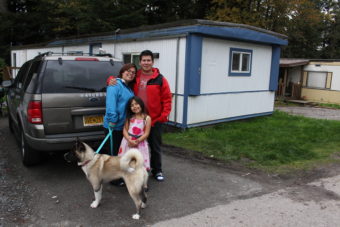
James Refeurzo and his family outside their family home. (Photo by Elizabeth Jenkins/KTOO)
James Refuerzo and his family outside their home. (Photo by Elizabeth Jenkins/KTOO)

Medicaid expansion has been available to Alaskans for over a month, and 93 people in the capital city have enrolled. 263 in all of Southeast. It’s providing coverage for the uninsured. But it’s also offering increased care for those who qualify with Indian Health Service.

For one Juneau man, that means having options to treat alcohol addiction.
James Refuerzo says he fell on hard times when he was in his 20s, and he’s still paying for it now. Back then, he didn’t think he had a drinking problem.

“Maybe one time I’d overdo it. Then all a’sudden I find myself doing something I totally wouldn’t be doing if I was sober,” he said. “With my addiction sometimes I’d drink eight or 10 beers and make a dumb decision and say, ‘Hey I think I can drive.”

After his third DUI, he was locked up at Lemon Creek Correctional Center. Refuerzo is the father of three small kids. He spent two years away serving his sentence and had a revelation.

“Realizing, hey, this has got to stop. ‘Cause the next time I get in trouble, I’m automatically going to be in jail for five years,” Refuerzo said. “And I don’t want to do that and with my kids, something had to change and that’s when I went to Rainforest.”

He knew SEARHC was another option. That’s the tribal health care organization serving Alaska Natives in Southeast. Refuerzo is Tlingit from the Wooshkeetaan Clan. So most of his medical needs are covered. But Juneau SEARHC only offers limited outpatient care for substance abuse treatment.

“It’s tough just to ask for help but then when you ask for it and to be told to wait, it’s a little bit tougher.”

At Rainforest Recovery Center, he says he was able to fill out a form and come back that same day. The center has a sliding-scale payment policy. There’s an overnight treatment program. Refuerzo opted to do outpatient. And he says things got better. He was meeting with a counselor regularly and talking about his problems.

“When I got my job and everything I didn’t qualify for the sliding scale and I was paying 100 percent,” he said.

Refuerzo only works part-time and owes Rainforest over $1,300.

“It’s gone to collections now. I just got another letter saying this one is going to go to collections, too. It’s like I got to take care of it later on in life when I start making more money and decide to start fixing my credit,” he said.

So he stopped going Rainforest. Then he heard he qualified for Medicaid, which pays for treatment.

Bettyann Boyd, Refuerzo’s girlfriend, helped him sign up. She works at SEARHC and has been covered by Indian Health Service and Medicaid for a long as she can remember. Medicaid covers travel expenses for medical reasons and specialized care. Giving her family more opportunities.

“Just the choice, the choice to have a different option to go to a private clinic, a private dental. If you’re not feeling comfortable with the IHS services,” Boyd said.

And she’s glad those choices could extend to her boyfriend, Refuerzo. She’s proud of the work he’s done on himself. She’s going to counseling, too.

“We’re doing really good and we been doing really good. Who knew we’d be able to live in this trailer and have a trailer and own it,” she said. “Everything just keeps going up higher and higher.”

Refuerzo hasn’t heard back yet if he’s been approved for Medicaid. Some people who’ve signed up have had to wait. But after Nov. 1 new applicants will get an instant response from the Health Care Exchange that could speed up the process.

When his enrollment card does come, Refuerzo says it’ll feel good to slip it in his wallet.

“For once I’ll feel like I’ve got something in my life that means something material wise. … I’ve never carried an insurance card before. And each time I’ve been asked, I’ve never had insurance number in my life,” he said. “And it’s going to be nice knowing that I got Medicaid and I’m not just stuck seeing one person because that’s the only person I can see. I can seek out other opinions, other options.”

He’s four months sober. But he says it’ll be nice to know he can get help when he needs it.

Tsimshian master carver’s life and work remembered

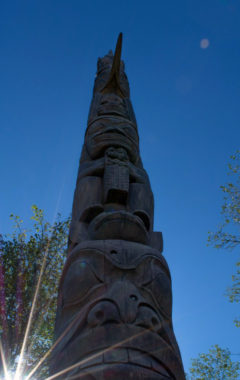
The uninvited guest holding a basket of roses on the Healing Heart toem pole (Photo courtesy of Cathy Mcintosh).

More than a hundred people gathered recently at Healing Heart Park in Craig on Prince of Wales Island.

The Healing Heart totem pole first was raised in Craig 20 years ago. Tsimshian master carver Stan Marsden  carved the pole in memory of his son, Jimmy Marsden, who died of a cocaine overdose. Stan Marsden dedicated the pole to the youth of Alaska as a symbol of sobriety.

The ceremony was a rededication, and a memorial for the carver who died this summer. Marsden’s grandson, Jasper Nelson, unveiled a new plaque that tells the story of the pole.
“The uninvited guest, the human part of the pole, he is holding a basket of roses which symbolize love peace and healing. He represents the spirt of compassion. The uninvited guest wasn’t originally planned to be on this pole. ”

The 46-and-a-half-foot tall pole was a bit longer than expected when it arrived, and not knowing what to put in the humans hands, Marsden left that part uncarved.

“But right near the end of it, a visitor came in and right on the empty block, the only flat part on the pole they left a vase of roses. So that’s what Papa decided to carve in there.”

Roses played an important part in the memorial, as well. A variety of colored roses were passed out, and guests were asked to place them in a heart shaped wreath in memory of those who have died from an overdose or are struggling with addiction.

Many people, including some who had never carved before, helped Marsden with the pole.

“My Grandpa he never said he carved this pole by himself . He never carved it alone. What he always used to tell us was everybody working together made this pole.”

The ceremony was followed by a community lunch and dancing. Several Native dance groups traveled from Metlakatla, Ketchikan, Hydaburg and Klawock for the occasion.

‘I thought he was safe,’ brother says of man found in wetlands

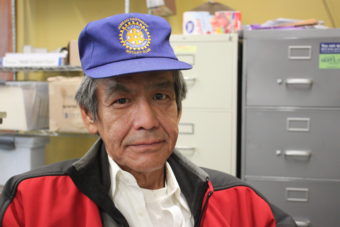
At The Glory Hole, James Knudson, 57, cries intermittently while talking about his brother, John Knudson, who died last month. (Photo by Lisa Phu/KTOO)
At The Glory Hole, James Knudson, 57, becomes emotional while talking about his brother, John Knudson, who died last month. (Photo by Lisa Phu/KTOO)

There are moments when James Knudson forgets his younger brother, John Knudson, is dead.
“Riding on the buses, I start looking out where we used to see him, around Switzer or A&P or down at the bus barn, places you know he hung out. I catch myself looking for him,” Knudson says.

His brother’s body was found in the Mendenhall Wetlands in mid-September. Juneau Police said he had likely been in the water and exposed to the elements for at least several days. His body was sent to the state medical examiner.

John Knudson, 56, is one of at least eight people who have died outside in the past three years. These are just the ones we know about based on the 2012 Juneau Homeless Coalition survey.

John Knudson during his younger adult years. (Photo courtesy Jennie Knudson)

Juneau Police still don’t know what caused Knudson’s death. His brother James Knudson doesn’t either, but he has a theory: “My suspicion is that he was by either Switzer Creek or Lemon Creek and fell in there and then got washed out.”

Knudson says his brother was staying with a friend in the Lemon Creek area. He assumed he was safe, even though he hadn’t heard from him in a few weeks. The two brothers had always looked out for each other.

“If somebody got in a little scrap with somebody else, somebody would show up and help out. But this time I didn’t have any feeling. I thought he was safe,” Knudson says.

Knudson is staying at the Bergmann Hotel at the moment. He says he’s been homeless for 10 years. He says his brother became homeless when he split up with his girlfriend.

“He had his issues with alcohol, like other people, like I do at times,” Knudson says. “It’s a tough life living on the streets. I’d been there and we’d both lived on the streets together at different times.”

Just one year apart, the two brothers — of seven children total — were close growing up and as adults. They were both born in Juneau but spent their early years in Hoonah.

John Knudson's school picture. (Photo courtesy Jennie Knudson)
John Knudson’s school picture. (Photo courtesy Jennie Knudson)

James Knudson’s favorite story about John is one their mom used to always tell.

“My dad had just gotten back from deer hunting, had a couple deer hanging out in the shed. That night my brother came up to me. He had a butter knife in his hand, goes, ‘Jer, let’s go hunt some deer.’ That’s what they called me, ‘Jer.’ I looked at my brother and go, ‘What if we run into a bear?’ Holding a butter knife, he goes, ‘We’ll jump on his back,'” Knudson says, laughing.

Knudson says his brother fell into the wrong crowd at a young age, got in trouble and paid for it the rest of his life. Knudson says his brother went to a mining trade school.

“The instructor thought he would be a good mine worker, but with his felony, he couldn’t get a job at the mine. I tried to talk to him about it. I guess some people can work around a felony as far as working in the mine, but my brother just wouldn’t look into it,” Knudson says.

Instead, John Knudson went into construction and mechanical work.

“He’s a real good worker. It’s just alcohol got the best of him,” Knudson says.

Knudson continues to struggle with alcohol. He’d been sober for two months, but started drinking again while planning his brother’s memorial services. He says John’s body will be cremated, his ashes spread over their parents’ graves.

John Knudson would’ve been a candidate for Juneau’s Housing First project. If the remaining $2.4 million in funding is secured by January, the project could be complete as soon as 2017.

“In the meantime, we should just not accept this as an acceptable reality, because it’s not acceptable. It’s not acceptable to have people die on the street,” says Glory Hole Executive Director Mariya Lovishchuk.

If you see someone laying outside, ask if they’re OK. If they’re not, call for help.

“We just need to treat people like human beings,” Lovishchuk says.

A memorial service will be held for John Knudson on Sunday, Oct. 4 at 6 p.m. at the Tlingit-Haida Community Council Building on Hospital Drive.


Price Soars For Key Weapon Against Heroin Overdoses

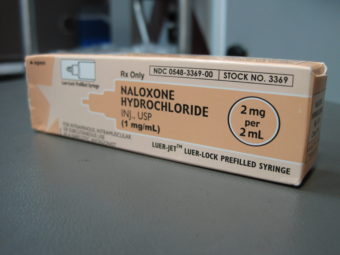
Naloxone HCl preparation, pre-filled Luer-Jet package for intravenous administration. (Creative Commons photo by Intropin)

Around the U.S., a worsening heroin epidemic has more and more cities turning to the anti-overdose drug naloxone to reduce deaths from abuse. Also known as Narcan, the medication blocks the effects of opioids and reverses the respiratory depression that occurs during an overdose.

Baltimore recently stepped up its naloxone training, focusing on drug users, and their families and friends. So far this year, city health workers have taught nearly 4,400 people how to use naloxone. That’s more than quadruple the number trained in 2014.

A big concern for Baltimore and other cities is the price of naloxone, which has risen dramatically as demand has gone up. In February, the Baltimore City Health Department was paying about $20 a dose. By July, the price had climbed to nearly $40 a dose.

Maryland Rep. Elijah Cummings, ranking member of the House Oversight and Government Reform Committee, places the blame squarely on the manufacturers and, in particular, Amphastar Pharmaceuticals, the company that makes the naloxone most widely used by health departments and police.

“When drug companies increase their prices and charge exorbitant rates, they decrease the access to the drug,” Cummings said this summer. “There’s something awfully wrong with that picture.”

Amphastar says it raised prices because of increased manufacturing costs, including a rise in the prices of raw materials, energy and labor.

Naloxone isn’t a new drug. It was first approved by the Food and Drug Administration in 1971 as an injectable medication, used primarily in hospital settings.

Today, Baltimore and other cities are choosing intranasal naloxone for community use — naloxone that can be sprayed into the nostril and doesn’t require needles. The intranasal delivery method isn’t explicitly approved by the FDA. Amphastar is currently the only company that makes naloxone in a dosage that can be administered that way.

Daniel Raymond is policy director for the Harm Reduction Coalition, which advocates for broader access to naloxone. He discussed naloxone pricing over the years, the changing market for the drug and what it means for prices and competition. Here are highlights, edited for length and clarity, from a conversation with All Things Considered‘s Audie Cornish.

On the price of naloxone a decade ago

When we started following this issue, it was over 10 years ago, and for the injectable naloxone it was about a dollar a shot. Each vial was dirt cheap. So it’s been a really dramatic increase over a fairly short period of time.

On how the market for naloxone has changed

Emergency rooms have traditionally been the main purchasers of naloxone. It’s also used by anesthesiologists, and it’s been used on some ambulances. So it was typically a hospital market. The hospital would buy in bulk, and there wasn’t a whole lot of prescribing going on.

Now we’ve got over 40 states that have passed laws facilitating access to naloxone, and have first responders carrying it and community distribution. That’s the majority of the country that’s moving in this direction of making naloxone more accessible.

On intranasal naloxone and potential new competitors

Amphastar is currently the only manufacturer in the U.S. who makes the dosage of naloxone used for intranasal administration. They have no competition. They can set whatever price they want, and almost a year ago, they decided to almost double that price. It’s hitting programs and health departments and first responders across the country really hard.

There are a couple companies that saw the need for an FDA-approved intranasal naloxone device. They’ve designed new devices that they’ve submitted to FDA for approval. So, I’m hoping by the end of the year, we’ll have one or two other intranasal naloxone devices available. The challenge will be whether these companies decide they want to compete on price, or they just want to take a share of the market.

On Evzio – the naloxone auto-injector

What the makers of Evzio — a company called kaleo — thought about was: Can we make something that your grandmother could use? So they designed this cartridge that’s an auto-injector. It actually talks you through the process of reversing an overdose. Now, they needed to do the research to show they had the right dose, to show that people could actually follow the instructions and use it without any training at all. And they needed to do all the manufacturing and assembling. So those R&D costs start to add up. The costs of the production line start to add up. Their gamble was, if they could take the complexity of educating somebody out of the picture, then they could drive more doctors to prescribe this.

On pharmaceutical companies’ pricing strategies

I think their choice in front of them is that they can have a narrow market at higher prices, or a much broader market at lower prices. Either way, they’re going to making money. The latter way, they’re saving more lives.

NPR and All Things Considered will continue reporting from Baltimore in the coming months, checking in with Baltimore Health Commissioner Leana Wen and her team periodically. Stay tuned for future stories.

Copyright 2015 NPR. To see more, visit http://www.npr.org/.
Read Original Article – Published SEPTEMBER 10, 2015 3:33 PM ET


Kenai Peninsula doctor promotes opioid overdose antidote

At the Ninilchik Tribal Council Community Clinic, Dr. Sarah Spencer is looking to make a dent in the number of opioid overdoses on the southern Kenai Peninsula. She’s advocating an antidote called Naloxone that is proven to counteract the effects of opioids. She wants to give naloxone kits to patients who are at risk.

Opioids are either naturally derived from the opium poppy or they’re man-made, synthesized from natural opioids. Examples of synthetic opioids are heroin and prescription painkillers like oxycodone. According to the National Center for Health Statistics, in 2013 16,000 Americans died from a prescription opioid overdose and 8,000 died of heroin overdose.

Dr. Sarah Spencer Explains Benefits of Naloxone. (Photo by Quinton Chandler/KBBI)

“The states that have the biggest program that distribute these kits like in Massachusetts where the kits are widely distributed among community members who have an interest in trying to help … they’ve shown that they’ve reduced their overdose death rates by approximately half,” says Spencer.

Spencer works at the clinic, the emergency room at South Peninsula Hospital in Homer and she’s also working in addiction medicine at the Homer Medical Clinic. She says overdoses are relatively rare in these small communities, but they happen often enough.

“I think all doctors who have worked in the emergency room in the last year have seen at least one or more overdoses come in. Hopefully if the person makes it to the emergency room we can save their [life]. But, we’ve had a few deaths in the community from people accidentally overdosing so if we can save one of those people by having those kits available that would be great,” says Spencer.

Overdoses are unpredictable. They can potentially kill in just a few minutes or their victims could live for a matter of hours.

“What happens is they become very sleepy and their breathing slows down sometimes stopping completely but sometimes just slowing down so much the person can’t get enough oxygen in. They turn blue and eventually when you don’t have enough oxygen then you die,” says Spencer.

Having naloxone kits on hand will give the friends and family of overdose victims a chance to reverse those symptoms immediately. Armed with tales of naloxone’s success in the Lower 48, Spencer is introducing the antidote to her co-workers at the Ninilchik Clinic. She and a handful of her colleagues are seated in a semi-circle around a small tray holding the naloxone.

“This is a trainer for it like there [are] trainers for the epi-pen,” says Spencer.

Spencer is demonstrating how to use the most expensive option, an automatic injector. The white and black trainer has a kind of rectangular shape and fits easily in Spencer’s palm. It’s biggest perk…it talks its user through the injection. The price might push people away from the auto-injector, but it’s not the only choice. The naloxone itself is a clear liquid and it also comes in a transparent vial that can be attached to a syringe. The medicine is then injected or it can be squirted up a person’s nostrils. This route means more steps, but it’s much cheaper.

“If you’re going to be paying cash at a local pharmacy, if you don’t have insurance, you’re going to be paying between $80 to about $120 for the medication. And it is covered by many insurances,” says Spencer.

Spencer stresses the naloxone kits are most effective if their users have practiced and know exactly how to assemble and deliver the antidote before they’re faced with an overdose.

“If you overdose you’re going to be unconscious and you can’t help yourself. So the key thing is to have patients when they get the kit, they take it home, and sit down and read the instructions with their friends and family members,” says Spencer.

Naloxone is now available at the clinic in Ninilchik. Spencer says there are a few local pharmacies on the Southern Peninsula carrying the kits, and they’re also available at the Homer Medical Clinic. She’s eventually hoping to have the kits for overdose patients who come into South Peninsula Hospital’s emergency room.

“Previously we didn’t really have anything to offer them when they left the emergency room other than counseling them to see a counselor and try not to let it happen again. As far as being able to give them a kit to use in case of emergencies that hasn’t been an option,” says Spencer.

Spencer encourages anyone struggling with addiction to reach out for help. She says there is hope and community resources they can lean on.

Site notifications
Update notification options
Subscribe to notifications