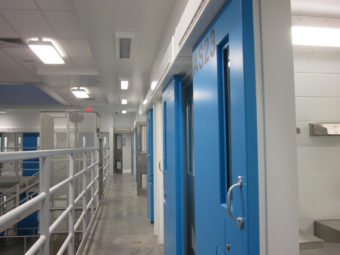
Gastineau Human Services’ new Mount Juneau Counseling and Recovery building on Oct. 24, 2024. (Photo by Yvonne Krumrey/KTOO).
Gastineau Human Services officially opened the new Mount Juneau Counseling and Recovery building in Lemon Creek on Thursday.
The social services nonprofit’s additional facilities also feature an additional 8-beds in its substance use treatment center that offers residential services to now serve up to 27 people at a time.
Gastineau Human Services Executive Director Jonathan Swinton said four of those beds have already been occupied for a week, and the counseling center has been in operation for longer.
“We’ve been running in this building for a couple of months now, but just being strategic to find time we could do this formal ceremony,” he said during Thursday’s ribbon cutting.
This comes a month after Bartlett Regional Hospitalʼs Rainforest Recovery Center shut its doors. This new addition replaces half of Rainforest’s former capacity. Bartlett donated furniture from its program to GHS for the new program.
The new residential facility was originally slated to open in January, but opened earlier to fill the gap left by Rainforest’s closure. Swinton said they are still trying to fill some staff positions.
GHS already offers transitional housing for people experiencing homelessness and who were recently incarcerated.
Board President Forrest Clough said GHS has expanded rapidly to try to meet Juneau’s needs for more addiction and mental health treatment.
“What we’ve seen over the course of the last couple years here is really a big expansion of our services and trying to meet unmet needs in the community, trying to break out of what we were doing and what we’ve been doing for years,” Clough said. “And not stop doing those things, but expand on that to meet the community’s current needs, and being able to step in and fill some of the holes that have been left as service providers have dropped out.“
Swinton also showed off an undeveloped parcel of land that will be developed into a 51-bed residential center on campus. The City and Bureau of Juneau gave GHS $2 million for this future expansion.
This story has been edited to clarify the additional facilities and services GHS now offers.
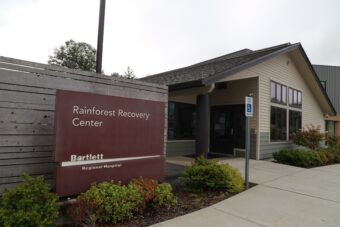
Rainforest Recovery Center on Tuesday, Sept. 17, 2024. (Clarise Larson/KTOO)
Bartlett Regional Hospital has operated the high-intensity substance misuse treatment program at Rainforest Recovery Center for over two decades.
The 16-bed facility has allowed Juneau residents and others in Southeast Alaska to access treatment faster, without having to travel to places like Anchorage or Seattle.
But this spring, the hospital shared that the program, along with a handful of other services, was draining money and contributing to a financial crisis that could close the hospital. Rainforest was expected to lose close to $800,000 next year.
In June, the hospital’s board of directors agreed that if it can’t secure subsidy money or find a third party to take over the program by the end of October, then it would be eliminated. But, late last week the hospital shared with staff that the center would be closing much earlier — by next Tuesday.
Joe Wanner, the hospital’s chief financial officer and soon-to-be CEO, explained the decision to the Assembly at a meeting Monday night.
“Rainforest is open through the 23rd. We’re actively discharging patients due to staffing shortages in the program,” he said.
Some Assembly members, like Christine Woll, were taken aback by the news. Earlier this month, the Assembly discussed and indicated support to give the hospital $500,000 toward continuing the program through next June during a finance committee meeting.
“I hear the comments about not having enough staff in this current moment. If someone could walk me through how we got from not having enough staff in this current moment to closing the program permanently, that would be helpful,” she said Monday.
Wanner said that since June, nine staff members at Rainforest have resigned. Kim McDowell, Bartlett’s chief nursing officer and chief operating officer, said that’s in large part due to the uncertainty of the program’s lifespan.
“I think that when you have any period of uncertainty, especially for staff, they have to make what decisions is best for their families,” she said. “People decided that they needed to move on and look for different work.”
Without enough staff, McDowell said it puts patients at risk. The center currently has four patients, but they will be discharged before Tuesday. McDowell said one will finish their program before then, and the other three patients will seek treatment elsewhere.
Rainforest Recovery isn’t the only treatment facility in Juneau. Gastineau Human Services is a nonprofit that helps people affected by homelessness or addiction. Jonathan Swinton is the executive director of Gastineau Human Services. He told KTOO on Tuesday the facility plans to partner with the hospital to expand its 19-bed substance misuse treatment program in the coming months. That program opened last year and plans to have 27 beds by early next year.
“We’re in discussions right now with Bartlett to contract with them to provide an increased level of medical assistance to the residents in our treatment program, with the goal being that those in need in the community will still get the level of service that they have been through the Rainforest program,” he said.
Rainforest’s impending closure comes after the hospital closed its crisis care unit in July. It was a program designed to offer immediate care to adolescents in crisis. The hospital had only started offering the service last December. Hospital leaders said the closure was also due to a lack of funding and staff.
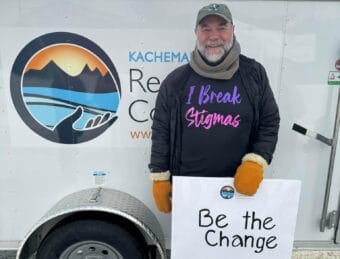
Willy Dunne, vice president of Kachemak Bay Recovery Connection, stands in front of their mobile recovery unit. The organization will use funds from the state’s opioid settlement to open a center in downtown Homer and staff it. (Photo courtesy of Kachemak Bay Recovery Connection)
Alaska’s Division of Public Health announced 18 organizations in the state that will get grants as part of the National Opioid Settlement. The grants will fund programs to help communities address the state’s increasingly-deadly opioid epidemic.
Kachemak Bay Recovery Connection, an organization based in Homer that provides resources for people in recovery, is one of the grant recipients. Willy Dunne, the organization’s vice president, who is in long-term recovery himself, said the $142,742 grant will fund peer support specialists, people with lived experience trained in support.
“They can relate to people in early recovery in ways that other clinicians might not be able to relate,” Dunne said. “So, that lived experience has been shown to be a very valuable tool in helping people expand and strengthen the recovery from substance use disorders.”
Dunne said the grant will also allow the organization to open a physical space in downtown Homer and to expand the reach of their mobile unit to communities further from Homer like Seldovia and Port Graham.
Set Free Alaska, another organization receiving $285,714 from the settlement funds, is a Christian organization that serves Alaskans in recovery, regardless of religion. They have outpatient centers in Wasilla and Homer.
Jason Manalli, their development director, said the grant will help expand their telehealth capabilities to reach more people in the Mat-Su borough, Kenai and Soldotna.
“Over the last couple of years, we’ve actually refined our practice and our service line to be able to provide quality service through telehealth, and it’s provided us a great opportunity to be able to reach people that we wouldn’t be able to reach in person,” Manalli said.
The funds came from settlements with Johnson & Johnson and three major pharmaceutical distributors, companies that contributed to the opioid epidemic nationally and in Alaska. According to the division of public health, the grants represent just under $3 million annually for three years, totaling about $8.5 million.
The money Alaska has from settlements is tiny compared to the real cost of the opioid epidemic in the state. In a recent report, the Alaska Mental Health Trust Authority estimated that the opioid crisis cost Alaska about $400 million in just one year. That estimate factors in loss of productivity due to addiction and loss of life for the hundreds of Alaskans who die every year from opioid overdose.
The organizations funded are the Alaska Behavioral Health Association, the Bethel Family Clinic, the Camai Community Health Center, the Aleutian Pribilof Islands Association, Southeast’s Kin Support Program – Haa Yatix’u Saiani, Petersburg Medical Center, Prince of Wales Health Network, Norton Sound Health Corporation, Maniilaq Association, Mat-Su Youth Housing, Set Free, Sunshine Community Health Center, Interior AIDS Association, Central Peninsula General Hospital, Kachemak Bay Recovery Connections, Akeela, Alaska’s Children’s Trust, and Volunteers of America Alaska.
Gov. Mike Dunleavy on Monday announced a new state awareness campaign called “One Pill Can Kill,” aimed at addressing the fentanyl crisis in Alaska. (Wesley Early/Alaska Public Media)
Alaska officials have announced a new awareness campaign aimed at highlighting and combating the growing danger of the synthetic opioid fentanyl.
Gov. Mike Dunleavy and U.S. Sen. Dan Sullivan announced the “One Pill Can Kill” campaign at an Anchorage news conference Monday. Sullivan said that Alaska’s 40 percent increase in drug deaths from 2022 to 2023 was larger than any other state.
“Alaska is under attack,” Sullivan said. “In 2023, opioids killed more Alaskans than ever before.”
More than 340 Alaskans died from an overdose last year, and state health officials say about three out of every four deaths were due to fentanyl. Last year, state troopers seized 721 pounds of illegal drugs, including about 183 pounds of fentanyl.
“That is potentially 41-and-a-half million potential overdose deaths,” said Capt. Cornelius Sims with the Alaska State Troopers’ statewide drug enforcement unit.
Dunleavy said the campaign will focus on educating Alaskans about the risks of fentanyl and how prevalent it is in the state, as well as resources available for people struggling with substance misuse. He said he’s hopeful that the state will reach as many Alaskans as possible.
“We’re going to check our protocols to see what additional things we need to do with outreach,” Dunleavy said. “The social media platforms have evolved immensely in the last couple of years as well. So we’ll be having that conversation as well.”
Part of the funding for the campaign comes from the $58 million settlement the state received from several major pharmaceutical companies.
During the news conference, Dunleavy also pushed for legislators to pass House Bill 66, a bill he sponsored that would increase the penalty for drug dealers selling fentanyl from manslaughter to second-degree murder.
“If your activity has baked into it the death of innocent Alaskans, you need to be prepared to pay the consequences,” Dunleavy said.
State lawmakers have until midnight on May 15 to pass the bill during the regular legislative session.
Crosses represent opioid overdose deaths in Alaska at a 2023 event in Anchorage organized by the David Dylan Foundation. (Rachel Cassandra/AKPM)
More Alaskans died from an opioid overdose last year than ever before, according to preliminary data, and the state reported the nation’s highest per capita increase in opioid overdose deaths.
The numbers are heartbreaking, said Lindsey Kato, the director of Alaska’s Division of Public Health. She said overdose deaths can have a ripple effect of grief, especially in smaller communities.
“I’ve lost many friends to the opioid epidemic, family members, etc.,” Kato said. “Personally these numbers are absolutely heartbreaking. Professionally, these numbers are heartbreaking. But I also know that we’re up against a lot.”
There were 342 fatal opioid overdoses reported in Alaska in 2023, according to the division. That’s about a 45% rise from the year before. The increase comes as Alaska scrambles to respond to an epidemic that continues to shift form.
The first wave of the opioid epidemic stemmed from overprescription of painkillers, and in the second wave, people already addicted shifted to heroin when prescription pill supply was reduced. This current, third wave is driven by synthetic opioids like fentanyl. It’s up to a hundred times more potent than morphine and supply is seemingly unlimited compared to drugs like heroin or cocaine which rely on crops and are limited by growing seasons. In a state without enough access to substance abuse treatment, Alaskans remain vulnerable to both addiction and overdose.
But organizations throughout Alaska are working to reduce the number of people dying from overdose, through education, connection to services and distribution of Naloxone and Kloxxado, which can reverse an overdose temporarily.
Kato said the state gave out more than 46,000 overdose reversal kits last year and without those, she said, the number of people dying would have been higher.
“I don’t want those that have been working so hard in this space to feel like they have not accomplished something,” Kato said. “I think the one thing I found out in this field is that we hardly [ever] get to know the number of lives that we save.”
Kato said opioid reversal drugs are essential for reducing deaths; most overdoses happen with someone else present.
Dr. Sarah Spencer, an addiction medicine specialist in Ninilchik, said she’s noticed most of her patients now combine methamphetamine with fentanyl, which can be more risky. She said it’s a common misconception that stimulants like methamphetamine can keep someone from overdosing on opioids.
“Fentanyl in particular is like a very incredibly potent, super fast acting respiratory depressant,” Spencer said. “A stimulant [is] not able to make a difference in that. It’s just not strong enough to actually help to keep the person awake.”
Spencer said people sometimes take fentanyl in a powder form but most often in counterfeit blue pills. Seven in 10 counterfeit pills in the country now have a potentially-lethal dose of fentanyl and she said people can overdose when smoking fentanyl too.
Spencer said many populations within Alaska don’t have enough access to addiction treatment including people who are incarcerated. She said the state doesn’t do a good job of getting medications for treating opioid addiction to them and it would be one of the biggest ways to reduce overdose rates in the state.
“They are 120 times more likely to die [in the] first two weeks that they’re released,” Spencer said. “It would reduce our state’s entire overdose rate if we had universal availability of medication for opioid use disorder throughout a person’s incarceration, and that warm handoff to treatment afterwards.”
In 2022, 11% of overdoses in the state were people recently released from incarceration and those numbers haven’t been released yet for last year.
Kato said that’s something on the Division of Public Health’s radar and they hope to strengthen relationships with the state’s Department of Corrections. She also said the state needs to think beyond just reducing deaths, and look at prevention.
“How are we focused on helping people thrive, not just keeping people alive?” Kato asked. “How do we go a little bit more upstream in our prevention, and think more about how we can keep people healthy?”
The state plans to release final data on opioid overdoses in Alaska in September, including which demographics were hit hardest. Kato said she also wants to look carefully at how youth are impacted.
Bottles of wine line shelves at a Fred Meyer grocery store in Anchorage on June 29, 2022. A bill pending in the Alaska Legislature would require posted warnings about the links between alcohol consumption and cancer. (Yereth Rosen/Alaska Beacon)
The link between alcohol and cancer has been established by medical professionals since the 1980s. But public awareness of that link is low.
A bill pending in the Alaska Legislature aims to change that.
The measure, House Bill 298, would require businesses that sell alcoholic beverages post signs warning of the cancer link. The cancer message, as proposed by the bill, would augment the currently required message warning that consumption of alcohol during pregnancy can cause birth defects.
The bill has no sponsors from the Republican-dominated House majority, and there is no Senate version. The prime sponsor, Rep. Andrew Gray, D-Anchorage, said he had minimal expectations about its fate when he introduced it in January. “When we filed it, we expected to not get a hearing at all,” he said. To at least raise awareness about the alcohol-cancer link, he said, he issued a press release.
Then, as he describes it, something surprising happened: The bill started to move. “Lo and behold, we got a hearing,” Gray said. It got another hearing and advanced from the House Health and Social Services Committee to the House Labor and Commerce Committee.
Gray and his aide David Song discussed the public-awareness gap during a hearing on Monday in the second committee.
“Alcohol-related cancers affect tens of thousands of Americans each year. Despite the longstanding medical fact that alcohol increases cancer risk, there has not been an accompanying change in public perception about the risks associated with alcohol consumption,” Gray told the committee.
A 2020 survey by the National Institutes of Health found that 10% of respondents believed that wine drinking lowers cancer risks, which is false, Song told the committee. The cancer link for beer, wine and liquor consumption was acknowledged by only 24.9%, 20.3% and 31.2% of survey respondents respectively, he said. In contrast, about 90% of Americans say tobacco use causes cancer, a message imparted in warning labels required on tobacco products, he said.
“So, in other words, the warning labels that connect a product with cancer do work in terms of increasing public awareness,” Song said.
Along with tobacco use and obesity, alcohol use is one of the main cancer risk factors over which people have some control. The American Cancer Society links alcohol use to numerous types of cancer.
The bill introduced by Rep. Andrew Gray, D-Anchorage, would replace the sign on the left, which is required by state law, with the new design on the right. Gray titled his bill the Alcoholic Beverages and Cancer Act. (Graphic provided by Alaska Legislature)
A recent study published in the medical journal The Lancet that evaluated global cancer statistics ranked alcohol use as the No. 2 modifiable cancer risk.
Warning signs about the alcohol-cancer link are required in a few places. One is the Yukon Territory in Canada, Thomas Gremillion, director of food policy at the Consumer Federation of America, told the committee. His organization favors a national rule requiring such signs as well as state efforts such as this bill, he said.
But there is also skepticism about the idea.
House Majority Leader Dan Saddler, R-Eagle River, at a House Health and Social Services Committee hearing on March 12, said he has philosophical problems with the bill.
“The question that comes to my mind is: How much obligation does the state have to inform people of the risks of legal activities?” Saddler said.
The same arguments about alcohol’s cancer-related risk warnings could be made for injury-warning signs on bikes, cars, private airplanes or roller skates, Saddler said, presenting questions about whether there is a threshold for such warning requirements.
“They are good-intentioned. But the road to, say, a ‘cotton-wool’ state could be paved with good intentions,” he said, using a term for bandages used over-protectively.
Gray said a constituent of his, a breast cancer survivor, brought up another concern: Although only a light drinker, he said, she worried that she and others might be blamed for bringing their cancers on themselves.
Those objections notwithstanding, Gray said the bill might attract support from majority members. “I think there’s a chance that we could get it to the floor,” he said. If not, its substance could be added to a different bill, he said.
An amendment passed in the House Health and Social Services Committee that seemed to simplify the measure may have created a hurdle, however. The amendment changed the on-site requirement from three signs, as currently is in law, to two. Instead of requiring two separate signs warning against minors’ unlawful entry and use of alcohol, the bill as amended would combine warnings about minors into a single sign.
Replacing just one set of signs – the point-of-sale warning about health effects — would have cost under $10,000, too little to warrant a fiscal note describing costs to the state, Gray said. But replacing two types of signs, along with the need to mail new signs to remote sites, brings the estimated cost to around $25,000, Joan Wilson, executive director of the Alaska Alcohol and Marijuana Control Office, said at Monday’s hearing.
That is enough to justify a fiscal note and, according to legislative rules, consideration by the House Finance Committee, Gray said.
“If I wanted this to go to the floor, I’d want to avoid Finance, which means I’d want a zero fiscal note,” he said.