Alcohol & Substance Abuse

Alaska House passes bill to increase jail time for fentanyl and other drug crimes

Rep. Mike Cronk, R-Tok, speaks in favor of a bill that would increase the penalties for certain drug offenses. (Lex Treinen/Alaska Public Media)

The Alaska House passed a bill Thursday that would increase penalties for people who distribute fentanyl, other opioids and methamphetamine. It would also increase the penalties for people who distribute a broad class of drugs to teenagers and to mentally incapacitated people.

The legislation comes as overdose deaths related to fentanyl — a powerful synthetic opioid — surge in Alaska. According to the state health department, 145 people died of fentanyl overdoses in 2021. That’s a more than 400% increase in four years.

Some legislators, including Rep. Will Stapp, R-Fairbanks, spoke passionately about the need to increase penalties for drug dealers.

“If individuals come in to our state and want to distribute a substance as deadly as fentanyl and somebody dies, prison is where they deserve to be,” he said.

The bill approved by the House was initially introduced by Gov. Mike Dunleavy’s administration. It says a person can be charged with second-degree murder if they distribute opioids including fentanyl and methamphetamine that result in someone dying of an overdose. The maximum prison sentence would be 99 years. Previously, it was considered manslaughter.

Some legislators argued the bill was too broad, since the penalties for distribution would also apply to drugs other than fentanyl, such as oxycodone, which is more common. Rep. Jennifer Armstrong, D-Anchorage, said there’s no evidence that stricter jail sentences reduce overdoses.

“Drug-induced homicide prosecutions have significant unintended consequences by deterring people from calling 911 when they witness an overdose for fear of being found in some way complicit,” she told the House.

Research by the Pew Charitable Trust shows that stricter drug laws don’t have any effect on drug use or overdoses.
The plan to ramp up penalties for distributing drugs to people under 19 and mentally incapacitated people also drew criticism, since it includes a wide array of drugs — classified by the state as Schedule IA to IVA — some of which are commonly used — like Adderall or non-addictive drugs like psychedelic mushrooms. People can now face a felony charge for distributing any of the drugs in that category.

The bill ultimately passed by a 35-5 vote, with most Republicans and some Democrats voting in favor of the bill. It now goes to the Senate, with less than a week left in the legislative session.

A Sitka-based treatment program for Alaska teenagers is moving to Juneau

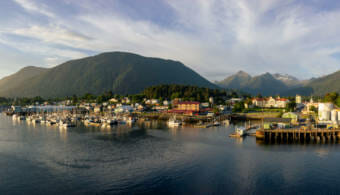
Panorama of Sitka in August 2015 (Photo by David Purdy/KTOO)

A Sitka-based residential treatment program for Alaska teenagers is moving to Juneau.

Raven’s Way treats teens who have been diagnosed with substance use or dependence. It’s operated by the Southeast Alaska Regional Health Consortium. But sometime later this year, the program will merge with Juneau Youth Services, which SEARHC is in the process of acquiring.

SEARHC’s communications director Lyndsey Schaefer said the details are still being ironed out, but SEARHC offered jobs to all Raven’s Way staff.

“80% of the current Raven’s Way staff in Sitka, have been offered positions in Sitka as well, because we are going to use the space that’s vacated by Raven’s Way — the buildings there in Sitka — to expand our adult substance use treatment program,” Schaefer said. “The remaining staff that were not offered positions in Sitka have been offered positions at the new Raven’s Way campus in Juneau. So there isn’t anyone that was not offered a position.”

Schaefer said this means Sitka’s adult substance use program will effectively double in size as well.

Like Raven’s Way, Juneau Youth Services provides residential treatment for teens, as well as therapeutic foster care and case management. Schaefer said it’s too soon to say exactly what combination of services will continue to be provided, but once the purchase of Juneau Youth Services is finalized, it will be known as the Raven’s Way campus.

“Regardless of where it is, Raven’s Way has been very important and very impactful. We understand that,” Schaefer said. “Youth outside of Southeast Alaska will have a direct route to get to Juneau, which will allow us to expand the program reach and impact, and I think that’s a great thing.

Raven’s Way was in the news this time last year when SEARHC closed Crossings, a wilderness program for at-risk youth based in Wrangell which was one of the community’s largest private-sector employers. At the time, four of the 16 staff members were offered jobs at Raven’s Way, and the other 12 were offered “commensurate positions” in Wrangell.

Because SEARHC is still in the process of acquiring Juneau Youth Services, the timeline for the move to Juneau hasn’t been nailed down yet. But Schaefer said the class of teens that graduates from Raven’s Way this April will be the last group to complete the program in Sitka.

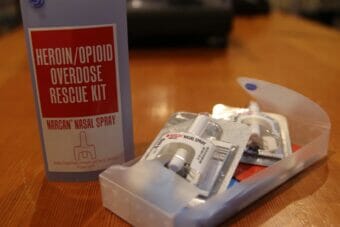
Narcan to be available over the counter soon, though questions remain about cost

(Emily Kwong/KCAW)

The overdose-reversing drug Narcan soon will be available over-the-counter. The U.S. Food and Drug Administration said this week it approved the product for use without a prescription, with the goal of reducing opioid deaths and making it easier for people to access the life-saving emergency medication.

It will be a while before Narcan is available on pharmacy and grocery store shelves. The FDA estimates it could take months to jump through some regulatory hoops.

But Shari Conner with Change 4 the Kenai said she thinks having it available over-the-counter will help reduce stigma and help Alaskans stay prepared. Conner is the project coordinator with the local coalition, which works to prevent substance abuse on the Kenai Peninsula.

“Really, no one’s immune from having an overdose in your home,” Conner said.

She said anyone who takes an opiate prescription following a surgical or dental procedure has access to opiates, in their house. Having Narcan on hand, she said, is like having a fire extinguisher nearby.

“As Alaskans, we have a little kit of emergency stuff that we take out camping and fishing,” Conner said. “It’s just a safety measure, just like anything else.”

Narcan contains 4 milligrams of naloxone– a medication that quickly reverses the effects of an opioid overdose.

It comes in a nasal spray, and since 2015, has been available by prescription. Today, there are emergency kits around Alaska at libraries and health centers. On the Kenai Peninsula, there are kits available at Kenai Public Health and the Change 4 the Kenai building, for example. Alaskans can find emergency kits in fish processing plants and other high-traffic areas, through Project Gabe. And many emergency service providers carry the drug with them — as well as the more powerful Kloxxado, which contains an 8-milligram dose of naloxone.

It’s been an especially important tool as the state’s drug overdose death rate has shot up. Alaska saw the largest percent increase of any state from 2020 to 2021, according to data from the Alaska Department of Health. A big culprit has been fentanyl, a synthetic opioid that’s more potent than other narcotics.

Conner said there’s still a lot to learn about the way over-the-counter Narcan will be rolled out.

But she said Wednesday’s approval is a good step forward.

“I think we’re going in the right direction, for sure,” she said. “I just wonder what the cost will be.”

Today, prescription Narcan is available in a two-dose pack for less than $10 when it’s not covered by Medicaid or private insurance. But over the counter, those prices could be much higher, health economists and advocates warn — especially when it remains the only over-the-counter overdose reversal drug on the market.

Conner said her organization, Change 4 the Kenai, is hosting an emergency Narcan kit-building event soon. She says they’re trying to plant more Project Gabe boxes across the community, as well, to make Narcan as ubiquitous as possible.

Bill would add second-degree murder charges for drug dealers in Alaska overdose deaths

""
The Alaska State Capitol on April 22, 2022, in Juneau, Alaska. (Photo by Rashah McChesney)

Citing Alaska’s high mortality rates associated with drug overdoses, Alaska Gov. Mike Dunleavy is seeking harsher criminal penalties for people who make or supply controlled substances that cause someone’s death. Under the legislation, prosecutors would be able to charge drug dealers and drug manufacturers connected to the death with second-degree murder, exposing criminal defendants to longer sentences and eliminating early release.

Several family members of individuals who’ve died from substance poisoning support the bills. However, the ACLU of Alaska has raised concerns about the legislation’s effectiveness and its potential to undermine public safety.

On March 27, the House Judiciary Committee approved one version of the legislation, House Bill 66, and sent it to the finance committee. On Friday, the Senate Judiciary Committee held its version, Senate Bill 64, for further review.

Broadly known as drug-induced homicide laws, other states have adopted similar measures. But critics of the policies say harsher sentences aren’t meaningful deterrents for manufacturers and dealers, and may actually prevent friends and family from calling 911 for help during an overdose out of fear they may be arrested.

Current Alaska state law allows for manslaughter charges in drug-related deaths. The call for increased penalties comes as the state grapples with a spike in overdose deaths, leaving grieving families desperate for accountability and insistent for an end to the epidemic.

In 2021, 253 Alaskans died from a drug-related overdose, an increase of nearly 74% over the prior year, according to the Alaska Department of Health. Data published by the department in July 2022 show overdose deaths have risen every year since 2018, driven largely by fentanyl and methamphetamine.

“That’s an increase that demands the attention of the leaders in Alaska,” Deputy Attorney General John Skidmore told the Senate Judiciary Committee during a Mar. 22 hearing.

Alaska law already provides for a charge of manslaughter in instances where someone knows they are involved in a crime, and someone dies as a result of that conduct.

Increasing the penalty to second-degree murder would mean a longer minimum sentence — 20 years instead of four to seven years — and could potentially result in a life sentence.

“It allows us to pursue those individuals that peddle these poisons to our citizens more aggressively,” Skidmore said as he presented the bill.

Sandy Snodgrass fights back tears as she described her the death of her son from a fentanyl overdose, speaking at a May 3 news conference in Wasilla on fentanyl abuse and efforts to combat it. She recently testified in favor of House Bill 66, which would allow Alaska prosecutors to charge drug dealers and drug manufacturers connected to overdose deaths to be charged with second-degree murder. (Photo by Yereth Rosen/Alaska Beacon)

“Until we have all the tools that we can bring to bear on this, they’re going to continue to kill Alaskans,” said Sandy Snodgrass, whose son, Robert Bruce Snodgrass, 22, died in 2021 from fentanyl poisoning.

“This law, I think, is one of the tools that can be used in prosecutions to negotiate with lower-level drug dealers,” she told the committee.

Snodgrass explained she’d hoped the law would be used to go after drug trafficking organizations, and not friends and families of the deceased who may themselves be struggling with addiction or substance misuse.

Snodrass wasn’t alone in urging lawmakers to pass the bill.

Stacy Eisert’s son, Jason, 41, a high school English teacher, also died from fentanyl poisoning in 2021.

“My son’s death was an act of homicide by those persons who knowingly manufactured or delivered a controlled substance to Jason. There isn’t a prison sentence for these individuals that can compare to the prison sentence that I have been in that I endure every day,” Eisert said during her testimony to the Senate Judiciary Committee.

“Every person who sells drugs is aware that fentanyl could be laced in the drugs. So I implore you to vote yes,” said Karen Malcolm Smith, speaking after Eisert. “Because we’re losing a generation,” she said,

In 2017 Smith’s son, David Dillon, 25, died from an overdose.

Skidmore said drug-induced homicide cases can be difficult to prosecute, because it requires proving that the drugs were a direct cause of a death. Prosecutors also need to be able to connect those drugs back to specific individuals who made or supplied them.

“Our ability to prosecute those cases is very, very limited,” Skidmore said during the hearing. “I’m not asking you to change the challenges for us in presenting them. What the bill does ask you to do is to authorize a greater penalty to be associated for the people who engage in that conduct.”

In a letter filed in opposition to Senate Bill 64, ACLU of Alaska Advocacy Directory Michael Garvey asked lawmakers to take note of the bipartisan U.S. Commission on Combating Synthetic Opioid Trafficking, which he said does not recommend new or increased sentences.

The legislation “is more likely to be used against people with substance misuse issues and people seeking help than high-level drug dealers, and will deter people from calling for medical assistance. Eighty percent of people incarcerated in Alaska have a substance use disorder. This bill will make that problem worse,” wrote Garvey, who also criticized the elimination of “good time,” which he said would disincentivize rehabilitation.

Good time is a path to early release by following rules and participating in required activities during incarceration. In Alaska, good time makes defendants eligible for up to one-third off their prison term.

The group Fair and Just Prosecution, an organization of elected prosecutors focused on justice reforms, has also deemed such prosecutions as problematic. “These prosecutions undermine Good Samaritan laws, potentially increase the risk of overdose deaths, exacerbate racial disparities, and consume limited law enforcement and criminal justice resources,” the group wrote in a recent report on Drug-Induced Homicide Prosecutions.

The Senate Judiciary Committee has not announced a date for the next hearing on the bill. A hearing for the House version in the finance committee also hasn’t been announced.

This story originally appeared in the Alaska Beacon and is republished here with permission.

Alaska fentanyl dealer gets 21 years in federal prison

The James M. Fitzgerald U.S. Courthouse & Federal Building in downtown Anchorage, pictured here on a rainy day, August 31, 2022. (Valerie Kern/Alaska Public Media)

An Anchorage man has been sentenced to more than two decades in federal prison for his role in a 10-state ring distributing fentanyl and other drugs, which federal prosecutors say was controlled by Mexican ringleaders.

Dustin Noonan’s 21-year sentence was handed down following a guilty plea to charges of drug and money-laundering conspiracy, according to a Friday statement from U.S. Attorney for Alaska S. Lane Tucker’s office.

“From March 2018 through October 2020, the leaders of the organization regularly mailed large amounts of drugs to distributors throughout the country, including mailing parcels to Noonan in Anchorage, and deposited hundreds of thousands of dollars of drug proceeds into various bank accounts,” federal officials wrote.

The stiff prison term comes amid a broad-based push by all levels of Alaska law enforcement to fight fentanyl trafficking. Nearly 2.5 million doses of the deadly drug were seized statewide during a campaign last summer according to Alaska State Troopers. The surge of fentanyl has prompted Anchorage police to begin carrying overdose-reversing Narcan spray, as state authorities began distributing even stronger doses of a similar drug.

Noonan was originally arrested by Anchorage police during a June 2020 domestic-disturbance call. Police recovered a .45-caliber pistol from his vehicle, which Noonan – who had been convicted of 2006 knifepoint robberies at St. Petersburg, Fla. pharmacies – was legally prohibited from owning.

In 2021, Noonan was among eight Americans and two Mexicans charged in the drug investigation. Prosecutors say the drug ring spanned 10 states including Alaska, with law enforcement recovering six kilograms of heroin, plus four kilograms each of fentanyl and methamphetamine.

“Over several months in 2020, investigators intercepted five drug parcels intended for Noonan, which together contained one kilogram of fentanyl and nearly 800 grams of heroin that Noonan planned to distribute throughout Alaska,” federal officials wrote. “The kilogram of fentanyl that Noonan intended to distribute was enough to kill 500,000 people.”

Five other defendants in the case are awaiting sentencing, with three more receiving sentences ranging from 70 months to time served. One defendant – Mexican national Victor Pompa-Villa – is still at large.

Ketchikan tribe’s business arm eyes ‘healing center’ to help with opioid crisis

A preliminary design for the proposed “10-mile project” that would include a substance abuse treatment center. (Photo courtesy of Camille Booth).

Ketchikan Indian Community owns a swath of land about 10 miles north of downtown, in the Mud Bight area. It’s been set aside for years, and the tribe’s new business arm is working to turn it into something big: what it calls a “healing center” for community members — Native or not — with substance abuse issues.

Ketchikan — and Southeast Alaska as a whole — has seen a steep rise in opioid-related deaths in the last few years. State health officials tallied 23 opioid-related deaths in Southeast in 2021 — the last year that data is available — and eight were in Ketchikan, with two in nearby communities.

Advocates have long rallied for more treatment options for the island. Ketchikan Indian Community President Norman Skan says that’s the problem the tribe hopes to address.

“About two years ago, we just saw the trend of opioid use just getting out of control — in not only in our community, but outlying communities,” Skan said. “And we felt like we needed to do our part to help the individuals out.”

It’ll be the first major project for the Ketchikan Tribal Business Corporation, essentially the business arm of the tribe. The corporation is a so-called IRA Section 17 Corporation, named for the section of the Indian Reorganization Act that sets out the rules governing it. It’s wholly owned by the tribe but operates separately. An online statement says that the corporation’s mission is “to develop Ketchikan Tribal Business Corporation into a stronger, healthier, and more prosperous organization that continues to reach higher levels of economic competitiveness.”

Camille Booth is the corporation’s operations manager.

“It gives us the benefits of being tribal with also being able to build revenue in other streams and other areas,” she explained. “So it’s very much our economic development arm.”

Booth said the corporation is “somewhat comparable” to regional and village corporations set up by the Alaska Native Claims Settlement Act. But instead of distributing profits to shareholders, dividends could potentially go to Ketchikan Indian Community members.

“Just like with any corporation, then, once the company is profitable, … dividends are likely, but the company has to be profitable before dividends are offered,” she said.

The corporation has three divisions — commercial, real estate, and government contracting.

Booth said the real estate division will focus on leveraging the tribe’s existing properties. The government contracting division could provide a variety of services.

“That could be an IT areas, it can be environmental services, it can be in procurement, there’s all sorts of areas of government contracting,” she said. “There’s all sorts of contracting that fit our type of effort.”

The healing center is part of a larger initiative dubbed “the 10-mile project,” from the corporation’s commercial division. The corporation hopes to develop the property with alternative housing for people in recovery, single-family homes, trails, and even tourist attractions and art installations.

“It’s very much the big vision. … In phases, of course,” Booth explained. “So the first phase would be the healing center and actually the substance use disorder center with housing for that sort of a transitional type housing, and then the next then it would build into the business area and then into additional housing out there because it is a very large property, too.”

John Brown is the corporation’s vice chair.

He said work is still in the beginning stages and the 16-bed inpatient treatment center — let alone everything else sketched out for the property — won’t open its doors for at least three years.

“They purchased the property and came up with, you know, and again, this was a long standing thing that he wanted to try to accomplish,” Brown said. “And so we are, we are part of that process. And so we’re in the process of, again, we’re putting ourselves in place, so we can do stuff. And then the next phase is ‘OK, how much funding do we need, who do we need to contact’ — those types of things.”

Details are a bit hazy in this early phase of the project, but Booth said she hopes the project will support community members in every stage of their recovery.

Site notifications
Update notification options
Subscribe to notifications