Alcohol & Substance Abuse

Public can weigh in on how Alaska should use millions of opioid settlement money

Bottles of opioid pills, drugs
Members of the public have until 5 p.m. on Friday, Sept. 30, to submit written comments on what the state should do with the settlement.(Creative Commons photo by K-State Research and Extension)

The Alaska public has a chance through the end of September to weigh in on how the state should spend its share of a landmark settlement over pharmaceutical companies’ role in the nation’s opioid epidemic. The total amount coming to state and local governments in Alaska is $58.5 million from drug manufacturer Janssen/Johnson & Johnson, along with three other companies.

A state advisory council has made draft recommendations on how a large portion of that money should be used to help Alaskans recover from opioid abuse and addiction. Members of the public have until 5 p.m. on Friday, Sept. 30, to submit written comments. You can also give verbal comments during a virtual public comment session from 3 p.m. to 4 p.m. on Thursday, Sept. 29.

Anchorage Sen. Tom Begich is a member of the Governor’s Advisory Council on Opioid Remediation, which produced a report with draft recommendations on how the settlement money should be used. The council started deliberating in December 2021.

Begich said public comments are important and hopes a wide range of Alaskans look at the report: “Those who have had relatives who have suffered from opioid abuse or if they themselves have – they should be looking at this for sure because they are directly impacted by this.”

“If you are an agency or an entity that is dealing with opioid addiction, you should be looking at this. If you’re an employer who might have an insight into how opioid addiction is affecting your workplace, you should look at this. And frankly, any public entity ought to be looking at it as well,” he said.

According to the report, Alaska, in 2021, experienced the largest percent increase in overdose deaths of any state in the United States, losing at least 253 people to overdose, with 196 deaths attributed to opioid overdose.

Begich said the council had lengthy discussions on what the best process would be to create the most sustainable approach to opioid addiction.

In the settlement, the money would be distributed over the next 18 years. Of the State of Alaska’s share of the settlement, the council recommends accepting a one-time lump sum payment instead of the smaller future payments. That money would be deposited into a new account, along with any supplemental legislative appropriations made during the 2023 legislative session, and invested.

“You could either take the money for 18 years at approximately $2 million a year or you could do a lump sum payment, which is slightly less, but would allow you to invest it and then take the money out, like a dividend if you will, sort of very similar to the dividend concept,” Begich said.

The lump sum payment option would allow the money to last even after 18 years have passed, he said.

“We could produce roughly anywhere from initially $1.5 million to $1.75 million to eventually, as the thing grew, as much as $2 million or $2.5 million annually in perpetuity to address opioid addiction, opioid approaches,” Begich described.

Another recommendation outlined in the report is for the Legislature and governor to support a one-time state general fund match up to 100% of the opioid settlement amount.

The report recommends that the state Department of Health be responsible for allocating and distributing the funds. “The council would work with the department to develop the process for equitable allocation that accounts for the diverse geographic and demographic makeup of Alaska,” the report says.

The report also has recommendations on how to choose which evidence-based and culturally appropriate opioid remediation activities to fund and on how to incorporate feedback from Alaskans on the overall process. Read the full report here.

Written and verbal comments on the recommendations in the report will be reviewed by the council in October. The council may incorporate the comments in its final recommendations.

This story was originally published by the Alaska Beacon and is republished here with permission.

Her son died of an overdose in Anchorage. Now she’s pushing for city police to carry Narcan.

Anthony Brotzge marches near Anchorage Police Department headquarters on Aug. 2, 2022, with a sign showing Bruce Snodgrass, who died from fentanyl poisoning last October. (Wesley Early/Alaska Public Media)

As opioid deaths climb rapidly in Alaska, the medication Narcan has been touted as a life-saving tool to combat overdoses. While many police departments across the state use Narcan, the Anchorage Police Department — the state’s largest law enforcement agency — does not.
Sandy Snodgrass wants that to change.

Snodgrass became an advocate for Narcan after her 22-year-old son Bruce died of fentanyl poisoning in Anchorage last October. She said she’s shocked that Anchorage police aren’t required to carry the overdose reversing drug. She spent four hours on Tuesday handing out Narcan kits to people in front of the police department’s downtown headquarters, as part of a rally she planned to demand the department change its policy.

“Since I learned that APD does not carry Narcan, I’ve been rolling up on APD officers any chance I can get and asking them if they’d like a Narcan kit,” Snodgrass said. “And they all want Narcan kits. I’ve yet to speak to an officer that does not.”

Snodgrass said she gave 25 Narcan kits to officers as they walked in and out of the building on Tuesday.

Sandy Snodgrass is an advocate asking for Anchorage Police to carry Narcan with them to combat fentanyl overdoses. (Wesley Early/Alaska Public Media)

“One of whom commented, ‘Why are you here?’ I said, ‘We’re here to ask APD why they’re not carrying Narcan kits,'” Snodgrass said. “She said, ‘That’s a good question.'”

Snodgrass’ call for police to start carrying Narcan comes as Alaska opioid-related deaths skyrocket, with recent numbers from the state showing a 70% increase from 2020 to 2021. Roughly three in every four opioid overdose deaths in the state were related to the synthetic opioid fentanyl.

“For the average person, two milligrams of fentanyl will kill you,” said Michael Troster, executive director of Alaska’s High Intensity Drug Trafficking Areas unit. The organization is part of a federal program that coordinates with local, state and federal agencies to reduce drug trafficking.

Troster said Narcan is a major tool for fighting fentanyl overdoses. Narcan is the brand name for the reversal drug naloxone.

“It’s an opiate antagonist,” Troster said. “So unless you have opiates in your system, the way it was described to me, it would be like shooting water mist up your nose.”

He said a majority of law enforcement agencies across the country carry and administer Narcan.

“Alaska is pretty much the same as the rest of the country,” he said. “Most of them have it, but there are places everywhere that don’t.”

Alaska State Troopers use it, as does the Wasilla Police Department. Recently, Village Public Safety Officers in Southeast were trained to use it, too.

Anchorage police officials declined several interview requests earlier this week about the department’s Narcan policy.

In an email, an Anchorage police spokesperson said that while the police department doesn’t use Narcan, the fire department — which houses the city’s medics and Mobile Crisis Team — does.

“The most important component of saving a life is establishing airflow which is accomplished through CPR,” wrote APD spokesperson Renee Oistad. “We live in an area where both APD and AFD response times are quick. Should APD arrive on scene first, administering CPR is the proper response until AFD arrives to assess the situation.”

But change may be coming to the department.

At a meeting on Wednesday, amid increasing calls that police carry Narcan, Anchorage Police Chief Michael Kerle said the department will reconsider its policy, reported the Anchorage Daily News. He said he planned to coordinate with a medical advisor and the city’s legal department, but cited hurdles of training, cost and safety concerns.

“Everyone’s coming out of the woodwork to give free Narcan right now. Once that’s over, Narcan is like, $37.50 a dose, and we need to come up with a funding source,” Kerle said at the public safety meeting. “It’s going to be expensive, and the majority of that’s going to get thrown away because we’re not going to use it.”

Recently, a nonprofit called Project HOPE sent hundreds of kits to the police department, only for them to be returned, which is how Snodgrass got them for her Tuesday rally.

“So the interesting thing about the Narcan that I brought today,” Snodgrass said. “They’re the Narcan kits — 100 of the 600 Narcan kits — that were returned from APD. I have them today.”

Outside of Anchorage police headquarters, roughly 20 people joined Snodgrass in her protest, waving signs with messages like, “Reverse an overdose, save a life” and “Why won’t APD carry Narcan?”

One of the demonstrators was Anthony Brotzge, a former day supervisor at the now-closed Sullivan arena mass homeless shelter. He said he had to administer Narcan before at work. He also has used Narcan in his personal life, when his wife Rebecca had an overdose.

“My wife, back before we got clean, if it hadn’t been for Narcan, we would’ve lost her,” he said. “But we had it, and she’s still here because of it.”

While Anchorage police say their response times are quick, Snodgrass said sometimes they aren’t quick enough.

“I know, last week, of an incident that occurred on Lake Otis and Tudor,” Snodgrass said. “A man had gone unconscious, unresponsive behind the wheel of his car. APD again did CPR on the man. Fire department arrived 10 minutes later with Narcan. The man passed.”

Troster, with Alaska’s High Intensity Drug Trafficking Areas unit, said Narcan would ideally be available everywhere, similar to the prevalence of automatic external defibrillators.

“Until we wrap our hands around the scale of the problem, the treatment of the victims, Narcan’s just got to be so available that you don’t have to sit and wait until the people with it show up,” Troster said.

As for Snodgrass, she said she’s going to continue advocating for Narcan use, so other people don’t meet the same fate as her son Bruce.

“I know that Bruce would not want anyone else to die the way that he did, so my end goal is that APD provide lifesaving Narcan to people that may die,” said Snodgrass.

In addition to the advocacy in Anchorage, a bill meant to raise national awareness of the growing dangers of fentanyl titled Bruce’s Law has been brought forward by U.S. Sen. Lisa Murkowski.

Report details Alaska demographics hurt most by 2021 spike in drug overdose deaths

Alaska Health Commissioner Adam Crum stands behind a lectern
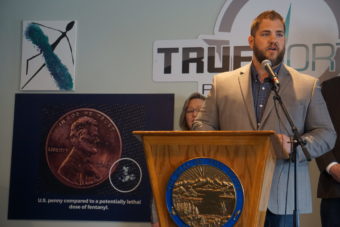
Alaska Health Commissioner Adam Crum, speaking about fentanyl at a May 3 news conference in Wasilla, uses a chart to show that even a tiny amount of the synthetic opioid can be fatal. Behind him is Sandy Snodgrass, the mother of a 22-year-old fentanyl overdose victim, Bruce Snodgrass. The rate of fentanyl-related overdose deaths increased by 150% from 2020 to 2021, according to a new report issued by the Alaska Department of Health. About three-quarters of the state’s opioid deaths last year involved fentanyl, often in combination with other drugs, according to the report. (Photo by Yereth Rosen/Alaska Beacon)

In Alaska, the state with the nation’s biggest increase in drug overdose deaths from 2020 to 2021, certain demographic groups have been at higher risk, according to a newly released report: men more than women, Alaska Native people more than other ethnic groups and Anchorage and Gulf Coast residents more than those in other parts of the state.

The report, issued Thursday by the Alaska Department of Health’s public health division, also highlighted the risks of certain types of drugs and drug combinations.

In all, Alaska’s overdose fatalities spiked by 74% in that one-year period, rising from 146 in 2020 to 253 in 2021, the report said. That increase was largely driven by ingestion of fentanyl, a synthetic opioid, and methamphetamine, a psychostimulant, it said. The rate of deaths for overdoses involving fentanyl increased by 150% in that single year, and the death rate for overdoses involving methamphetamine increased by 148%, the report said.

Drug mixtures were involved in most of the overdose deaths since 2017. In those years, 58% of the deaths were in cases where victims combined drugs from more than one narcotic, sedative or psychotropic category, the report said. About a third of the fatalities during that period were of people who had mixtures from at least three categories of drugs.

That record shows a need for more education about the risks of combining substances, the report said.

In particular, fentanyl was involved in nearly three-quarter of the opioid deaths, many of which also involved mixtures with methamphetamine or heroin, it said. “The high potency of fentanyl combined with the tendency for mixing or co-use with other substances complicates intervention and treatment efforts,” it said.

Among demographic groups, the overdose rate for males was 42.9 per 100,000, compared to 26.9 per 100,000 for females, the report said.

A bar graph showing overdose deaths in Alaska from 2012 t0 2021. The highest number before 2021 is 146. The number of overdose deaths in 2021 is 253.
Alaska drug overdose deaths, as tracked from 2012 to 2021 by the state Division of Public Health. The graph is from the division’s 2021 Drug Mortality Overdose Update. (Graph provided by Alaska Division of Public Health)

For Alaska Native and American Indian people, the 2021 overdose rate was 77.7 per 100,000 people, compared to a 2021 rate of 28.8 for white Alaskans. For both Indigenous and white Alaskans, overdose death rates increased substantially from 2020 to 2021. For Black Alaskans, the death rates rose slightly from 2020 to 2021. For Asian/Pacific Islanders and Hispanics, the total overdose death numbers were too small to discern a trend.

Within Anchorage, the 2021 overdose death rate was 49.3 per 100,000 people, compared to the statewide rate of 35.2. The Gulf Coast had Alaska’s second-highest regional rate for 2021 overdose deaths at 40.3 per 100,000 people. The Gulf Coast includes the Kenai Peninsula and Kodiak Island boroughs and the Chugach and Copper River census areas.

The age groups with the highest rates for overdose deaths are young adults 25 to 34 years old and middle-aged adults 45 to 54 years old, according to the report.

The statistics can be used to help guide prevention and response programs, the report said. “Engaging with people at high risk of overdose is key to preventing more deaths,” it said.

The statistics in the report are preliminary. The 2021 number may not be complete and could change, the report said.

Village public safety officers get opioid response training in Juneau as statewide overdose rates climb

Two men in a classroom studying a piece of paper
Michael Betts and Logan James-Lee discuss CPR compression techniques at an opioid response training at the Generations Southeast building in Juneau, AK. July 21, 2022. (Photo by Claire Stremple/KTOO)

Michael Betts is a village public safety officer for the community of Hydaburg on Prince of Wales Island. Under the fluorescent lights of a classroom, he knelt in front of a life-sized dummy that he was told was overdosing on opioids.

Betts checked his pulse.

“Hey man,” he said, giving the dummy a shake. “He’s not breathing.”

Betts quickly unwrapped a package of naloxone nasal spray, stuck it in the dummy’s nose and sprayed.

“You’re always going to want to call 911 once you administer that Narcan,” a trainer from the fire department tells him. “When it kicks in, they’re going to go into immediate withdrawals.”

Betts is the only first responder who lives in the community of 400 people. He said he knows a lot of opioids are trafficked into Hydaburg and then distributed to the rest of Prince of Wales Island, but he hasn’t had to resuscitate a real person with naloxone yet.

“Everybody probably has Narcan in their purse, in their glove box, somewhere in their house in a drawer,” Betts said. “A lot of times we don’t even get called. We hear about it the next day.”

Betts and eight other people came to Juneau to take part in an opioid overdose response course offered by Central Council of Tlingit and Haida Indian Tribes of Alaska with funds from a federal grant. The classroom role play is meant to prepare him and other VPSOs for an overdose situation, where they’re likely to be the first person on the scene.

Alaska has the fastest rising opioid overdose rate in the nation. More than 200 Alaskans died from overdoses in the last year.

""
Participants prepare to give Narcan to a dummy. (Photo by Claire Stremple/KTOO)

Jason Wilson runs the public safety department for the Central Council of Tlingit and Haida. He says VPSOs are the definition of first responders. 

“They’re not just law enforcement,” he said. “They’re also EMTs. They’re also the ambulance drivers. They’re the fire chief, or they’re a part of the fire department. They’re a big part of the search and rescue within a community. They’re animal control within a lot of our communities.”

The Central Council of Tlingit and Haida runs the VPSO program for the Southeast Alaska communities of Kake, Angoon, Pelican, Saxman, Hydaburg, Thorne Bay and Kasaan.

“Being able to respond to overdoses is really important to the Tribe, and in our communities. So we’re pretty excited about this,” Wilson said.

They’re not just learning how to treat a health emergency; they’re also learning how to police narcotics. One of the instructors Central Council brought in is Chris Cuestas, a former police detective and a national drug expert.

He said Alaska is seeing a peak in opioids, especially fentanyl, and that the state has the same distribution patterns and the same underground market network of narcotics as he sees nationwide.

“The challenge is how do we minimize their influence in communities and villages in Alaska,” he said.

That’s a challenge because these remote communities are small and have few law enforcement resources. But Cuestas said it’s also a strength. He thinks the VPSO program is ahead of the national curve because individual officers  have so many roles.

“You are actually able to participate in some of the prevention and intervention,” he said. “Even the community education components to reduce some of the risk factors in the community.”

He said that’s the direction he expects a lot of law enforcement agencies in the Lower 48 to take.

US death toll from drug overdoses is rising fast among Black and Indigenous people

""
More than 91,000 people in the U.S. died from drug overdoses in 2020. There were sharp increases among certain racial groups, a new report finds. (Photo by Jeff Chiu/AP)

Historic rises in drug overdose deaths are disproportionately affecting Black and Indigenous people in the United States.

A new analysis from the Centers for Disease Control and Prevention using data from 25 states finds that fatal overdoses increased by 44% among Black people in 2020 compared with the year prior.

The jump in drug overdose deaths was almost as sharp for American Indian and Alaska Native people — groups that together saw a 39% increase over the previous year.

The steep rise in deaths among Black and Indigenous people far outpaced what was seen among white people during the same time period. That group had a 22% year-over-year increase in drug overdoses in 2020.

Reports finds stark disparities by age and income

The CDC report points out that these differences in overdose deaths can’t be fully explained by patterns of substance use.

“The disproportionate increase in overdose death rates among Blacks and American Indian/Alaska Native people may partly be due to health inequities like unequal access to substance use treatment and treatment biases,” Dr. Debra Houry, acting principal deputy director at the CDC, told reporters on Tuesday.

Altogether, more than 91,000 people died because of drug overdoses in 2020, a historic rise of 30% compared with the year before.

While white people had the largest number of overdose deaths that year (more than 26,000 people), the rate of increase in deaths was the highest among Black and Indigenous people, a trend that has been documented in other recent studies.

The CDC analysis found that the disparities were even starker among some age groups in these populations.

Speaking to reporters at a briefing, the CDC’s Mbabazi Kariisa, the main author of the report, said, “Younger Black people, 15 to 24 years old, had the largest increase in overdose deaths — 86%.”

And the death rate among Black men 65 and older was seven times that among white men in the same age group.

The report also found that counties with the highest income inequality had the highest rates of overdose deaths, especially among racial and ethnic minority groups.

“Among Black people, overdose [death] rates in counties with the most income inequality were more than twice those of counties that had less income inequality,” said Kariisa.

Income inequality is known to have a bigger impact on the lives of minorities, she added: “This can lead to lack of stable housing, reliable transportation and health insurance, making it even more difficult for people to access treatment and other support services.”

No evidence of treatment among many who died

Kariisa and her colleagues also found that members of racial and ethnic minority groups were the least likely to have had access to treatment for substance abuse.

“The percentage with evidence of prior treatment for substance use was lowest for Black people, at 1 in 12,” said Kariisa.

Among American Indian, Alaska Native and Hispanic people, only 1 in 10 had received substance use treatment in the past, she said. “In fact, most people who died by overdose had no evidence of getting substance use treatment before their death.”

The dramatic rise in overdose deaths is largely driven by illicitly manufactured fentanyl, “including for people using other drugs like cocaine or methamphetamine who may not know they are being exposed to these potent and deadly opioids,” said Houry, referring to fentanyl contamination in illegal drugs.

Addressing fentanyl in the drug supply and historical socioeconomic inequities will be key to addressing these disparities, she added.

Houry stressed the need for wider availability of substance abuse treatment services and harm reduction measures, such as naloxone — a medication that can reverse an opioid overdose — and fentanyl test strips, which allow users to tell whether the drug they’re using contains fentanyl.

“Some prevention strategies will have more immediate benefits, while others will have longer-term and sustained effects,” she said.

Copyright 2022 NPR. To see more, visit https://www.npr.org.

State to put opioid emergency kits in seafood plants and harbors across Southeast Alaska

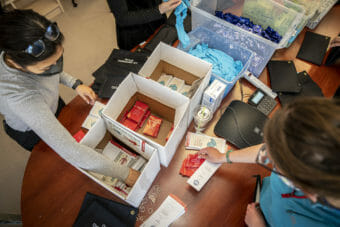
Public health nurses and volunteers fill opioid emergency kits in Juneau. June 10, 2022. (Photo by Claire Stremple/KTOO)

A group of about a dozen state health nurses and volunteers met in Juneau on Friday to assemble opioid emergency kits for fish processing plants in Southeast Alaska.

They’re red metal boxes full of the overdose-reversing drug naloxone, sharps containers, fentanyl test strips, rubber gloves and CPR masks.

The kits are part of a new state Department of Health and Social Services program to prevent opioid overdose deaths among industrial workers, starting with Southeast Alaska fisheries.

Sitka public health nurse Denise Ewing is spearheading the project. Its goals are raising awareness around opioid overdoses, educating people about the risks of fentanyl and providing industrial workers with overdose prevention resources.

The initiative is called Project Gabe. It’s named for Ewing’s son, Gabe Johnston, who died of an opioid overdose this January.

“Our son struggled with opioids for many years, and we went through that struggle with him,” she said.

Ewing’s partner and another one of her sons have both worked in seafood processing.

“When he passed, it was something that we wanted to do together,” said Ewing. “We’ve got to stop this — this is stoppable, but it’s going to take a long time — if I have to give a one-on-one education to every person.”

So Ewing decided to try to get her message out across the seafood industry.

She started in Sitka, where she’d build relationships with fish processing plants as a state nurse during the pandemic. She said at first she thought it would be hard to sell the idea because of the stigma that surrounds opioids and addiction. But processors and employees were on board.

Ewing educated new hires about opioids at their start-of-the-season orientation meetings. She talked about the risk of fentanyl, a potent and cheap synthetic opioid that’s been driving record overdose rates in the state.

After her talks, she said employees shared stories with her of the people that they knew who passed away from opioid abuse.

She mounted opioid emergency boxes with life-saving naloxone in the same locations at each plant.

Project Gabe will install opioid emergency kits in seafood processing plants in Southeast Alaska. June 10, 2022. (Photo by Claire Stremple/KTOO)

“Seafood processors kind of hop from seafood place to seafood place often. So we standardized it so that they knew that if they were in the galley, there was one in the galley. If they knew they were near the fish dock, there was one of the fish dock,” Ewing said.

Mike Duckworth Jr. is the plant manager for Silver Bay Seafood in Sitka. He said when Ewing reached out about Project Gabe, the idea “hit home” for him — a member of his extended family had overdosed, too.

He says there’s around 400 people working at his plant, and they haven’t needed one of the kits yet, but he’s glad to have them as a precaution.

“We absolutely do feel safer,” he said.

“This is my 25th year working in this industry. And I can say that I have been at other plants and facilities in Alaska that, you know, this would have saved somebody’s life.”

Duckworth says he’s expecting all Silver Bay plants in the state to adopt the program.

Juneau Public Health Nurse Sarah Hargrave helped pack boxes with the volunteer crew. She wants to see that success spread across the region.

“What we’re doing now is trying to expand that work regionally. Our goal is to have these mounted and standardized places in seafood processors, and also with docks and harbors across Southeast,” she said.

The group filled about 150 boxes. Some will stay in Juneau, others will go to places like Cordova, Tenakee Springs, Pelican and Gustavus.

The state plans to expand the program to other regions and industries in the future.

Correction: An earlier version of this story misspelled Gabe Johnston’s last name.

Site notifications
Update notification options
Subscribe to notifications