Alcohol & Substance Abuse

Juneau police seized nearly 10K pills believed to contain fentanyl in a string of busts this week

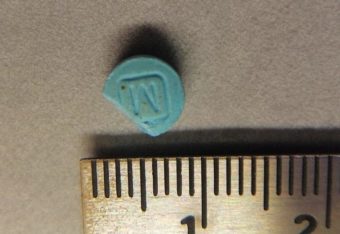
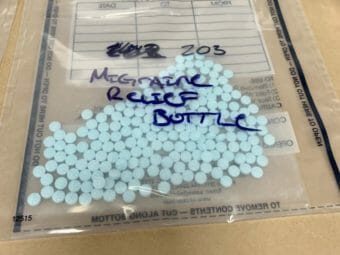
A bag of blue pills labeled "migraine relief bottle"
Counterfeit pills suspected to contain fentanyl seized by Ketchikan police in March 2022. (Photo by Eric Stone/KRBD)

Juneau police and the regional drug task force Southeast Alaska Cities Against Drugs (SEACAD) have made three drug busts in the last five days.

“It’s not typical,” said Lieutenant Krag Campbell. “Especially to have, I mean, it’s a pretty large quantity amount for Juneau — and even Southeast Alaska. And then to have them pretty much back to back like that.”

On Saturday, police arrested a Washington woman at the airport with 4,100 pills believed to contain fentanyl and 55 grams of methamphetamine.

On Monday, police intercepted a Juneau man who received drugs by mail at Harris Harbor. The package contained about 2,640 pills believed to contain fentanyl, plus 134 grams of methamphetamine and 40 grams of heroin.

And on Tuesday afternoon, police arrested two Juneau men at the airport with more than 3,000 pills believed to contain fentanyl and nearly 70 grams of methamphetamine.

Campbell said he’s proud of the work the regional task force does, and he’s grateful for support from the state’s federally funded drug task force, the High Intensity Drug Trafficking Areas program. But he says the real drug crackdown will come from the courts.

“We can arrest 1,000 people, but if the people aren’t held accountable and they’re not given sentences to change behaviors then it’s not that impactful,” he said.

Fentanyl is behind a 71% increase in drug overdose deaths in Alaska from 2020 to 2021. More than 250 Alaskans died from a drug overdose last year. Alaska has the highest rising rate of overdose deaths in the nation.
Alaska has the fastest rising rate of overdose deaths in the country, CDC says

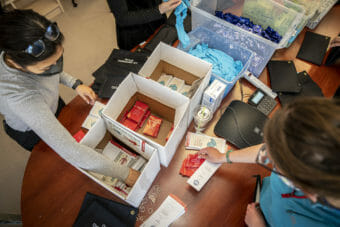
A new shipment of the overdose reversing drug naloxone arrived in Anchorage the last week of April. Test kits now have twice the amount to counteract the effects of fentanyl. The state’s health department recommends all Alaskans carry naloxone. (Image courtesy of Project HOPE.)

Alaska had the highest increase of drug overdose deaths in the nation last year, according to provisional data released by the Centers for Disease Control and Prevention on Wednesday.

Alaska’s rate of drug overdose deaths is usually lower than the national average.

Jessica Filley, with the state’s health department and Office of Substance Misuse and Addiction Prevention, says Alaska is now leading the nation because of the synthetic opioid fentanyl.

“It’s just been a slower process to get up here,” she said. “So I think what we saw happening on the East Coast in 2013 with this surge of fentanyl is just now hitting us up here.”

Alaska’s rate of overdose deaths increased by 75.3% last year, compared to 15% nationally. That’s as national overdose deaths reached an all-time high.

The state’s health department recommends all Alaskans carry naloxone, a drug that can rapidly reverse an overdose.
Overdose deaths continued to rise in 2021, reaching historic highs

""
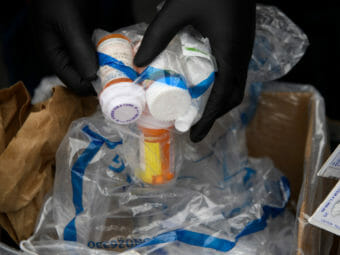
Containers of pills and prescription drugs are boxed for disposal during the Drug Enforcement Administration’s 20th National Prescription Drug Take Back Day on April 24, 2021. Nearly 108,000 people died in 2021 from drug overdoses. (Photo by Patrick T. Fallon/AFP via Getty Images)

New provisional data released by the federal government estimates that nearly 108,000 people died from drug overdoses from January to December, 2021.

“That’s about a 15% increase from the number of deaths in 2020,” says Farida Ahmad, a research scientist with the Center for Disease Control and Prevention’s National Center for Health Statistics. Nearly 94,000 died in 2020.

The year-to-year rise in overdose deaths was much higher from 2019 to 2020, jumping by a historic 30%. While the rise in deaths slowed down in 2021, the total number of deaths is still the highest annual overdose deaths ever recorded in the U.S.

“Over 80,000 of those deaths involved opioids, which was about a 15% increase from last year,” says Ahmad.

And more than 71,000 of all opioid related deaths involved illegally manufactured fentanyl, which in recent years has been mixed in with a range of illicit drugs.

“These past three years we have seen an increase of contamination of other illicit drugs with fentanyl, be it cocaine, be methamphetamine, and more recently, illicit prescription drugs,” says Dr. Nora Volkow, director of the National Institute on Drug Abuse.

This has put a bigger population of drug users at risk of overdoses, she adds. “In many instances, these may be people that take just one pill and they get that contaminated pill and they can die.”

That includes teenagers, she adds, who have until recently been less likely to die from an overdose. A recent study showed that for the first time in a decade, the number of teens who died from overdoses rose in 2020. Volkow and other addiction researchers think it’s primarily because fentanyl is becoming increasingly added into counterfeit prescription drugs, which are popular among this age group.

“It’s absolutely devastating and heartbreaking that we continue to remain in this position,” says Sheila Vakharia, deputy director of research and academic engagement at the Drug Policy Alliance, an addiction policy advocacy group. “We are over 20 years in this overdose crisis and there’s no sign of any kind of slowing down of deaths. If anything, things have only seemed to have gotten more dire.”

In April, the Biden administration announced its plans to address the rising number of overdose deaths, including increasing access to harm reduction methods like Naloxone, the medication that reverses overdoses.

Vakharia says she was heartened to see such “historic” investments in improving access to harm reduction measures.

“Harm reduction has historically been incredibly underfunded and has been relegated to state and local funding or private funding to sustain itself,” she says.

However, a lot more needs to happen to address the scale of the problem, she adds. There are currently just “two legally operating above-the-ground harm reduction overdose prevention centers in the country,” at a time when communities across the country need them, she says.

“And so I think that all of our efforts moving forward can definitely be further enhanced, can be further amplified and further ramped up,” she adds.

Copyright 2022 NPR. To see more, visit https://www.npr.org.

Alaska is fighting a surge in fentanyl deaths with stronger overdose kits

A new shipment of the overdose-reversing drug naloxone arrived in Anchorage the last week of April. Test kits now have twice the amount to counteract the effects of fentanyl. (Image courtesy of DHSS.)

A synthetic opiate called fentanyl is behind a surge of drug overdoses in Alaska. As a result, overdoses in the state have become so deadly that one of the tools used to fight them has changed.

Naloxone is an overdose reversing drug that’s found in opioid emergency kits distributed by the state to places like the Glory Hall, Juneau’s homeless shelter. The shelter had been short on what people casually call Narcan kits — Narcan is the brand for naloxone — for the last several weeks. Luke Vroman and other harm reduction advocates in Juneau were starting to get worried.

But last Friday the shelter received a battered cardboard box filled with new kits. This fresh shipment didn’t contain Narcan at all. It was full of a new brand called Kloxxado that has twice as much naloxone in each dose. This box has fifty kits in it — that’s 100 doses of naloxone.

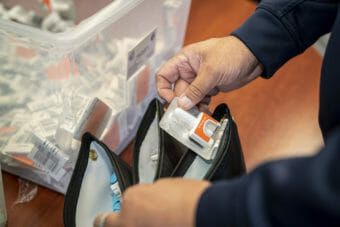
“It comes with two, so it’s like four of the old ones,” said Vronan as he unzipped one of the kits. “Which is good because it is taking more than one for people, you know.”

If you haven’t seen naloxone before, it looks kind of like that allergy spray that goes up your nose. Except instead of reducing sinus inflammation, it blocks or reverses the effects of opioids.

Vroman said it takes a lot more to bring people back from an overdose now that fentanyl is in most of the drugs around here. He’s seeing the effects at the shelter.

“I’ve worked with Glory Hall for two and a half years, and in the last year, I’ve seen 300% more overdoses,” Vroman said. “None of them deadly, thank God. But yeah, just a lot more overdoses.”

Fentanyl is more deadly than heroin because it’s a lot stronger and can precipitate an overdose in really tiny amounts. It exists because there are medical applications for fentanyl where those tiny doses are closely monitored, but it’s really dangerous on the street where there’s no oversight.

Getting that increased dosage of naloxone is part of why these emergency kits were so scarce for awhile — and not just in Juneau, but across the state.

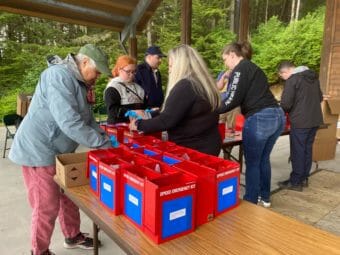
The state packed 3,000 opioid overdose emergency kits and sent them across the state. (Photo courtesy of DHSS.)

Karol Fink, a leader in the chronic disease prevention section of the state’s health department, oversees the state’s supply of free naloxone through a program called Project HOPE.

“About mid February, we were being cautious with the amount of naloxone we sent out to our partners,” she said. “We ran out probably in early March.”

She said finding a higher dosage of naloxone meant the state had to renegotiate with vendors, which took time.

“We also didn’t realize how quickly we were going to run out because there was a surge of opioid deaths in the Mat-Su area, and that really brought attention to the issue,” said Fink.

That meant there was an increase in demand for the kits. Fink said the new shipment of naloxone arrived earlier this month, and the program packed up thousands of new kits to distribute across the state.

They’re needed. Nearly 300 Alaskans died of opioid overdoses last year, and most of those deaths involved fentanyl.
“From a public health perspective, this is unprecedented. And the state of Alaska and health officials, we are very concerned,” she said.

It’s not slowing down, either. The state’s drug task force seized twice as many grams of fentanyl in the first three months of this year than it did in all of 2021.

And, to be clear, the shortage was just of that free naloxone through Project HOPE. People could still get the drug with a prescription.

Dolores Van Bourgondien, a nurse at an addiction treatment clinic in Juneau, traced the explosion of fentanyl in Alaska back to about a year ago. Over the course of two weeks last April, the number of her patients with fentanyl in their urine went from 2% to nearly 14%. She said now it’s more than half.

“What we’re seeing on the street, what we’re seeing in our toxicology, what we’re hearing from our patients, okay, preempts anything that comes out kind of publicly,” she said.

She said naloxone and things like recent drug busts across the state help slow deaths down, but the pace is relentless.

“I think everybody’s who’s involved in this, we — you just feel as if you’re paddling upstream, you’re not making any headway,” she said.

Naloxone is only a short-term fix to the most acute symptom of addiction. It gives people like Van Bourgondien time to connect people who use drugs to the other resources they need for long term recovery — things like treatment, housing and access to mental health care.

Ketchikan advocates call for local, state and federal action to address opioid crisis

A bag of blue pills labeled "migraine relief bottle"
Counterfeit pills suspected to contain fentanyl seized by Ketchikan police in March 2022. (Photo by Eric Stone/KRBD)

Mental health advocates in Ketchikan are calling for local, state and federal officials to do more to address a surge in drug overdose deaths.

Preliminary data from the state health department shows 23 people died of drug overdoses in Southeast Alaska last year, including eight in Ketchikan and two on surrounding islands. While those numbers haven’t been finalized, the data suggests that drug-related deaths in Southeast more than tripled from the year before.

Local advocates put the number much higher — closer to two dozen overdose deaths for Ketchikan alone in 2021.

Deborah Asper works for the Ketchikan Wellness Coalition. She says one part of the issue is the rise of strong, synthetic opioids.

“That’s really what’s kind of tearing through Ketchikan right now is this fentanyl craze,” Asper said.

Opioids were involved in more than 75% of the region’s overdose deaths, and fentanyl played a role in nearly half. Statewide, officials say nearly 60% of fatal drug overdoses involved fentanyl.

Authorities have seized thousands of small, blue counterfeit oxycodone pills containing fentanyl all over the state in recent years, from Ketchikan to Wasilla to Utqiagvik. Gov. Mike Dunleavy recently called on the state Legislature to increase penalties for drug dealers.

But supply is only part of the equation. Asper, who is seven years sober from opioids, says demand for the pills remains strong.

“There are people that look for that potency. I think that especially when I was using, I wasn’t thinking — you never think you’re going to overdose, right? You never think that that’s going to happen to you,” she said.

She says she’d like to see the state expand drug treatment programs within its jails and prisons.

“We have all these people in one area, but we’re choosing not to do anything with them,” she said.

A spokesperson for the state Department of Corrections, Betsy Holley, says some state prisons and jails do offer inpatient and outpatient treatment programs and psychotherapy, and state officials look to place offenders from all over the state in those programs. But state-run correctional institutions in Ketchikan, Juneau and much of rural Alaska don’t offer the same services.

The Ketchikan Wellness Coalition’s director, Romanda Simpson, says housing people recently released from jail would also go a long way towards addressing the crisis. She asked Ketchikan’s City Council on Thursday for funding to expand their reentry transition house from five to 14 beds.

Asper is also pushing for Congress to expand access to non-opioid painkillers with the NOPAIN Act. She says that would offer one more way to prevent addiction or relapse.

“Every time I go to the emergency room, or every time I need pain management, I’m always prescribed opioids,” she said. “I don’t want opioids — that’s not how I want to manage my pain. And so this will open up other options for people who don’t specifically want narcotics.”

Alaska Sens. Lisa Murkowski and Dan Sullivan signed on this week as cosponsors of the legislation.

Gov. Dunleavy speaks out as fentanyl crisis intensifies in Alaska

An overdose rescue kit that Capital City Fire & Rescue distributes to people when they get a 911 call for an overdose in Juneau, Alaska on April 15, 2022. (Photo by Lyndsey Brollini/KTOO)

Overdose deaths increased more than 70% in Alaska last year. The state’s health department says that’s because of the highly toxic synthetic opioid fentanyl. It’s been found mixed with heroin, cocaine and methamphetamine.

In a press conference Tuesday Gov. Mike Dunleavy said the problem is only intensifying. The state’s High Intensity Drug Traffic Area task force seized twice as much fentanyl in the last three months than they did in all of 2021.

“It’s incredibly deadly at an incredibly small dose,” Dunleavy said. “Parents, kids and all Alaskans must understand this poison—and that’s what it is—is in our state in many different forms.”

He said he will work with the state legislature to increase the punishment for drug trafficking and told drug dealers they’re in for a “rude awakening.”

Dr. Tom Quimby joined the governor for the press conference. He directs the Emergency Department at Mat-Su Regional Medical Center, a region hard-hit by overdoses.

“What I see happening every day in our emergency department is that this problem knows no bounds. It crosses all levels of our society. I see people in all socioeconomic classes, all ages, all religions, all races, living in all geographic regions, all political parties who are affected by this,” he said.

Sandy Snodgrass’ 22-year old son died of a drug overdose last fall. She said she would do everything in her power to spare another parent from surviving the death of a child.

“There are many parents that I know personally in this room. It is too late to save their children. But they’re here today to save your children,” she said. “Please help us: carry Narcan. Talk to your children tonight about fentanyl.”

Narcan is a brand of the overdose reversing drug naloxone. The state just received 11,000 more doses that it will give away for free in kits that include fentanyl test strips.

Medication-assisted treatment is also available in Alaska to help people quit using opioids.

Nearly 250 Alaskans died of drug overdoses last year. Six of every ten drug overdoses in Alaska involved fentanyl.

Site notifications
Update notification options
Subscribe to notifications