Claire Stremple

"I support KTOO reporters and guide coverage that informs our community and reflects its diverse perspectives."

When she's not editing stories or coaching reporters, you can find Claire outside with her dog Maya.

What questions do you have for candidates as they compete for your votes this election? 

A sign hangs outside City Hall as the 2024 municipal election nears on Thursday, Sept. 26, 2024. (Clarise Larson/KTOO)

It’s municipal election season. That means the KTOO newsroom is busy building out its annual Municipal Candidate Guide. We pose six questions to each candidate and publish their answers in an easy to read – and compare – format. We hope you’ll look it over as you mull your votes in September and October.

KTOO’s local election coverage is part of our commitment to an informed and engaged electorate in our community. We’ll also cover this year’s local ballot measures and anything else election-related that arises.

And as the KTOO newsroom takes on its municipal election coverage, we want to hear from you. What questions do you have for candidates as they compete for your votes this election? On which issues would you like to hear their policy ideas? Submit your thoughts to us through the form at the bottom of ktoo.org/elections or below.

To hear from the candidates themselves, mark your calendar for Friday, Sept. 19. KTOO is teaming up with the League of Women Voters of Juneau to host and broadcast a live candidate forum. You can catch it live on 104.3 FM.

Bringing you the trusted information you need to vote with confidence is at the core of what we do at KTOO Public Media. Tune in!


Ask KTOO your election questions

As we enter local election season, we’d like to hear from you: what would you like to hear from assembly and school board candidates as they compete for your votes? Send us your questions here and our reporters will answer them!

Name(Required)
Email(Required)
Please let us know what's on your mind. Have a question for us? Ask away.

Newscast – Thursday, April 17, 2025

In this newscast:

  • Tlingit and Haida president calls for unity amid federal uncertainty at tribal assembly in Juneau;
  • Alaska Governor Mike Dunleavy vetoes education funding boost for the second year in a row;
  • Southeast Alaska landslide conference canceled amid federal uncertainty;
  • The future of a federal program that supports rural Alaska schools remains grim; and
  • An eruption at Mt. Spurr is looking less likely than previously forecasted.

State’s fix for Alaska’s food stamp backlog misses the mark, insiders say

Gov. Mike Dunleavy redirected $1.7 million to help replenish food banks because delays in food stamps have strained food aid systems statewide. Ron Meehan, who manages policy and advocacy for the Food Banks of Alaska, said that money should last about six weeks. (Courtesy of Food Bank of Alaska)

Thousands of Alaskans waited months for food stamps from last fall through this winter, as applications built up in the state’s Division of Public Assistance. Thousands more are still waiting.

Gov. Mike Dunleavy signed a bill Friday that will put millions of dollars into a fast-tracked solution to fix the state’s months-long backlog. But advocates and insiders say the emergency funding doesn’t go far enough — and the biggest problems are going unaddressed.

‘Very much a Band-Aid’

The bill will put $3.1 million toward overtime pay and dozens of additional temporary and contract workers. Dunleavy’s proposed capital budget also includes $54 million toward an overhaul of the Department of Public Assistance’s aging computer system.

Those funds come on the heels of $1.7 million that the governor redirected to help replenish food banks because delays in food stamps have strained food aid systems statewide.

Ron Meehan, who manages policy and advocacy for the Food Banks of Alaska, said that money is already in use. Pasta, green beans, corn and trail mix are already loaded on trucks and on their way to food banks across the state.

He said that will make a big difference — but for only about six weeks.

“It’s very much a Band-Aid,” he said. “It’s a very temporary solution. And it’s not meant to fill the full gap. But it puts us in a much better position than we were in before we had it.”

By Meehan’s calculation, if the state usually distributes $348 million a year in food stamps, a four month backlog means roughly $120 million isn’t getting to Alaskans. He said the Supplemental Nutrition Assistance Program, or SNAP, provides at least 10 times as much food as the food bank network does in Alaska.

Meanwhile, state officials say they’ve nearly worked through the thousands of backlogged food stamp applications. But Meehan said the state’s food banks haven’t felt relief yet — many are seeing more demand, especially among working families.

On the Kenai Peninsula, the food bank is averaging three new families a day — some who haven’t used the service in years. In Cordova, the Salvation Army has gone from serving 57 families to 80. And the Fairbanks soup kitchen has served a record number of people every month since last November.

“The people we support are frustrated, they’re confused, and they’re hungry,” Meehan said. “We’ve heard from people that have been watering down soup to feed their kids, eating dog food or simply going days without eating.”

Attrition problem led to a ‘human catastrophe’

People who process benefits like food stamps say all of this could have been avoided. And to set things right, the state needs to figure out how to hire and retain fully trained staff.

State leadership blamed the backup on its old computer system, a deluge of recertifications after pandemic benefits ended and a cyberattack in May of 2021.

“That’s just not true,” said Fred Rapp, an eligibility worker of 15 years who works for the Fairbanks office. “COVID and the computer hack that occurred — the only thing that really did was just finally expose what was actually happening at the division. It made it so that it was not able to really be hidden anymore from the public.”

He said people started quitting in 2010, during the Parnell administration, due to a combination of staff cuts and drastic changes to processes — including abandoning the department’s longstanding case management approach, where eligibility workers worked with assigned families.

And he said the benefits for Tier IV state employees don’t incentivize them to stay. (Teachers and other state workers have described similar problems with Tier IV.)

“We just lost so many really, really smart and good people, because they just weren’t willing to put up with what was going on anymore,” he said. “You gotta keep asses in the seats. If you don’t do that, then everything else that you’re trying to do is not going to work.”

Rapp said he’s been asking elected officials to address the high rates of attrition ever since Gov. Parnell was in office. He said he hears about the effects of his department’s dysfunction every day.

This winter, Rapp said he talked to an elder who couldn’t get food stamps. Her freezer was getting bare, and she didn’t have anyone to hunt for her. She told him she was just hoping a squirrel or a grouse came through her yard so she could cook it, he said.

And the backlog affects other benefits, too. He said he often talks to new mothers caught in the wait for Medicaid. They risk losing postpartum care coverage if they don’t have appointments in the first two months after delivery — but simple address changes can keep people from getting care, and an update can take the division months.

Rapp calls it a “human catastrophe,” which he says could have been avoided if the division had enough staff and could retain experienced eligibility workers.

Rapp said his experience makes him a fast worker. But because so many newer hires quit, long-time employees are thin on the ground. He wants to see the state get serious about retention.

He — and other eligibility workers, who spoke with KTOO anonymously for previous stories — said they’re dismayed to see the state instead put millions into software that has proven to be unreliable.

The system in question is called ARIES, or Alaska’s Resource for Integrated Eligibility Services. Workers say it barely functions.

“The reason why that’s so terrifying to me is because everybody that uses ARIES knows that it’s a junker,” Rapp said. “The best way I can describe it to you is that they were going for building something like a Ferrari, but when they actually opened the hood and put the engine in, it ended up being something like a lawnmower engine.”

When asked about ARIES, the Department of Health spokesperson Sonya Senkowsky said in a statement that “any issues with the ARIES system have been easily addressed and have not had a significant impact on processing the backlogged information.” She said after the investment, the system will function differently, and some Medicaid applications may be automated.

But Rapp said frequent “hiccups” with ARIES lead to delays in getting people approved for Medicaid. Each time the program fails, he has to set that case aside, file a trouble ticket and wait for someone in IT to get things back on track. In nine years, Rapp said he’s seen documentation of at least 70,000 such trouble tickets.

ARIES was supposed to be a tool for processing all the state’s public assistance, but the state only rolled the system out part way. Rapp and other eligibility workers say they have serious concerns about putting all the division’s programs on a system Rapp said “can’t even handle Medicaid.”

More work to be done

“He’s not wrong at all,” said Magen James, a SNAP Outreach Manager for the Food Banks of Alaska. She works closely with state eligibility workers like Rapp to help Alaskans get SNAP benefits.

James doesn’t work directly with ARIES, but she said it was never fully implemented, and that slows workers down.

“They started the migration process, but they never completed it. And so it was wasted funding,” she said.

And she agrees that the state needs to address deep-rooted staffing shortages and invest in retaining fully trained employees. She said she’s found that new, hastily trained staff make a lot of mistakes.

“Many of the [Division of Public Assistance] employees that are staffing their call center, they’re not even trained with the appropriate information,” she said. “We’re consistently having to correct the misinformation that comes out from these front line workers that are just being thrown into the fire.”

She said she’d like to see the state fund some solutions they haven’t tried yet. Alaska is one of only a handful of states that doesn’t use a federal tool that lets families who qualify for certain other benefits automatically qualify for food stamps. It saves eligibility workers time, which translates to state savings, and it’s also proven to help low-income working families.

James also said people should be able to apply online. Alaska is one of only two states that doesn’t have an online application for SNAP. The legislature passed a bill last year that should have had online applications available by last July, but it hasn’t happened. Now the state aims to have it in place by December of this year.

And James said that trying to help people navigate such a dysfunctional system takes a toll on workers, too.

“My entire team is basically dealing with secondary trauma all day long, because everybody that we deal with is hungry and don’t have their benefits,” she said.

James described hearing from people who have to choose between medicine and food while they try to get their benefits straightened out. She hopes the state can turn things around — both for hungry Alaskans and for workers like Rapp who hear these stories and struggle to make things right.

“These people are making decisions between two survival choices. It’s very difficult to hear and to help,” she said.

A rare federal reprimand

Jesus Mendoza Jr. runs the regional United States Department of Agriculture office, where he oversees food stamp programs. He said that Alaska’s backlog is the worst in the western states.

“It is serious, it is very serious,” he said. “There’s a substantial number of Alaska citizens that are not getting benefits.”

He sent a letter back in February to Alaska’s Department of Health Commissioner, Heidi Hedberg, addressing the division’s failures. He asked her to come up with a plan to fix the backlog. Alaska is not the only state with a backlog, but it is the only state to receive such a warning.

“We expect that the state will work as fast as possible to redress the situation,” Mendoza said. “Because if it’s a month, if it is two months, it is too long for recipients not to get benefits.”

He was quick to point out the state’s progress, though, like new contract hires and the $1.7 million that Gov. Dunleavy put toward food banks. But he acknowledges that the computer fixes the state is proposing will take time.

“Replacing an eligibility system is not going to be easy. And it’s gonna take probably more than a year,” he said. “We have to work with the state to make sure that in the meantime, and while we catch up with the backlog, we don’t end up in the same place a few months later down the road.”

But eligibility workers like Rapp say that’s a likely future without a more honest reckoning about the staffing issues.

‘They’ve known about this the whole frickin’ time’

Rapp said he doesn’t want the state to get in trouble, but he sees the need for an intervention with teeth.

“I really do wish that the federal government would step in,” he said. “If they have to start fining the state, if that’s what it is that finally gets the state to pay attention and do the right thing, you know, then maybe they need to consider that.”

Rapp describes himself as a Dunleavy supporter and said he mostly likes Dunleavy’s policies, but he thinks the governor is missing the mark with solutions.

“He could own this thing if he wanted to,” he said. “It’s not like anyone’s going to hold him accountable at the polls.” Dunleavy is serving his second consecutive term, the state’s limit.

Rapp said he tried to warn Dunleavy and the legislature about the dysfunction in 2018, and that neither Govs. Parnell and Walker nor the legislature showed the will to solve the problem, either.

“There should be no more excuses. Excuses are over,” Rapp said. “They’ve known about this the whole frickin’ time. They just chose not to do anything.”

This story has been updated to reflect that Gov. Dunleavy has now signed the fast-track bill.

State experts call Alaska’s maternal mortality rate ‘a call to arms’

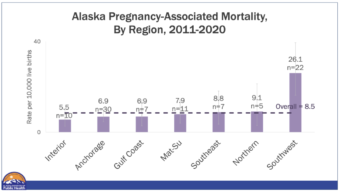
The pregnancy-associated mortality rate in Southwest Alaska was much higher than the rate in Alaska overall. (Maternal Child Death Review Committee/Alaska Department of Health and Social Services)

Maternal deaths went up 40% nationwide in 2021. The rate also went up in Alaska.

Alaska has its own way of measuring maternal mortality, so comparisons to national rates are tricky. But in 2021, Alaska reported its highest number of pregnancy-associated deaths in the last decade — more than double the most recent five-year average.

Ness Verigin leads the Maternal Child Death Review program for the state. They called the increase a call to arms.

“We had a tragic number of maternal deaths and pregnancy associated deaths during that year,” Verigin said.

Twenty mothers died.

The Maternal Child Death Review looks at deaths that happen from the start of pregnancy until one year after a pregnancy ends. Verigin says that in Alaska, most of these deaths don’t happen during labor. Instead, they happen because of violence afterwards. More than half of maternal deaths in the last five years were linked to intimate partner violence – Alaska has some of the highest intimate partner violence rates in the nation.

“Pregnancy-associated deaths due to violence are what we’re really looking at, because that’s where we’re losing most maternal life,” Verigin said. “Even when we’re looking at deaths from overdose and suicide, we more often than not find a history of trauma and violence.”

There’s another factor that may have influenced the spike in maternal mortality in 2021: the COVID-19 pandemic. During Alaska’s delta wave, state physicians spoke out about how overcrowding and rationed care at hospitals had a devastating effect on the maternity ward. And national data shows an uptick in violence against women throughout the pandemic years.

Most maternal deaths in Alaska happen more than 42 days after delivery. Earlier this year, Gov. Mike Dunleavy announced a bill that would extend postpartum Medicaid coverage from sixty days to a full year. The bill would increase access to care for treatable illnesses, like postpartum depression.

The state and grassroots organizations are working to address the issue. Alaska Native women are disproportionately represented among maternal deaths. The Alaska Native Birthworkers Community is a volunteer-led non profit that offers birth and postpartum support to address the disparity.

Verigin also manages a new program that provides free doula support and culturally competent care to pregnant people.

“It’s kind of become the latest big thing: cultural doulas and doula support as maternal mortality prevention — and doula support as violence prevention,” they said.

The program’s aim is to prevent maternal deaths from violence and it expanded from its 2021 pilot program last year. Verigin says they can see that it’s working.

Correction: The graph’s caption has been updated to reflect that the rate of pregnancy-associated mortality in Southwest Alaska is higher than for the state as a whole, not the overall number of deaths in Southwest Alaska.

State tracks a bump in Alaska homicides over the last five years

""
An Anchorage Police patrol vehicle is parked outside the Anchorage Police Department Headquarters on a sunny spring day in early May 2021. (Photo by Hannah Lies/Alaska Public Media)

Yearly homicides more than doubled from 2011 to 2019 in Alaska.

That’s according to the state’s report on the most recent data, which shows that the state’s annual homicide rate increased steadily and significantly over the last decade.

Alaska’s homicide rate is higher than the national average, according to the report. And the national average is high already — more than seven times higher than other high-income countries combined in 2015.

The state makes these reports so epidemiologists and other state agencies can see what is changing with homicide rates in Alaska over time.

“What we saw when we looked at the timeline is that we see about midpoint, this increase,” said Deborah Hull-Jilly, a state epidemiologist that has monitored injury data for more than two decades.  “So what’s the difference? What’s happening there that is impacting homicides, and having more homicide victims in the last five years?”

Five hundred and thirty-two Alaskans were killed from 2011-2020 — most with guns. Homicides by firearm increased substantially in most regions in Alaska over the course of the study.

Alaska Native people were killed at four times the rate of white Alaskans. Men were the most frequent victims, accounting for two-thirds of the homicides in the state. Of female victims, nearly 40% were killed by intimate partners, like current or former spouses.

Nearly half of the state’s homicides took place in Anchorage, which is home to almost 40% of the state’s population.

But Hull-Jilly says there was another metric that mirrored the bump in the rise in homicide rates in the last five years. More than half of homicide victims tested positive for the use of alcohol or drugs — especially marijuana and methamphetamines.

“We have to keep a closer eye and look at … suspect-victim relationships, particularly when it comes to substance use,” she said, noting that if victims are using methamphetamines, they are likely to be around other users, who can become more aggressive under the influence of the drug

“This homicide report is just the beginning of some very good data, working with our law enforcement partners, to see if we can’t identify more information that will aid in the prevention of these cases,” she said.

Homicides account for nearly 20% of the state’s violent deaths — a number that is dwarfed by suicides, which account for about 70% of the violent deaths. The remainder, Hull-Jilly said, are from people killed by police and deaths with “undetermined intent.” The homicides counted in the study are only for closed cases.

The first year of the pandemic was an exception to the other years of the study. While homicides spiked in the rest of the nation, they decreased by more than a third in Alaska.

Site notifications
Update notification options
Subscribe to notifications