Claire Stremple

"I support KTOO reporters and guide coverage that informs our community and reflects its diverse perspectives."

When she's not editing stories or coaching reporters, you can find Claire outside with her dog Maya.
Alaska senator’s fight to regulate ‘forever chemicals’ gets a boost from new federal standards

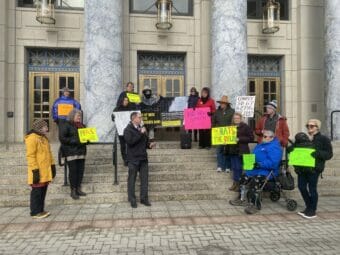
Senator Jesse Kiehl speaks to clean water advocates as they rally for state-level PFAS protections on March 14, 2023. (Claire Stremple/KTOO)

On Tuesday, the Environmental Protection Agency proposed the first ever national limit on PFAS compounds in drinking water.

Known as “forever chemicals” because they don’t break down in the environment, PFAS have been linked to cancer, liver damage and high cholesterol.

The news comes as one Alaska lawmaker continues his fight to regulate the chemicals — which have been found in drinking water from the North Slope to Southeast Alaska — at the state level.

“The most important thing we can do in Alaska today is turn off the tap,” said state Sen. Jesse Kiehl from the Capitol steps at a rally Tuesday in Juneau.

Kiehl represents Gustavus, where PFAS from firefighting foam has contaminated drinking water, soil and berries. His previous bills, which did not pass, sought to regulate the amount of PFAS in Alaskans’ drinking water.

Kiehl’s current bill, SB67, would instead outlaw firefighting foams that contain PFAS and require the use of alternatives that do not contain the chemicals. The foams are typically used on fuel fires at airports.

“The way it’s gotten into Alaskans’ drinking water is firefighting foams,” he said. “We don’t have heavy manufacturing in the state that has discharged this stuff. We don’t have people getting their drinking water downgradient from landfills where there might be a bunch of this stuff. It really has been firefighting foam.”

He said the EPA announcement is great news, but he still wants to stop contamination before any more gets in drinking water.

“I still need to pass this bill to prevent any new spills of this stuff into Alaska’s environment,” he said.

Health effects in Alaska

On the Capitol steps Tuesday, a group of demonstrators rallied in support of Kiehl’s bill.

Michelle Meyer was diagnosed with what her doctors called a rare form of leukemia when she was in her late 50s. She grew up in Yakutat, where PFAS contamination from firefighting foams has been documented.

“I drank the water at my elementary school for years, and it was contaminated, so I am coming to terms that I can probably attribute it to my exposure,” she said. “I want to see this bill pass so that no more children are exposed to PFAS contaminated water.”

PFAS chemicals are linked to cancer, among other negative health effects, but it is hard to attribute specific illnesses to them because they accumulate in the system over time.

Meyer’s son Connor joined her on the Capitol steps. He said he will never forget the pain of seeing his mother so ill and preparing for her death.

“I really hope that this bill goes through, so that no other child ever has to be in that scenario, to think about these sorts of things at such a young age,” he said.

Meyer also attributes his mother’s illness to PFAS — and he says it could have been prevented.

“All of this came because she chose to stay in a place that she was culturally connected to,” he said. “It scares me that living in the village is not responsible health-wise — that the inaction from the government and from community leaders around this topic have created an unsafe space for children to grow up.”

Federal action

Alaska does not regulate PFAS in drinking water. But when the EPA’s standards take effect, the state’s water systems will need to clean any of the “forever chemicals” out of their water. It’s an expensive and complicated task. Water utilities could end up paying.

The manager of the state’s Department of Environmental Conservation’s drinking water program is supportive of the move.

“I think this is a step in the right direction,” said Cindy Christian, who has worked for the agency for nearly 25 years. “PFAS has been an issue throughout the country, and the EPA has committed to promulgating this rule.”

Christian said DEC will implement the federal standards once they are finalized, which will limit PFAS in drinking water to 4 parts per trillion — a concentration so small that it’s on the threshold of detectability. Water systems throughout the state will likely be required to test their water — and treat it, if PFAS are present.

Patrice Lee is an advocate for clean air and water in Fairbanks, where the municipal water has four types of PFAS in it. The levels aren’t a violation because the state has no standards, but they will be if the new federal standards take effect.

The city’s report says the contamination came from firefighting foams. Lee testified in favor of Kiehl’s bill this week.

“Scores of lakes can no longer be fished and the fish cannot be taken or eaten,” she told legislators. “In my very favorite family place, the Pile Driver Slough where we’ve always spent Mother’s Day, can no longer be fished in because it’s contaminated with PFAS.”

The public has 60 days to comment on the EPA’s proposal. The agency expects to enact the standards by the end of this year. If enacted, Cindy Christian says her program will have two years to adopt the new rules.

Correction: A previous version of the story misidentified Connor Meyer. 

Juneau’s wastewater has four times as much COVID as the national average

Juneau-Douglas Wastewater Treatment Plant outflow pipe sign Gastineau Channel
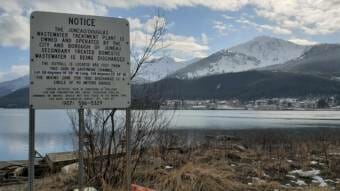
Signs along the beach behind the Juneau-Douglas Wastewater Treatment Plant indicate where treated wastewater flows into Gastineau Channel on March 18, 2021. (Photo by Jeremy Hsieh/KTOO)

This weekend marks the third anniversary of the World Health Organization’s declaration of the global pandemic — and Juneau’s wastewater is awash with COVID.

Charlee Gribbon is Bartlett Regional Hospital’s disease preventionist. She says only about 3% of COVID tests are coming back positive in the hospital’s lab — but the city and state no longer track cases closely, so most public health data gives an incomplete account of how many cases there are.

“Anecdotally, I would say that there are more cases being talked about than they are actually being confirmed,” she said.

There is one metric Gribbon said the public can rely on: Juneau’s wastewater has more than four times the national average of COVID-19 in it.

“I definitely take more impact from this because you’re not relying on people to go get tested or tell you that they’re sick, or even know that they have any symptoms,” Gribbon said.

Gribbon says Bartlett has five employees out sick this week. She said healthy people may be infected and show only minor symptoms, like a headache, but the hospital is still admitting an average of one to three people weekly with COVID-19.

“COVID really is affecting people over age 65,” she said. “They’re getting really sick, and they’re hypoxic, and they’re taking a long time to recover.”

She said she thinks it’s worth wearing masks in public if it means sparing older people from serious illness.

Gribbon says prevention is best, but antiviral medication is a useful tool for preventing serious illness if you do get COVID-19. It’s available in Juneau with a prescription from your primary care doctor.

Newscast — Tuesday, March 7, 2023

In this newscast:

  • Twenty Alaska legislators urged Walgreens leadership to reconsider its decision not to sell the abortion drug mifepristone after pressure from the state’s Attorney General;
  • Juneau’s School district asked the Assembly for $2.5 million to pay off debts and expenses ahead of the next fiscal year;
  • Emergency provisions were flown into Kodiak last weekend after rough weather delayed food deliveries to the island;
  • The Alaska Marine Highway System announced significant changes to the summer ferry schedule;
  • A lost sled dog was returned to its owner in Clam Gulch.

Alaska legislators say state Attorney General overstepped with Walgreens letter over abortion pill

The Alaska State Capitol doors have required key cards to unlock throughout the 2021 legislative session, June 16, 2021. (Photo by Andrew Kitchenman/KTOO and Alaska Public Media)
The Alaska State Capitol doors on June 16, 2021. (Photo by Andrew Kitchenman/KTOO and Alaska Public Media)

Alaska legislators urged Walgreens leadership to reconsider its decision not to sell the abortion drug mifepristone in the state after what they called “inappropriate pressure” from the state’s attorney general, Treg Taylor.

Nearly two dozen members of the Alaska House and Senate signed on to the letter and enclosed a copy of the state’s constitution, encouraging Walgreens CEO Rosalind Taylor to review it.

Rep. Zack Fields, D-Anchorage, said the Attorney General should not be able to “bully companies into undermining the constitutionally protected rights of Alaskans.”

“Our Attorney General may not like the (state) constitution, but it is the law of the land, and he doesn’t get to single handedly eliminate core rights of Alaskans,” Fields said.

Abortions and the drug mifepristone are legal in Alaska, and the state Supreme Court has ruled that the right to abortion is protected under the Alaska Constitution’s privacy clause.

But Walgreens announced they would not carry the drug in Alaska and 19 other states after Taylor joined other state attorneys general in signing on to a letter discouraging it. Walgreens has been in the process of getting certified to distribute the drug after a January rule change by the FDA allowing retail pharmacies to carry it.

In a written statement, Taylor’s office said that because Walgreens did not distribute the drug directly to patients in Alaska before the letter, the availability of the drug to Alaskans has not changed.

Fields says Walgreens is one of many places to get a prescription in his district in Anchorage. He’s boycotting the national chain.

There are about a dozen Walgreens stores in the state, mostly in Anchorage and other Railbelt communities. But Fields said the problem is bigger than Walgreens, and that other companies should know that abortions are constitutionally protected in the state of Alaska.

“I don’t think I’ve ever seen an issue that prompted such anger,” he said. “I think it is unprecedented. It is particularly outrageous, and it needs to be addressed immediately.”

The Anchorage Daily News reported Sunday that pharmacists at Safeway, Costco and Fred Meyer have the drug in stock or available for people with prescriptions.

Alaska legislators are not the only elected officials balking at the Walgreens decision. NPR reported Tuesday that Walgreens shares fell nearly 2% after California Gov. Gavin Newsom announced the state would no longer do business with the company.

Department behind Alaska’s food stamp backlog will soon be processing 260k Medicaid reapplications

The Emergency Department and Day Surgery entrance at Providence Alaska Medical Center in Anchorage. (Jeff Chen/Alaska Public Media)

In April, the state’s Division of Public Assistance will begin the year-long process of reviewing every Medicaid recipient in the state. 

All 263,000 Alaskans who receive Medicaid have been guaranteed coverage over the last three years during the COVID-19 public health emergency. Now the division has to resume its usual checks to make sure people still qualify — while it manages a backlog of food stamps and other public assistance applications.

Alaska turned in a plan to the federal government, but it is one of only nine states without a publicly posted plan for how it will wind down from the public health emergency. It does have an FAQ and some information on its website.

“What’s important to know is we don’t want anyone to lose health care coverage,” said Deb Etheridge, Director of the Division of Public Assistance. She took over leadership with the division last month in the midst of the backlog because she said she believes in the department and its mission.

“For the individuals who will be transitioning off of our state Medicaid program, we’re working with the federal marketplace with the Division of Insurance to ensure that they have options for health insurance,” she said.

Most of the recertification work falls to the eligibility staff, who will determine if individuals still qualify for federal assistance. But there is something Alaskans can do to prepare: make sure their addresses are up to date with the state.

Notifications about when and how to reapply for Medicaid will arrive by mail, and Etheridge said that checking and reading the mail will help speed the process. 

Updating an address does require a call to the division’s virtual contact center — which has frustrated public assistance recipients with long wait times over the past few months. But Etheridge said the division will be training 75 new contract workers to answer the phones in the coming weeks, which should significantly lessen wait times.

“It’s a major insurance event,” said Jared Kosin, the president & CEO of the Alaska Hospital and Healthcare Association.

Kosin said that people tend to fall off the rolls when there’s a change that requires action from the consumer. He said moments like this one require methodical planning and execution.

“It can be really disruptive to have a lot of people drop off of Medicaid,” he said.

Officials say some reapplications will be processed automatically, but others will need to be done manually by the same eligibility workers that are processing a months-long backlog of food stamps.

But there’s a key difference between the food stamp applications — also known as SNAP benefits — and the Medicaid ones, Etheridge said. 

“The SNAP backlog actually stopped benefits. And so we are quickly processing to get up to speed on our SNAP backlog,” Etheridge said. “That benefit stop is not happening from the Medicaid redeterminations.”

Deputy Commissioner of the Department of Health Emily Ricci said Alaskans who no longer qualify for care will have 30 to 60 days for appeals. The department hasn’t yet released a public plan for what will happen after that.

“We’re going to have a lot more information that’s available for individuals slightly closer to that start date,” Ricci said.

Site notifications
Update notification options
Subscribe to notifications