
Claire Stremple

"I support KTOO reporters and guide coverage that informs our community and reflects its diverse perspectives."

When she's not editing stories or coaching reporters, you can find Claire outside with her dog Maya.
Rural Alaskans will be disproportionately affected by abortion pill lawsuit, say doctors and advocates

The building that houses the Juneau Planned Parenthood facility on May 12, 2018. (Photo by David Purdy/KTOO)

Bristelle Larsen lives in Dillingham. Twenty years ago, she became pregnant.

“I was very early on in my pregnancy and knew in my heart that I was not going to be a mom,” she said.

She worked seasonally between fish processing in Dillingham and operating ski lifts in Girdwood—jobs that require physical labor that she couldn’t manage pregnant or with an infant. So, she chose to have an abortion.

She had to travel to Anchorage, one of only three cities in the state that offers them. She was vague about her trip with employers because of the stigma that surrounds abortion.

“I just told them I needed to go to Anchorage for medical, which is really common,” she said.

She stayed at what she called a “shady” hotel because it was affordable, and she paid cash for the procedure. She says she was lucky enough to have $2,000 for travel and the bill.

She said a medication abortion, known as the abortion pill, wasn’t an option for her at that time because she didn’t live close enough to Anchorage. Her doctor didn’t want to send her hundreds of miles back to Dillingham where they couldn’t check on her. But she said she could see some benefits.

“I think it might have been less traumatic physically,” she said. “Not having to go through putting on the gown and going through the whole rigmarole.”

The rigmarole meant she had to watch her ultrasound and wait 24 hours before her procedure.

When she got home a few days later, she said she worked “light duty” at work for a week while she recovered.

That was almost 20 years ago, but the trip would be the same today. More than a quarter of people who seek abortions in Alaska travel more than 30 miles for care, according to Planned Parenthood. In rural communities off the road system, people sometimes have to fly hundreds of miles to the nearest city.

Barriers to care

Abortion is legal in Alaska, but doctors and advocates say it is not equitable or accessible because of the state’s geography and large rural population. And some say a lawsuit joined by the state’s attorney general could limit access even further by asking the U.S. Food and Drug Administration to reverse its approval of mifepristone, a drug that ends pregnancies. Doctors say it’s the most effective abortion pill on the market.

A statement from Alaska Attorney General Treg Taylor says he joined the state in the lawsuit because the federal government allows the pill to be prescribed by mail, which means even people in states where abortion is illegal can get it. That’s not the way most people in Alaska get it — Planned Parenthood, the state’s main prescriber only does so in person — but the lawsuit would still make the pill unavailable to Alaskans.

“Mifepristone is safe. It’s effective. It has been used by more than 4 million people since the FDA approved it more than 20 years ago,” said Rose O’Hara Jolley, the director of Planned Parenthood Alliance Advocates in Alaska. “So this case is baseless. There is no reason from a science standpoint, from a healthcare standpoint. It is simply about restricting access to abortion, even in states where abortion is legal.”

Geography is one of the barriers to reproductive care in Alaska. Even people in remote areas who choose to end their pregnancies with the pill usually travel because Planned Parenthood doesn’t prescribe it by mail, even though that is legal.

State data shows that roughly 1,200 – 1,300 people seek abortions per year in Alaska. The majority of them use Planned Parenthood, which is also the main provider of clinical abortions in the state. O’Hara Jolley said about half of Planned Parenthood’s patients choose the abortion pill over a clinical abortion.

“There’s so many barriers to access that removing a medically proven safe and effective way to access an abortion is going to disproportionately affect people who are already seeing barriers to care,” said O’Hara Jolley.

O’Hara Jolley said that, especially for people who live in rural areas, the cost of traveling to get care in Alaska is prohibitive. They added that about half of the people who seek abortions already have children, so those parents also have to find childcare. Safety is another barrier: Alaska has among the highest rates of intimate partner violence in the nation, and the risks only go up for pregnant people.

If the lawsuit is successful, O’Hara Jolley said Planned Parenthood will still prescribe abortion pills, but it will have to use a slightly less effective drug if mifepristone is no longer legal. Planned Parenthood would use only misoprostol, which can be up to 10% less effective. They said this will exacerbate current inequities in healthcare because people will likely need to pay more visits to the clinic.

“Abortion will still be safe and legal in Alaska,” O’Hara Jolley said. “We just will have one less method for people to choose from.”

Politics and medicine

“We need to be very aware of the direction that the legal system is going when it pertains to this sort of thing,” said Dr. Robin Holmes, a primary care provider in Homer. “The overall implication is that politicians took away physicians’ rights to prescribe medications that are safe and effective for purely political reasons.”

The clinic where Holmes works does not provide clinical abortions or prescribe abortion pills. It offers sexual and reproductive care and education for people of all income levels in the southern part of the Kenai Peninsula. It’s the only comprehensive reproductive health care for a region the size of West Virginia, Holmes said. Her role is to guide people who are pregnant through their care options, whether they want to keep their pregnancies or terminate them.

Abortion is protected in the state’s constitution through the right to privacy, but Holmes said that it can be hard to find care that feels private in small towns in Alaska.

“It’s geography, it’s insurance, it’s stigma,” she said. “Alaskans are already so limited in their access to even getting reproductive health care as far as STI screenings or long acting contraceptive options. What we don’t need is to have another political imposition to our health care access.”

She said for Alaskans who live in rural places, time-consuming travel to Juneau, Anchorage or Fairbanks is usually necessary. And for people who want to get an online prescription for the abortion pill, they might not have sufficient internet access.

Navigating options

Robin Holmes counsels people in the same situation as Bristelle Larsen was in Dillingham 20 years ago. That is, people who don’t have ready access to abortion services. Larsen says that navigating travel and care options was hard then, but shame was the biggest barrier for her.

“If you know someone who might be in this situation or opens up to you about the situation, it’s important not to assign judgment to whatever choice they’re going to make,” she said.

She said she knows people who have had abortions have gone on to have children when they were prepared and lead healthy lives.

“It’s not a sentence of doom,” she said.

A decision in the case is expected as soon as the end of this week. It could be a sentence to more medical uncertainty for rural Alaskans.

Gov. Dunleavy adds $9M to budget to address food stamp, Medicaid backlog

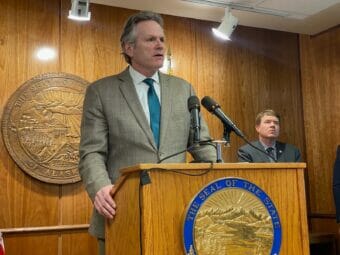
Governor Mike Dunleavy announces his budget amendments at the state capitol in Juneau on Feb. 15, 2023. (Photo by Claire Stremple/KTOO)

Gov. Mike Dunleavy added $9 million to his budget this week to address a backlog in the Division of Public Assistance that’s left thousands of Alaskans waiting for food stamps and Medicaid. The money will be spent on hiring contract workers to help state employees get through the backlog so they are prepared for upcoming Medicaid recertifications.

Dunleavy called the increase “significant” and said it would be used to fund more than 100 temporary and contract positions. There’s also an additional $54 million in the capital budget for improved computer systems in the division.

Democratic Representative Andy Josephson says he fought staff cuts to the division of public assistance last session. Now he credits the governor with being responsive to the crisis.

“We’ll just have to see how it plays out,” he said. “And it still begs the question of how we got here. And I think that there are many questions that remain about that.”

Unaffiliated minority leader Calvin Schrage said he thinks the contract workers and additional funding will address the food stamp backlog and get benefits to Alaskans. But he said he has some concerns, such as whether contract workers will replace state employees.

“Also we’ve heard reports that some of this is a result of understaffing in prior years,” he said. “And so, making sure that we have adequate staffing moving forward, that this isn’t just a one-time boost to get past a difficult decision and then go back to slower or dysfunctional service.”

Department of Health Commissioner Heidi Hedberg says the budget calls for contract workers because the division does not need more staff.

“We’re going to always continue to reevaluate, but we believe that our permanent positions are sufficient,” she said.

But the union that represents state workers disagrees. It rallied on the capitol steps last week to ask for more staff for the division. It has filed a grievance against the state because it says the contract labor violates its collective bargaining agreement.

Alaska joins lawsuit that would take the abortion pill off the market

Alaska Gov. Mike Dunleavy follows Deputy Attorney General Treg Taylor into a news conference at the governor's Anchorage office on Friday, Sept. 27, 2019.
Alaska Gov. Mike Dunleavy follows Deputy Attorney General Treg Taylor into a news conference at the governor’s Anchorage office on Friday, Sept. 27, 2019. (Photo by Nat Herz/Alaska Public Media)

Alaska has joined nearly two dozen states in a lawsuit that would eliminate Americans’ access to a pill used for abortions, even in states where abortion is legal.

The pill would be taken off the market if the judge sides with the plaintiffs.

On Friday, Alaska Attorney General Treg Taylor joined a coalition of states and anti-abortion groups in a lawsuit that aims to revoke the U.S. Food and Drug Administration’s approval of the abortion pill, called mifepristone.

Taylor’s office wrote in a statement that, by allowing the drug to be available through the mail, the FDA subverted the authority of states that have outlawed abortion.

“That intentional undermining of State authority by the federal government is what Alaska and the 21 states who joined the lawsuit take issue with,” the office wrote.

Abortion is legal in Alaska. But if successful, the suit will reduce access to abortions here. The pill is used for about one third of abortions in Alaska. And about a third of Alaska women live in a borough without a clinic that provides abortion services.

The defendant’s opposition says the lawsuit is “extraordinary and unprecedented” and could cause “significant harm” if successful. It argues that the courts should not tell the FDA to remove a safe and effective drug that has been on the market for more than twenty years.

Matthew Kacsmaryk, a Trump-appointed judge in Texas, will decide the case. A ruling could come as soon as the end of the month.

At Juneau rally, state workers call for more resources to fix food stamp backlog

State Rep. Genevieve Mina, D-Anchorage, told union workers she was a legislative staffer when the Dunleavy administration cut jobs from the Division of Public Assistance. “And now look what’s happened,” she said. “We’re in a crisis.” (Photo by Claire Stremple/KTOO)

Dozens of state workers rallied on the Capitol steps in Juneau on Friday to ask the government for better benefits, full staffing and safe working conditions. 

The rally was for all of the thousands of state workers in the Alaska State Employees Association/AFSCME Local 52, but its focus was on supporting those at the state’s Division of Public Assistance as they tackle a massive backlog of food stamp applications that has left thousands of Alaskans waiting months for public benefits.

The union criticized the state’s plan to hire contract workers to fix the backlog. The state has blamed it on aging technology and a cyber attack in May of 2021, but employees say chronic understaffing is the cause.  At the rally, union members said they also need safer workplaces and for the state to hire permanent Alaska employees — rather than contractors who could be from out of state.

“This has been an ongoing problem with the division,” said Joey Tillson, a Division of Public Assistance worker from Ketchikan who spoke on behalf of union members. “We cannot do a bandaid fix, and we cannot go and temporarily fund the staffing. Alaskans are being harmed by this. Every person that you know and love is somehow affected by public assistance in this state.” 

Dawn Bundick speaks at a rally for Department of Public Assistance workers in front of the state capitol in Juneau on February 10, 2023. (Photo by Claire Stremple/KTOO)

She said the division has had a backlog since she started in 2016, and it’s only gotten worse because there isn’t enough staff. Tillson said she’s had to talk other employees out of quitting because morale is so low in the division. 

Freshman Rep. Genevieve Mina, D-Anchorage, said that she watched as division workers asked the Dunleavy administration not to cut jobs when she was a legislative staffer in 2021. 

“There were concerns that were raised by legislators, by union members, by folks at DPA and all across the board who were talking about the crisis that could come if you don’t all have the resources that you need,” she said. “And now look what’s happened. We’re in a crisis.” 

She warned the crisis could get worse with an onslaught of new applications when Medicaid recertifications come in the spring.

Union director Heidi Drygas called the division’s staffing shortage “dire.” But she said one of the state’s main solutions to the food stamp backlog — hiring contract workers — is a violation of its contract with employees. The union has filed a grievance.

“It’s a blatant violation of our contract. But we made it very clear to the commissioner and the director of personnel and labor relations that we would like to amicably resolve this issue,” she said. “We’re very concerned these will more than likely be out-of-state positions for really good jobs that should remain in state.”

Drygas is also concerned that the Dunleavy administration has ordered division staff to return to offices while they face threats of violence from Alaskans who are frustrated and desperate after months of waiting for benefits. She says security contracts should have been in place first.

“Workers are afraid to return to work,” she said. “And until those safety measures are put in place, we don’t think they should have to.”

Anchorage Democrat Sen. Forrest Dunbar and House Minority Leader Calvin Schrage led the crowd in chants and pledged to support better wages, real pensions and better staffing.  

Meanwhile, Tillson said conditions are hard for division workers. She said she appeared before the Legislature last year on behalf of the union to ask them not to cut jobs, but the state defunded more than 100 positions in the division anyway.

But Tillson said she’s heartened by new leadership. Director Deb Etheridge began just weeks ago, and Commissioner Heidi Hedberg has been in her post only a few months. 

“I’m willing to give them the opportunity to go forth and help with making the change,” Tillson said. “I’m putting faith in the Legislature this session, now that the information is out there.”


Correction: A previous version of this article gave the wrong title for Heidi Drygas, who is the union’s director.

Thousands of Alaskans are still waiting for food stamps as state scrambles for solutions

The produce section at Foodland IGA in Juneau. (Photo by Tasha Elizarde/KTOO)

After a months-long wait, thousands of Alaskans have gotten their food stamps. But thousands more are still waiting. 

MaryRuth Moore of Soldotna reapplied for herself and her four children in October. Since then, she’s been watering down crock pot meals to stretch the food she has.

“I feel like I’ve kind of become a scientist in the kitchen, and trying to make things go further,” she said. “So what this boils down to is less vegetables, less fruits — and especially the fresh ones.”

Waits for food stamps stretched out to months following a flood of 8,000 renewal applications in August, after the state’s pandemic health emergency lapsed. State officials say the Division of Public Assistance is working through the backlog faster now, but eligibility workers — staff who process paperwork for benefits like food stamps and Medicaid say they were told to cut corners to do that. And even Alaskans who have now gotten their benefits say that the months they went without have left them with debt and fears for the future.

Moore says she, too, has been relying on credit cards to get through. She says she worries about how she’ll pay them off, and knows thousands of other people are going through the same thing.

“It’s a very powerless feeling to know that the situation you’re in is so dependent, and there’s no one to reach out to,” she said. “There doesn’t seem to be any accountability.”

Moore connected with Alaska Legal Services and filed a case last week. The state’s largest provider of civil aid is Alaskans’ main recourse — the ombudsman’s office was also a resource for those who sought overdue food stamps, but say they are no longer legally allowed to help after a group of Alaskans filed a class action lawsuit against the state last month.

Alaska Legal Services Advocacy Director Leigh Dickey said that last January, the group processed just a handful of complaints. This month they’re working on 200 cases related to food stamps, and they’re taking on more pro bono lawyers to help handle the workload. She said they file 20 to 30 new cases a day, and it’s not slowing down.

“It’s just booming,” she said. “It hasn’t tapered at all.”

“There may be some sanctions”

At legislative briefings in late January, Department of Health Commissioner Heidi Hedberg blamed the departments’ difficulties clearing the backlog on legacy technology and the effects of a cyberattack on the department in May of 2021. She said the department was pursuing solutions.

Hedberg and other leadership told state legislators that there has been renewed productivity in the Division of Public Assistance. Deputy Commissioner Emily Ricci said “the number of recertifications being processed daily increased substantially last week, which is positive.”

Ricci, who described the delays as unacceptable, said the department had finished issuing food stamps to people who applied in September and was working on October. 

But two eligibility workers — who say chronic understaffing is behind the slowdowns — told KTOO that their division’s leadership overstated the progress to the committee. 

The eligibility workers did agree that they have been working faster — but they say it’s because leadership directed them to skip mandatory federal processing requirements.

“When I don’t verify anything you tell me, of course I can get your documents processed faster,” one eligibility worker said. KTOO is not using their name because they fear they could lose their job for speaking out.

Staff say they’ve been instructed to approve or deny cases without verifying information like employment and income with anyone except the applicant. Eligibility workers say federal guidelines require they verify with people like landlords and bosses to make sure information is accurate. 

Skipping verification has risks, both to recipients and to the state. If people get larger benefits than they should, they’ll have to reimburse the government later. 

Deb Etheridge, the new director of the state’s Division of Public Assistance, says the department knows the risks and is doing everything it can to get people their benefits.

“We’re taking all measures that we can to expedite this food stamp recertification process,” she said. “We are talking with our federal partners and engaged with them. And they’re aware of steps that we’re taking. And there may be some sanctions, perhaps, but it’s nothing that we’re doing without full awareness and transparency.”

Etheridge, who has been on the job for four weeks, says she took on the role now because she believes in the programs and the staff.

She spent 30 years working in public service before taking on the role. She’s worked in the division, and she’s even been an eligibility worker before.

She described the backlog as an “all hands on deck” situation.

“We’re working very hard,” she said. “We don’t want this to be happening.”

She said with support from the commissioner and the governor, they’re making strides on the solutions that Hedberg set out for the Legislature.

The commissioner didn’t cite understaffing as a root cause in her briefing to the legislature, but the department recently made 53 hires — mostly new roles, Etheridge said, but also to replace staff attrition. 

The department also signed a contract with a group that will find contract workers to answer phones so that highly trained staff can focus on recertifications. And she says two current employees are working on IT solutions while the department looks for contractors to update technology that they say is behind the slowdown.

Etheridge also said security contracts to keep employees safe in their offices should be in place by the end of the month.

But she says her larger goal is to build a department that won’t experience this kind of backlog again.

“I really want to leverage technology to make things easier for people who are applying for assistance,” she said. “Ideally, it’s one-touch processing for all applications, which means that individuals who are applying for benefits can call or they can apply online, and they can get immediate feedback.”

Meanwhile, a lawsuit

Saima Akhtar is the lead attorney for the class action lawsuit ten Alaskans filed against the state. She’s litigated cases like this for about a decade, where citizens sue the state not for money but for the federal benefits they’re due.

She says food stamp programs nationwide are struggling to process benefits on time. And she has insight into the solutions the state is proposing.

“Assuming that technology is the problem and the fix is sometimes part of the issue. In my own experience, in other places, it is never the whole issue,” she said.

“A 30-day processing standard has been the standard in the SNAP regulations, actually, for years and years. And so that was the standard when many of these older computers were the norm, or were the expected technology.”

She said some of the methods the state is using to work through the backlog are effective, like waiving the need for time-consuming personal interviews. But she says that’s a short term fix — the federal waiver will expire after a year.

“The interview will come back in the future,” she said. “So there will have to be sufficient staff to conduct the interviews and maintain the caseload at the end of that time period. This is not a function that can be carried out by computers. It is a mandatory piece in the application process.”

“Why didn’t they plan for it?”

Natalie Richards of Soldotna got her benefits in January after five months of waiting. But she says the experience has left her with credit card debt and nagging fear that it will happen again.

“It’s really frightening to live that way,” she said. “Thinking that your basic needs of food and shelter aren’t going to be met.”

She said she’s grateful the state paid her benefits for all the months she was waiting, but she doesn’t feel like the trial is over. She says she’s using the money sparingly, just in case something like this happens again. And she doesn’t understand why services for the most vulnerable Alaskans are letting them down.

“Everybody deserves to eat,” Richards said. “Why is there such a delay now? I mean, they knew that the pandemic COVID stuff was going to end. Why didn’t they plan for it?”

She said people deserve better from state leadership.

“They still go home and eat their dinner, you know?” she said. “What about the people they were responsible to look out for?”

SEARHC acquires Juneau Youth Services and Juneau Obstetrics and Gynecology

The Juneau campus of SEARHC, pictured here on Dec. 19, 2018, is located off Hospital Drive.
The Juneau campus of SEARHC, pictured here on Dec. 19, 2018, off Hospital Drive near Twin Lakes. (Photo by Jeremy Hsieh/KTOO)

Southeast Alaska’s Native-run health consortium is acquiring two Juneau care providers.

Juneau Youth Services and Juneau Obstetrics and Gynecology will join the Southeast Alaska Regional Health Consortium, or SEARHC.

The addition of Juneau Obstetrics and Gynecology will expand SEARHC’s women’s health care significantly in Juneau. Previously its only board-certified OB/GYN was in Sitka.

“We are very excited to expand the breadth and depth of women’s health services for our patients,” said Dr. Elliot Bruhl, SEARHC’s Chief Medical Officer, in a press release.

Bruhl said Juneau patients were often referred outside of SEARHC for services that go beyond general women’s health care — things like high risk pregnancies or fertility treatment. Now, he said, patients will be able to access them more easily.

SEARHC Vice President of Primary Care Martin Benning said the transition should be complete by this spring. He said Juneau Obstetrics and Gynecology patients can continue care with SEARHC.

“We’re fully set up to take care of everyone in the community,” said Martin Benning. “Our intent is to make sure those patients continue to get the care that they’re getting now.”

Juneau Youth Services will also join SEARHC in the coming weeks. The mental health nonprofit offers services from therapy to residential care for youth.

“The needs for residential services are important in the local Juneau and Southeast environment. They also fill a critical need in the state,” said Eric Gettis, SEARHC’s Vice President of Behavioral Health.

Gettis said the addition of JYS’s residential services will allow SEARHC to keep more youth behavioral health patients in Alaska and close to home for in-patient care.

He said JYS reached out to SEARHC for support as it navigated inflation costs and the tight labor market.

“We have a set of infrastructures that small organizations really just struggle with,” Gettis said. “So examples of that might be information technology, or IT software, human resources, facilities, expensive facilities, expertise, additional clinical support.”

JYS Executive Director Amy Simonds Taylor said she expects to open another treatment unit soon. JYS is accepting referrals for youth who need residential care and has open positions for behavioral health associates, case coordinators and supervisors.

Current patients will not lose access to care. The transition is scheduled to be complete in the coming weeks.

Site notifications
Update notification options
Subscribe to notifications