Claire Stremple

"I support KTOO reporters and guide coverage that informs our community and reflects its diverse perspectives."

When she's not editing stories or coaching reporters, you can find Claire outside with her dog Maya.

Juneau hospice and nursing home closures are the latest symptom of the nation’s nursing shortage

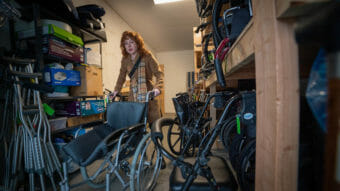
Kelly Aicardi of Juneau’s Catholic Community Services in the hospice loan closet on Dec. 14, 2022. (Photo by Paige Sparks/KTOO)

Kelly Aicardi pulled open the garage-style door to a storage unit full of wheelchairs, walkers, beds and bedpans. The equipment-stuffed space is called the loan closet, and it’s what’s left of hospice care in Juneau. The city’s only provider of in-home and end-of-life care closed down in September.

“This used to be a lot more active when we had hospice patients,” Aicardi said. “Part of being in hospice is that we provide any equipment that is needed for the patient.”

She’s a volunteer coordinator for Catholic Community Services. The organization’s hospice and home health division closed because it couldn’t afford to keep nursing staff.

Now home and hospice patients are going without specialized care and even resorting to emergency room visits. It’s one of the consequences of a broader nursing shortage that’s affecting medical care across the state and shows no signs of slowing down.

The organization’s director, Erin Walker-Tolles, says she had long struggled to staff the program, but the pandemic made the market for nurses even tighter.

“There is a massive health care worker crisis happening in this country. And it’s especially challenging in Alaska,” she said.

Walker-Tolles says they were priced out as the need for traveling nurses increased dramatically and prices soared over the past few years.

“All across the country, the healthcare worker shortage is affecting especially nonprofit and smaller health care providers,” she said.

Bartlett Regional Hospital will take over hospice and home care, but there will be a wait. The hospital is also taking over the local nursing home for the same reason. But Juneau care providers aren’t the only ones struggling to maintain staff. Roughly a quarter of all nursing positions in Alaska are vacant.

Jared Kosin is the president and CEO of the Alaska Hospital and Healthcare Association, a trade group that represents hospitals and care centers. He says consolidations like the ones in Juneau are essentially closures, they just look different. He described a negative feedback loop that’s dogging the state’s healthcare providers.

“Once you’re short on workers and nurses, you’re essentially limited in your capacity and the services you can provide. And when you are providing less services, there’s less revenue coming in,” Kosin said.

Expenses are going up dramatically while the ability to collect revenue is going down. That’s leading to consolidations like the ones in Juneau, and closures in the Lower 48. Kosin says people get stuck in hospitals when smaller providers of what’s called “step-down care” — non-hospital environments like hospice and nursing homes — can’t stay afloat.

“If you can’t discharge out to the lower level of care, the system really grinds to a halt,” he said.

Kosin says the buildup of patients in the hospital is bad for the hospital’s bottom line. There’s no payment mechanism to support unnecessary stays in hospital beds. It’s an economic problem that’s created a social one.

“You still have all those people piling up to the hospitals,” he said. “They’re stuck in the most expensive environment of care in our healthcare system. And the real hard part with that is, not only is it the most expensive environment, they don’t need to be there.”

Back at the hospice loan closet, Kelly Aicardi was figuring out how to manage the non-medical services she can still provide.

“It’s been stressful for the employees, for sure,” Aicardi said. “But it’s way more devastating to the community as a whole.”

She says she’s been fielding phone calls from people whose parents are dying and need end of life care.

“They know that this is the only hospice. And then I have to tell them that we’ve suspended services, and then they’re like, ‘What can I do?’ And it’s really hard, because I don’t really have answers for them.”

No response from state officials as some Alaskans go months without food stamps

The IGA Foodlane Grocery Store in Juneau on Dec. 20, 2022 (Photo By Paige Sparks/KTOO)

Nikita Chase is a single mom with two kids at home. She said she hasn’t gotten her food stamps since October.

“You’re supposed to get it on the first [of the month], but you’re not getting anything. And there’s no communication,” she said. “So everybody’s just sitting, waiting, up in the air. And when you call, you get no answers.”

She’s one of an unknown number of Alaskans waiting on food assistance from the state. They’re trying to figure out why a system meant to support them isn’t working.

The state made it easier to get food stamps, also known as the Supplemental Nutrition Assistance Program or SNAP benefits, during the pandemic. Last year, more than 80,000 Alaskans used the program.

But this fall, many Alaskans were asked to refile their paperwork.

Chase said she did that in October — and hasn’t gotten a response.

The first time she reached out to the Alaska Division of Public Assistance for help, she said she was the one-hundred-and-eleventh caller. She never got a call back. The second time she waited on hold for hours.

“Four and a half hours! Just to talk to somebody who then informed me that there were 18,000-plus cases that needed to be worked,” she said. “This is happening to a lot of people, and they’re not getting these SNAP benefits, so they’re gonna have to make a choice between paying their bills or feeding their families.”

Chase said she can’t pay her electric bill this month because she chose to spend the money on food for her family. She says this comes right before a cold snap in the region — and the holidays.

“We won’t be having a big Christmas dinner and things are a lot tighter,” she said. “I’m concerned about when I will get food stamps or food benefits. I don’t know when that’s going to happen. So now instead of having freedom to buy a lot of fresh things at the store, everything’s either frozen or canned.”

Chase lives in Tenakee Springs, a remote town in Southeast Alaska. She sent her paperwork by mail, which can take a long time coming from her community. She’s afraid she’ll be at the end of what sounds like a long line.

“Around Thanksgiving, you know, I call again. I’m asking these people for help, and to find out what’s going on. And they basically told me, there’s nothing that they can do. And that I just have to wait,” she said.

That wait is especially tough in remote places. Chase’s dollars go farther if she shops in Juneau, but there are only two more ferries into town this year. If her food stamps don’t go through before then, she’ll be waiting until March for a ferry out of town. Some smaller towns also lack the food pantries and other resources of urban centers.

“I definitely have heard news of people not getting their food stamps,” said Luke Vroman, who runs Juneau’s homeless shelter, The Glory Hall. “Even just yesterday a client of mine mentioned that she’d been told it could be months for her food stamps to be approved.”

He said The Glory Hall needs to know about any backups in case they need to start preparing more meals.

“They need to come out with a statement because there’s definitely a buzz. People have figured out that it’s not operating as it’s supposed to be,” Vroman said.

Ernie Hard helps people navigate social services for Bartlett Regional Hospital and he’s hearing from clients who aren’t getting food stamps, too. He and his colleagues have tried to call Public Assistance, but they had to wait like Nikita Chase did.

“I’ve seen it with my coworker, they’ll get put on hold and let you know that you’re number 236 and you got a three hour wait line,” he said.

Hard said he works with employees at the Division of Public Assistance a lot, and he’s sympathetic because he thinks the division is understaffed.

“The people there are super nice and helpful,” he said. “But, you know, they’re swamped. Which is tough for everybody. It’s tough for them, and it’s tough for the people that need the service.”

The state’s Division of Public Assistance has not responded to KTOO’s requests for comment over the course of the last week. When KTOO visited the division’s offices, Director Shawnda O’Brien declined an interview. She said the division was still working to decide what information to share with the public.

The division has not said how many people are waiting for their food stamps, how much longer the estimated wait time is, or what is causing the delay. It has not said whether SNAP recipients will receive the money for the months they had to wait.

Are you waiting on SNAP benefits? KTOO wants to hear your story. Send a message to reporter Claire Stremple using this form: 

Staff contact

Just ‘tweaks’ for new management plan at Glacier Bay National Park and Preserve

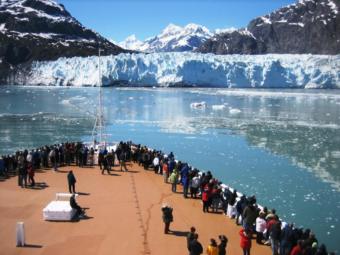
(Photo courtesy of National Park Service).

Glacier Bay National Park and Preserve is updating its marine management plan and environmental assessment for the first time since 1984. The document guides decision-making for park management and sets rules for visitors.

Superintendent Philip Hooge said a lot of work went into the draft, but the public shouldn’t expect huge changes at the park. He called the changes “tweaks.”

“I think Glacier Bay is one of those kind of amazing parks where we found the right tool,” he said. “We’ve dealt with a 6% increase (in visitors). But yet, at the same time, you can have the same experience you had in the ‘90s.”

Management at Glacier Bay is unique because visitors mainly experience the park from the water, and the majority of visitors stay on cruise ships. He says the park’s contract system with the cruise ship industry results in some of the strongest environmental standards in the world — so the existing quota system won’t change.

But the park is proposing changes for private vessels. That’s because it says visitor patterns and the environmental conditions have changed since 1984.

“We were having challenges with private vessel permits,” Hooge said.

He said it’s easier for locals to get permits, and some people have figured out ways to game the current system.

“So we did want to try to make those kind of more equitable, you know — still provide recreational opportunities for local people, but provide kind of a more level playing field for people who’ve never been to the park.”

The number of permits per day is proposed to stay the same, but the permit season will be lengthened by two months.

Travis Mingo works for Alaskan Dream Cruises and Allen Marine. He checked in at a public hearing in Juneau this week to see if his company would be affected.

“I don’t think it will,” he said. “It’s good. It doesn’t mean we have to change how we do our business.”

Steve Box is a commercial halibut fisherman who has one of the few remaining licenses in the park. He came by to see how it might change his livelihood.

“The more traffic, the more detrimental it is to the bay overall. So I’m just curious on what their plan was,” he said.

The document is a long one, but park officials say that Chapters 2 and 3 should give the casual reader enough information to understand the changes. The public comment period runs through Dec. 30.

Also, mega-yacht owners should take note that anything longer than 79 feet won’t be counted as a private vessel anymore. They’ll be in the same class as cruise ships.

Newscast — Wednesday, December 14, 2022

In this newscast:

  • Alaska’s new lieutenant governor Nancy Dahlstrom steps into the spotlight;
  • Student employees in the University of Alaska system seek to unionize;
  • A musk ox attacked and killed a man in Nome;
  • The Spring herring forecast for Sitka Sound is historically high, but slightly lower than last years’ forecast;
  • The state is auctioning 3 million oil and gas leases this month as investor interest wanes.

Juneau’s nursing home will merge with Bartlett Regional Hospital

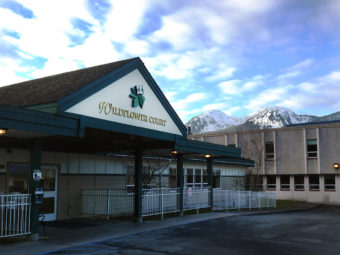
Wildflower Court is a non-profit, 57-resident long-term-care facility in Juneau. (Photo by Ed Schoenfeld/CoastAlaska)
Wildflower Court is a non-profit, 57-resident long-term care facility in Juneau. (Photo by Ed Schoenfeld/CoastAlaska)

Bartlett Regional Hospital plans to take over operation of Juneau’s nursing home.

Wildflower Court is the second small care provider to be absorbed by the hospital recently because of a tough market for nursing staff.

The long-term care facility has struggled to hire and retain staff since spring of 2021. Later that year, the administration closed one wing of the nursing home because of the staff shortage. Wildflower Court is licensed for 61 beds, but now only 47 of them are full.

“Part of going with larger organizations is the depth of resources,” said Robert Rang, the interim administrator for Wildflower Court. 

He said Wildflower Court is the last independent nursing facility in the state – others are affiliated with local governments or bigger health care providers.

“We have challenges recruiting because we have a one-person HR department,” Rand said. “We don’t have the buying power that they have regarding supplies and equipment. And so all that stuff just starts cumulatively taking its toll.”

Rang said the board considered merger proposals from both Bartlett Regional Hospital and Southeast Alaska Regional Health Consortium, or SEARHC.

Bartlett spokesperson Erin Hardin said she thinks the hospital was selected because it’s next to Wildflower Court’s building. She said the hospital does not yet know when the merger will take effect.

“The next step will be to put together a transition team so that we have folks from both organizations at the table to start to map out what that plan and timeline will look like,” she said.

The hospital has pledged to retain Wildflower Court employees and said there will be no lapse in services for residents.

Site notifications
Update notification options
Subscribe to notifications