Claire Stremple

"I support KTOO reporters and guide coverage that informs our community and reflects its diverse perspectives."

When she's not editing stories or coaching reporters, you can find Claire outside with her dog Maya.
Newscast — Wednesday, November 16, 2022

In this newscast:

  • Juneau Empire reporter Mark Sabatini breaks down Juneau’s election results;
  • A salmon hatchery operator in Prince William Sound is on the hook for $1 million in hazardous waste violations;
  • Language immersion programs are no longer on the chopping block to balance the Anchorage School District’s budget;
  • High winds in Juneau knock out downtown power.

Naturalists reveal history of centuries-old spruce that fell on Gastineau Avenue

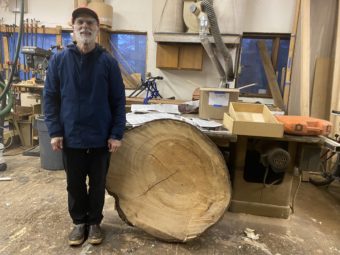
A man stands smiling next to a cross-section from a spruce tree. Standing on edge, it comes up to his waist.
Naturalist Steve Merli stands next to the cookie from the spruce that fell on Gastineau Avenue on Sept. 27, 2022. The asymmetry of the rings shows that the tree was leaning out from a steep slope. (Photo by Claire Stremple/KTOO)

After it fell, the old tree above Gastineau Avenue slid about 650 feet down the shoulder of Mt. Roberts before crashing through a few houses and taking out a power line.

The tree knocked one home off its foundation, flipped a pickup and triggered an evacuation alert for the neighborhood. It took the city fifteen truckloads to haul away the debris.

The slide was over in a few seconds, but when Juneau naturalist Steve Merli looked at a slice of the tree — called a cookie — he saw a much longer story.

“That’s a calendar,” he said.

Merli and naturalist Richard Carstensen founded Discovery Southeast in Juneau to teach youth about the outdoors. They’re used to using ecological evidence to answer human questions.

Fingers point to a black scar in the rings of a tree
Naturalist Richard Carstensen points to a scar that a rock left long ago on the tree that crashed into Gastineau Avenue. (Photo by Claire Stremple/KTOO)

Carstensen said the rings tell us the tree was likely older than the United States. It sprouted and took root on the steep mountainside during the Little Ice Age, sometime in the 1700s. That’s back when Áakʼw Tʼáak Sít, the Mendenhall Glacier, extended about five miles further than it does today, and the Gastineau Channel was choked with icebergs. Typical August weather during the time included sleet.

But the rings show a lot more than the tree’s age.

“The first thing we noticed was that the rings are way bigger here,” Carstensen said, pointing out a contrast between the two sides of the tree. One side has wider rings. “A conifer tree that’s based on a steep hill is almost always leaning out, like in this case toward the channel. When they lean over time, they get thicker rings on the lower side.”

Carstensen said old trees like this one can actually thrive on Juneau’s steep slopes.

Goats, old trees and steep places

A pandemic-born obsession with mountain goats led Carstensen to new insights about incline and tree longevity. He spent a lot of time watching goats on avalanche paths, and he noticed some really old trees where he didn’t expect them.

“You cannot study goats and not become intrigued with their relationship to avalanches,” Carstensen said. “Because that’s the main way they die. But it’s also creating the best goat winter habitat in the world.”

A man leans against a large spruce tree
Naturalist Richard Carstensen stands in front of an old spruce in the Behrends slide path in downtown Juneau. (Photo by Claire Stremple/KTOO)

Out on the Behrends hillside, he pointed out a grazing goat. It was munching on nettles at about 1,000 feet up and easy to see because there was only low foliage around him. This is a known avalanche path, and the little trees are a giveaway — mostly alders and low brush. But Carstensen pointed out a huge spruce.

“I call this the brave outlier because it sits out right in the firing line. And I’m guessing it’s at least 300 years old,” he said.

The spruce is extremely thick — Carstensen calls it “refuge diameter.” In other words, there’s safety in its girth. There aren’t many other trees around it because anything too much smaller gets toppled or buried.

“Every year, there’s an avalanche. And more often than not, it piles up to the base of this tree to 10 feet or more,” he said. “And you’ll walk over it and you go, ‘how did this thing survive?’”

He said there are even more trees like this up high. He’s seen them while installing cameras to check out the goats.

It turns out big trees do well on steep hillsides, and not just because they aren’t likely to get logged. “Colluvium” is the term for rocky soil on slopes like these around Juneau. It’s coarser than soil in a valley, for instance, and will have rocks and even boulders in it. Those give roots something to hold onto. Carstensen said the deep water table on a very steep hillside also helps because trees will send their roots down further.

He pointed out a hemlock that would have been inconspicuous if there wasn’t a huge bald eagle nest in its crown. It’s about five feet thick at the base. Carstensen said it’s easily 1,000 years old.

“If we were to core that hemlock, I can guarantee you that the outer foot alone would have 300 rings,” he said.

The life of a tree

The cookie from the Gastineau Avenue tree tells us the tree lived on a steep slope, but it also tells us a little about its life there. The rings are so dense at the core that they nearly blend together. Carstensen said that’s rare for the species.

“Normally, a spruce gets started in a canopy gap, and the center rings are pretty big. But this tree was suppressed by an overhead canopy, so it was growing very slowly, like a hemlock grows in a forested, shady situation,” he said.

Carstensen pointed out a dark spot in the trunk where a rock likely bashed the tree. According to the rings, it took almost three decades to fully heal. It wasn’t the only evidence of abuse, either — the rings knit around other dark spots, all on the uphill side of the tree.

Debris left from the Sept. 27, 2022 landslide and treefall on Gastineau Avenue, after the city cleared the street. (Photo by Claire Stremple/KTOO)

There’s no definitive answer to what took the tree down. It could have been high winds, or saturated soil that gave way. The base of the trunk was rotten, according to Juneau city officials.

Most of the tree went to the dump — what’s left still rests between the damaged houses on Gastineau Avenue.

Correction: An earlier version of this story misstated the name of Discovery Southeast.

Juneau’s volunteer workforce not immune to lingering pandemic effects

Frank and Crystal Johnson are volunteers from the Lion’s Club that lend their time at Helping Hands food pantry in Juneau. “I get to come down here and meet people and just get to say ‘hi’ and have that chance to do something nice that makes somebody say, ‘Ooh, I kind of matter,’” Johnson said. November 4, 2022. (Claire Stremple/KTOO)

Some Juneau nonprofits have struggled to find volunteers over the last year. It’s a serious problem for organizations that rely on unpaid staff. 

Laurie Wolf, the president and CEO of Alaska’s Foraker Group says that’s something she’s seen statewide — and it’s linked to a national phenomenon of people leaving or changing jobs.

“Not unlike in the workplace, where we’re seeing the great resignation and the great reshuffle in how people are choosing to spend their work time, we’re also seeing that same reflection in people’s volunteer time,” said Laurie Wolf, the president and CEO of Alaska’s Foraker Group.

The organization works directly with many of Alaska’s volunteer boards by offering support and training.

“People are really taking stock about how they want to spend their free time,” she said. “Do they want to be board members? Do they want to be volunteers?”

Wolf says she’s seen two main outcomes of the pandemic for Alaska nonprofits — they either needed to ramp up services because of increased demand or close down for public health reasons.

A Meals on Wheels staff member preparing food. Courtesy of Catholic Community Service.

In Juneau, there’s evidence of that trend. Marianne Mills is the program director for Southeast Senior Services, which runs the Meals on Wheels delivery service.

“Since the pandemic, it’s been a real challenge finding enough volunteers because the number of routes have doubled,” she said.

Meals and Wheels has struggled to find volunteers since the beginning of the pandemic.

The Helping Hands food pantry has served Juneau for nearly four decades, but it will be closing at the end of the month. The pandemic shut down its typical fundraising events, and there aren’t enough volunteers to staff the operation.
“I’m basically down to one volunteer that’s been doing everything,” said Karen Fortwengler, the organization’s director. “Trust me, this was not an easy decision.”

One of Juneau’s oldest food pantries will close this month

Fred Jackson (center) waits outside Helping Hands with his son, Louis, on Friday, Nov. 4, 2022. (Photo by Claire Stremple/KTOO)

One of Juneau’s oldest food pantries is slated to close at the end of the month.

Helping Hands is a nonprofit that’s been around for almost four decades. Volunteers collect food from local stores and distribute it two nights a week to anyone who needs it. Now it doesn’t have enough cash — or volunteers — to stay open.

On a cold Friday evening, several dozen people waited at Switzer Village Mobile Park Rec Center for the food bank’s doors to open. Many of them were regulars.

“I’ve been going here for many years now,” said Fred Jackson, who waited with his son. “It’s sad to hear. It’s gotten us through some very tough times.”

His grandkids visit on the weekend, so tonight he’s looking for special snacks.

Pam Bearden is chatting with a friend further up the line. She says she loves that supermarkets donate food that’s past its “sell by” date but is still good to eat.

“It helps all of us kind of stretch a buck because it’s really hard for a lot of folks right now, so I’m grateful,” she said. “This is a big deal. I mean, years ago all this good food got thrown out in the garbage.”

Inside the rec hall it’s warm and bright. The walls are lined with shelves of bread. A cooler full of yogurt hums. Shopping carts loaded with meat, soda pop and huge cans of baked beans are ready for guests.

“It’s pretty sad because it’s a great organization to volunteer for,” said Sierra Gorbutt. She started volunteering here three years ago. Now she’s one of the only volunteers left, but even she is leaving soon — to take on a full-time job.

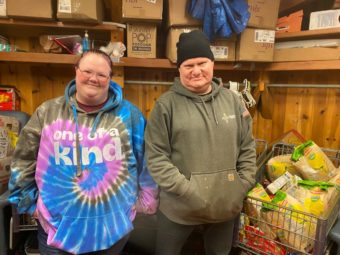
Sierra Gorbutt and Kevin Fortwengler are the two remaining Helping Hands volunteers. Pictured on Nov. 4, 2022. (Photo by Claire Stremple/KTOO)

“We would still probably be standing strong, but with the corona [virus pandemic] — it ate up all the savings to keep this place running,” she said.

Helping Hands usually holds fundraisers throughout the year, but the pandemic shut down those revenue streams.

Gorbutt says everything they can’t give away will go to the dump. She points to a shopping basket loaded with kibble — it’s the last of the dog food.

Karen Fortwengler is the director of Helping Hands. She took over leadership after her mother stepped down from the role about a year ago.

“Trust me, it’s not been an easy decision,” she said. She was emotional thinking about the closure. “I’ve been struggling for months to keep this place afloat. And the money’s gotten down there so low that I can’t do it anymore.”

To stay open, she says she’d need about $30,000 that she just doesn’t have. And she said even if she did, she doesn’t have the volunteers to staff it any longer.

Two more volunteers slip through the doors before Helping Hands opens for the evening. One of them is Crystal Johnson from the Lions Club. She comes in every Friday to help out.

Sierra Gorbutt says the soda pop and canned food are typically gone by the end of the evening. Helping Hands estimates it serves about 100 guests each night. (Photo by Claire Stremple/KTOO)

“This is actually my favorite day of the week, I tell everybody,” Johnson said. “Because I get to come down here and meet people and just get to say ‘hi’ and have that chance to do something nice that makes somebody say, ‘Ooh, I kind of matter.’”

People start filing in when the doors open at 5:30 p.m. Bread, chips and canned foods move from the shelves to shopping bags as the room fills with people and the line outside shrinks.

Helping Hands is now open only on Fridays due to the volunteer staff shortage. It will close for good on Nov. 25.

The Southeast Alaska Food Bank will still be open on Tuesday and Thursday afternoons. They also have a list of other local food pantries on their website.

In Bethel, a homegrown solution to the state’s nursing shortage

Amber Bukowski leans into Melanie McIntyre’s car to give her a flu shot. She’s wearing lavender gloves and has a small bandage ready.

Bukowski counts down and quickly empties the syringe in McIntyre’s arm while a Yukon Kuskokwim Health Center employee observes.

“It’s like a mosquito bite or like a little pinch, that’s all,” McIntyre said, leaning back to let her kids know how it went—they’re next.

This is one of many flu shots Bukowski will give today. She’s working the drive-through clinic on a frosty Saturday morning as part of the clinical hours towards her nursing degree from the Kuskokwim campus of the University of Alaska Fairbanks.

She and the three other students in her cohort are part of the long-term solution to the state’s dire need for nurses – specifically, Alaska-trained nurses who intend to work in the state. Alaska is increasingly reliant on out-of-state healthcare workers — an expensive, short term fix to a longstanding problem. The nursing program at the Kuskokwim campus isn’t huge, but it is putting four new nurses directly into the Bethel community this year.
Bukowski isn’t new to patient care, though. She got her start in Chevak, where she’s from originally.

“I started out as a health aide in the village clinics and transferred over to be a supervisor and took classes part time and then ended up in the nursing program,” she said.

Previous experience in health care isn’t required to start the degree program. The campus in Bethel offers pre-nursing courses, too.

Bukowski and the other three students in her cohort will take the test to become fully certified nurses after they pass their exams this December.

“It’s a lot of info,” Bukowski said. “A lot of hard work and dedication. But anybody can do it.”

Her classmate Michael Vicente worked as a public health official for the hospital in Bethel until he started the nursing program two years ago.

“I just felt like I’d been called to nursing,” he said. “This is the next step into working closer with the community on a one-on-one basis instead of community wide.”

Twyla Elhardt teaches the nurses-to-be.

“We have a huge shortage of healthcare workers here,” she said.

Elhardt came to Bethel as a nurse in 2015, then became a nursing instructor a couple of years ago. She said that’s because she has a passion for seeing students from the region learn to take care of its residents.

“I get to see elders cared for by nursing students who are from the same village. And it’s a beautiful thing,” Elhardt said. “I’d love to see that increase.”

She said local nurses break down barriers to care because they understand where their patients are coming from.

“If they want to be here for the long haul, I think you just have an amazing investment, not just in direct patient care, but into the whole healthcare system,” she said.

Seal hunting regulations on St. Paul Island show a new path for federal marine mammal protection

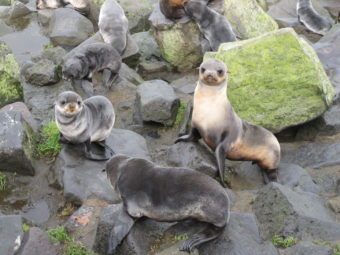
Seal pups on St. Paul Island. (Photo courtesy of Justine Kibbe)

This October marks the 50th anniversary of the Marine Mammal Protection Act, the conservation law that prohibits the killing of marine mammals. It does have an exception for Alaska Native people, and the federal government now works with Tribes to co-manage animals for subsistence use.

On St. Paul Island there’s a model for how this kind of partnership might guide Alaska’s marine mammals – and the people who depend on them – through dramatic climate shifts.

The Aleut Community of St. Paul Island Tribal Government has a partnership with federal scientists at NOAA Fisheries to manage Steller sea lion and fur seal populations.

“It’s actually just gotten better as the years go,” said Aaron Lestenkof, a local hunter who works for the Tribe. “And we have weekly meetings with them. And, you know, try to keep up to date on things happening here.”

Lestenkof is an Island Sentinel—a Tribal member who monitors hunting and stranded marine mammals on the island, among other duties. Federal biologists work only seasonally on the island, but Sentinels are there year round.

Lestenkoff says the changing climate has made fur seals more available over the last decade. They used to leave St. Paul in winter, but he says now some of them stay on the island over winter due to climate change. The Tribe worked with the federal government to update local regulations so hunters could take advantage of the longer seal season. That’s important because the changing climate means a decrease or even a crash in other subsistence foods, like halibut and crabs, respectively.

Lauren Divine is the director of the ecosystem office for the Tribal government on St. Paul. She says the federal regulation change was a milestone. Now the Tribe runs a research project on northern fur seals.

“We’re leading as a Tribal government, rather than kind of supplementing something that NOAA is doing,” she said. “This is something that addresses our Tribal member concerns, and is led and funded by our Tribal government.”

She says federal management needs to do more to keep up with climate change, but recent co-management decisions have given her hope for the future.

Site notifications
Update notification options
Subscribe to notifications