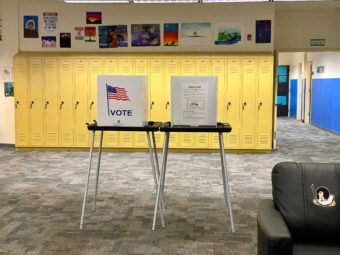
Voting booths at Bethel High School on October 25, 2022. (Claire Stremple/KYUK)
Bethel students are going to the polls this week. They’re voting with Sharpies, and there’s only one question on the ballot — it’s up to them to pick the sign that will mark a local playground.
It’s part of a city-wide effort to raise community-minded citizens. City leaders also hope it will interest parents and families in the upcoming general elections.
“If the community isn’t voting, they’re not sharing their voice,” said Lori Strickler, Bethel’s city clerk.
This election may not seem as consequential as the upcoming general elections, but Strickler said they’re actually related.
She said kids can also bring a little voter awareness home to their families — and maybe even spur adults to vote.
“Having conversations about elections within the household will help encourage the adult voters to look into what’s going to be on the ballot,” she said.
She brought voter information for this year’s state elections for students to take home.
Less than 19% of Bethel voters turned out in this year’s local elections. In 2018 and 2019, more than a third of the population voted in municipal elections.
Strickler set up voting booths and the city’s ballot counting machines at Bethel High School earlier this week. It looked like the real deal, except the backdrop was yellow lockers and classroom doors.
She explained how the student vote would work to a couple dozen middle schoolers at a time. There was some gum snapping from the crowd, but everyone paid attention.
Hannah Japhet and Andrea Simon head back to class after a student vote. October 25, 2022. (Claire Stremple/KYUK)
The students took turns in the polling booths and then fed their ballots into the machines. Everyone voted, and the stickers were popular.
Hannah Japhet and Angela Simon still have five years before they can vote in a general election, but they both said they might vote when they’re eligible.
A few students even grabbed the grownup election materials to take home. They’ll find out the results on Monday.
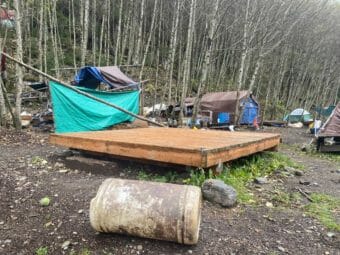
Juneau’s Mill Campground on October 14, 2022. (Photo by Claire Stremple/KTOO)
The City and Borough of Juneau closed the Mill Campground on Saturday.
The campground above the cruise ship docks is not for recreation. It’s for people experiencing homelessness in Juneau. It closes for winter every year.
David lived at the campground with his girlfriend. KTOO isn’t using his last name because of the stigma attached to homelessness. He said up to 40 people lived there this summer.
“It’s got its problems,” David said. “But overall, I really do like it.”
He said he knew the closure was coming, but he doesn’t have a plan for where to stay next. Other housing solutions like Juneau’s shelter, The Glory Hall, and the Housing First complex in Lemon Creek don’t work for him — too crowded, he said.
“I stayed in the woods last year,” he said. “For eight months.”
He said last winter the snow got pretty high around their tent and it was really hard to keep things dry.
“We survived. It would have been easy to do if I had a stove and water,” he said.
That’s part of the reason the camp closes. The road up to the Mill Campground isn’t serviced over the winter, so it’s not possible to haul water and service the toilets up there.
“It’s not a park and it’s not recreation,” said Dale Gosnell, a ranger for the city’s Parks and Recreation Department, which maintains the campground.
On Monday, he was on site cleaning up leftover tarps and other belongings that people didn’t take along when they moved out. He said the city only leases the campground for the summer because the rest of the year it’s too difficult to manage. Plus, he said, it’s dangerous.
“Even camping out in the summer in Southeast Alaska is challenging with all the rain we get,” Gosnell said. “In the winter, it becomes life threatening, potentially, with cold weather and snow. Tents would collapse under snow weight, potentially.”
The Glory Hall is getting ready for some people from the camp to relocate there.
“We’ve already had a few people come and ask about space here,” said Luke Vroman, the Glory Hall’s deputy director. “And what we tell them is we’re very full, but we’ll do what we can.”
There’s high demand for beds and sleeping spaces in the winter months.
Juneau also has an overnight warming shelter, run by Resurrection Lutheran Church. Its doors don’t open until the temperature starts to dip below freezing.
Brad Perkins helps manage the warming shelter. He said the church is still hiring staff.
The city increased the church’s funding for the program this year, but Perkins said his expenses are going up, too. He has to buy more food at Costco this year because of shortages at local food banks.
The weather should stay in the 40s through next week. Perkins said they will likely open when the weather starts to dip into the mid-30s.
There were nine people still at the Mill Campground on Monday. The Glory Hall picked them up for lunch.
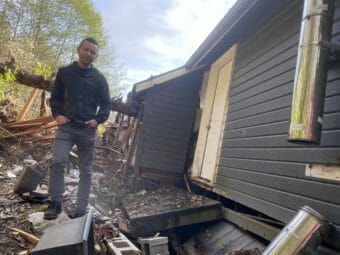
Jin Mitchem stands by the back of his wrecked Gastineau Avenue house on Oct. 6, 2022. (Photo by Claire Stremple/KTOO)
Jin Mitchem’s door hangs off its hinges, and a robin pecks around on the living room floor. A bear has scattered food wrappers it scavenged from the kitchen. Golden insulation sprays out of a ripped wall. Most of the house is leaning on the downhill neighbor’s home, like a kid leaning on a parent’s shoulder, and the front stairs are lying flat on the ground.
“Honestly, it’s hard to know where to start,” Mitchem said.
Falling trees destroyed his home when a late September storm triggered a landslide above Gastineau Avenue. Mitchem left for work about an hour and half before one tree skewered through the living room window.
Now homeowners and the community are grappling with how to respond. And with another question — who pays?
For Mitchem, the answer so far has been “friends and kind strangers.”
A friend started an online fundraiser for Mitchem that’s raised nearly $50,000 so far. He said he can’t even count the number of people who have offered to let him stay in their homes.
“Right now, I don’t have a house. But, you know, I have life. I have friends. And last week I learned I have a community,” he said.
Jim Mitchem’s Gastineau Avenue house, pushed off its foundation, leans against the house in front of it on Oct. 6, 2022. (Photo by Claire Stremple/KTOO)
Mitchem just moved from a hotel to a temporary apartment. His insurance is paying for his stay. After that, he’s not sure.
“It kind of depends on whether my insurance agrees to cover for the situation or not,” he said.
The situation involves tree removal, demolition, preparing the land and a house rebuild.
His downhill neighbors are also displaced — the electricity isn’t even back on in their apartments.
Mitchem says he thinks he’d like to rebuild, but he has some concerns about the location now. His home is in a severe landslide hazard zone, according to city maps.
Landslide insurance is ‘exceedingly hard’ to get
City officials say the fallen trees are what totaled his house. That’s good news for Mitchem, because he doesn’t have landslide insurance. Most people don’t.
Juneau homeowners looking for landslide insurance have a tough time. Some say mortgage brokers have told them they simply cannot get landslide insurance in Southeast Alaska anymore.
“It is available. But it’s been extremely hard to write,” saidEmil Mackey, an insurance agent in Juneau. He says he gets an automatic rejection when he tries to get landslide insurance for Juneau clients.
He says that’s because of fatal and destructive landslides in the region. The 2015 slide in Sitka and 2020 slide in Haines changed how insurers view risk region-wide.
“No matter where you are in Juneau, if you’re within one mile of any historic landslide, which is anybody near a mountain, which is everybody in Juneau — yes, it takes basically a geo survey to get approved,” Mackey said.
Evan Hartung stands by the newly repaired utility pole outside a damaged Gastineau Home where he was a renter. Now displaced, Hartung plans to try van life in the Lower 48. (Photo by Claire Stremple/KTOO)
A geotechnical survey can cost thousands of dollars.
Mackey says this latest landslide is likely to affect insurance, too. And not just in Juneau.
“I think it’s actually going to affect the availability of landslide insurance throughout Alaska, because most insurance companies actually consider risks on a state level or a county level and not necessarily on a city level,” Mackey said.
Accelerating change
Both of Carole Triem’s homes are in landslide zones. The Juneau Assembly member is calling for the city to do a better job responding to landslides. And, no, she does not have landslide insurance.
Carole Triem (Photo courtesy of Carole Triem)
Triem isn’t an outlier — roughly half of the downtown area is in a hazard zone for landslide or avalanches, according to the city’s new hazard maps. But she says it’s more than downtown hazards. Flooding in the Mendenhall Valley at Jordan Creek and erosion on waterways are some examples.
“They’re just going to become more frequent and have greater severity,” she said. “I think that that means our role is going to have to change, it’s going to look different than it has historically, just because the planet is changing.”
Triem says 20 years ago, risk calculation was more static in Juneau — residents could be expected to make their own risk assessments.
“Climate change is changing that. I think that now that means that we have a role to play as a city government in helping people figure out what those risks are,” Triem said.
After the landslide on Gastineau Avenue, the city cleared the road. Deputy City Manager Robert Barr says that’s been its main job so far. They may relocate a culvert for better hillside drainage. But he says further involvement isn’t in the playbook, yet.
“It’s not that the community has decided to do nothing,” Barr said. “It’s that the community has decided to move forward in a more individualistic nature about thinking about risk and these sorts of emergency events.”
Debris left from the September, 2022 landslide and treefall on Gastineau Avenue after the city cleared the street. (Photo by Claire Stremple/KTOO)
In other words, as a community, Juneau hasn’t made a plan for how the local government should be involved after a landslide destroys a home or a neighborhood.
But Barr said that could change. The assembly will resume talks about new hazard maps and what they mean next month.
Barr said the city could decide to move forward in a more “communal perspective,” where the city could change building codes or adopt plans that conform to the latest scientific knowledge of the area.
The city has considered buyouts in hazard zones before — that’s where the city buys dangerous property so people don’t continue living there. The assembly rejected those proposals for Behrends Avenue in 2008.
Barr says the city hasn’t considered buyouts for the homes damaged by this landslide.
Looking over the wreckage of his home, Mitchem says that’s an offer he might take.
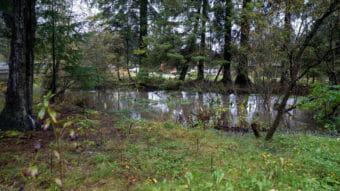
Flooding near Jordan Creek after record breaking rain fall in Juneau on Sept 26th 2022. (Photo by Paige Sparks/KTOO)
It’s going to be extra wet in Juneau for the next few days. Forecasters say moderate to heavy rainfall will inundate the region starting from Wednesday through the weekend. They expect up to 5 inches of rain and winds with gusts of up to 50 miles per hour.
Pete Boyd with the National Weather Service calls it a strong fall storm.
“Those type of rainfall amounts over a 24-hour period are not uncommon. But we’d like to keep everyone aware, especially when we start getting these higher rainfall amounts and how they’re going to be impacting the area,” he said.
All that rain means the National Weather Service issued a flood watch from Wednesday afternoon through Friday. Sitka, Yakutat, Gustavus, Hoonah, Juneau, Haines and Skagway all fall in the flood watch zone.
“If you live along or recreate on any waterways or rivers, take extra caution. Be aware of any immediate rising water levels,” he said.
Boyd said it’s not the strongest storm the weather service has ever seen, but he doesn’t recommend camping this weekend either.
“It’s going to be kind of miserable, just with the rainfall,” he said.
He added that hardier souls who are prepared for the weather might still go outside.
To get more up-to-date information on rainfall and flood risks, you can visit weather.gov/juneau.
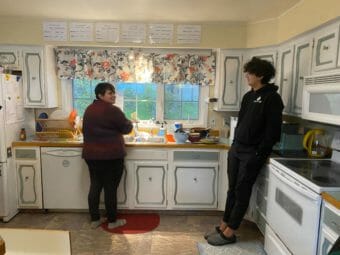
Stevi Frets and Max Pyles joke as they do the dishes at the Sun’aq Tribe’s language house in Kodiak on Sept. 15, 2022. (Photo by Claire Stremple/KTOO)
Half of the first language speakers of Kodiak Alutiiq died between 2020 and 2022. But that’s not stopping new speakers from learning the language and passing along a distinct culture and worldview to the next generations.
At the Sun’aq Tribe’s language house, everything is a lesson—catching up on gossip, making a grocery list or washing the dishes.
No one lives here full time, but the Sun’aq Tribe uses a federal grant to pay a group of language apprentices and mentors to master the language.
“To really get the language down, you gotta use it in practice,” said Dehrich Chya, a mentor at the language house. “The point of a language house is it’s a place where you can just get together and use the language in your day to day life.”
“Heritage languages are so important,” said mentor Stevi Frets. “And when you learn them, it’s like, ‘Okay, I’m part of the crew saving it now.’ There’s no like, ‘Yeah, I learn a little Alutiiq on weekends, when I can.’ All of a sudden, you’re like, ‘Oh, my gosh, my language, I have to save it, I have to do everything I can’.”
Kodiak is home to a powerful movement to bring the Alutiiq language back into daily use. For about 100 years, American schools and governments suppressed the language and punished children for speaking it. Now the last Elders who speak it fluently are almost gone.
Frets says there are a few Elders in town she can speak with, and a lot of folks who have gone through some basic language classes at the University.
“But there’s not a lot of people you can like have a conversation with around. Like, I think they’re mostly in this room right now,” she said with a laugh.
In some ways, Frets says she feels like she missed out. The tribe estimates there are now only about 17 Elders who are fluent Alutiiq speakers left. They lost about that many during the pandemic. It’s a turning point.
But the language movement isn’t giving up, it’s moving forward.
Hailey Thompson administers the grant. She says part of the Sun’aq Tribe’s goal is to train fluent speakers who can in turn teach the language.
“We have a lot of motivation to learn Alutiiq. People want Alutiiq preschools, and Alutiiq language classes at the high school, and Alutiiq language class at the college,” she said. “But the problem is we don’t have the teachers to teach those classes and workshops.”
Hailey Thompson manages the Sun’aq Tribe’s language grant. “It’s not a job you can just clock out of,” she said. “If we don’t build more Alutiiq fluent people… then there’s not going to be anyone for my kids to learn from. So that’s what probably keeps me going.” In Kodiak on Sept. 15, 2022. (Photo by Claire Stremple/KTOO)
A solid foundation of language revitalization already exists in Kodiak. But Thompson says it’s different now—there were a lot more elders before.
“The next wave of what it looks like is building resources, archiving things that we know we’re going to need, spending the time that we know we can get with elders,” she said. “That’s what it looks like right now. Just cherishing all the things, that all the resources we can get… before we know that they’re gone.”
The stakes are high, but the rewards are immense. Frets and the others are building fluency to be able to teach the next generation of Alutiiq speakers.
At the Alutiingcut Childcare Center about a dozen preschoolers learn numbers in Alutiiq and Alutiiq versions of popular kids songs. There probably won’t be any birth speakers left by the time they’re older, but the language movement is working to ensure they’ll have teachers.
An Alutiiq language program exists at the Kodiak college and courses at the high school. And the tribe hopes to put 18 people through its program at the Language House over the course of its 3-year grant.
Learners meet up with Elders at the museum once a week. Three of the Elders that used to be at those sessions died during the pandemic, but the museum records them so new learners and descendants of the speakers can hear their stories.
Dehrich Chya, the Alutiiq Museum’s Language and Living Culture director, sits with Elders at a weekly session in Kodiak on Sept. 16, 2022. (Photo by Valerie Kern/AKPM)
Florence Pestrikoff didn’t grow up speaking Alutiiq, even though most people in her village did. But for the last couple of decades she has been an active speaker and teacher–she learned in the first wave of language revitalization about 20 years ago.
“I love speaking my language,” she said. “In the past it was — people were ashamed of the language. It’s sad. Really sad.”
American missionaries and schools enforced strict English-only policies for years. Parents like hers encouraged English to protect their children. The result was a swift decline in speaker numbers.
Pestrikoff answers her cell phone in Alutiiq and says she speaks it with her husband. And that’s the vision of the language movement—to have the language be in use. At home, in the grocery store, on the street.
And to carry the values that are embedded in the words.
“We never say goodbye. There is no goodbye in Alutiiq,” Pestrikoff said. “You say ‘Tang’rciqamken. I will see you later.’ I like that.”
Just like the language in Kodiak schools and homes — quiet for a while, but coming back.
Close
Update notification options
Subscribe to notifications
Subscribe
Get notifications about news related to the topics you care about. You can unsubscribe anytime.