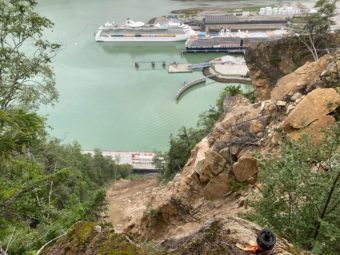
The cruise ship berth directly below the rock slide is empty for the rest of the 2022 season. August 3, 2022. (Stremple/KTOO)
Alaska Sen. Lisa Murkowski was in Skagway last week as part of a tour of Southeast Alaska. She also took the opportunity to survey a looming rockslide threat.
Skagway is more than a cruise ship port. It is also a port of entry to Canada at the Fraser border, just 20 miles out of town.
Murkowski said that’s a big part of why she’s interested in helping Skagway address the issue.
“This is one of those gateway communities to the border,” she said. “And so this is about access. This is not just about a tourism community. This is a community that has its own economic identity as well. But you got to be able to move in and out.”
Murkowski said there might be ways the federal government can help. She cited her work on last year’s federal infrastructure bill, which focuses on things like roads, rails, bridges, ports, harbors and the Alaska Marine Highway System.
“When we think about ways that the federal government can help facilitate healthy communities, making sure that you’ve got a good, strong, safe waterfront is pretty important,” Murkowski said.
Murkowski also visited Juneau, Haines, Tenakee Springs and Wrangell during her tour.
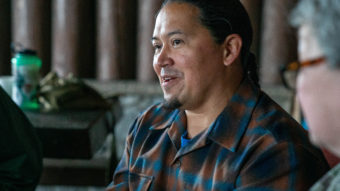
University of Alaska Southeast professor X̱ʼunei Lance Twitchell in Juneau. (Photo by Paige Sparks/KTOO)
X̱ʼunei Lance Twitchell teaches Alaska Native languages at the University of Alaska Southeast. He started listening to podcasts years ago — long before he ever considered creating one of his own.
“And then I started to think, ‘Well, where are the Indigenous voices?’” he said.
He says he found podcasts about almost everything, from true crime to decolonization and anti-racism. But he says he didn’t hear anything about his life’s work: language revitalization.
Twitchell’s name is practically synonymous with a growing Indigenous language movement in Southeast Alaska. He teaches students that Indigenous language is fundamentally connected to culture and identity — things that colonization has tried to extinguish.
He’s taught all over the region. He’s writing Lingít language textbooks and a dictionary. And he’s been pushing the state to incorporate Indigenous languages into curriculum and daily life as a member of the Alaska Native Language Preservation & Advisory Council.
Now he’s the host of a new podcast called Tlél Wudakʼóodzi Ḵaa Lʼóotʼ — or Tongue Unbroken, if you don’t speak Lingít yet. The first season launched in August. It’s a platform for people who are doing language revitalization and decolonization work across North America.
Listeners will hear from a Lakota language teacher who’s fighting for data sovereignty in Standing Rock, a Nanticoke tribal member in Delaware who is bringing their language back from dormancy and a member of the Cherokee Nation about blood quantum and identity.
He and his guests take on serious conversations — Indigenous languages in Canada and the United States are endangered after years of colonialism and government policies aimed at erasing Indigenous culture. His approach highlights successes in language revitalization work without ignoring the challenges.
“Doing this work, you engage with a lot of people who are resisting you, and who are active in resistance,” he said. “When you’re resisting decolonization, if you’re resisting language revitalization, then you’re on the side of genocide and of white supremacy and racism. And now I have a platform to sort of share some of that stuff.”
He says he’s felt resistance as a language advocate in front of the legislature and even in academia. But he’s made a lot of headway. Just this year, UAS began offering Alaska Native language courses for free. He says when he arrived, a lot of language programs were shrinking. Now, he says so many people want to take courses that the university may have to hire more instructors.
Twitchell was supported by iHeart media’s Next Up Initiative, which is aimed at training creators from underrepresented groups in the art of podcasting. He says the podcast gives him an opportunity to speak frankly about how language revitalization is linked to decolonization.
“There’s all these terms that are out there, like ‘cancel culture’ and ‘wokeness’ and stuff. But I think those terms are employed to get people to stop talking about equity. And we’re not going to,” he said.
Twitchell says he hopes it’s another step towards normalizing the use of Indigenous languages in mass media.
“We’re just part of the things that everyone else is,” he said. “Because y’all are on our land. So you can’t just pretend that we’re not here.”
The guests vary, but the podcast is also personal. Twitchell shares stories from his life and stories that have been passed down to him. He interviews his own kids, who understand Lingít.
Those links are the point. Twitchell says the podcast name, Tongue Unbroken, uses the Lingít verb that refers to how a rope might break. But in this context, he says, it means an unbroken chain of communication.
A woman crosses Marine Way in front of Juneau City Hall on Sept. 25, 2017. (Photo by Jeremy Hsieh/KTOO)
Juneau’s only hospice and home care provider says it can’t sustain its services alone. Catholic Community Services has been seeking a partner to shore up the program since mid-summer.
CCS Executive Director Erin Walker-Tolles says that’s because the cost of labor has about doubled due to demand.
“Travel staff used to be $55 an hour, and now they’re quoting us at $120 or more an hour,” she said. “There’s just really no way to keep up with the cost of staffing the programs in the face of the shortage.”
She says staffing was hard before the pandemic, but over the last few years the situation has become dire.
“Nurses, physical therapists, occupational therapists have been leaving the field — leaving the industry,” she said. “Whether they’re burned out or ready to retire, there are fewer nurses.”
Walker-Tolles says the program needs three more nurses. It has only one full-time staff nurse, and the contracts for its two traveling nurses will expire in late October. CCS hasn’t been able to find more travel nurses to replace them.
CCS has reached out to the City and Borough of Juneau for support, but there’s no plan yet in place.
In a letter to the mayor dated Aug. 12, Walker-Tolles wrote that the service wouldn’t take new clients after this week if it couldn’t secure an additional $50,000 a month in funding. The letter also suggested current clients could be moved or discharged without new funding.
CCS already has contracts with CBJ and city-owned Bartlett Regional Hospital for transit and medical services. But Walker-Tolles says the amount of those long-standing contracts has not kept up with rising costs.
At a subsequent assembly meeting, Deputy City Manager Robert Barr said the city would assist the program through the hospital. Walker-Tolles met with the hospital’s new CEO, David Kieth, to talk about a partnership this week.
“Our main goal is to make sure that we remain able to provide care,” she said.
Walker-Tolles told KTOO there are no plans to shut down services, nor should there be a break in services. But she says CCS would have to start “triaging referrals.” That means the hospice and home care program won’t be able to accept all new patients if there is not enough staff to support them.
CCS cares for roughly 50 home health patients and usually anywhere from four to twelve hospice patients at a time. Walker-Tolles says the program gets up to ten referrals a week.
Close
Update notification options
Subscribe to notifications
Subscribe
Get notifications about news related to the topics you care about. You can unsubscribe anytime.