Claire Stremple

"I support KTOO reporters and guide coverage that informs our community and reflects its diverse perspectives."

When she's not editing stories or coaching reporters, you can find Claire outside with her dog Maya.

Lack of data blunted Alaska’s COVID response, New York Times investigation shows

Luke Dihle, RN at Bartlett Hospital, leaves a triage tent near the entrance of the hospital on Monday, April 7, 2020 in Juneau, Alaska. (Photo by Rashah McChesney/KTOO)

How public health systems collect and report data during a pandemic can help determine how diseases spread and how to stop them. But a New York Times investigation shows that data in Alaska — and across the nation — continues to be lost or unusable due to under-investment in public health.

Reporter Sharon LaFraniere traveled to Alaska for the story. She says Alaska’s data shortfalls during the pandemic weren’t unusual — and the only solution is spending money to modernize public health systems.

Listen:

The following interview has been edited for length and clarity.

Claire Stremple: What’s the data failure? How did it happen?

Sharon LaFraniere: The government never invested enough money to modernize the data systems for state and local governments. Over the past decade, we spent $38 billion to modernize health records at hospitals and clinician’s offices. And we’re seeing results from that now, like if you go into your doctor’s office, and many places, the doctor can right there, you know, look up your electronic record. But we didn’t spend the same. We didn’t spend money to modernize the state and local health departments. We left them with the spreadsheets, telephones, fax machines, Excel  sheets. The old system. I think many people don’t understand–and I certainly didn’t understand, until I got into this–how behind state and local health departments are in the data. They’re way behind.

Claire Stremple: You wrote that the low vaccine rate contributed to the heavy death toll in the United States from COVID-19. But so did the lack of data. Why is that deadly?

Sharon LaFraniere: Nobody can pinpoint we lost XX million, or how many other people became severely ill from COVID, because we didn’t have data. But basically what happened is the fact that the data pipeline, if you think of the digital pipeline, is totally riddled with holes and obstacles, and it doesn’t flow. It means that the government did not respond as quickly as it could have. Because to some degree, they were flying a little bit blind. All the senior federal health officials that I’ve spoken to in the last three years are utterly convinced it had a real impact.

Claire Stremple: What made you come to Alaska to tell this story?

Sharon LaFraniere: Two reasons. One, the Alaska State Health Department is a pretty hard charging health department, and it has a lot of talented people in it.

Secondly, because its problems are quite typical.

Claire Stremple: What was the atmosphere like when you were here. What did you see? Did anything kind of stand out to you while you were reporting?

Sharon LaFraniere: I mean, I’m saying this not to be flattering, but I think the health department is incredibly hard working and very dedicated. I mean, why else would you be carrying stacks of paper, you know, from the fax machine at 6 a.m. and entering it all by hand if you didn’t really care?

Claire Stremple: You reported a lack of race and ethnicity data. How does that happen? And what are the consequences?

Sharon LaFraniere: So race and ethnicity is one of the data fields that is often just left out. And so for instance, in Alaska, the someone has a COVID test and they test positive, the lab test comes back in 6out of 10 cases where the field that says race and ethnicity is simply left blank. And so the health authorities don’t want to say, ‘hey, we’re not going to process these results, because you left this critical information blank.” They process the results. But then when Dr. Zink wanted to know about the disparate rate of COVID testing among minorities–she basically was trying to figure out where Alaska needed to put more testing sites to correct this–and she couldn’t get an answer because that field was left blank way too often. It matters when you’re trying to figure out how to allocate resources.

Claire Stremple: What are the consequences of using trained epidemiology staff to do a bunch of manual data entry? You know, what could they have been doing instead? And what did epi staff in Alaska have to say about this?

Sharon LaFraniere: To me was one of the more troubling things is that if you, I mean, think of it  like if your phone didn’t sync with your computer, right? Then you enter your information in the phone, you’re going to enter it again in the computer. That’s what was happening here. So a whole bunch of people had to be roped in to re-enter information because the databases could not connect with each other. So the health department was forced to basically reduce some of its most highly trained epidemiologists, for periods of time, simply to enter data.Cecause the data had to be entered. So they would do it on weekends, they would do it at night. So it would start at 6am. It was an immense amount of effort, just to get the data entered. And that’s not unusual. And then a disturbing thing about it is people put in all that effort, and then a lot of it wasn’t useful. Because the date by the time the data got entered, it was too late to be meaningful, or it was too incomplete to guide decision making.

Claire Stremple: In your reporting did you or did anyone you spoke to have a sense of how we fix it?

Sharon LaFraniere: I mean, you fix it by money. Basically, if the system is upgraded, then there are faster ways to fill in the missing information, right? And it’s not just money, it’s not just that they need software and better systems and all that–they need the people to run the systems, right? They need data scientists and data analysts and people who are trained as an epidemiologist and as data scientists, and they don’t have those people, they have a completely skeletal staff.

Claire Stremple: To your point about money, Alaska got less funding than expected, much less funding than expected for improvements. What are the consequences of that? And why is it still not a priority?

Sharon LaFraniere: I’m not sure why Alaska didn’t get more money, like why its share of the pot was less. But I know that the pot is too small. And when you divvied up among fifty states, what Alaska ended up with from this latest grant, a five year grant was about $1.8 million a year for that for public health personnel and infrastructure. And of that there was $213,000 a year for data modernization. And, like one of the state health officials said, ‘Well, that’s about enough for a nice campervan.’ It’s partly that I think Congress allotted a certain amount of money, but it just isn’t enough money.

Juneau landslide damages homes, displaces residents

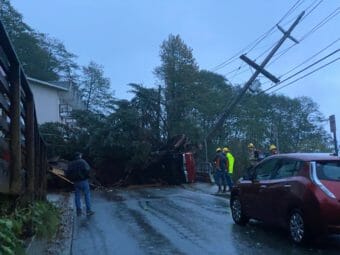
A landslide on Gastineau Avenue in Juneau, Alaska on Sept. 26, 2022. (Photo by Claire Stremple/KTOO)

A landslide in downtown Juneau Monday evening damaged homes and knocked out power to parts of Juneau and Douglas. No injuries have been reported.

The National Weather Service office in Juneau had cautioned that landslides were possible earlier in the day, but no major warnings were issued.

Then the power went out around Juneau, just after 6:00 p.m. A few minutes later, Juneau’s power company tweeted that there was a “significant landslide on Gastineau Ave. with lines down.”

Cruise ship passengers in the harbor reported seeing a flash when the transformer blew.

First responders were on the scene within a few minutes, going door-to-door asking residents to evacuate. It was voluntary. Some stayed, and some left.

Alenita Danner was looking for her 80-year-old mom. She couldn’t get to her because a large spruce tree had fallen across the road.  

“My mom called, and she said that my aunt’s house was on the road,” Danner said. 

Part of her aunt’s house was underneath the tree. There was significant damage, but no one was inside. 

Danner’s mom was able to evacuate down one of the long stairways that runs down the steep hill below Gastineau Avenue and meet her daughter downtown.

The downed tree was also on top of Evan Hartung’s truck. 

Hartung was watching television. When he heard shaking and rumbling, he ran outside, barefoot. He said the 2020 slide in Haines was on his mind.

An AEL&P crew assessing the damage from Monday night’s Gastineau Avenue landslide on Tuesday morning, Sept. 27, 2022. (Photo by Paige Sparks/KTOO)

Sarah Wallace and her partner live in the unit next to Hartung. 

“We looked at the window. We saw him running out without any shoes. And then my partner and I grabbed both of our cats and ran out. And then I ran back in for a second to grab our coats. And yeah, we’ve been out here ever since,” Wallace said.

They planned to stay with friends, after swinging by a brewery to decompress. 

Their landlord, Terry Schwarz, said the tree missed his house, but it isn’t fine. 

“There’s another house on top of it right now,” he said. 

The view from 153 Gastineau Ave. on May 18, 2022. The roof in the foreground is 157 Gastineau Ave., Terry Schwarz’s house, immediately downhill. (Photo by Ian Dickson/KTOO)

Schwarz was finishing dinner at his home in North Douglas when he got the news. 

 “I hope that we can get this cleaned up real quick,” he said. “I’m also glad that Jin wasn’t in his house — that’s the guy above us.” 

Damage from the Sept. 26 landslide on Gastineau Avenue in Juneau, seen the next morning. (Photo by Paige Sparks/KTOO)

Schwarz says weather like this is getting more common.

“It’s been raining pretty wild,” he said. “Rainfall intensity has definitely increased over the last couple of years here and landslides have been more and more common.”

About a dozen people who evacuated from the neighborhood ended up at a temporary shelter set up by the Red Cross and Capital City Fire/Rescue at a downtown fire station. 

A woman holding a baby sits looking at a Red Cross volunteer, who is seen from behind
An American Red Cross volunteer assists evacuee Monica Johnson after a landslide on Gastineau Avenue in Juneau on Sept. 26 2022. (Photo by Paige Sparks/KTOO)

Monica and Travis Johnson were there with their two young children.

Travis was at work when the slide happened. The road was blocked by a tree, so he couldn’t get to his family by car. 

“I had to come around and park down below and go up the steps and get my family and bring them back down,” he said.

Virginia John-Daniels and her partner John Hillard came to the shelter with their dog and cat. 

“We just packed up what little we could. Definitely grabbed animals and some food for them too,” John-Daniels said. “You know, I’m just praying it doesn’t hit our place and everything we work for.”

A woman wearing a mask stands in a room with her fingers interlaced. Behind her, a man sits while a woman carries a baby.
Britta Tonnessen assists residents who evacuated from Gastineau Avenue after a landslide in Juneau Alaska, Sept. 26 2022 (Photo by Paige Sparks/KTOO)

John-Daniels has been at her place for 5 years. She used to work for the Red Cross and said it was “very different” to be on the other side of emergencies.

The Red Cross and the city plan to offer hotel vouchers for people displaced by the slide. 

The next morning, Juneau residents Jean Findley and Bret Schmiege look at the damage from a Sept. 26 landslide on Gastineau Avenue in Juneau. (Photo by Paige Sparks/KTOO)

In a news release, the City and Borough of Juneau said that roads were closed in the slide area, and people should stay at least a block away. Crews will begin clearing debris in the morning.

Aaron Jacobs, a hydrologist with the National Weather Service office in Juneau, said one-to-three inches of rain had fallen in the last 24 hours and that two-to-three more inches were expected to fall by Tuesday morning.

This story has been updated.

An ancient discovery in Southeast Alaska could help pinpoint how and when the first humans got here

A slightly blurry underwater photo of a small rock wall covered with algae
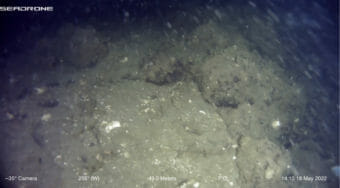
A view of the weir from an underwater drone. (Image courtesy of Sealaska Heritage Institute)

An underwater discovery on the west side of Prince of Wales Island shows that people have lived in what we now know as Southeast Alaska for at least 10,000 years. And scientists say it may support the theory that the Pacific coast was first settled by people traveling along the shoreline, living off the sea.
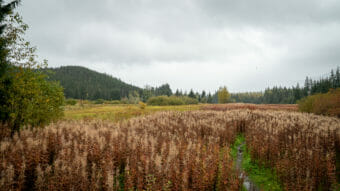
Canadian archeologists, in partnership with Sealaska Heritage Institute, found the weir in Shakan Bay — the culmination of a search that started when a weir-like shadow showed up on a sonar image more than a decade ago.

Fish weirs are barriers used to trap or redirect fish. They’re some of the earliest forms of fish traps, and they’re still used today. The team was able to date the submerged weir based on when it would have been at sea level — at least 10,000 years ago.

Sealaska Heritage Institute President Rosita Worl says the weir not only shows that Indigenous people were living in Alaska that long ago, it reveals how North America’s earliest communities could take root here.

“Generally scientists think that you have to have agriculture to develop a civilization,” said Worl. “I think what we see here is that the Indigenous people developed the technology to harvest significant numbers of fish. So you can see the beginning of what turns out to be a very complex culture.”

She says the discovery also supports the coastal migration theory over the other main theory — that the earliest peoples traveled on an interior land route.

“It was previously thought that the occupation of the Americas was through an ice free interior corridor,” Worl said. “But that corridor wasn’t opened up until later.”

Archeologist Kelly Monteleone says the discovery helps rebut a main argument against the coastal migration theory, which is that there aren’t a lot of archaeological sites to prove it.

“But that’s because we haven’t really looked,” she said. “The amount of work we’ve done is so small in comparison to what’s been done terrestrially.”

Monteleone has been looking for the weir for more than a decade, when something that looked like a fish weir showed up on a sonar image.

“Until we could actually get eyes on it, we couldn’t confirm it was really a weir,” Monteleone said.

She got funding to search for the weir in 2012 but didn’t find it. She’d been looking in the wrong place. This year, she found it right away.

“I felt so validated after spending, you know, 12 years of my life talking about this potential fish weir.,” she said.“I have presented on this all over the world. So to finally find it was just so exciting.”.

She found the weir by piloting an underwater drone outfitted with a camera. Video footage shows a jumble of shell and algae-covered rocks. Moneteleone says she knows it’s a weir because rocks wouldn’t naturally be in stacks or formations like the ones they found underwater.

She’ll continue her underwater research with the Sealaska Heritage Institute in Southeast Alaska next summer. There’s some sonar evidence for shell middens — piles of shells that indicate human presence and often contain artifacts. She’ll be looking for those and more archaeological sites that explain how and when the earliest people got here.

No arrests and few details from police after Juneau woman found dead along popular trail

The area around Kaxdigoowu Héen Dei, also called the Brotherhood Bridge Trail, on Sept. 23, 2022. The body of Juneau resident Faith Rogers was found about 200 yards from the trailhead on Sept. 21. (Photo by Paige Sparks/KTOO)

A Juneau woman was found dead on a popular Mendenhall Valley trail on Wednesday. Police are investigating Faith Rogers’ death as a homicide. 

“She was a very gentle, kind person,” said Rogers’ friend Mary Neary.

The two met more than 20 years ago and became close. Neary remembers vacationing together in Hawaii and spending holidays with Rogers’ family.

A smiling woman sits at a table holding a spoon in a bowl of something you can't see
Photo courtesy of the family of Faith Rogers

Neary says Rogers worked in childcare while she worked toward her master’s degree in social work — all while raising her three children as a single mom.

Rogers, who was 55 years old, worked with Neary at Bartlett Regional Hospital for many years. Rogers was a substance abuse counselor. Neary says that work speaks to the kind of woman she was.

“She was a very caring person. Really cared about her clients and always gave everything to her work,” Neary said.

Juneau Police have shared little information with the public.

On Wednesday, Juneau police said in news release that a woman was found about 200 yards from the Glacier Highway trailhead for Kaxdigoowu Héen Dei, also known as the Brotherhood Bridge Trail, and that they were investigating the death as a homicide.

In a Thursday update, police identified the woman as Rogers and said they had questioned and released what they called a person of interest.

Public Safety Manager Erann Kalwara is the department’s spokesperson for the case. Kalwara wouldn’t say if there is a public safety risk.

“I think people are going to have to care for that themselves,” she said. “I think that’s just really a personal choice for people.”

But Kalwara said there is a reason police asked people to stay away from the trail.

“We also ask people to stay away from the area because we are investigating the murder of a woman. It only occurred two days ago, and we don’t have the suspect in custody,” she said.

Kalwara would not say if the department has any leads, how Rogers died or if there was evidence of other crimes.

Rogers’ body was sent to Anchorage for an autopsy. 

Anyone with information can make an anonymous tip at juneaucrimeline.com.

Alaska has the highest rate of women killed by men in the nation for the 7th year in a row

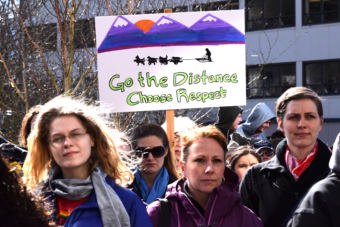
Supporters of the Alaskans Choose Respect campaign listen to speakers during a rally at the state Capitol, March 27, 2014 — when the rate of women killed by men in Alaska was slightly lower than it was in 2020. (Photo by Skip Gray/Gavel Alaska)

Alaska has the highest homicide rate in the nation for women killed by men — for the seventh year in a row.

The state has been first or second on that list for a decade. That’s according to a report released Tuesday from the Violence Policy Center, a Washington, D.C. nonprofit that advocates for gun control.
The report details findings from the most recent data, which is from 2020. In that year, 12 Alaska women were killed by men. More than 90% of the victims were killed by someone they knew. A quarter of them were killed with guns.

The report says state lawmakers should prioritize ending the “epidemic of deadly violence” against Alaska women — and particularly Alaska Native women. 

Women in Alaska were killed at more than twice the national average rate. That’s 3.43 women were killed by men for every 100,000 people. Alaska Native women were killed by men at ten times the rate white women in Alaska were. 

The federal Office of Violence Against Women is holding its annual Government to Government Tribal Consultation meetings in Anchorage this week. Its aims are to figure out how to administer tribal funds to make Indigenous women safer and to strengthen the federal response to these violent crimes.

Shaktoolik residents say they need aid to rebuild their berm before winter storms hit

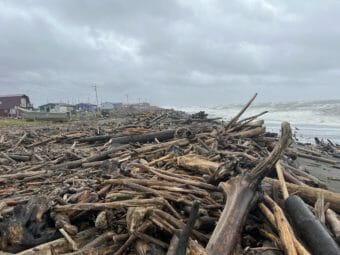
Broken wood piled up along a battered coast
The storm destroyed Shaktoolik’s berm, all that stands between the village and the waves. (Photo courtesy of Gloria Andrew)

People in Shaktoolik are back in their homes after many evacuated to the school when the remnants of Typhoon Merbok hit Western Alaska over the weekend. But the storm washed away the berm that protects the village from the sea.

“We’re back in school,” said Agnes Takak, the school secretary and a member of the Shaktoolik Council.

“We have everyone here. Right now we’re just trying to be there for our children. Getting them back into what we are trying to say is normal.”

She says her generation built the berm after elders saw how much land was lost due to erosion. Children in Shaktoolik now have always known the protection of the berm. She says it was a symbol of their security.

She says one student asked: “What are we going to do now?

Takak says there’s a lot of clean up to do. Residents are assessing damage to their homes and properties.

She said if the next storm comes before the village can rebuild the berm, the community could get wiped out.

Shaktooliks coastal berm, before and after the storm. (Photos courtesy of Gloria Andrew.)

“Our organizations don’t have any funding to rebuild right now. We need financial assistance, ASAP. Our lives are at stake,” said Takak.

Mayor Lars Sookiyak says Shaktoolik is pressed for time. He expects a big storm in November.

He said planes can land at the airstrip, but there’s hardly any air traffic, so Shaktoolik could also use some food and water.

“The stores are getting a little bare,” he said.

He’s also concerned about erosion from the storm. The village sits on a narrow spit of land between the Norton Sound and the Shaktoolik River. If the ocean breaches the river, it could pollute it with salwater.

“There’s a risk of losing the freshwater source and Shaktoolik becoming an island,” he said.

Logs washed into the community after the berm was damaged, but water stayed out of the homes.

“My ankles didn’t even get wet — and I didn’t even have my high heels on!” Eugene Asicksik said with a laugh.

Asicksik is on the Shaktoolik Council, and he’s the president of the local Native corporation. He and his family sheltered briefly at the school. But he said the village was prepared — they’ve seen big storms before and had systems in place.

“The electrical system held up. The only thing we did was disconnect the electrical wire to our winter water pumping station, which was a good thing,” said Asicksik.

He says the village likely has enough water for the remainder of the month. By then he’s hoping the village will be able to pump water normally for winter.

Most boats weathered the storm, though Asicksik said one sank in place.

Site notifications
Update notification options
Subscribe to notifications