Elizabeth Harball, Alaska's Energy Desk
Trump’s path to ‘energy dominance’ in Alaska has a key opponent: Lawyers

Erik Grafe at Earthjustice’s office in downtown Anchorage. (Photo by Elizabeth Harball/Alaska’s Energy Desk)

This March, lawyer Erik Grafe won a big case. And he didn’t win against just anyone, either.

Along with coalition of other environmental groups, Grafe won against the president of the United States.

Grafe is an attorney with Earthjustice in Anchorage. He was one of the lawyers behind a significant court decision in March, when a judge in Anchorage struck down Donald Trump’s executive order re-opening vast portions of the Arctic Ocean to oil leasing, after former President Barack Obama banned development there in 2016. The Trump administration is appealing. But for the time being, the ruling has effectively hobbled the administration’s push to expand oil drilling opportunities in some 125 million acres of the Beaufort and Chukchi seas.

Early on, the Trump administration made expanding oil development in Alaska’s federal lands and waters a priority, with former Interior Secretary Ryan Zinke proclaiming “the only path for energy dominance is a path through the great state of Alaska.”

Earthjustice, Grafe said, “is built for this moment.”

“We’re there to stop them by making sure that the laws that are meant to protect those areas, that are meant to allow the public to be involved in those decisions — that they’re upheld,” Grafe said.

The offshore drilling case highlights the key role of the courts as the Trump administration pursues its vision for Alaska. Two and a half years into this administration, when it comes to the “path for energy dominance,” lawyers in Alaska like Grafe have proven to be significant impediments.

But now, they’re gearing up for the most high-profile court battle yet: oil development in the Arctic National Wildlife Refuge’s Coastal Plain. The first major opportunity for groups to sue will come this fall, when Interior is slated to release its final environmental analysis on a planned oil lease sale there.

Legal teams working for environmental groups have been preparing for this fight from the minute Trump took the White House, according to Brook Brisson, a senior staff attorney at Trustees for Alaska.

Brook Brisson, an attorney with Trustees for Alaska, in the Arctic Refuge near the Kongakut River and Brooks Range foothills in 2012. (Photo courtesy Brook Brisson)

Drilling in the Refuge may now be legal, but it still must comply with a bevy of other laws, like the National Environmental Policy Act, the Endangered Species Act and the Alaska National Interest Lands Conservation Act, to name a few.

“The tax law did not wipe any of those off the books,” Brisson said. “What we do in our work now is to make sure that whatever program they are going to try to put in place complies with the law, and if they don’t, our role will be to hold them accountable.”

Environmental groups and their lawyers have been critical of the work Interior has done so far. In March, they sent an over 400-page letter to the Bureau of Land Management picking apart the agency’s draft environmental analysis for oil leasing on the Coastal Plain.

“BLM’s draft EIS is so lacking and its analysis so flawed that bringing it into compliance with legal mandates will require significant revisions,” the letter stated.

Another criticism often lodged against Interior’s efforts to hold an oil lease sale in the refuge has been speed.

“You just can’t create an oil and gas leasing program, much less analyze fully a potential lease sale in an area that hasn’t had a history of that in two years or even less, really. You’re not going to make the right call on that,” said Peter Van Tuyn, a longtime environmental attorney in Alaska. “When you have that kind of rush, you’re guaranteeing litigation — that’s no surprise to anybody. I also think you’re increasing the likelihood of being reversed in court.”

In response to that charge, Interior officials have asserted they are not cutting corners, claiming that because the Coastal Plain oil lease sale is a top priority, more staff time and resources are being devoted to the project.

As with the dispute over Arctic offshore drilling, the courts will likely determine who is right. And to be sure, lawyers on both sides acknowledge lawsuits over Arctic Refuge drilling are virtually guaranteed, no matter how long Interior works on it.

In response to an interview request for this story, Interior spokesperson Molly Block declined to comment on litigation directly. In an email, Block said, “Congress has given the Department clear direction to establish and administer a competitive oil and gas program on the Coastal Plain.”

Eric Fjelstad, a partner at the law firm Perkins Coie in Anchorage who often represents oil, gas and mining companies, cautioned against giving lawyers too much credit for influencing the fate of the Trump Administration’s plans in Alaska. Economics are key, he said.

“From my perspective in the trenches, the markets, what’s happening with the economics of a project, its marketability, its ability to get financed — those are still the outsize issues that primarily drive whether things happen or not,” Fjelstad said.

But Fjelstad acknowledged litigation “plays, certainly, a real role in things here” due to the vast amount of federal land in the state.

In Alaska, the pro-oil development side frequently points out that big green groups that sue to halt oil drilling are often based out of state. For that reason, environmental litigation is often cast as the work of interlopers, set on shutting down one of the state’s primary economic drivers, and who don’t have Alaska’s best interest at heart.

Grafe lives and works in Anchorage, but Earthjustice is a national group, headquartered in San Francisco. Still, he rejects that narrative.

“We are no more interlopers than the oil companies, for example, which are multinational corporations, after all, interested in extracting resources, which by its definition means taking wealth from the state, out of the state,” Grafe said.

Grafe added that public lands belong to all Americans, not just Alaskans.

And no matter what the White House’s agenda is — whether it’s to halt oil drilling to deal with climate change, or to pursue “energy dominance” — all Americans have a right to challenge that agenda in court.

Wildfires crimp Alaska’s major transportation corridor, halting tourist operations and delaying groceries

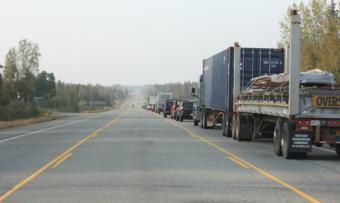
A line of traffic Tuesday, Aug. 20, just south of the Parks Highway-Talkeetna Spur junction. (Photo by Casey Grove/Alaska Public Media)

Major wildfires that flared up in Southcentral Alaska over the weekend paralyzed some of the region’s busiest road corridors, forcing reroutes and long waits for travelers, buses filled with tourists and trucks trying to resupply grocery stores from Soldotna to Fairbanks.

Both the Parks and Sterling highways — major transportation routes north and south of Anchorage — experienced temporary closures due to the fires. As of Tuesday afternoon, the highways were passable but with major delays, according to the Alaska Department of Transportation and Public Facilities.

Officials warn the highways may close again with little notice.

There’s a lot of very erratic fire behavior, and so it tends to change very rapidly,” warned the transportation department’s Meadow Bailey.

Bailey said the state is advising travelers to avoid driving through fire areas unless it’s absolutely necessary.

“The traffic is really, really heavy. There are a lot of long wait times, and additional travelers just make that situation even more difficult,” said Bailey.

Traffic backups are a hot topic on a Facebook group set up for locals to post information about the McKinley Fire along the Parks Highway.

Colleen Bridge, who lives in both Talkeetna and Anchorage, posted photos of the line of traffic near the Talkeetna Spur junction on Monday afternoon. In a Facebook message, Bridge said she ultimately waited two hours to get through, on her way to doctor and dental appointments in Anchorage.

Driving through, Bridge reported seeing “obvious burn areas” and “smoldering visible” but “no open flames.”

A line of traffic waits for a pilot car to lead drivers through the stretch of the Parks Highway north of Anchorage, where the McKinley Fire is still burning on Tuesday, Aug. 20, 2019.
A line of traffic waits for a pilot car to lead drivers through the stretch of the Parks Highway north of Anchorage, where the McKinley Fire is still burning on Tuesday, Aug. 20, 2019. (Photo by Nat Herz/Alaska Public Media)

For one major trucking company, the wildfires have resulted in significant delivery delays to both the Kenai Peninsula and Fairbanks, forcing truckers traveling north to take an alternate route, according to Paul Friese, vice president of sales and marketing for Lynden Transport in Alaska.

Friese said staffing is the biggest challenge. The Alaska Railroad is restricting freight service to Fairbanks due to both the McKinley Fire and a retaining wall failure near Healy, so Lynden has been scrambling to find enough drivers to compensate.

“We’re kind of juggling to figure out what’s next, and surviving and getting through it, but it’s been certainly a challenge,” said Friese.

Getting chilled and frozen goods to grocery stores on the Kenai also has been an issue, said Friese.

“We were able to get some vehicles down there, and then they closed the road en route, so we had drivers that have sat for, I think, 10 or 12 hours on the highway waiting to get through,” said Friese.

Jeffery Temple, director of corporate affairs for Fred Meyer, said the road closures on the Sterling Highway have made it difficult to restock the store’s Soldotna location. But that store should be resupplied today, he said.

“We do have five trucks that are ready to go,” Temple said.

A Chugiak Volunteer Fire and Rescue Company firefighter passes traffic along the Parks Highway on Tuesday, Aug. 20, 2019.
A Chugiak Volunteer Fire and Rescue Company firefighter passes traffic along the Parks Highway on Tuesday, Aug. 20, 2019. He and others were fighting the still-burning McKinley Fire north of Willow and south of Talkeetna. (Photo by Nat Herz/Alaska Public Media)

The wildfires have also caused a logistical mess for Southcentral Alaska tourism companies.

Josh Howes is president of Premier Alaska Tours, which runs a fleet of over 100 motor coaches. Howes said at about 5 p.m. Sunday their company had about 1,000 tourists in buses stuck at the Talkeetna Spur junction trying to get through the fire.

“Most of them had flights out on Monday to fly home, or they had to get to a cruise ship on Monday,” said Howes.

“We waited and waited, hoping that there would be an opening at some point, and at 11 o’clock at night, we finally had to turn everybody around and go back to Denali or Fairbanks,” where they had to find hotel accommodations for them all during peak summer tourist season, Howes said.

“It was pretty significant, for sure,” said Howes.

The Kenai Peninsula fires led some travelers to abandon plans to take the Sterling Highway and seek alternate modes of transportation, and some charter plane companies reported an uptick in demand.

Tom Soderholm, director of operators for Smokey Bay Air in Homer, said they received around 10 charter requests over the weekend until the road reopened, mostly from tourists.

“It was just basically helping people out of a jam that needed to get to some of the places that the road closure would not allow,” Soderholm said.

Smokey Bay Air also offers bear-viewing tours, and the road closures affected that business, as well, Soderholm said.

“We’ve had to do a lot of rescheduling,” he said.

Alaska Public Media reporter Nat Herz contributed to this report.

State raises concerns about Red Dog Mine spill cleanups

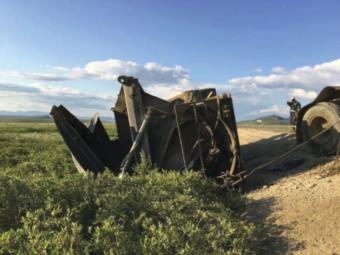
On June 20, 2019, a truck rolled over on the road to Red Dog Port, spilling about 5,300 pounds of zinc concentrate. (Alaska Department of Natural Resources photo)

Following a truck rollover earlier this summer, emails show state regulators raised concerns about how the Red Dog Mine near Kotzebue is cleaning up after spills on the sensitive tundra.

To get to market, material mined at Red Dog has to be trucked 55 miles to port. According to Red Dog and Teck, the Canadian company that operates the mine, about 10,000 truck trips are made every year. State records show five times since 2012, the trucks have rolled over, leading to a spill.

The most recent incident happened on June 20, when approximately 5,300 pounds of zinc concentrate fell out onto the tundra.

While coordinating the cleanup, emails between workers at the Alaska Department of Natural Resources and the Department of Environmental Conservation show the state had issues with how past spills were addressed.

In an email sent to a DNR employee on July 5, a DEC employee wrote “there are a number of roll over spill sites to tundra that need further work.”

Another email sent on July 2 from a DEC employee to DNR noted the agency was working with Red Dog to assess the spill sites and there were a few that “I would like them to basically completely re-do.”

The emails were obtained by Alaska Public Media through a public records request.

In an interview, Tom DeRuyter, the northern Alaska region state on-scene coordinator with DEC, said he’s not aware of any kind of gross negligence on the part of Red Dog, and that given the many truckloads that travel down the road every year, there is always going to be some risk of a spill. But DeRuyter said the state is concerned about lasting harm to the tundra after spill cleanups.

“When you start excavating tundra you do really severe damage to the tundra itself,” DeRuyter said. “That takes long-term restoration, and it would be great if we could figure out a way to remove the zinc concentrate without doing the severe damage to the tundra root system that you do with an excavator.”

Tundra can be difficult to rehabilitate after it is dug up. In the emails, workers discussed nonnative plant species that were starting to grow in previous spill sites.

“Successful tundra rehabilitation can be challenging due to the presence of frozen soils and shorter growing seasons,” Patty Burns, an environmental coordinator with DNR, said in an email. “As a result, we try to minimize excavation in tundra during spill responses. Our understanding of tundra rehabilitation has improved in recent years as we’ve learned from similar rehabilitation projects on the North Slope.”

Burns said Red Dog has requested that regulators review past sites with them to make sure they are complying with state requirements going forward.

In the case of the most recent spill, Red Dog did apply for a permit to excavate tundra. According to documents submitted to the state, much of the zinc concentrate was removed from the environment using a vacuum truck.

Greta Schuerch, spokesperson for Red Dog and Teck Alaska, declined an interview request.

In an email, Schuerch said Red Dog works with all involved parties, including government agencies and a subsistence committee made up of Noatak and Kivalina residents, to “ensure a full cleanup of every incident is undertaken and there is no long-term environmental impact.”

Red Dog and Teck said the trucks carrying the zinc concentrate to port are mechanically limited to a speed of 45 mph and the drivers are not paid by the load.

“Every incident is fully investigated to determine the cause and take steps to prevent a re-occurrence,” said Scheurch.

Reporter Nat Herz contributed to this story.

Point Lay sees earliest walrus haulout ever

A Pacific walrus bull. Due to declining sea ice, walrus started hauling out in 2007.
A Pacific walrus bull. Due to declining sea ice, walrus started hauling out in 2007. (Public domain photo by Joel Garlich-Miller/U.S. Fish and Wildlife Service)

The U.S. Fish and Wildlife Service today confirmed that walrus are again gathering on the shores of a barrier island near the Native Village of Point Lay.

It’s the earliest walrus haulout since it began happening in 2007, according to the federal agency.

The haul-outs are associated with declining sea ice due to climate change. This summer, the Chukchi Sea saw the lowest ice extent on record for July, according to the Alaska Center for Climate Assessment and Policy.

When the sea ice is low, the walrus instead come to shore to rest.

Fish and Wildlife spokesperson Andrea Medeiros said a Point Lay resident spotted the walruses while boating and estimated there are several thousand of the animals on the island. Medeiros said an official count won’t happen until September at the earliest.

One of the biggest concerns with the haulouts is that walrus are skittish onshore, so disturbances can be dangerous for them.

“If they hear a plane, they are going to likely react and stampede into the water, which leads to the deaths of animals, frequently,” Medeiros said.

Fish and Wildlife, the Eskimo Walrus Commission and the Native Village of Point Lay are sending out notices to pilots, mariners and others in the area to keep a safe distance from the animals to minimize disturbance.

Members of the public with questions about the haulout can call 1-800-362-5148.

Democratic presidential candidates take to Twitter to weigh in on Alaska politics

The leading Democratic contenders for the White House are weighing in on Alaska politics and the ferry strike — at least on social media.

Massachusetts Sen. Elizabeth Warren tweeted her thoughts on the state’s ongoing political situation on Tuesday. Warren linked to an Alaska Public Media story about Anchorage declaring a civil emergency, and called Gov. Mike Dunleavy’s budget cuts “extreme.”

On Monday, Vermont Sen. Bernie Sanders chimed in on the ferry labor dispute, tweeting “I stand with the IBU” and urging Dunleavy to “bargain in good faith” with the striking ferry workers.

And late last week, former Vice President Joe Biden also tweeted his support for the ferry workers on strike, calling the funding cuts to the Alaska Marine Highway System “draconian.”

The top-polling Democratic candidate for President then called on Gov. Dunleavy to “restore full funding immediately.”

Current Republican President (and frequent tweeter) Donald Trump has not yet weighed in on Gov. Dunleavy’s recent policy choices. But in the past, Dunleavy has received Trump’s enthusiastic support — both in person and on social media.

(Creative Commons photo by Fred PO)

‘We’re never going to surrender’ — Sarah James on a life fighting oil drilling in the Arctic Refuge

Sarah James (Photo by Elizabeth Harball/Alaska
Sarah James in her kitchen in Arctic Village, mixing ingredients for fry bread. (Photo by Elizabeth Harball/Alaska’s Energy Desk)

Neetsa’ii Gwich’in elder Sarah James is known internationally for her advocacy surrounding one of the most contentious issues in Alaska: oil development in the Arctic National Wildlife Refuge.

And, on the occasion of Arctic Village’s annual spring carnival, James is also known for her fry bread.

Assessing the supply of flour in her kitchen early one April afternoon, James, 75, wasn’t sure she had enough ingredients on hand to satisfy the demand.

“Even if I mix up ten pound, they’re crazy for it,” she said. “They wanted it yesterday.”

The recipe is one-of-a-kind.

“This is Navajo fry bread,” James explained. “But it became my own fry bread — my own recipe. So it’s my fry bread now.”

James’ recipe originated in Oregon where, at 13, she began attending Chemawa Indian High School in Salem. Like many Alaska Native children at the time, she was sent away to boarding school.

But James’ roots remained firmly in the land where she was born. As she folded ingredients together with a long spoon, James spoke about her family going into the mountains in summer to hunt sheep and other game, catching trout in the nearby Old John Lake and seeing caribou stampede upriver — she remembers listening from a tent as they hit the water, crossed and shook off on the other side.

Arctic Village, James’ home, is just south of the Arctic National Wildlife Refuge. (Photo by Elizabeth Harball/Alaska’s Energy Desk)

“Even though I went to Western school, I feel like I learned more from growing up off the land,” James said. “It makes more sense.”

James’ desire to preserve that way of life drove her into the thick of the battle over the Arctic National Wildlife Refuge. For decades, James has traveled around the world to speak about her people’s ardent opposition to oil drilling in the refuge’s coastal plain, where the caribou herd they hunt commonly gives birth to calves.

Speaking to James in her kitchen, it becomes clear she carries multiple roles within her. She is an elder, a keeper of traditional knowledge and history — a true Neetsa’ii Gwich’in woman, as the first tribal chief of Arctic Village put it in a recent interview. James is also a seasoned, politically astute and indefatigable activist.

Recently, though, James transitioned to a more formal role. She has been appointed as a spokesperson on the Arctic Refuge issue for the three Neets’aii Gwich’in tribal governments that own 1.8 million acres at its borders — the Arctic Village Council, the Venetie Village Council and the Native Village of Venetie Tribal Government. The tribes are now engaging directly in government-to-government meetings with the Trump administration as it plans for an oil lease sale in the refuge.

James draws a distinction between her work and the work of conservation groups.

“They are for recreation, for animal protection, hiking, rafting… We Neetsa’ii Gwich’in, we have always been there. God put us there to take care of that part of the world,” James said.

Asked when she began her advocacy, James doesn’t name a specific event: “It’s not when I started. I was born with it.”

Even before the Arctic Refuge controversy heated up, James was involved in notable protests. While attending college and working in San Francisco in the late 1960s, she fell in with a group of other indigenous students.

“And they were talking about Alcatraz, ‘we should just take Alcatraz back,’” James recalled.

And they did — for 19 months. Led by Mohawk activist Richard Oakes, a group occupied the former prison island starting in November 1969. James was there for part of it. She remembers watching government helicopters flying overhead.

But James describes her role in the Alcatraz occupation as a “tagalong.” Her leadership on the issue she became known for came later.

In 1988, Gwich’in leaders from across Alaska and Canada gathered in Arctic Village and passed a resolution formalizing their opposition to oil development in the refuge.

In part, it reads: “The health and productivity of the Porcupine Caribou Herd, and their availability to Gwich’in communities, and the very future of our People is endangered by proposed oil and gas exploration and development in the calving and post-calving grounds in the Arctic National Wildlife Refuge.”

The leaders asked James, then in her forties, to be one of eight representatives to take that resolution into the political arena.

“They said, ‘the only way we can win is to do it in a good way, make friends, [explain] why we say no to oil, educate them in a good way, stay united — and no compromise,’” James said.

James speaking at a rally against oil development in the Arctic Refuge in Washington, D.C. in 2005. (C-SPAN)

James took that philosophy with her on many trips to Washington, D.C. during Congress’ repeated attempts to open the refuge’s coastal plain to oil development. There, she rubbed shoulders with powerful figures on both sides of the fight, from former Alaska Senator Ted Stevens to former Secretary of State John Kerry. In 2005, during President George W. Bush’s second attempt to allow oil exploration in the refuge, she kept a 5-month vigil near the Capitol, outside the National Museum of the American Indian.

On the wall by James’ kitchen, there is a photo of her shaking hands with former President Bill Clinton, who vetoed a bill allowing drilling in the refuge in 1995. Clinton signed the photo with a note that reads, “With thanks for your great work.”

Gail Small, one of James’ good friends, said they often talk about shifting between their own cultures and the political world of Washington, D.C. Small, a program director at an organization for indigenous women leaders, is Northern Cheyenne and also has long advocated on similar issues.

“I grew up on the reservation,” said Small. “For you to understand the complexities of the Western world and be able to move back and forth between those worlds — it’s exhausting, it’s tiring, and the fact that Sarah’s been doing this for like 50 years, it’s a remarkable achievement for anyone.”

Small said she has watched as James, exhausted from a long international flight, came to life when delivering a speech. She said James would arrive at meetings with pre-written resolutions of support for the Gwich’in.

“One thing about Sarah James, she always comes prepared,” said Small. “She’s always got all these papers, pulling them out of her backpack.”

And just as her elders directed, James’ message is always positive.

“Sarah never tries to be someone who’s angry, or aggressive. She just talks her story,” Small said.

James explained this is intentional. Of course she hears the criticisms often directed at her and other Gwich’in advocates — like that they’re working at the behest of their environmentalist allies or overstating the risk to caribou at the expense of economic benefits for other Alaskans.

But James refuses to fight with her critics.

“I say what I need to say and leave,” she said. “Not even mention how mean they are, or they’re wrong, or what. I don’t answer them.”

And, James added, “We always won!”

Her side did win — until 2017, when Congress passed the Tax Cuts and Jobs Act, which included language opening the Coastal Plain to oil leasing. In the very long war over the Arctic Refuge’s fate, it was a big battle lost.

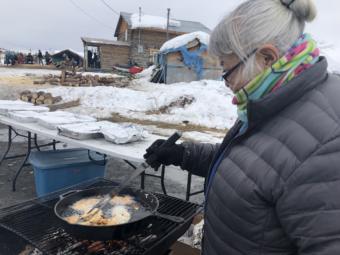
Sarah James, preparing frybread for neighbors and guests at Arctic Village’s annual spring carnival. (Photo by Elizabeth Harball/Alaska’s Energy Desk)

But a lot could happen between now and when oil rigs show up in the refuge. The possibility of lawsuits and elections loom over the entire process. So James isn’t giving up.

“We’re proud to be Gwich’in, we’re proud to be caribou people. We love our food. We love who we are. So we’re never going to give up on that,” James said. “We’re never going to surrender.”

After she finished preparing the frybread dough, James rode her four-wheeler down a snow-covered road to the fire pit, where her neighbors and friends had gathered for the spring carnival. There, James dropped pieces of dough into a pan of bubbling oil. It was served to residents and visitors alongside hot tea, rice, salmon, jello and, of course, caribou.

This article has been updated to clarify James’ current role.

Read and listen to more stories from our series The Future of the Arctic Refuge: Riches or Ruin?

Site notifications
Update notification options
Subscribe to notifications