Nat Herz, Alaska Public Media

Renegade Alaska House member makes his case: “This partisan thing has been killing us”

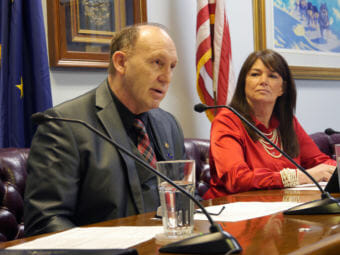
Rep. Gary Knopp, R-Soldotna, speaks during a House Minority press availability, April 6, 2017. (Photo by Skip Gray/360 North)
Rep. Gary Knopp, R-Soldotna, speaks during news conference in 2017. (Photo by Skip Gray/360 North)

Last month, Republican state Rep. Gary Knopp of Kenai threw the state House into disarray.

After the fall election, Republicans thought they had 21 votes — barely enough to form a majority in the 40-member chamber. But Knopp abandoned the group, saying its hold on power was too shaky.

Since then, he’s pushed for a coalition balanced between Democrats and Republicans. But with the start of the session just one week away, lawmakers from the two parties are still in a standoff, with Knopp caught in the middle.

Knopp, from his home in Kenai, talked with Nat Herz of Alaska’s Energy Desk about why he struck out on his own. The interview has been edited and condensed.

Alaska’s Energy Desk: Can you explain to me how you decided to leave the group of 21 Republicans?

Rep. Gary Knopp: We had zero chance of success. Any single member would hold veto power. We’d have to walk in lockstep on every single policy issue and budget issue. No chance of that happening. Zero chance. And I didn’t want to be part of that. I could see it – when you’d sit through the organizational meetings and you’d look at the questions that were posed and the answers that were given, (they) left everything as ambiguous as you could possibly imagine. No clear cut answers. My side was so hellbent on maintaining control, they didn’t care about success of the caucus. They cared about being in control.

[Republicans may take control of the Alaska Capitol. But don’t expect to hear ‘kumbaya’ just yet.]

Some of the veteran legislators – what they wanted to do is go down (to Juneau) as 21. They wanted to go down on a wing and a prayer and say, “We’ll get to Juneau and then the Democrats will come join us and bolster our numbers.” Well, if you know any of the Democrat-led coalition, that simply was not going to happen. They knew how fragile we were, and they weren’t going to come over and boost our numbers. I could see that implosion coming once we got Juneau in session. And I wanted to fix it now, not fall apart once we got there. And since I couldn’t get anybody entertaining the idea of the coalition, my idea was to weaken the numbers. Make them realize you’re going to have to have the talk because you do not have 21.

AED: Do you think the current majority is really going to be able to find 10 other members of the Republican group to break away from that group, or even any members at all? Anyone who’s done that has put themselves right in the line of fire of the party and Republican primary voters. Am I wrong?

GK: Yeah, you are. There’s a big difference between jumping ship to shift the balance of power to a different party, and working across party lines to get something done. And that’s why I took the position: I’m leaving the Republican caucus because it won’t function, but I’m not joining the Democrats for the exact same reason. They will not function with a small majority either. You’re right, one or two won’t come. Three or four won’t come. They need to have the discussion as a group, agree to coalesce and work together. That’s what they have to do.

AED: So, you think it’s going to take a larger group than one or two or three Republicans being willing to join a coalition. It really has to be like eight or 10?

GK: Absolutely. The more you can get to participate, the better body you’ll have. The more functionality you have.

AED: How long do you think we might still have to wait before a coalition majority comes together?

GK: I’d like to say tomorrow. But it could be weeks.

AED: One more problem I see envisioning your kind of coalition is that the majority from last year still seems so rock solid. Do you think it’s realistic to expect a group from that coalition to break off and join a similar group of Republicans? Or do you think it’s a question of getting most of the Republicans to start working together with last year’s majority?

GK: There’s nobody breaking off. You’ve got to get the Republicans to agree to work across the party lines. That’s the barrier. If they choose that they just absolutely will not, then they will sit in the minority by themselves. That’s a personal decision they can make. I have no idea why somebody who would maintain their principles and values wouldn’t work with whoever it took to get that stuff done.

AED: So, you think it’s not last year’s coalition that has a problem with working across party lines and forming an organization? It’s really the Republicans that are demanding purity, and who are going to have to be willing to compromise to make things work?

GK: You’re spot on. The current coalition, in my conversations with their leadership people, and them reaching out to their members, have expressed no concerns. They’ve been very supportive of the coalition concept. I can’t say the same for my side of the aisle. They’re willing to do a coalition if they’re controlling everything. The conversations started with, ‘There can be no Democrats in leadership.’ Well, that’s a nonstarter in negotiations.

They’ve come off of that a little bit. Different positions have been offered. But it still gives a slant, and that’s a nonstarter.

AED: Can you talk to me a little bit about how you think the Republican Party could either be part of the solution or is part of the problem here? The Republican Party, in the past, has gone after their own members who have worked across party lines and caucused with Democrats. Are you expecting that, and do you think that’s an obstacle to your goal of forming a balanced coalition?

GK: It absolutely is an obstacle. People are afraid of the party eating their own, attacking their own, which they did the last couple of years. But in the party’s defense, they only went after those who jumped party lines and shifted the balance of power. In a way, I understand that.

The party supported a lot of the new incumbents. We’ve got seven new Republican legislators this year who won due to the support of the party. So, they’re very cautious. And they count on some of the people who’ve been there a while.

What I did do was call the new chair of the Republican Party, Glenn Clary. I’ve never met the man, but I introduced myself and I said, ‘Glenn, I want you to know: I didn’t abandon my party. I didn’t abandon my Republican values or my principles, my conservative nature. What I abandoned was a Republican caucus that was dysfunctional, had no chance of success. You guys helped create this problem. You ought to be reaching out trying to help fix it. You need to be reaching out to the members and encourage them to start talking about a coalition, working across the party lines.’

People get it confused. Working across party lines doesn’t mean you’re jumping ship to the other side. It means you’re willing to work with the other members of the House that were elected. You wonder sometimes, when you’re elected in a district representing 17,000 people: Do you think you’re just representing Republicans? You’re representing the Libertarians, the Democrats, undeclared, independents. We’re representing all them people. It’s absolutely ludicrous to do what we do. This partisan thing has been killing us for years, to no gain. And it’s really time for it to end.

The Republican Party hasn’t attacked me in this. I haven’t heard a word from them. They may at some point in the future. I don’t know. We’ll see how this plays out. I think the best thing that can happen to the Republicans, or even the Democrats if they want to claim credit, is the fact that we coalesce. And we go down there and we perform like people expect us to do. And we come out of there in 90 days or 100 days, having done our business. Addressing the big things on the agenda, which are the crime reform, the PFD and the budget. People don’t want to be naming state birds and amphibious frogs when we’ve got serious things to talk about right now.

New salmon-counting technique treats Alaska stream like a crime scene

Downstream view of the fish counting weir at Auke Creek that is located north of downtown Juneau
This fish weir in Auke Bay, near Juneau, was where scientists tested a new salmon-counting technique that takes a cue from crime scene investigations. (Photo by Matt Miller/KTOO News)

The state of Alaska spends millions of dollars each year counting salmon. Managers need accurate numbers to decide how many fish can be caught, and how many should be allowed to escape upstream to spawn.

Much of the counting is done by state employees who watch salmon swim through specially designed stations. But what if you could count the number of fish just by testing for DNA in a bottle of river water? There’s a new technique that could make that happen, according to a just-released study in the journal Molecular Ecology Resources.

The Alaska Department of Fish and Game already has several ways to count salmon, but they all depend on detecting the fish themselves. Managers use sonar in places where they can’t see through the water, they count from towers where visibility is better and they use weirs to actually stop the fish and count them individually, according to Chris Habicht, the director of the department’s genetics lab.

A lot of that counting takes people — and those people have to be paid. But what if the state could save money by counting the salmon without the actual fish?

That’s where Taal Levi, a professor at Oregon State University, comes in. Levi has spent the past several years exploring whether a new technology called environmental DNA, or eDNA, can be used to count salmon.

The technique, which is only a decade old, involves sampling water from a stream, then testing it to detect salmon DNA. DNA, Levi says, can come from “any source of cell — mucous, skin cells, feces, urine.”

“It’s a lot like a crime scene. If there was a murderer, and a murderer got cut, or left any sort of tissue or even skin cells, you could use the DNA in those skin cells or blood to identify the murderer,” he said.

Pink salmon, plus an occasional silver and red congregate in a pool above the Auke Bay weir. (Photo by Matt Miller/KTOO)

Levi is the lead author on the new study, which relied on water samples from Auke Creek, near Juneau. Researchers were already operating a fish-counting weir there, and Levi could use the proven numbers from the weir to test the accuracy of his eDNA sampling.

As it turned out, the level of eDNA in the water closely tracked the number of salmon traveling through the stream, the study said. Levi said the results show that ultimately, the sampling technique could be an inexpensive way for managers or even citizen scientists to acquire a lot more data about salmon returns.

“It’s essentially trivial amount of money for the amount we spend on salmon management,” he said.

There are still some potential problems with the sampling technique. For example, the eDNA is diluted when there’s more water flowing through the stream, so it’s essential to also have accurate measurements of stream flow.

The eDNA signal produced by salmon also appears to decrease the farther away the fish get from a sampling site. So Levi said he thinks that accurate counts will require water samples to be tested at least daily, if scientists want to make sure they can detect big daily pulses of fish.

Habicht, from the genetics lab, said he thinks the technology isn’t ready for use by state managers yet.

“I think a lot more work would need to be done before one could get a handle on whether this is a cost-effective alternative to the other methods,” he said.

Government shutdown, if it continues, could cost Alaska’s lucrative Bering Sea fisheries

Fishing trawlers lined up in Dutch Harbor, on Sep. 24, 2013, in Unalaska, Alaska.
Fishing trawlers lined up in Dutch Harbor, in the Aleutian Islands, in 2013.(Creative Commons photo by James Brooks)

The federal government shutdown is already causing problems for participants in the upcoming fishing season in the Bering Sea, which are likely to escalate if the stalemate in Washington, D.C. continues.

Even if the shutdown does persist, the federal government will allow the Bering Sea fisheries to start as scheduled, with an initial opening for cod Jan. 1, and a second opening for pollock and other species Jan. 20.

But the fisheries are heavily regulated, and before boats can start fishing, the federal government requires inspections of things like scales — for weighing fish — and monitoring equipment that tracks the number and types of fish being caught. And the National Marine Fisheries Service, which regulates the Bering Sea fisheries, isn’t doing those inspections during the shutdown.

Other boats need special permits before they can start fishing, and those permits aren’t being issued during the shutdown, either.

(Photo courtesy Wikimedia Commons)
Pollock are one of the major species caught in the Bering Sea fisheries. (Photo by Wikimedia Commons)

“My understanding is the vessels that have not been certified yet will not be certified until the government opens up again,” said Haukur Johannesson, whose company, Marel, provides scales to the huge factory vessels that work in the Bering Sea. “And if they don’t get certified, they cannot go fishing.”

The scope of the problems couldn’t immediately be determined, as many industry representatives said they were still assessing potential impacts or declined to go into specifics. NMFS’s law enforcement offices, which are still open during the shutdown, has received calls from “a small percentage of fishermen requiring an inspection,” Al Duncan, a Sitka-based assistant special agent in-charge, said in a email.

The Bering Sea fisheries are a major industry for Alaska, and for Washington, where the largest boats are headquartered. Annual catches are valued in the hundreds of millions of dollars, and Bering Sea pollock is used in mass market products like fish sticks and McDonald’s Filet-O-Fish sandwiches.

The shutdown would only have to affect a small number of Bering Sea boats for the economic impact to be substantial — a single fishing trip for a large factory trawler can be worth millions of dollars.

Nearly all of the large boats that fish for cod starting Jan. 1 have already had their required inspections, said Chad See, who leads a trade group that represents them, the Freezer Longline Coalition. And there are still more than three weeks before the start of the more lucrative pollock season, which could leave enough time for inspections to take place if the shutdown ends.

But the shutdown is already causing problems for at least one boat.

The 180-foot Baranof, which works in a number of different fisheries from crab to cod, has more than two dozen crew members who flew out Wednesday to Dutch Harbor, in the Aleutian Islands, for the winter fishing season.

They were planning to start fishing for red crab Jan. 1, said Doug Wells, government affairs director for Romanzof Fishing Co., which owns the boat. But before the Baranof can leave the dock, it needs an electronic scale to be certified by federal regulators.

And right now, because of the shutdown, those regulators are unavailable to do the inspection, even though they’re already in Dutch Harbor and willing to help, Wells said.

“It’s infuriating,” he said in a phone interview from Seattle. “These are just guys that have done a ton of work and are sitting there ready to go, and are being prevented by a bunch of politicians.”

The red crab fishery closes in mid-January, and if the Baranof can’t make its catch by then, the company’s losses would be in the hundreds of thousands of dollars, Wells said.

Workers inspect pollock offloaded at Unalaska's UniSea processing plant.
Workers inspect pollock offloaded at a seafood processing plant in Unalaska in the Aleutian Islands. (Photo by Sarah Hansen/KUCB)

He said Romanzof and other fishing companies and industry groups are pressing members of Congress and agency officials for a fix.

The shutdown is also causing problems for companies that supply fishing boats with observers — the independent scientists who, on the government’s behalf, ride on the boats and gather data on fish that are caught and thrown back.

The National Marine Fisheries Service is still holding required training classes for observers, said Stacey Hansen, program manager at Saltwater, an Anchorage-based observer company.

But, she added, NMFS is not holding “debriefings” for observers when they return from a fishing trip — which are required before those observers can go on on their next trips. That’s sidelined three of her employees, with two more who will be affected by the end of the weekend, she said.

“I’ve got a group of people that are now stuck,” Hansen said. “These people are in purgatory, they’re in limbo — they’re just sitting and waiting until they can get on with their lives.”

Veterans of the Bering Sea fishing industry said they’ve survived past government shutdowns without too many damage.

“It’s happened before and it’s worked out,” said Brent Paine, who runs United Catcher Boats, a trade group of cod- and pollock-fishing boats. But, he added: “If you call me up next week and we’re still in the same situation, I think the anxiety level will probably be up quite a bit.”

He and others stressed that the federal employees who are still on the job have been diligent.

“The people we’ve talked to within National Marine Fisheries Service today and yesterday have been very supportive and helpful,” he said. “This is the border wall that’s causing the problem.”

New Alaska wildlife managers could revive old fights over federal protections, bear- and wolf-killing

Wolves on the Denali Park Road. (Photo by NPS Photo / Nathan Kostegian)
Wolves travel along the Denali Park Road. The new administration of Alaska Gov. Mike Dunleavy is likely to revive old conflicts like one over a state program that kills wolves and bears to boost caribou and moose populations. (Photo by Nathan Kostegian/National Park Service)

Alaska Governor Mike Dunleavy is shaking up the Department of Fish and Game.

His acting commissioner, Doug Vincent-Lang, has made a pair of unconventional, high-level appointments. Rick Green — the right-wing talk show host known as Rick Rydell — is Vincent-Lang’s new special assistant.

And Eddie Grasser, who earlier this year worked as a lobbyist for a hunters’ advocacy group, Safari Club International, will lead the department’s wildlife conservation division.

The administration of Dunleavy, a Republican, has not released its proposed budget for the department, and it also hasn’t announced any major policy changes.

Doug Vincent Lang (Photo courtesy Alaska Department of Fish and Game)

But Vincent-Lang, who served as a top fish and game official under the previous Republican governor, Sean Parnell, said he won’t shrink from some of the more contentious policies he promoted in his past stint at the department. And that’s likely to shift the complex dynamics between the different entities and interests involved in Alaska’s fish and wildlife politics – from the state and federal governments to tribes, hunting organizations and fishing groups.

Under Parnell, Vincent-Lang fought the federal government on several fronts. One of them was over federal protections for endangered species like humpback whales and Steller sea lions, with the state arguing that such protections unnecessarily restricted activity like fishing and oil and gas development.

“Increasingly, I think we’re seeing an intrusion by the federal government into states’ rights to manage,” Vincent-Lang said in a phone interview Friday. “We’re going to fight hard to protect those — and where we can, cooperate with our federal agencies on research and other things.”

Vincent-Lang was also an advocate for predator control, a controversial state program that kills wolves and bears in an effort to leave more moose and caribou for hunters.

“I’m not going to shy away from doing predation control to increase productivity,” he said. “To the extent that we’re going to manage to ecosystems to maximize the number of moose and caribou coming out there for putting food on Alaskans’ plates, I’m willing to do that.”

Green, the special assistant, will earn $87,000 annually to work with Vincent-Lang on outreach and communication.

Two weeks ago, Green was still broadcasting his drive-time Anchorage talk radio show under the name Rick Rydell.

Rydell once referred to himself as a “flame-throwing conservative” who skewered “wacko” liberals on the radio. But in a Thursday phone interview, he was back to his given name, Rick Green, and sitting at a desk as a state employee.

Rick Rydell, the new special assistant to the Alaska fish and game commissioner. (Photo courtesy Rick Rydell)

Green, in a phone interview, described one of his main tasks as “rebuilding trust” with different groups frustrated with the way Alaska’s fish and game have been divided up. He cited dipnetters as one example, saying they were frustrated by the lack of available fish on the Kenai River in the summer.

That echoes one of Dunleavy’s criticisms on the campaign trail of the previous governor, independent Bill Walker, who Dunleavy described as overly sympathetic to commercial fishermen.

Vincent-Lang said that as he started as commissioner, he talked with Bob Penney, a longtime advocate for Kenai River recreational fishermen and a major financial supporter of Dunleavy’s gubernatorial bid.

Vincent-Lang also said he plans to meet with commercial fishermen from the same area in the next week. He hasn’t yet named his department’s new top fisheries managers – Vincent-Lang said that will likely happen in early January.

While those high-level jobs remain unfilled, some conservation-minded Alaskans said they’re worried that the fish and game department under Dunleavy will focus on hunting to the detriment of wildlife viewing and tourism.

“If I were a wolf or a bear in Alaska right now, I would be headed for the Canadian border, ASAP,” said Rick Steiner, an environmental advocate and former marine conservation professor in Anchorage.

Among Steiner’s concerns was the hiring of Grasser as the department official in charge of wildlife conservation.

Grasser grew up in a family of hunting guides, and once rode horses as they swam across the Copper River in the Wrangell Mountains. Later, he became a lobbyist and advocate for sportsmen’s groups like the Alaska Outdoor Council and the National Rifle Association.

In the 1990s, Grasser pushed the fish and game department to cut spending on programs like bear- and bird-viewing. At the time, he was representing the Alaska Outdoor Council, and argued that those non-hunting programs sucked up revenue from taxes on guns, bullets and hunting and fishing licenses.

More recently, Grasser has lobbied for another hunters’ advocacy group, Safari Club International.

Steiner said appointees like Grasser, Green and Vincent-Lang are too narrowly focused on the interests of recreational hunters from Alaska’s more urban regions, and Outside.

“I think the out-of-state trophy hunters and trappers will fare well,” Steiner said. “The major stakeholders that should be very concerned are the commercial fishing industry, the tourism industry and even the subsistence community.”

Steiner’s comments hinted at long-running conflicts over subsistence between rural Alaskans, particularly Alaska Natives, and urban hunters — groups that sometimes vie for the same fish and game.

But a top official at the Alaska Federation of Natives — one of the most powerful advocacy groups that backs subsistence users — said it’s way too early to judge the direction of Dunleavy’s administration.

“We’re looking forward to meeting them and sitting down and talking to them about the pressing issues, and seeing where our common ground is,” said President Julia Kitka.

Last month, Ruth Botstein argued Alaska’s case at the Supreme Court. This month she was fired.

The administration of newly-elected Republican Gov. Mike Dunleavy has taken the unusual step of firing two prominent attorneys at the Alaska Department of Law, including one who represented the state before the U.S. Supreme Court last month.

It’s typical for incoming governors to clean house at the highest levels of state agencies. But it’s rare for a new administration to dismiss attorneys at the state law department, even though those attorneys lack union protections – and the move has raised questions about the motivation for the firings that remain unanswered.

“I don’t recall any administration reaching into the ranks since Wally Hickel came in in 1991,” said Democrat Bruce Botelho, the transition coordinator for the previous governor and a former attorney general under Hickel and Tony Knowles. Botelho said he thinks the firings are “troubling.”

State attorney Libby Bakalar cites a statute governing the appeal process for election certifications and recounts during a press teleconference at the Division of Elections office in downtown Juneau on Nov. 26, 2018.
Libby Bakalar (Photo by Jeremy Hsieh/KTOO)

One of the fired lawyers is Libby Bakalar, a state elections attorney who, in a since-deleted tweet, attributed her dismissal to her liberal advocacy and her criticism of President Donald Trump. Bakalar publishes a personal blog, One Hot Mess, that she uses to skewer the president and other right-wing political figures, and she’s spoken at rallies and traveled to Washington, D.C. this year to oppose the Supreme Court nomination of Brett Kavanaugh.

“It’s painful to be forced to ‘resign’ from a job for no apparent reason other than I dislike Trump and care about social justice, and frequently say so on my own time, just like [the First Amendment] allows,” she wrote.

The other fired attorney is Ruth Botstein, who argued for the state in the U.S. Supreme Court last month in a lawsuit originally brought by John Sturgeon.

Sturgeon is a moose hunter, timber harvester and hunting advocate who’s challenging the federal government’s authority to manage navigable waterways in national preserves. And his case has become a celebrated cause for conservative Alaska politicians, including Dunleavy.

The state has supported Sturgeon’s lawsuit, and Botstein’s appearance in the Supreme Court last month was to argue on Sturgeon’s behalf.

A month later, Botstein was fired. The move baffled people in Alaska’s legal world, and Sturgeon said he’s confused, too.

Ruth Botstein (Photo courtesy Alaska Judicial Council)

“Ruth did a fantastic job,” Sturgeon said in a phone interview this week from a logging camp on Afognak Island, near Kodiak. “I was extremely surprised that they didn’t keep her, and I’m not sure the reason.”

The three-sentence email notifying Botstein of her firing, from then-Acting Attorney General Ed Sniffen, didn’t specify why she was dismissed. It was sent at 12:20 p.m. December 3, less than an hour after Dunleavy was sworn in and two days before he named Kevin Clarkson as his attorney general.

Officials at the governor’s office and Department of Law refused to answer questions about the firings, saying they were confidential “personnel matters.”

Botstein and Bakalar declined to comment.

The two attorneys were part of a broader group of state workers dismissed when Dunleavy succeeded Bill Walker, an independent.

It’s standard for incoming administrations to request resignations from agency heads, top deputies and other policymaking staff in politically appointed jobs. Bill Walker has said that in 2014 he asked for resignations from about 250 of the state’s 15,000 workers, and retained “many” of them.

Dunleavy asked about 800 people to offer their resignations, including many in positions that are technically appointed but traditionally seen as non-political, like petroleum geologists, psychiatrists, actuaries and low-level prosecutors. Employees who wanted to keep their jobs were instructed to make their resignations contingent on acceptance by the new administration.

Tuckerman Babcock, Dunleavy’s chief of staff, said at the time that the new administration was not planning widespread layoffs. Instead, he said, Dunleavy wanted to make sure state employees were committed to his agenda. Some state workers, however, saw the request as an effort to extract a partisan loyalty pledge – particularly given that Babcock’s previous position was chair of the Alaska Republican Party.

“The state of Alaska hired me for my expertise, not my political allegiance,” Anthony Blanford, the director of psychiatry at the Alaska Psychiatric Institute, wrote in a letter to the Anchorage Daily News.

Tuckerman Babcock was elected chairman of the Alaska Republican Party (Photo by Josh Walton)
Tuckerman Babcock (Photo by Josh Walton)

Anecdotal accounts have emerged like the firings of the two attorneys, as well as Blanford and another psychiatrist at the Alaska Psychiatric Institute who refused to offer a resignation. But Dunleavy officials have declined to specify the total number of state workers dismissed.

A spokesman for Dunleavy, Jeff Turner, said Thursday that a reporter would have to file a public records request to find out.

Bakalar, who’s not registered with a political party, had become a target of Alaska conservatives amid her involvement in contentious, election-related cases — though her recent legal work required her to take positions that clashed with both liberal and conservative candidates and causes.

Bakalar, who earned $120,000 a year, assisted with the state’s defense of election workers’ conduct in a disputed 2016 state House race in northern Alaska. And she also drafted the Walker administration’s legal justification for initially rejecting, on constitutional grounds, a proposed initiative to protect salmon habitat.

Her work drew praise from supervisors, including one who wrote in a performance evaluation that Bakalar did a “splendid” job on elections issues, according to a copy of Bakalar’s personnel file that she released to a reporter.

Since Trump’s election, Bakalar has appeared at rallies in Juneau for liberal causes, and she’s referred to Trump on her blog as “gaslighting misogynist trash,” a “bona fide sociopath” and a “pathological liar.”

Palmer attorney Nancy Driscoll Stroup has been criticizing Bakalar’s blog for two years, and Stroup said she filled out a form on Dunleavy’s website suggesting that his transition team “carefully vet” attorneys in three specific sections of the Department of Law that handle politically sensitive cases — including the sections where Botstein and Bakalar worked.

Stroup said she thought some of the attorneys in those three sections were “very, very liberal” and might not be on board with Dunleavy’s conservative agenda. And she said she thinks attorneys who work on politically sensitive cases while engaging in public political activism create a “lack of trust.”

“I would feel the same way if they were partisan in the other direction, too,” she said. “Go into private practice if you want to do that.”

Stroup said no one from the Dunleavy administration contacted her about her note. She also said she did not complain about Botstein specifically.

The firing of Botstein, who’s also not registered with a political party, has been more perplexing to observers. Her peers gave her good marks when she applied for a recent seat on the Alaska Supreme Court; her overall rating of 3.8 on a survey of attorneys who’d worked with her was a full point higher than the rating for Clarkson, Dunleavy’s attorney general.

John Sturgeon
John Sturgeon speaks at the Alaska Capitol in 2016. (Photo by Skip Gray/360 North)

Botstein, who earned $130,000 a year, posted a barrage of anti-Trump tweets the month Trump was inaugurated. But she has only used her Twitter account once in the past year and has just 15 followers.

One theory is that her work on politically delicate Sturgeon case somehow made her a target of the Alaska Outdoor Council. That’s the powerful hunting and fishing advocacy group that’s supported Sturgeon’s lawsuit along with the state, but clashed with the Walker administration on the best way to defuse broader conflicts over state and federal land management.

But Sturgeon, a vice president of the council, said that theory is wrong.

“I called everybody else to ask if anybody had put in a bad word on her. And nobody in Alaska Outdoor Council did anything,” he said. “So that wasn’t the reason.”

Ben Stevens, former Alaska senator investigated by FBI, lands job with Dunleavy administration

Ben Stevens, the former Alaska Senate president once investigated for corruption by federal authorities, has landed a job in Gov. Mike Dunleavy’s administration.

Stevens will work as one of Dunleavy’s three policy advisors, focusing on transportation, legislation and fishing, a spokesman for Dunleavy, Jeff Turner, said in an email.

Stevens didn’t respond to a request for comment.

Ben Stevens’ portrait from when he was a state senator.

Stevens is one of three sons of the late U.S. Sen. Ted Stevens. Ben Stevens spent five years in the state Senate after Gov. Tony Knowles appointed him to an open seat in 2001; he ran unopposed in 2002, then didn’t seek re-election in 2006 amid the federal corruption investigation.

The FBI raided Stevens’ offices in the summer of 2006, as well those of at least five other state legislators.

Attention on Stevens focused on consulting work he said he did for oil-field services company Veco, while he was serving in the Senate. The payments totaled more than $240,000 over five years, and Stevens never said exactly what he did to earn the money.

At the trial of a different state lawmaker in 2007, a Veco executive said on the witness stand that he had bribed Stevens and another senator, John Cowdery. But prosecutors never charged Stevens with a crime, and he always denied wrongdoing.

Last year Stevens said he was considering running in the Republican Party primary for governor, though he never entered the race. He’s been working as president of Cook Inlet Tug and Barge, which operates from the Aleutians to Southeast Alaska.

As a consultant earlier in his career, many of Stevens’ clients came from the fishing industry. They included fish processors, a group of crab processors and an organization representing Bering Sea and Gulf of Alaska pollock trawlers.

Site notifications
Update notification options
Subscribe to notifications