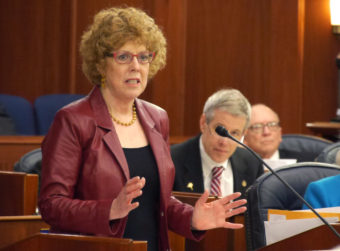
Anchorage GOP Rep. Gabrielle LeDoux’s is one of three legislative primaries that could be decided by Tuesday’s count of absentee votes. (Photo by Skip Gray/360 North)
State elections workers are preparing to count hundreds of absentee ballots that are likely to decide the winners of three razor-thin legislative races.
The state will conduct an initial count on Tuesday. A final batch of ballots will be counted Friday.
Both trail their primary challengers by fewer than 10 votes after the initial round of counting last week.
There are about 300 absentee and other ballots still to be counted in LeDoux’s race.
There are about 800 more uncounted votes in Micciche’s Kenai Peninsula Senate district.
And ballots are still coming in — absentee ballots can arrive up to 10 days after an election takes place.
Once the counting is done, a losing candidate or group of voters can ask for a state-paid recount in any race decided by fewer than 20 votes, or half a percent.
A third race that could end up that close is the one for the Kenai Peninsula House seat now held by Republican Mike Chenault.
Wayne Ogle, president of the Kenai Peninsula Borough Assembly, leads by three votes. His opponent is Ben Carpenter, a self-described outsider candidate who farms peonies.
Anchorage Republican Rep. Gabrielle LeDoux sits at Election Central at the Dena’ina Center downtown on Tuesday, August 21, 2018, while she waits for results in her closely-fought GOP primary with Aaron Weaver, a former cameraman at KTUU. (Nathaniel Herz / Alaska’s Energy Desk)
The results of Tuesday’s primary election didn’t answer one of the biggest questions about the future of the Alaska Legislature: whether the state House will stay under the control of a mostly-Democratic coalition next year.
But it did yield several surprises, including three stunning upsets that could send two of the state’s most powerful legislators packing. Senate Majority Leader Peter Micciche, a Soldotna Republican, trailed challenger Ron Gillham by a razor-thin margin of 12 votes out of more than 5,000 cast for a Kenai Peninsula-area seat.
In Anchorage, meanwhile, another legislative leader, Rep. Gabrielle LeDoux, trailed three votes behind her Republican primary opponent, Aaron Weaver, whose own GOP allies described as having mounted a lackluster campaign.
Weaver, a former TV cameraman, didn’t spend a single dollar on his campaign after January, according to his financial reports filed with state regulators.
A third long-serving incumbent, House minority leader Charisse Millett, an Anchorage Republican, trailed her primary challenger, Josh Revak, by a wide margin and conceded in a Facebook post Wednesday morning.
Ron Gillham (courtesy Ron Gillham)
“I think there’s a message that was sent that people were upset with the way things were going, the status quo,” Gillham said in a phone interview Wednesday from Seward, where he was picking up his campaign signs. “I took on the most powerful senator in the state and I’ve never run for office, and now here I’m sitting ahead of him.”
Gillham’s narrow lead, however, is not final, and neither is Weaver’s. The state still must tally hundreds of absentee and other uncounted ballots, and aren’t expected to finish doing so until the end of the month.
“We’ll just have to sit back and wait. I don’t actually know what to expect at this point in this race,” Micciche said.
Gillham said he decided to run for Micciche’s seat after a conversation with some of his co-workers on the North Slope, where he works for Arctic Slope Regional Corp. running a crane.
“Everyone was complaining about what was going on with the government. And I just thought, ‘If you’re going to complain, you might as well do something about it,’” Gillham said.
Gillham ran a shoestring campaign. He raised $8,000, half of which was his own money. Micciche raised almost 10 times as much, with donations from executives and industry PACs.
Like several Republicans challenging sitting GOP legislators, Gillham attacked Micciche’s vote for Senate Bill 91, the 2016 criminal justice reform bill that some people have blamed for a rise in crime.
He also attacked Micciche’s vote to use some of the Permanent Fund’s earnings to close the state’s massive deficit.
But no one in Alaska’s political world seemed to take Gillham seriously, until Tuesday night.
That was also the case with Weaver, the challenger to LeDoux, who as chair of the House Rules Committee wields huge power over which legislation comes up for a vote.
Even the Alaska Republican Party, which desperately wanted to unseat LeDoux after she joined the largely-Democratic House majority coalition two years ago, had largely given up hope of beating her. Tuckerman Babcock, the state GOP chair, described Weaver’s campaign as practically nonexistent.
“If you look on our Facebook pages, in discussions that we’re having with people in the district, it’s, ‘Who is Aaron Weaver? I’ve never met him. Should I vote for him? I’ve never met the guy,’” Babcock said in a phone interview Wednesday.
He called it “amazing” that LeDoux could “lose to a candidate that people don’t even know who he is or what he looks like.”
Weaver didn’t dispute Babcock’s characterization, calling it “absolutely right.” He said LeDoux’s campaign fundraising – she ultimately collected more than $100,000 – made her an “unstoppable force.”
Weaver raised less than $3,000.
“I thought it would be better to return my campaign contributions so that people could spend it on their kids, rather than spend it on a futile campaign,” Weaver said Wednesday.
He said he thinks the results reflect “much more of a vote of disapproval of LeDoux than it was for me, because I really ran, effectively, a silent campaign.”
“I just didn’t put that much effort into getting the message out because I didn’t think I’d have a chance,” Weaver said.
A downcast LeDoux spent Tuesday evening at a results-watching party at the Dena’ina Center downtown, where she sat at a table with one of her legislative aides, checking her phone.
“Obviously it’s a nail-biter. I’m still cautiously optimistic,” she said at the end of the evening. She added, “I feel real good about the absentees. I’ve really, really worked the absentees.”
Millett, who lost her GOP primary for her South Anchorage district, had spent a decade in the Legislature, most recently as the Republican minority leader.
She was a candidate to be House speaker if Republicans take back control of the chamber in November. Instead, Millett lost her primary decisively to Revak, a former aide to U.S. Rep. Don Young and U.S. Sen. Dan Sullivan. Revak, a U.S. Army veteran, ran campaign ads that showed him dressed in combat gear.
Josh Revak accepts congratulations from Anchorage Republican Rep. Gabrielle LeDoux at Election Central at the Dena’ina Center downtown on Tuesday, August 21, 2018, Revak held a commanding lead over incumbent Rep. Charisse Millett in the GOP primary race for a South Anchorage House seat. (Nathaniel Herz / Alaska’s Energy Desk)
“It’s really surreal and there’s a healthy level of fear, because every vote that’s tallied in those numbers are folks that would put their faith in me,” Revak said in an interview Tuesday night. “And I take that very seriously and I just hope I can live up to those standards.”
Tuesday’s results appear likely to push the Republican-dominated Senate in an even more conservative direction.
But the dynamic in the state House is still murky. State GOP leaders failed in their effort to take down another moderate in Kodiak, Louise Stutes.
But they did help fend off a primary challenge to one of their allies, George Rauscher, a Sutton Republican.
The Republican primary for the Eagle River House seat now held by ultra-conservative Lora Reinbold, meanwhile, went to Kelly Merrick, who was backed by organized labor. She defeated Jamie Allard, who had Reinbold’s endorsement.
Some Republicans have said they fear Merrick, with her support from organized labor, could join a mostly-Democratic majority. As she left the Dena’ina Center late Tuesday, Merrick, who’s also a former Congressional aide to Young, said her campaign donations from figures in “business and industry” should settle those fears.
But she declined to speak directly about which group of legislators she might organize with.
“I’m not talking about any of that tonight. I’ll talk to you guys about that another time – we’re just celebrating tonight and enjoying this and realizing we have to work until November before anything will happen,” Merrick said.
Merrick faces nonpartisan Joe Hackenmueller in the general election. And the races for many more competitive districts also won’t be decided until November.
“I think we’re going to know about the makeup of the House, and who’s in the House majority, after the November election,” LeDoux said. “Regardless of whether I survive this primary or not.”
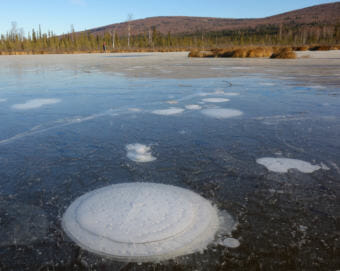
Permafrost-derived methane bubbles are trapped in the ice on a pond near Fairbanks, Alaska. Methane from lakes like this one could be a significant driver of global warming, according to a new study released last week. (Katey Walter Anthony/University of Alaska Fairbanks)
A new study led by a Fairbanks-based scientist suggests global climate projections have been drastically underestimating carbon emissions from permafrost.
Such projections had previously shown the Arctic absorbing as much or more carbon than it emits, thanks to enhanced plant growth that comes, in part, from warmer temperatures. But the new study found that permafrost emissions could more than double once models start accounting for methane that bubbles up from thermokarst lakes, a special type of lake that forms in permafrost.
“If we take into account these lakes, we realize, ‘Oh, we actually have a pretty significant source of permafrost carbon this century,’” Katey Walter Anthony, the lead author and associate professor at University of Alaska Fairbanks, said in a phone interview.
Other scientists said the study, published in the journal Nature Communications, underscores the limitations and uncertainties of climate modeling – and how policymakers might need to take more aggressive steps if they want to keep global temperatures under control.
While such global models currently describe permafrost as an insignificant source of carbon, Walter Anthony’s study said permafrost emissions could rival those from land use change like forest-clearing and burning – the second-largest human source of emissions, after fossil fuels.
“The models that we’ve used to construct these carbon budgets, of how much CO2 we can emit and stay below a certain temperature threshold that we say is the edge of where things go from bad to really bad – those carbon budgets are probably made with models that are incomplete and may, in many ways, be very optimistic,” said Charlie Koven, a scientist who works on climate models at Lawrence Berkeley National Laboratory in California. He added: “The magnitude of the uncertainty is really large.”
Scientists have long known that permafrost, the frozen ground beneath most of Alaska, holds huge amounts of carbon. One study estimated that there’s twice as much carbon in permafrost as there is in the air.
If global warming helps thaw the permafrost and puts more of that carbon into the air, it could warm the earth even more.
But global climate models currently show permafrost thawing slowly, from the top down. And they also show increased plant growth, suggesting the plants are absorbing more carbon than is being released in the Arctic.
Those models, however, don’t include the thermokarst lakes examined by the new study.
Thermokarst lakes are formed when permafrost thaws and the ground sinks, forming a pool of water. The pool thaws more permafrost below and around it, in a process that happens much more quickly than the gradual, top-down thaw.
Microbes then eat the thawed soil and release methane, a potent greenhouse gas.
Accounting for thermokarst lakes boosts projections of permafrost emissions in the later part of this century by as much as 118 percent, according to the new study.
Why haven’t thermokarst lakes been included in global climate models before? Scientists have known about them for a long time; Walter Anthony has been studying them for years, using helicopters to help map the permafrost near Fairbanks.
But because lakes make up a very small fraction of the overall land area in the Arctic, they’ve been difficult to represent on a global scale, according to Walter Anthony.
Her study calls for the broader climate models to start incorporating thermokarst lakes so that there’s a more “comprehensive projection” of permafrost-related carbon emissions this century.
Model experts said that’s more likely to happen now that the scale of the emissions from lakes has been estimated. But it’s still likely to take several years before the projections of emissions from thermokarst lakes can be refined enough to include, they said.
“We don’t have large-scale data sets of the distribution of how these lakes are changing throughout the Arctic,” said Koven, the California scientist. Much of the scientific observation of the lakes has been in Alaska, while there’s also a lot of permafrost in Siberia, he added.
Thermokarst lakes are not the only potential source of emissions that aren’t represented in climate models, experts said.
There are all sorts of processes that could stabilize or destabilize the earth’s climate that aren’t included in existing versions.
Insects or droughts could kill trees. Nutrients could flow through soil in unexpected ways. The Amazon rainforest could die off, or absorb more carbon.
“Our uncertainty is a really big problem and we’re doing tons of work all across the field to try to reduce that uncertainty – understand it and reduce it,” said David Lawrence, a scientist who works on climate modeling at the University Corporation for Atmospheric Research in Colorado. The study, he said, adds to an “already-large uncertainty range.”
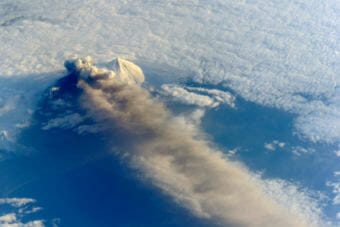
Pavlof Volcano, on the Alaska Peninsula, jetted lava into the air and spewed an ash cloud 20,000 feet high in 2013. (International Space Station – NASA)
A $12 million budget boost from Congress will help modernize the instruments that protect transcontinental jet planes from threats posed by volcanic ash.
Leaders at the Alaska Volcano Observatory say new technology will help them issue more precise forecasts, which would translate into restrictions for smaller areas or shorter periods of time.
Alaska has dozens of active volcanoes dotting the Aleutian Islands and Cook Inlet, just west of Anchorage. The observatory, a partnership between the U.S. Geological Survey, the state and University of Alaska Fairbanks, is charged with watching them.
The observatory monitors Alaska’s volcanoes through a network of seismic sensors installed on the sides of volcanoes. But the system for transmitting data from the sensors is obsolete, according to Tom Murray, who works at the U.S. Geological Survey and oversees the observatory.
“It was obsolete 20 years ago, and it’s more obsolete now,” he said.
The current system sends data with an analog signal, which Murray compared to using an old telephone. The analog signal can pick up noise and static that interfere with scientists’ ability to interpret the information.
The cash from the federal government will pay to convert the system to a digital one, Murray said. The digital signal will allow scientists to capture a broader range of seismic activity, from low rumblings to big explosions.
Some sites, especially those that are more accessible, have already been converted; the rest, including far-flung sites in the Aleutians, will take three to four years to finish. Many of the remote monitoring sites can only be reached by helicopter.
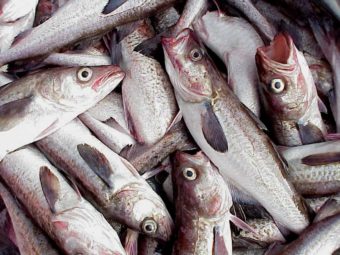
Workers inspect pollock offloaded at at a processing plant on Unalaska, in the Aleutian Islands. (Photo by Sarah Hansen/KUCB)
You’ve probably heard about the blob, the pool of warmer-than-normal water that wreaked havoc on fish and wildlife in the North Pacific.
But you might not have heard about what’s happening in the Bering Sea, at the Pacific’s northern limits.
After several years of blob-related warmth, water temperatures off much of Alaska’s coast have returned to normal. But not in the Bering Sea, where in some places they’re still as much as 9 degrees Fahrenheit higher.
“The blob faded away. The Alaska marine warmth did not,” said John Walsh, chief scientist at the Fairbanks-based International Arctic Research Center.
Federal scientists are now trying to determine what the effects could be, since the Bering Sea is home to some of the world’s largest commercial fisheries. The $400-million-a-year annual pollock catch is processed into popular items like fish sticks, imitation crab and McDonald’s Filet-O-Fish sandwiches.
In the winter, vast expanses of ice also help insulate coastal Bering Sea villages from storms. And the ice can be a platform for subsistence hunters searching for seals and walrus.
Except that last winter, there was far less ice in the Bering Sea than scientists have ever seen. It’s likely the ice’s extent was at its lowest in at least 150 years, based on historical records, according to Rick Thoman, a Fairbanks-based climate expert with the National Weather Service.
Part of the reason was abnormally warm water. Scientists think the blob spilled some of its heat into the Bering Sea, which was also warmed by natural variation: consistent warm winds from the south.
The heat has penetrated deep into the water, meaning that it will take longer for the Bering Sea to cool off. It’s also slowed the formation of ice, which means the water is absorbing even more heat – since ice, when it’s present, helps reflect sunlight.
Scientists aren’t sure exactly what the changes will mean for fish.
But they’re trying to figure it out, in part because the Bering Sea produces nearly half of the U.S.’ annual catch of fish and shellfish.
“The Bering Sea is an extremely productive ecosystem that produces immense amounts of fish,” said Phyllis Stabeno, a Seattle-based oceanographer with the National Oceanic and Atmospheric Administration. “And that’s part of NOAA’s mission, to manage these types of things.”
If the Bering Sea changes enough, there will be species that benefit and species that suffer, she said.
Scientists initially thought pollock would thrive in warmer water, she added. But it turns out the heat may not be so good for pollock’s food, a type of plankton, she said.
As water temperatures change, researchers are also seeing shifts in which species are found where.
“The ecosystem is always more complicated than we think,” Stabeno said. “We do know that there will be winners and there will be losers if the system changes enough. But we can’t say who they are at this point.”
One other thing researchers have noticed is that the Bering Sea seems to be oscillating between warm and cold for periods of multiple years, when in the past, individual years could be more variable, Stabeno said. Scientists refer to the longer warm and cold periods as “stanzas.”
The current Bering Sea warmth doesn’t appear to be irreversible – it hasn’t reached a “tipping point,” said Walsh. But climate change is heating the Arctic twice as fast as the rest of the world, and the waters off Alaska’s coast are expected to steadily warm as part of that trend.
“I do see this march toward more frequent, unprecedented warm events,” Walsh said. But, he added: “It’s not going to be a straight line.”
Pollock fishermen are watching the Bering Sea temperatures, said Stephanie Madsen, who leads an industry group, the At-Sea Processors Association.
“But honestly, for our fishery, we haven’t seen any dramatic shifts or changed the way that we prosecute it,” she said. Over the long term, she added, “we’re not extremely nervous.”
“We expect some changes. But we don’t believe there’s an imminent crash,” she said.
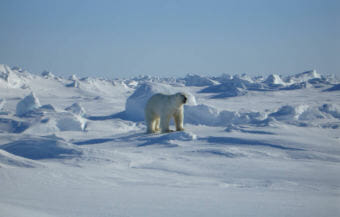
A male polar bear near Kaktovik. (Photo courtesy U.S. Fish and Wildlife Service)
The Trump administration Thursday announced a set of proposed revisions to the Endangered Species Act to make it easier for developers to navigate the law.
But environmental groups criticized the changes, calling them a “wrecking ball” aimed at the 45-year-old law that protects species like polar bears and sea otters.
Two federal agencies, the interior and commerce departments, announced the revisions in a phone call with reporters. The U.S. Fish and Wildlife Service, within the Interior Department, oversees endangered and threatened plants and animals on land, while the National Oceanic and Atmospheric Administration, within the Commerce Department, oversees marine species.
“By streamlining the process, you increase the public’s buy-in,” said Earl Comstock, a senior Commerce Department official. “Because people don’t see this, necessarily, in such an adversarial light. Communities can get their projects while we protect the resources.”
The Endangered Species Act has been the subject of lawsuit after lawsuit in Alaska. That’s in part because required habitat protections can make it more difficult or expensive to develop projects, like oil and gas infrastructure.
Industry groups have long been pushing for changes.
“I think oftentimes it’s been used as a tool to really just put up additional roadblocks and to prevent responsible development,” said Marleanna Hall, executive director of the Resource Development Council. The group advocates for Alaska businesses that produce oil, minerals, timber and fish.
The proposed changes fit into a broader Trump administration effort to cut regulation of industry.
The Endangered Species Act revisions are outlined in three proposed rules, which total 118 pages. They have not yet been formally published by the government, which will set off a public comment period before the rules are finalized.
Among the revisions is one that could address climate change. It would give managers permission to ignore climate change impacts when deciding whether to protect endangered species’ habitat.
That’s because the Endangered Species Act itself doesn’t empower the government to stop threats like shrinking glaciers, rising sea levels or melting snow, the rule says.
“In those situations, a designation could create a regulatory burden without providing any conservation value to the species concerned,” the rule says. In such cases, it adds, habitat protections and ensuing conservation measures “could not prevent glaciers from melting, sea levels from rising or increase the snowpack.”
Environmental groups say the provision appears to target polar bears, and takes a defeatist attitude toward species threatened by climate change. Oil industry groups, Alaska Native corporations and the state have all challenged expansive federal habitat protections for polar bears in the past, saying they were ineffective and overly broad.
“They definitely were thinking about drilling in the Arctic when they wrote that,” said Brett Hartl, a lobbyist with the Center for Biological Diversity, in Washington, D.C. “They’re basically saying, ‘Polar bear sea ice — yeah, it’s critical to the species. But even if we designated it, we couldn’t protect it anyway because we have no tool at our disposal to address climate change. So, you know, why bother?'”
Hartl says environmental groups will challenge the proposal in court once it’s finalized.
Close
Update notification options
Subscribe to notifications
Subscribe
Get notifications about news related to the topics you care about. You can unsubscribe anytime.