Aging

At the language house in Kodiak, new learners keep the Alutiiq language alive

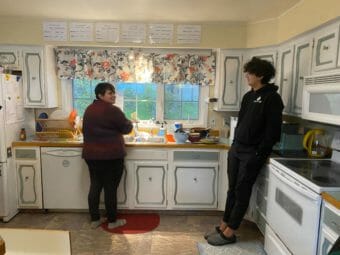
Stevi Frets and Max Pyles joke as they do the dishes at the Sun’aq Tribe’s language house in Kodiak on Sept. 15, 2022. (Photo by Claire Stremple/KTOO)

Half of the first language speakers of Kodiak Alutiiq died between 2020 and 2022. But that’s not stopping new speakers from learning the language and passing along a distinct culture and worldview to the next generations.

At the Sun’aq Tribe’s language house, everything is a lesson—catching up on gossip, making a grocery list or washing the dishes.

No one lives here full time, but the Sun’aq Tribe uses a federal grant to pay a group of language apprentices and mentors to master the language.

“To really get the language down, you gotta use it in practice,” said Dehrich Chya, a mentor at the language house. “The point of a language house is it’s a place where you can just get together and use the language in your day to day life.”

“Heritage languages are so important,” said mentor Stevi Frets. “And when you learn them, it’s like, ‘Okay, I’m part of the crew saving it now.’ There’s no like, ‘Yeah, I learn a little Alutiiq on weekends, when I can.’ All of a sudden, you’re like, ‘Oh, my gosh, my language, I have to save it, I have to do everything I can’.”

Kodiak is home to a powerful movement to bring the Alutiiq language back into daily use. For about 100 years, American schools and governments suppressed the language and punished children for speaking it. Now the last Elders who speak it fluently are almost gone.

Frets says there are a few Elders in town she can speak with, and a lot of folks who have gone through some basic language classes at the University.

“But there’s not a lot of people you can like have a conversation with around. Like, I think they’re mostly in this room right now,” she said with a laugh.

In some ways, Frets says she feels like she missed out. The tribe estimates there are now only about 17 Elders who are fluent Alutiiq speakers left. They lost about that many during the pandemic. It’s a turning point.

But the language movement isn’t giving up, it’s moving forward.

Hailey Thompson administers the grant. She says part of the Sun’aq Tribe’s goal is to train fluent speakers who can in turn teach the language.

“We have a lot of motivation to learn Alutiiq. People want Alutiiq preschools, and Alutiiq language classes at the high school, and Alutiiq language class at the college,” she said. “But the problem is we don’t have the teachers to teach those classes and workshops.”

Hailey Thompson manages the Sun’aq Tribe’s language grant. “It’s not a job you can just clock out of,” she said. “If we don’t build more Alutiiq fluent people… then there’s not going to be anyone for my kids to learn from. So that’s what probably keeps me going.” In Kodiak on Sept. 15, 2022. (Photo by Claire Stremple/KTOO)

A solid foundation of language revitalization already exists in Kodiak. But Thompson says it’s different now—there were a lot more elders before.

“The next wave of what it looks like is building resources, archiving things that we know we’re going to need, spending the time that we know we can get with elders,” she said. “That’s what it looks like right now. Just cherishing all the things, that all the resources we can get… before we know that they’re gone.”

The stakes are high, but the rewards are immense. Frets and the others are building fluency to be able to teach the next generation of Alutiiq speakers.

At the Alutiingcut Childcare Center about a dozen preschoolers learn numbers in Alutiiq and Alutiiq versions of popular kids songs. There probably won’t be any birth speakers left by the time they’re older, but the language movement is working to ensure they’ll have teachers.

An Alutiiq language program exists at the Kodiak college and courses at the high school. And the tribe hopes to put 18 people through its program at the Language House over the course of its 3-year grant.

Learners meet up with Elders at the museum once a week. Three of the Elders that used to be at those sessions  died during the pandemic, but the museum records them so new learners and descendants of the speakers can hear their stories.

Dehrich Chya, the Alutiiq Museum’s Language and Living Culture director, sits with Elders at a weekly session in Kodiak on Sept. 16, 2022. (Photo by Valerie Kern/AKPM)

Florence Pestrikoff didn’t grow up speaking Alutiiq, even though most people in her village did. But for the last couple of decades she has been an active speaker and teacher–she learned in the first wave of language revitalization about 20 years ago.

“I love speaking my language,” she said. “In the past it was — people were ashamed of the language. It’s sad. Really sad.”

American missionaries and schools enforced strict English-only policies for years. Parents like hers encouraged English to protect their children. The result was a swift decline in speaker numbers.

Pestrikoff answers her cell phone in Alutiiq and says she speaks it with her husband. And that’s the vision of the language movement—to have the language be in use. At home, in the grocery store, on the street.

And to carry the values that are embedded in the words.

“We never say goodbye. There is no goodbye in Alutiiq,” Pestrikoff said. “You say ‘Tang’rciqamken. I will see you later.’ I like that.”

Just like the language in Kodiak schools and homes — quiet for a while, but coming back.

With early Alzheimer’s in the family, these sisters decided to test for the gene

Three women post for a photo on and around a red porch swing
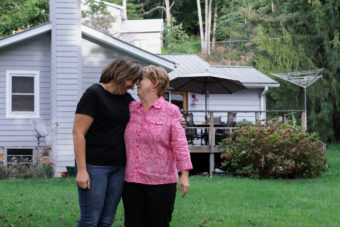
Karen Douthitt (left) and her two of her older sisters, Susie Gilliam (center), and June Ward (right) each took a test for the genetic mutation presenilin 1 after their mom got Alzheimer’s disease in her early 60s. Each child of a parent with this mutation has a 50% chance of inheriting it. (Photo by Juan Diego Reyes for NPR)

In some families, Alzheimer’s disease seems inevitable.

“Your grandmother has it, your mom has it, your uncle has it, your aunts have it, your cousin has it. I always assumed that I would have it,” says Karen Douthitt, 57.

“It was always in our peripheral vision,” says Karen’s sister June Ward, 61.

“Our own mother started having symptoms at age 62, so it has been a part of our life.”

Nearly a decade ago, Karen, June, and an older sister, Susie Gilliam, 64, set out to learn why Alzheimer’s was affecting so many family members.

Since then, each sister has found out whether she carries a rare gene mutation that makes Alzheimer’s inescapable. And all three have found ways to help scientists trying to develop treatments for the disease.

Bad news on the golf course

I met Karen and June in 2015, at the first-ever conference for families with a particular type of genetic mutation in which Alzheimer’s often appears in middle age.

The annual conference is sponsored by the Alzheimer’s Association and the Dominantly Inherited Alzheimer’s Network Trials Unit, a research program run by Washington University School of Medicine in St. Louis.

Karen and June had come to Washington, D.C., for the family conference because of something they had just learned about a cousin on their mother’s side.

The cousin had developed Alzheimer’s in her 50s. And genetic tests showed that she carried a rare, inherited gene mutation called presenilin 1. It’s one of three mutations that typically cause Alzheimer’s to appear in middle age.

The three gene mutations responsible for early Alzheimer’s are unlike a better known gene called APOE4, which merely increases the likelihood somewhat that a person will develop Alzheimer’s – and usually at age 65 or older. In contrast, the early-onset mutations, including presenilin 1, make it almost certain an individual will develop the disease, and usually before age 60.

Each child of a parent who has the presenilin 1 mutation has a 50% chance of inheriting it.

The genetic finding in Karen’s cousin seemed to explain why the sisters’ mother had developed Alzheimer’s in her early 60s. And it meant that any of the sisters, or all three of them, might also carry the mutation.

Karen got the news in March of 2015, during a round of golf.

Her takeaway: “We now have a coin flip of whether we’ll develop Alzheimer’s by the time we’re 62.” That was “kind of a heavy load on the golf course,” Karen told me at our first meeting.

June had a different reaction: “It was shocking news, but yet there was this element of, ‘oh, so now we finally know what’s been going on.'”

Karen and June talked it over with their older sister Susie.

The sisters had grown up with three other siblings in Swannanoa, a town in the Blue Ridge Mountains of North Carolina. But the three younger girls always had a special bond, “like a three-legged stool,” June says.

So they made a decision together in the spring of 2015.

“We’re doing what we can do,” June told me at the 2015 conference, “which is to participate in the drug trials and try to take what action we can toward a better future.”

They began raising money for the Alzheimer’s Association. And they volunteered for Alzheimer’s drug studies led by researchers at Washington University School of Medicine in St. Louis.

High stakes gene testing

All that happened seven years ago.

This summer, I sat down with Karen and June again. They were attending the annual family conference, this time in San Diego. Susie, the eldest of the three, was there too.

By this time, all three sisters had learned whether they carried the gene mutation.

Karen, the youngest, found out just after the 2015 conference.

“I decided to do gene testing relatively early after that meeting,” she says, “and I’m negative.”

The middle sister, June, waited until March of 2016.

“I decided I was ready to do genetic testing, just cause I like to know things,” she says. “And I turned out to be genetically positive for Alzheimer’s disease, which means that if I live long enough I will get it, unless the [experimental] medicine works.”

For years, Susie had chosen not to find out whether she carried the gene.

“I asked my husband and my two children, and everybody said they’d just as soon not know,” she says.

Eventually, though, their views changed. And in March of this year, Susie discovered that she, like June, carries the gene mutation.

At first, she was devastated.

“The next morning I was wallowing in self pity, and what I’m going to miss,” Susie says. “I’m going to miss birthdays, and my grandchildren won’t know me as a healthy person.

“But then on the front porch, in the mountains of western North Carolina, I’m rocking and there’s this single cloud in a Carolina blue sky, and I was praying for Him to take my worries away. And I’m sitting there rocking and this single cloud thins and thins and thins, and then, poof, it’s gone — and with it my worries.”

A plan for the future

The situation still worries little sister Karen — even though she’s negative for the mutation.

Late last year, she got some alarming news about her own health. She had breast cancer. But Karen says cancer doesn’t make a person feel helpless the way Alzheimer’s does.

“You go see a surgeon. You go see an oncologist. And then you have surgery and then you have radiation or chemo. There’s a to-do list,” she says. “Susie had her diagnosis in March and her to-do list is: Go see an attorney, make a will.”

Karen knows that June and Susie could develop symptoms at any time. She says that will be devastating for her family, which dotes on them.

“We call ’em marshmallows, ’cause they’re so sweet,” she says.

June has found some measure of solace by participating in Alzheimer’s research studies.

She knows the experimental drugs she’s taking are unlikely to help her. But she hopes they’ll eventually lead to treatments that will make a difference to younger members of her family.

“If anything I do can have a positive effect for their lives and their future, I’m all in,” she says.

June also has become a regular at the annual conference for families affected by the early Alzheimer’s mutations. She says it’s a place to hear about scientific advances — and feel a sense of ease.

“There’s a kind of sorrow about Alzheimer’s disease that, as strange as it seems, there’s a comfort in being in the presence of people who understand it,” she says.

June says attending the conference also reminds her that some other families carry a more extreme version of the gene mutation.

“Sometimes I feel guilty because I’m a 61-year-old woman with the gene who can still have a conversation and not make too many faux-pas,” she says. “There are people in their 30s here that are struggling already.”

The three sisters are still hoping for a drug that can slow down Alzheimer’s. But they are also planning for a future without that drug.

Karen and her husband have moved back to her childhood home in the Blue Ridge mountains. They live in the same small house where she and her siblings were raised. It’s part of a family compound they call “the holler.”

“I say it’s like the Kennedy compound except redneck,” Karen says. “Some of the houses have wheels on them. But my dream is to have both of my sisters there.”

“The good thing is we would be surrounded by family and people that have known us since we were children,” June says. “So if we walked away, somebody would help us find our way back home.”

Copyright 2022 NPR. To see more, visit https://www.npr.org.

‘You don’t want a young puppy’: Young shores up support with Alaska Federation of Natives

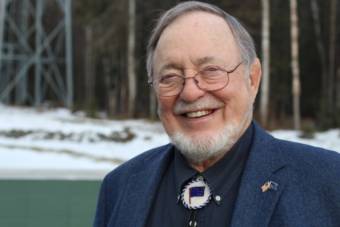
U.S. Rep. Don Young (Wesley Early/Alaska Public Media)

As the annual Alaska Federation of Natives convention got underway Monday, Alaska Congressman Don Young announced that Inupiaq business executive Tara Sweeney is one of his campaign co-chairs.
Sweeney, a former AFN co-chair, served as assistant secretary of Interior for Indian Affairs in the Trump administration and is a longtime executive at Arctic Slope Regional Corporation.

Young’s campaign made the announcement the same day he addressed the AFN convention.

“I am a person that you’ve always been able to ask me for help for something that you wish to get done,” he told the online convention. “And I’ll continue to do that. Because I listen to you and what you really want.”

Young is 88 years old and has been in office nearly 49 years. He told the convention he knows that some people question his capabilities, but he said with longevity comes wisdom.

“You don’t want a young puppy on this job right now,” he said. “This is very, very important, the next two years. We have some big challenges before us nationally that can affect you tremendously. So I want to be here to serve you.”

Young also congratulated AFN on the 50th anniversary of the Alaska Native Claims Settlement Act. He admitted he had his doubts that it would work but says Native people rose to meet the challenges.

Young now has two campaign co-chairs: Sweeney and state Sen. Josh Revak, R-Anchorage. The selection of two well-connected Republicans adds weight to the campaign and helps dispel persistent rumors that Young intends to retire before Election Day.

Four candidates have filed with the Federal Elections Commission to challenge Young, including Nicholas Begich III, the grandson of the congressman who previously held the seat.

Kenaitze Tribe’s craft classes help elders socialize and learn new skills

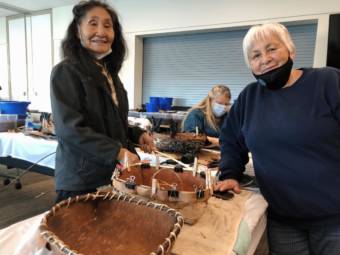
Linda Ross (right) has made several birch bark baskets with help from her friend, Helen Dick (left). (Sabine Poux/KDLL)

When it’s warm and wet, birch bark can be folded into baskets — a container for berries or a cradle for babies.

But when it’s not fresh off the birch tree, bark can be unyielding. And folding can be the hardest part, according to the dozen women making baskets Monday at the Dena’ina Wellness Center in Kenai.

Still, their instructor was singing their praises.

“They’re doing really good. The bark is hard, it’s really hard. But look, they’re making it anyway,” said Helen Dick, a Dena’ina elder. She learned to make birch bark baskets from her grandmother, growing up in Lime Village, near Lake Clark.

Now, she’s teaching others to make them, too — one of the Monday craft classes offered through the Kenaitze Tribe.

Dick said her grandmother would fill birch baskets with hot water to cook food. They’d use the scraps as a pain reliever.

Back home, she’ll often peel bark right off the tree. But when that’s not possible, bark needs to spend days soaking in water to become more malleable.

Still, folding requires some patience.

“This bark is old,” said class member Linda Ross. “It’s been in storage for a couple of years. And so it’s not pliable like it should be, like if we went out to the woods and got it fresh — but you only get it in the spring.”

Birch bark soaked in water for three days prior to the class. Dick said she usually peels bark straight off the tree to use for her baskets. (Sabine Poux/KDLL)

It was a sticking point for some. Rose Guilbeau accidentally tore part of her first basket when she was trying to fold the corners in like an envelope.

“The first time, I tried a small one,” she said. “But it didn’t work out and split on me. And now this is my second time.”

The second time went better than the first. Guilbeau and the other students wrapped another layer of bark around the top edge of the basket, then added a willow branch to keep the structure tall and rigid. They used clamps to keep it all in place and poked holes in both layers of bark with an awl for sewing.

While she worked, Barb Norbeck thought about how she might use her basket. She contemplated hanging it up on the wall, as decoration.

Or, she said, she could use it as a basket for bread.

“Because as I’m talking to you about it and giving it some thought — yeah, I think that’s what I’m going to do,” she said. “And I’m gonna need to look up the Ojibwe word for ‘bread.’ Cause that’s what I am, Ojibwe. And I’m going to want that to be part of the name for this piece.”

This basket was Norbeck’s first. Ross was making her fourth —  a wide and shallow container with a light outside and dark interior.

“She learns pretty fast,” Dick said.

“With your help,” Ross said.

Bessie Phillip, a wellness assistant at the Dena’ina Wellness Center, said classes like this are a great chance for students, many of whom are Dena’ina elders, to socialize. This fall, they made slippers and salmon skin earrings.

She said it was hard to cancel the classes for COVID-19.

“Oh my God, it was so depressing,” she said.

Now, they can work together again, in masks and spaced out around a large conference room.

Back in the class, each student added her finishing touches — a row of sinew stitches at the top to hold the basket together. Marion Keyes carefully wove the thin rod in and out of her small basket’s edge.

“It’s going to go on a wall next to my son’s basket that he made me years ago before he passed on,” she said.

Her son learned to make a basket from Dick at a cultural camp. They learned together how to make wood-handled ulus.

“It was really kind of a special time to be learning to do those things with my son,” she said.

She sad she likes making baskets because she can create useful things from nature, rather than buy containers made of plastic.

A woman holding up and studying a small birch basket
Monday was the first time Marion Keyes made a birch bark basket. She said it’s rewarding to make something useful from natural materials. (Sabine Poux/KDLL)

The practice also means a lot to her after she was told for so much of her life she should assimilate into non-Native culture.

“It’s doing something that I should’ve learned as a little girl,” she said. “My grandfather was Eastern Woodland Indian, Abenaki and Penobscot. And I never got to learn anything like that. I was always taught Catholic school stuff and regular non-Native stuff. My mom and dad seemed ashamed of my mom being Native.”

Another way Keyes finds connection to her Native culture, she said, is through language. She’s learning to speak Lingít.

Dick is one of the few people who still can fluently speak Dena’ina fluently, a highly endangered language. She teaches Dena’ina courses.

As with language, she said, basket making involves a lot of trial and error.

“Everything that we try to learn, we’re always making mistakes,” she said. “And we keep trying and then we make it. I watched my grandma make mistakes, she always said, ‘Try again.’”

It’s a lesson that will last long after the birch bark has dried.

New program funds veterans-choice caretakers in Alaska ‘they can hire and fire and train whoever they’d like’

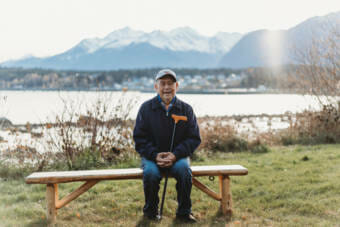
Veteran Joe Hotch at Picture Point in Haines. Hotch has been using a new program that lets veterans choose their own caretakers which allows him to continue living at home, instead of an assisted living facility. (Photo courtesy Mel G Photography)

Veterans Day reminds Americans to honor those who’ve served the country, but many senior veterans need help on a daily basis.

To help facilitate that, Southeast Alaska Independent Living (SAIL) is offering a program in which veterans can choose their own caretakers. It also allows those seniors to continue living at home, instead of an assisted living facility.

There are about 77,000 veterans in Alaska, but according to AARP, only about 29 percent of them access Veterans Affairs benefits. That’s why Janine Allen, who works in SAIL’s Haines office, wants to spread the word about their services.    
“I feel like anything we can do to promote veterans being able to obtain the care they need and be able to live happy lives at home is really what SAIL is all about,” she said.

SAIL’s newest program is called VOICE, which stands for Veteran Options for Independence, Choice and Empowerment. 

“It’s a veteran-directed program. So it’s designed for veterans that need assistance with their daily living, but they want to remain at home,” said SAIL Assistant Director Sierra Jimenez. 

Interested veterans need to enroll in VA Health Care and meet the criteria for nursing-home level care. Then the VA will give them a monthly budget. 

“Then they can hire and fire and train whoever they’d like,” Jimenez said. “It can be a family member, a spouse, it can be the neighbor. Our job is to help coordinate it and kind of be the in-between [person] with the VA and just make sure that the program is on track, answer any questions and help with paperwork.”

At that point, all the veteran has to do is submit time sheets for their chosen employees. Jimenez said the program is especially helpful for those who live in more rural parts of Alaska where there’s a shortage of care workers.

“So even though they qualify for services, they can’t get employees to provide them,” Jimenez said. “[VOICE] also allows people to hire a family member who is already doing the work. It can relieve some of the stress if they had to quit their job to take care of their spouse. Now they can get paid to do that.”

91-year-old veteran and Haines resident, Joe Hotch has been using the VOICE program for a year and a half. His wife Georgiana Hotch said Joe was able to hire two caretakers, set their wages and use any leftover funds to meet other needs, like purchasing a bed rail.

“That helps him to get out of bed in the morning or in the middle of the night,” she said. “It really helped him to regain independence at his age.”

Georgiana is not retired yet. She said VOICE allows her to continue to work without worrying about her husband.

“It has helped Joe and I immensely,” she said. “We’re very thankful.” 

SAIL offers VOICE throughout Southeast Alaska; partner organizations offer it in the Mat-Su and on the Kenai Peninsula. For more information about the program, you can contact your local SAIL office or visit its website.

Correction: This story has been updated to show that SAIL only offers VOICE throughout Southeast Alaska, partner organizations offer those services in the Mat-Su and on the Kenai Peninsula.

LISTEN: Katie Hurley remembered for charisma, energy and love for Alaska

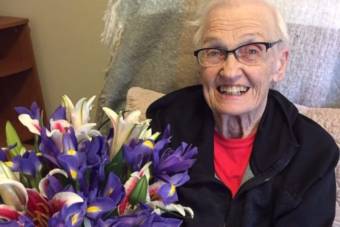
Katie Hurley at a Portland, Oregon long-term-care facility, in her late 90s. Among many state government and political offices she held, Hurley was the head clerk at the Alaska Constitutional Convention. She died Feb. 21, 2021 at the age of 99. (Hurley family photo)

Alaskans are mourning the loss of one of the last remaining participants in the crafting of the state Constitution, Katie Hurley, who died Sunday at the age of 99.

Hurley was a longtime assistant to territorial Governor Ernest Gruening, the chief clerk at the Alaska Constitutional Convention, and, later, a state legislator, among many other roles.

Hurley’s daughter, Susie Derrera, says her mother was principled and had a knack for taking on responsibility early in life, and her energy and charisma were on full display during her time working on Alaska’s foundational document.

Gov. Mike Dunleavy has ordered state flags to be flown at half-staff March 30, in honor of what would have been Hurley’s 100th birthday.

LISTEN HERE:

Site notifications
Update notification options
Subscribe to notifications