Andrew Kitchenman

State Government Reporter, Alaska Public Media & KTOO

State government plays an outsized role in the life of Alaskans. As the state continues to go through the painful process of deciding what its priorities are, I bring Alaskans to the scene of a government in transition.
Overhaul of Alaska alcohol laws makes progress in Legislature

Tasting room dog Chai inspects a beer at Onsite Brewing in Midtown Anchorage.  This year, the most controversial provision has been one that limits the number of tasting rooms for breweries, distilleries and wineries. (Photo by Abbey Collins/Alaska Public Media)

For more than 10 years, lawmakers have been considering a massive overhaul of Alaska’s laws governing the sale of alcohol in the state. It hasn’t happened, though, as different interest groups have fought over conflicting priorities year after year.

But people who’ve been watching the annual battle over a revision of the state’s alcohol laws see signs of progress this year. For Sarah Oates, president of the Cabaret, Hotel, Restaurant & Retailers Association, that’s a good thing.

“I don’t think there’s anything wrong with trying to help the existing hospitality industry,” she said. “This industry has suffered immeasurably over the last two years. We all know that. And it is still recovering.”

This year, the most controversial provision has been one that limits the number of tasting rooms for breweries, distilleries and wineries. Right now, there can be one for every 3,000 residents. Under the new law, there could only be one for every 12,000.

Fairbanks Democratic Representative Adam Wool is concerned about the change. He’s a former bar owner who says limiting the number of new tasting rooms will provide an advantage to the existing breweries.

“I don’t think they’re a bad influence on society,” he said. “I worry about the business competition level playing field.”

It’s a point that’s backed up by Sherry Stead, co-owner of Grace Ridge Brewing in Homer. She’s concerned that the bill will prevent new businesses from opening.

“It sets up monopolies in our small communities, limits competition and stops future business growth across Alaska,” she said.

The leading legislator guiding the bill on its long path through the Legislature is Soldotna Republican Peter Micciche, who’s now the Senate president. He says the regulation on the number of tasting rooms is a compromise, just like dozens of other sections of the bill. He says it was worked out by a team of stakeholders.

“We went back to the team and said, ‘How can you come together as a team on expanding opportunities to breweries, distilleries and wineries so they can succeed. People are voting with their feet. How can we do that and still not have a brewery on every corner?’ So this was the solution,” he said. “That’s why it’s a compromise.”

The law makes many other changes. It allows tasting rooms to stay open later: 10 p.m. instead of 8 p.m. But patrons would have to leave at closing time, while now they can linger with newly served drinks.

Other changes include:

  • Allowing brewery owners to buy a bar, restaurant or package store, or for such businesses to be attached to a hotel
  • Allowing package or liquor stores to provide limited free samples
  • Allowing golf courses to sell alcohol to those on the course — and not just beer and wine
  • Regulating online alcohol sales, including requiring delivery companies to get signatures from people aged 21 or older
  • Changing some sales to people who are younger than 21 from being crimes to being violations subject to fines

Micciche says the bill as it stands is the result of many compromises — and that it could serve as a model for what it takes to get something done in the Capitol.

“When we started these meetings, these people were 180 out, not even talking about these issues, they were talking past one another,” he said. “They got to the point where they could agree on something where they’re all equally unhappy with the outcome but recognize the value of where we are.”

The bill received support from nearly 40 people in public testimony recently, although a few asked that the limit on the number of tasting rooms be changed. The House Finance Committee is deciding whether to send the bill to the House floor. The Senate already passed the measure.

Budget work at Alaska House delayed as COVID cases surge, caucuses differ on masks

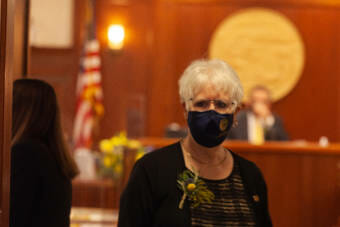
State Rep. Louise Stutes, R-Kodiak, leaves the House floor after being sworn in on Jan. 19, 2021, in Juneau. On Wednesday, Stutes said she reinstituted a mask mandate on the House floor in order to minimize the spread of COVID-19. Twenty-six people who work in the Capitol are active cases. (Photo by Rashah McChesney/KTOO)

Twenty-six people who work in the Capitol have been reported as active cases of COVID-19, including four or five legislators, according to House Speaker Louise Stutes. 

Stutes, a Kodiak Republican, has imposed a requirement that House members wear masks during floor sessions. But three members — Republican Reps. Ben Carpenter of Niksiki, David Eastman of Wasilla and Christopher Kurka of Wasilla —  have refused to do that, and as a result, Stutes hasn’t allowed the House to hold a full session all week. 

The Legislative Council has not re-introduced a mask requirement for the entire Capitol. On Feb. 23, the council dropped mask and testing requirements for those who work in the building. 

Stutes said she is doing what she can to minimize the spread of the virus.

“Masking may not be the end-all to everything,” she said. “But it certainly is helpful. It’s one of the many things you can do.”

Stutes said she had been clear when she dropped a mask requirement earlier this year that she would bring it back if there was a cluster of cases. 

“We’re stymied because a few people have determined that we’re violating their civil and personal rights by asking them to wear a mask,” she said. 

In a statement Tuesday, the Republican House minority caucus described canceling floor sessions as “a result of fear and virtue-signaling.” The caucus said it was present and ready to work. 

“We do not want the people’s business to be thwarted due to obvious delay tactics,” the statement said.

Stutes said she plans to resume work on the state budget on Monday, in the hope that the peak in cases would have crested by then. She said the House will meet each day as it finishes work on the budget. 
Legislators are divided over what to call state payments to Alaskans and the message it would send

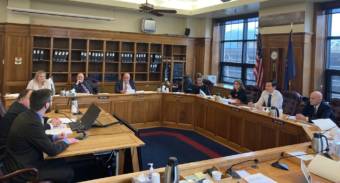
Members of the Alaska House Finance Committee discuss the proposed budget on March 16, 2022 in the Alaska State Capitol in Juneau, Alaska. (Photo by Andrew Kitchenman/KTOO and Alaska Public Media)
Members of the Alaska House Finance Committee discuss the proposed budget on March 16 in the Capitol in Juneau. On March 22, they voted down an amendment that would have paid the entire $2,550 payment to Alaskans proposed in the budget as a permanent fund dividend. (Photo by Andrew Kitchenman/KTOO and Alaska Public Media)

The Alaska House of Representatives is scheduled to debate the state budget this week. One of the biggest differences over the budget is not over dollars and cents — it’s over what name to call the money that will be sent to Alaskans later this year. The disagreement is over the message lawmakers want to send. 

This year’s budget is unlike any the Legislature has debated since the price of oil fell in 2014. Oil prices are back up, and so is state revenue. That allows for some big-ticket spending proposals in the version of the budget the House Finance Committee passed last week:

  • $1.2 billion to fund public education for the following year, a year ahead of time; 
  • $57 million to increase school funding per student; 
  • $472 million to pay off the last of the oil and gas tax credits the state has been paying off the last several years; and 
  • $395 million set aside to rebuild the Higher Education Investment Fund, used to pay for university scholarships and medical education. 

Under both Gov. Mike Dunleavy’s budget proposal and the one the House Finance Committee passed last week, Alaskans would receive roughly $2,550 in payments from the state. 

Dunleavy has said that’s the amount permanent fund dividends should be this year. He also wants to pay more than $1,200 in additional dividends, based on the difference between the PFD he proposed last year and the actual size of the dividend Alaskans received.

Members of the House majority caucus have proposed a 2022 dividend that’s half of what Dunleavy proposed. They’re calling the other half of the payment an energy relief check. 

Palmer Republican Rep. DeLena Johnson, a minority-caucus member, sponsored an amendment that would have paid the entire amount as dividends. She said that would be closer to the current formula. And she said the Legislature comes up with excuses each year to not follow the formula. 

“We could say the stock market is volatile,” she said. “We can say all kinds of what-ifs as why we don’t want to pay it. But the fact is that we have a statute. We’ve struggled with the statute. We’ve talked about the statute. I mean, this has brought the Legislature to a standstill — a standstill — over the last four years.”

Anchorage Democratic Rep. Andy Josephson, a member of the majority, opposed the amendment. 

“My main problem with this is that it fundamentally says, ‘Let’s forget the lessons of 2014 to 2021, as if that part of history didn’t happen,’” he said.

During those years, paying larger dividends would have required some combination of spending cuts, new taxes, or larger draws from state savings. 

So Josephson is concerned with the message describing the entire payment as a dividend would send — and that it would set up Alaskans’ expectations that dividends would be that size every year. 

Nikiski Republican Rep. Ben Carpenter supported the amendment. He said setting PFDs at the lower amount also would send a message that the Legislature wants to spend more of the annual draw from the permanent fund on government. 

“We’re communicating our intention to do something with the permanent fund earnings,” he said.

The two proposals also reflect a split over the formula setting the dividend amount, which hasn’t been followed since 2015. 

Neither proposal would follow the current formula, which would pay a dividend of roughly $4,200. 

Dunleavy’s dividend proposal is based on using half of the money the state plans to draw from permanent fund earnings on the PFD. That’s the same as what dividends would be under a formula he supports including in the state constitution. 

The House Finance Committee budget includes a PFD that is equal to what dividends would be if the state were to use one-quarter of the annual draw from permanent fund earnings on dividends. 

Anchorage Republican Rep. Sara Rasmussen predicted that Alaskans will understand the payments they receive this year as dividends, regardless of what they’re called. 

“I don’t think that, because we’re calling it something different, the public will recognize that this is two separate payments,” she said. “We can speak about it, but the majority of the public doesn’t tune in to the news regularly.”

She compared the energy relief check proposal to similar payments the state paid in 2008. She said that as long as Alaskans receive the money at the same time, it will appear to be a PFD. 

Fairbanks Democratic Rep. Adam Wool disagreed. He said the 2008 payments did not set up public expectations that dividends would be higher from then on, in part because the state government said it was responding to high energy prices. And he said that can happen again.

“It definitely was noted as a separate amount, due to high oil,” he said. “And I’d like to keep it that way.” 

Fairbanks Republican Rep. Bart LeBon also said he’s concerned about the precedent of calling the entire payment a dividend. 

“I mean, it wasn’t too many months ago in this building, we were talking, ‘broad-based tax’ like it was something that had to happen sooner than later and the only question to be answered was, ‘Is it a sales or income?’” he said.

LeBon said the talk of taxes stopped this year. But he predicted it could come back in the future if the state pays higher dividends.

The House Finance Committee failed to adopt the amendment, which means that half of the payment is still called an energy relief check. 

The timing of when the budget debate will begin is uncertain. On Monday and Tuesday, the House didn’t hold a full floor session, after some members refused to wear face masks. House Speaker Louise Stutes reinstituted a mask requirement on the floor after at least one representative and multiple staff members tested positive for COVID-19. 

State Sen. Elvi Gray-Jackson has suspended her US Senate campaign

Alaska State Sen. Elvi Gray-Jackson answers questions from reporters after filing to run for a U.S. Senate seat on Thursday, Feb. 10, 2022, in Juneau, Alaska. Gray-Jackson suspended her campaign last week and announced plans to run for reelection to her current seat in the state Legislature. (Photo by Rashah McChesney/KTOO)
State Sen. Elvi Gray-Jackson has suspended her U.S. Senate campaign and instead announced plans on Friday to run for reelection to her current seat in the state Legislature. 

Gray-Jackson says it would have been monumentally expensive to run for the U.S. Senate. And she called for campaign finance reform. 

What her district will look like is still up in the air, though, as a state Supreme Court ruling last week could lead to a series of changes to state Senate districts. 

The board may have to decide how many Senate districts it wants to rearrange after the state’s high court found that a pairing of most of Eagle River with the South Muldoon neighborhood violated the state constitution. At least four Senate districts will have to be rearranged if Eagle River and Muldoon are to have their own districts. 

Both Gray-Jackson’s decision and the final Anchorage Senate map could affect which offices candidates seek this year. For example, Democratic Rep. Chris Tuck had been interested in running for the state Senate district that Gray-Jackson lives in. He must now decide whether to oppose her or to run for a different office.

An Alaska politics recap: From redistricting lawsuits to a Capitol COVID outbreak

A masked woman waits in the stairwell of the Capitol Building on Tuesday, Jan. 19, 2021, in Juneau, Alaska. (Photo by Rashah McChesney/KTOO)

Alaska’s political scene has been busy. The state Supreme court ruled on redistricting last week, the House plans to take up the budget in a few days — and there’s yet another conflict about mask-wearing on the House floor. Andrew Kitchenman spoke to Alaska Public Media’s Lori Townsend about the latest developments and what happens next.
Listen here:

The following transcript has been lightly edited for clarity.

Andrew Kitchenman: So first, the biggest consequence is that the court upheld Anchorage Superior Court Judge Thomas Matthews’ finding that the redistricting board had violated the state constitution in how it paired a House district that includes most of Eagle River with a House district that includes the south Muldoon neighborhood to make up one Senate district.

On the other hand, the court rejected Matthews’ finding that there was a problem with the House district Skagway was placed in. Skagway had wanted to be in a district with downtown Juneau, but it will be with Juneau’s Mendenhall Valley area instead.

The only other change is that the court found a problem with which district the community of Cantwell was placed in. It basically said that Cantwell should be in the same House district as the rest of the Denali Borough, and not with the Ahtna villages. The court said that the board’s map for Cantwell wasn’t compact and that the board hadn’t justified it adequately.

So now Judge Matthews will have to give the board an order. The board may have to decide how many Senate districts it wants to rearrange to correct for the issue in Eagle River and south Muldoon. If all of Eagle River is kept in the same Senate district and both major pieces of Muldoon are kept in a Senate district, then at least four Senate districts will have to be rearranged.

The upshot of all of this could increase the number of competitive Anchorage Senate seats. Under the original map, both Eagle River Senate districts were heavily Republican.

Lori Townsend: When will we have a clearer idea about those Senate districts?

Andrew Kitchenman: First, Judge Matthews has to issue that order to the board. The board will have to meet and take action. And at that point, there could be one or more new lawsuits. But if there aren’t more lawsuits, then all of this could be resolved well ahead of the June 1 deadline for candidates to file for the election.

Lori Townsend: Andrew, given the fact that a number of other Senate districts could be affected, if lawsuits do come and push past the first of June, what would that mean for candidates who want to get into these races?

Andrew Kitchenman: Based on what’s happened in the past, the Senate would use the map that was current at that time — that is, the time of the lawsuits. And if there has to be changes to the map later, those will go into effect for the next general election in 2024.

Lori Townsend: What other state political news has happened recently that people should know about?

Andrew Kitchenman: Another piece of news is the Anchorage Democratic Representative Ivy Spohnholz has tested positive for COVID-19. Certainly not the first legislator to be in this position. The timing is a little awkward because the House majority only has a one-vote majority, and so any time a member is out, that does affect the House floor sessions. She tested positive on Friday, and she’s isolating and expects to be clear to be back on Thursday of this week. Since the House majority doesn’t have any votes to spare, that’s also when the floor debate on the budget is expected to pick up. House Speaker Louise Stutes reinstituted a mask requirement on the floor on Monday, but some members wouldn’t comply, so she ended the floor session. We’ll see what happens on Tuesday.

Special election dates announced to fill Alaska’s sole seat in US House

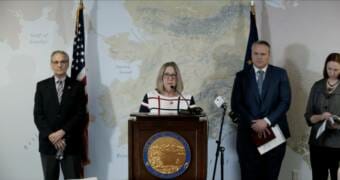
Gail Fenumiai, Division of Elections director, answers questions during a press conference Tuesday, March 22 about the special election process. (Video capture from Facebook livestream)

Alaska’s sole seat in the U.S. House of Representatives is vacant following the death of Rep. Don Young. Under the U.S. Constitution, vacancies in the House of Representatives must be filled by elections. 

There will be two special elections this summer to fill that vacancy: a special primary election by mail on June 11 and a special election to pick the winner on Aug. 16. That date coincides with Alaska’s regular primary election day and will be conducted the usual way with a mix of in-person and absentee voting.

Gov. Mike Dunleavy said he will issue a proclamation on Tuesday or Wednesday setting the election dates. 

State Division of Elections Director Gail Fenumiai said the timing allowed the state to avoid holding yet another election date. 

“The main concern is having this special primary election timely enough to get it certified, so the race can appear on the Aug. 16 primary election, so we would not be forced with doing yet another special election,” she said during a news conference on Tuesday. 

Since the June 11 special primary is coming up so quickly, that election will be held by mail.

The deadline for candidates to file to fill the vacancy is April 1. This date was picked to allow the Division of Elections enough time to print and mail absentee ballots to military and other voters who are overseas. 

The timeframe for setting the special primary and special election was set by a ballot measure Alaska voters approved in 2020. The ballot measure instituted the new open primary and ranked choice general election system. 

Voters will vote for one candidate in the special primary, which will be open to candidates from all political parties. Under Alaska’s new election system, the four candidates who get the most votes will be on the final special election ballot. That election will be the first conducted under the state’s new ranked choice voting system.

On Aug. 16, two elections will be on the ballot. In the special election, voters will be ranking four candidates to fill the final months of Don Young’s term.  But in the open primary for the next two-year term, voters will only be voting for one candidate to determine the top four that will advance to the Nov. 8 ranked-choice general election. The same candidates can run in both elections.

Lt. Gov. Kevin Meyer, who oversees elections, said the Division of Elections will work to inform voters about both the special elections and the new system. 

Meyer and division director Gail Fenumiai determined that the main way of voting for the June 11 special primary will be by mail, and every registered voter will have a ballot mailed to them. 

“The vote-by-mail option is pretty much the only way we can go and still have a successful primary special election,” Meyer said. 

Meyer attributed the decision due to the short timeframe. At least some voters won’t know what district they’re in and where their polling place is until  Alaska Supreme Court decides the outcome of lawsuits challenging the state’s new legislative district lines. That must happen by April 1.  

“So we don’t know districts yet entirely, the general public doesn’t know their districts yet, and or where their new voting places will be,” he said.

Meyer also said it would have been difficult to recruit enough poll workers to hold the special primary in the usual fashion. 

Voters will still have the option of voting in person at regional Division of Elections offices early or on the special election day. But most polling places will be closed. State law allows for this type of election to be conducted by mail. 

Both the voter and a witness will be required to sign the envelope for the mail-in ballots, Meyer said. 

The special election on the Aug. 16 regular primary day will be conducted in the normal manner, with polling places open and voters able to cast absentee ballots without giving a reason. The seat will remain vacant until Sept. 2, when the primary election results will be certified. The results of the election may not be known until 15 days after the election, the deadline for overseas ballots mailed by the election day to arrive, due to the complications of counting ranked choice ballots. 

Meyer acknowledged the challenges involved in this year’s election. He ticked the hurdles off, one by one: 

  • Holding the June 11 special primary election, as well as the special election on the regular Aug. 16 primary day and the Nov. 8 general election;
  • Hiring enough poll workers;
  • Buying paper ballots at a time of a national paper shortage and supply-chain difficulties;
  • Informing voters about new district boundaries and, for many, polling locations; 
  • Answering voter questions about the once-per-decade question on whether to hold a constitutional convention; and
  • Dealing with the ongoing COVID-19 pandemic. 

“We have a lot of challenges this year, probably the toughest year — that I know of anyway — to have elections,” he said. “But Gail and her crew are ready, prepared and we’re going to have good elections.”

Site notifications
Update notification options
Subscribe to notifications