Andrew Kitchenman

State Government Reporter, Alaska Public Media & KTOO

State government plays an outsized role in the life of Alaskans. As the state continues to go through the painful process of deciding what its priorities are, I bring Alaskans to the scene of a government in transition.
Governor announces official split of Alaska health and social services department

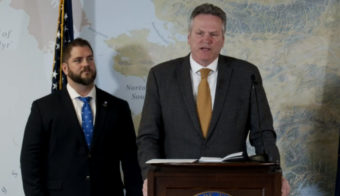
Adam Crum, commissioner of the Alaska Department of Health and Social Services, listens as Gov. Mike Dunleavy talks about the division of the agency into two smaller departments on March 21, 2022, in the Atwood Building in Anchorage. The Department of Health and the Department of Family and Community Services will be reorganized on July 1, 2022. (Screen capture of Dunleavy livestream)
Adam Crum, commissioner of the Alaska Department of Health and Social Services, listens as Gov. Mike Dunleavy talks about the division of the agency into two smaller departments on March 21, 2022, in the Atwood Building in Anchorage. The Department of Health and the Department of Family and Community Services will be reorganized on July 1, 2022. (Screen capture of Office of the Governor livestream)

The Alaska Department of Health and Social Services will be split into two separate departments in July. Gov. Mike Dunleavy proposed a similar change last year that he withdrew after nonprofit and tribal leaders, as well as legislators, raised concerns

Under the change, there will be a Department of Health that would continue to do most of the work of the current Department of Health and Social Services, like overseeing the Medicaid program. Medicaid is one of the largest pieces of the state budget. 

The other new department will be the Department of Family and Community Services. It will oversee foster care, juvenile justice, Alaska Pioneer Homes and the Alaska Psychiatric Institute. 

Adam Crum, the commissioner of the currently combined department, said the administration reached out to nonprofit and tribal organizations earlier in the process this year than last.    

“Over the last year, we have worked extensively with our stakeholder groups multiple times each week to make sure they understood what was going on,” he said at a news conference on Monday.

Crum said the large number of services he oversees has meant that he and his staff have moved from one crisis to another. And having two, more focused, departments will make that less likely. 

Senate President Peter Micciche, R-Soldotna, said the process went more smoothly this year. 

“The biggest difference this year was, we worked together and we worked together with stakeholder groups, front-line workers, division leaders, and the administration, as opposed to it sort of plunking down on the desk,” he said. “We knew it needed to happen, but I think folks needed to warm up to the idea.”

But the process wasn’t entirely smooth. A lawyer for the Legislature raised potential legal issues with the plan. And the House Health and Social Services Committee supported blocking Dunleavy’s plan. 

Anchorage Democratic Rep. Ivy Spohnholz, a member of the committee, said she would have liked to have seen the administration incorporate more public input into the plan than it did. 

“We’ve heard that very successful reorganizations in other states have taken years to plan before going live,” she said.

Last year, the governor withdrew his proposal after the House committee proposed rejecting it. This year, he didn’t, and Micciche says most senators supported the plan. 

Spohnholz noted that under state law, the commissioner sits on several state boards and commissions. And while the administration has divided up which commissioner would sit on which board, she said those changes can’t happen without the Legislature passing them. 

Alaska Supreme Court hears arguments over public testimony and ANCSA boundaries in redistricting appeals

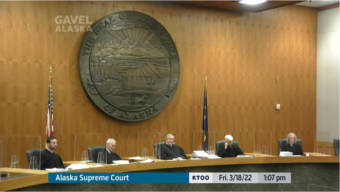
The Alaska Supreme Court hears oral arguments in three appeals of a Superior Court judge's ruling on legal challenges to the new state legislative district map on March 18, 2022, in the court's chambers in Anchorage. Pictured, from left, are Justice Dario Borghesan, Senior Justice Warren Matthews Jr., Chief Justice Daniel Winfree, Senior Justice Robert Eastaugh and Justice Jennifer Henderson. (Gavel Alaska screen capture)
The Alaska Supreme Court closes oral arguments in three appeals of a Superior Court judge’s ruling on legal challenges to the new state legislative district map on Friday in the court’s chambers in Anchorage. Pictured from left are Justice Dario Borghesan, Senior Justice Warren Matthews Jr., Chief Justice Daniel Winfree, Senior Justice Robert Eastaugh and Justice Jennifer Henderson. Matthews and Eastaugh participated because Justice Peter Maasen recused himself from the case, and Justice Susan Carney had a scheduling conflict. (Gavel Alaska screen capture)

The Alaska Supreme Court will decide in the next two weeks how much weight public testimony and the boundaries of Alaska Native regional corporations should be given in shaping legislative districts. 

The court heard arguments Friday about these and other issues raised in appeals of a Superior Court judge’s ruling on maps for the state House of Representatives and Senate. 

The Redistricting Board appealed whether Judge Thomas Matthews was wrong to reject the board’s decision to pair most of Eagle River with the South Muldoon neighborhood in a Senate district. In public testimony, South Muldoon residents had asked to be paired with the North Muldoon House district rather than Eagle River. 

Lawyer Holly Wells argued against the board’s position. She said the board violated the constitution by failing to take a hard look at public testimony. 

Chief Justice Daniel Winfree questioned Wells: 

“So you’re meaning of ‘taking a hard look at it’ means they have to agree with it?”

Wells said they didn’t, prompting Winfree to ask for evidence that suggests the board didn’t think about public testimony.

Wells replied: “Silence. There’s silence to suggest that.” 

The issue of public testimony came up in another board appeal of Matthews’ ruling, over whether the board gave enough weight to the testimony of Skagway residents. The residents had asked to be in the same House district as downtown Juneau, but the board map included Skagway in the district of Juneau’s Mendenhall Valley neighborhood. 

Board lawyer Matthew Singer said the board didn’t have to do what most people who gave testimony wanted. He compared it to how other government decisions are made. 

“We hold an election under our constitution and we give everybody an equal right to vote,” he said. “We don’t conduct straw polls of public testimony and then make public policy based on straw polls.”

Another appeal was made by the city of Valdez. In its case, Matthews upheld a House district drawn by the board that included both Valdez and part of the Matanuska-Susitna Borough.

Robin Brena is the lawyer for Valdez. He says the city is too far away from Mat-Su. 

“If you go out of your door and drive for 100 miles, you ought to go past a few folks that you’re districted with,” he said. “Call me old school.”

Brena also argued that the board gave too much weight to the regional corporation boundaries drawn under the Alaska Native Claims Settlement Act, or ANCSA. 

The regional corporation Calista supported the board’s position in Valdez’s appeal. Calista lawyer Eva Gardner said the court should give weight to these boundaries. She said Alaska Natives have not been considered by the state government in the past. She pointed to the large state seal above the justices. 

“Sitting here today, listening … I couldn’t help but notice the seal on the wall behind you,” she said. “And, really, I encourage you to look at it and pay attention to what it doesn’t include.

“There’s no hint of Alaska’s Native people in that seal. And that’s not right. The Calista parties ask today that your decision doesn’t allow the redistricting process to similarly ignore and exclude the ANCSA regions’ importance to the state of Alaska and give fair representation to those regions and their people.”

The court has until April 1 to rule on the appeals. 

State leaders mourn the loss US Rep. Don Young: ‘Alaska’s Alaskan’

U.S. Rep. Don Young, April 5, 2016.
U.S. Rep. Don Young, R-Alaska, speaks at a Native Issues Forum in Juneau, April 5, 2016. (Photo by Skip Gray/360 North)

State leaders from across the political spectrum reacted with shock and sadness to news of the death of Rep. Don Young on Friday. 
Senate President Peter Micciche called Young “Alaska’s Alaskan.”

“I think all Alaskans are having a tough time today,” he said. 

Micciche, a Soldotna Republican, said his family had grown close to Young through the years. He added that Young’s impact in his nearly 50 years in the House is immeasurable.

“He went out serving, and I think that was important to him. It was kind of who he had become,” Micciche said. “And we’re going to miss him, for a lot of reasons not just personal, but I think we’ll miss some of the results that we’ve enjoyed in this state because of his hard work.”

The Senate president said Young stood apart from other politicians. 

“I don’t think people in Alaska like the polish,” he said. “And he didn’t have any. He was a real guy, so you could be offended one minute, and then you’d be appreciative because, by golly, he’d pound on the desk and speak up for something you cared about.”

Dillingham independent Rep. Bryce Edgmon said Young helped shape legislation that continues to affect the state, such as the Magnuson-Stevens Act, which overhauled how U.S. fisheries are managed. 

“Don Young was Alaska, just like Ted Stevens was Alaska,” Edgmon said, referring to the U.S. senator who worked with Young on many bills. 

Gov. Mike Dunleavy released a statement calling Young a great friend. 

“This is the Congressman whom Alaska will remember forever. Alaska is a better place because of Don Young,” Dunleavy said. 

Other lawmakers’ statements recalled different ways Young affected them and the state. 

Anchorage Republican Sen. Josh Revak called Young a mentor and a dear friend.

Wasilla Republican Rep. Cathy Tilton said many members of the House Republican minority caucus felt a special connection to Young because he had served in the state House, from 1967 to 1971. Young also served in the state Senate, from 1971 to 1973, before his election to Congress. 

Members of the mostly Democratic House majority also released a statement. Nome Democratic Rep. Neal Foster said: “His loss is impossible to overstate.”

Alaska House committee proposes using part of rising oil money to fund schools a year ahead of time

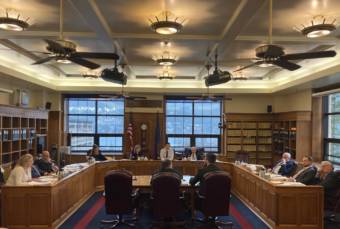
The Alaska House Finance Committee meets to discuss the state's improved revenue forecast on Wednesday in the Capitol. The committee's latest version of the budget includes an additional $1.2 billion to fund public education a year ahead of time. (Photo by Andrew Kitchenman/KTOO & Alaska Public Media)
The Alaska House Finance Committee meets to discuss the state’s improved revenue forecast on Wednesday in the Capitol. The committee’s latest version of the budget includes an additional $1.2 billion to fund public education a year ahead of time. (Photo by Andrew Kitchenman/KTOO & Alaska Public Media)

The Alaska House Finance Committee plans to spend some of extra state money from high oil prices on funding public education a year ahead of time. 

The committee updated its version of the budget on Wednesday, with $1.2 billion committed to public schools beyond what it already planned. If the plan becomes law, that would mean there’s enough money budgeted to cover the state share of school costs through June 2024.

Nome Democratic Rep. Neal Foster, a committee co-chair, said education is a priority for the House majority. 

“Stability is an issue when the school districts need to build their budgets,” he said. “We felt it’s important that with the amount of money that’s coming into the coffers, now is a good time to provide that stability to school districts.”

The amount is roughly one-third of the additional $3.6 billion the Department of Revenue forecast the state will receive in its spring revenue update on Tuesday. 
The committee would save much of the newly forecast revenue. 

Committee member Rep. Bryce Edgmon, I-Dillingham, said the Legislature should take a cautious approach in how it plans for oil revenue that may never materialize. 

“We come from a commercial fishing background, and I have yet to see a commercial fisherman spend money before his net goes in the water,” he said. 

Gov. Mike Dunleavy has proposed saving nearly all of the forecast surplus. 

He also wants the Legislature to pass the two permanent fund payments he’s proposed, totaling $3,700.

The forecast didn’t change the House Finance Committee’s approach to the dividend. The committee is proposing a one-time energy relief check that would be the same size as the dividend it’s proposing. The total would be roughly $2,500.

The committee’s current plan is to consider amendments to the budget on Monday.  Once the committee finishes its work on the budget bill, the entire House will vote on it, before it goes to the Senate. 

Dunleavy calls for big dividends as Alaska’s revenue forecast increases by billions

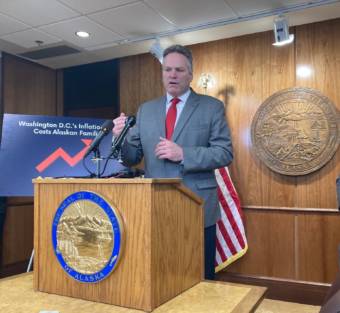
Gov. Mike Dunleavy talks about the state government's updated revenue forecast, which projects an additional $3.6 billion more than the December forecast on March 15, 2022, in the Alaska State Capitol in Juneau, Alaska. (Photo by Andrew Kitchenman/KTOO and Alaska Public Media)
Gov. Mike Dunleavy talks about the state government’s updated revenue forecast, which projects an additional $3.6 billion more than the December forecast on Tuesday, March 15, 2022, in the Capitol in Juneau. (Photo by Andrew Kitchenman/KTOO and Alaska Public Media)

Alaska’s state government now expects to raise $3.6 billion more this year and next than it expected to back in December, according to the annual spring revenue forecast released Tuesday. 

Gov. Mike Dunleavy urged the Legislature to send some of the money to Alaskans in the form of permanent fund dividends. He said the forecast is “great news for Alaska.”

“We’re just asking the Legislature to talk to their constituents about the pain they’re feeling right now, and the ability to help alleviate that pain through at least a $3,700 PFD,” he said.

That amount is based on a combination of half of this year’s draw from the permanent fund, equal to roughly $2,500 dividends, and an additional roughly $1,200 dividend to make up the difference between last year’s PFD and what Dunleavy had proposed. 

The spring update to the revenue forecast was driven up by the recent high price of oil.

The Department of Revenue projects oil will average $91.68 per barrel this year and $101 per barrel next year. Those numbers are substantially higher than the forecast in December of $75.72 per barrel this year and $71 per barrel next year.

The forecast for total state revenue over the next nine years increased by $8.6 billion.

The PFD amounts that Dunleavy is asking for are the same numbers he proposed in December. Dunleavy said the state should save the projected $3.4 billion surplus from the higher forecast. He said his proposal for now is to place the money in the Constitutional Budget Reserve. This account is down to roughly $1.5 billion.

“Last year and the year before, the discussion was, ‘Well, what are you going to cut? What are you going to take away?'” he said. “We don’t have to cut anything or take away anything this year.”

Revenue Commissioner Lucinda Mahoney issued a note of caution about the forecast. She wrote in a letter to Dunleavy that the forecast comes during a period of uncertainty. She also said that the forecast represents one plausible scenario within a range of potential outcomes. 

Ketchikan independent Rep. Dan Ortiz said the price of oil may not remain as high as forecast. He caucuses with the mostly Democratic House majority. 

“It certainly does make life easier in the Legislature, easier on the administration, in an environment where we have more revenue to deal with rather than less,” he said. “So, you know, it was a welcome forecast. However, I do think it was a little bit optimistic.”

Ortiz said that given the forecast, he would support increasing the amount of public education funding the state provides for each student. 

House majority caucus leaders said they would support $1.2 billion funding public education for the both the next year and the year after that in the budget. Last week, the House Finance Committee also proposed $394 million to restore funding to the Higher Education Investment Fund, which provides money for university scholarships and grants, as well as for medical education in the state.

Lawmakers issue subpoenas in a move to make Alaska Permanent Fund Corporation board members talk about Rodell firing

Members of the Legislative Budget and Audit Committee speak with their lawyer Christopher Slottee (center) on Tuesday, March 15, 2022, about the investigation into the firing of Alaska Permanent Fund Corporation executive director Angela Rodell. (Photo by Andrew Kitchenman/KTOO)

A legislative committee took the next step on Tuesday in the investigation of the firing of former Alaska Permanent Fund Corporation executive director Angela Rodell, and opened the door to forcing corporation board members to testify.

The Legislative Budget and Audit Committee voted 10-0 to issue subpoenas to all six of the corporation’s board members, four employees and a Department of Revenue worker.

The committee met after the state Department of Law rejected an earlier attempt by investigators to interview the trustees and employees.

In a letter to the committee, state attorneys questioned the fairness and impartiality of the investigation and called for someone who’s independent of the committee to examine the issue.

They also said that the investigation threatens the board’s independence. And they said it’s a problem that Committee Chair Sen. Natasha von Imhof, R-Anchorage, is friends with Rodell and had been given subpoena authority.

Christopher Slottee is a lawyer hired by the committee to investigate. He said he would again ask the trustees and staff members to testify voluntarily.

“If they respond and say that they will not do so, then we will proceed to subpoena those individuals who refuse to sit down for a voluntary interview and then we will move forward with our investigation, gathering the facts and coming to an impartial and objective evidence-based report,” he said.

Slottee said the committee’s authority to conduct an investigation is supported by state law.

Rodell was fired in December, six weeks after she raised fundamental questions about whether the board was committed to the corporation’s independence.

Trustees have not given a public explanation for why they fired Rodell. But board chair Craig Richards has said that the firing was appropriate. He pointed to negative reviews in her personnel file from some trustees that date back four years.

Site notifications
Update notification options
Subscribe to notifications