State Government Reporter, Alaska Public Media & KTOO
State government plays an outsized role in the life of Alaskans. As the state continues to go through the painful process of deciding what its priorities are, I bring Alaskans to the scene of a government in transition.
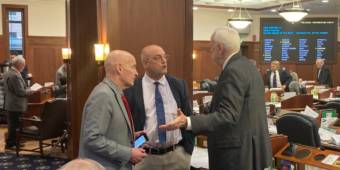
Reps. Dan Ortiz, I-Ketchikan; Andy Josephson, D-Anchorage; and Bart LeBon, R-Fairbanks, talk during a break on Monday in the Capitol. The House of Representatives was considering amendments to House Bill 234, which would reinstitute limits on campaign contributions in the state. Josephson had proposed an amendment that would have set a lower limit than the bill. (Photo by Andrew Kitchenman/KTOO and Alaska Public Media)
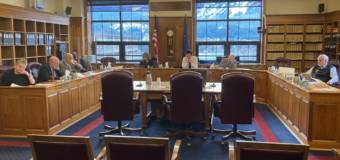
The Alaska House of Representatives is debating a bill that would bring limits to campaign contributions back to the state.
House Bill 234 would limit individual contributions to candidates to $2,000 over two years. There are no limits on individual donors currently.
Anchorage Democratic Rep. Andy Josephson supports reinstituting limits. On Monday, he proposed amending the bill to lower the individual limit to $1,500. Adjusting for inflation, that would be similar to a limit approved by 73% of Alaska voters in 2006.
“Now think about that,” Josephson said. “How many things do Alaskans agree on by 73%? Not that many.”
Homer Republican Rep. Sarah Vance opposed the amendment, as well as broader limits on contributions to candidates. She noted that courts have found that contributions are a form of speech.
“This amendment is further limiting that freedom of speech,” she said.
Vance also noted that contributions to independent expenditure groups aren’t limited. The U.S. Supreme Court invalidated limits to these groups in the Citizens United decision in 2010.
Josephson’s amendment failed by a vote of 16 to 22. Majority-caucus Reps. Matt Claman, D-Anchorage, and Kelly Merrick, R-Eagle River, as well as House Speaker Louise Stutes, R-Kodiak, voted against the amendment. Rep. Sara Rasmussen, an Anchorage Republican who isn’t a member of either caucus, also voted against it.
In July, a three-judge panel of the U.S. Court of Appeals for the 9th Circuit struck down Alaska’s previous individual limit of $500 per candidate each year. The court also invalidated a $500 limit to political groups and a $3,000 limit on the total amount candidates can raise from out-of-state donors. The court left a $5,000 limit on annual contributions to political parties in place.
Alaska Public Offices Commission staff members proposed using regulations to set new limits after the court ruling. But there weren’t enough commission members who agreed and the proposal died. Gov. Mike Dunleavy has said he opposes limits.
The House could vote on the bill later this week. If the bill is passed by the House, it would head to the Senate, where its prospects are unclear.
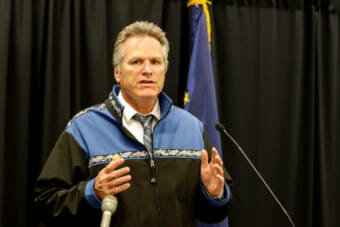
Gov. Mike Dunleavy at a news conference at the Atwood Building in Anchorage in August 2021. He joined other governors and legislators around the country who support a break in state fuel taxes. (Photo by Matthew Faubion/Alaska Public Media)
Gov. Mike Dunleavy has proposed suspending the state’s motor fuel taxes until June 2023.
Dunleavy joined a growing number of governors and legislators who’ve supported a break in their state’s fuel taxes.
In Alaska, the tax on gasoline is 8 cents per gallon.
Dunleavy said the suspension would help Alaskans affected by rising fuel prices and inflation.

Dunleavy offered the proposal as an amendment to a bill that’s been advancing in the Legislature. The current version of the bill would increase a surcharge on refined fuel by just over one half of 1 cent per gallon. The money would be used to fund the state Division of Spill Prevention and Response.
Bill sponsor Rep. Andy Josephson, D-Anchorage, said he would support the amendment to provide short-term relief. Josephson is an Anchorage Democrat.
Democratic candidate for governor Les Gara proposed suspending the tax earlier this week.
In 2014, the state sent a variety of information to AlaskaCare members, including retirees, on changes to their health care plan. In 2016, the Retired Public Employees of Alaska sued the state, saying the changes to the benefits violated the state constitution. (Photo by Casey Kelly/KTOO)
Retired public employees and the state government recently settled two lawsuits over changes in 2014 to the medical and dental plans for retirees. The settlement was announced on Wednesday.
The Alaska Constitution says that public employee retirement benefits “shall not be diminished or impaired.” But the state and retirees have differed on how to interpret this guarantee.
The Retired Public Employees of Alaska, or RPEA, represents more than 4,000 former state and municipal workers. It sued the state in 2016, alleging that changes to dental and other benefits violated the state constitution. It later filed a second, related lawsuit over medical benefits.
RPEA President Randall Burns said his group is pleased with the settlement. He said it addresses his members’ biggest concern, the lack of notice of changes.
“What gave rise to the lawsuits in the first place was the lack of really any notice when the retiree health plans were changed back in 2014,” he said. “And I mean, literally no notice and no chance to comment, no idea that this was coming. And this agreement gives us an absolute ability to participate and to be aware of about any future changes.”
Emily Ricci is the chief health administrator with the state Division of Retirement and Benefits. She worked on the settlement. She said it will help both those who pay for and receive benefits in the long term.
“The division believes that the work that we’ve done to date really reflects changes in process, improvements in communications that have benefited both the health trusts, the plans and the retirees,” she said.
State leaders said the agreement will usher in a new era of cooperation between the retirees and the state.
Under the terms of the settlement, retirees will have access to the older of two plans that offer dental, vision and hearing benefits as long as the plan remains financially viable.
The state agreed to draft new regulations for how public notice is given on plan changes.
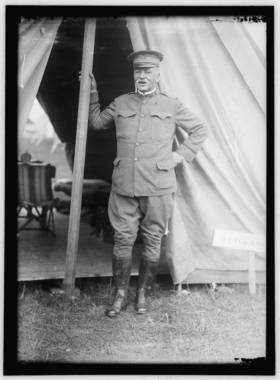
The Glenn Highway, which connects Anchorage to Glennallen, is named after Edwin Glenn, who oversaw U.S. Army expeditions in Alaska in 1898 and ’99. Glenn was convicted of committing war crimes in the Philippines the year after he left Alaska.
A bill working its way through the state Legislature would start the process of renaming the highway. But one House member is calling House Bill 352 a case of cancel culture.
Glenn was a career army officer. In the late 1800s he oversaw two expeditions in Alaska. Then he went to the Philippines, which at the time belonged to the United States — a trophy from the Spanish-American War. The Filipinos were fighting for their independence.
Anchorage historian David Reamer said that Glenn ordered soldiers to waterboard a Filipino man.
“When we say that he was a torturer, we say this because he admitted this,” Reamer said. “He admitted to doing these things. He admitted to ordering it. He admitted to overseeing it. He was there at times of torture. ”
Waterboarding simulates drowning and can cause lasting physical and psychological damage.
Soldiers who witnessed what happened talked about it after returning home, leading newspapers to report it. That led President Theodore Roosevelt and his secretary of war, Elihu Root, to order an investigation.
When Glenn was court-martialed, he admitted to what he did but denied it was torture. He was found guilty, paid a fine and was suspended from his command for one month.
Now Alaska lawmakers are considering a bill that would provide a process for renaming the Glenn Highway. It would require the state to consult with tribes, Alaska Native organizations and communities in the area to gather input on the new name.
Big Lake Republican Rep. Kevin McCabe opposed the bill at a March 1 House Transportation Committee meeting.
“This is cancel culture. I want that on the record,” McCabe said. “This is canceling somebody who when he did waterboard did not think it was torture. You make it sound like we’re pulling fingernails and that sort of thing. Waterboarding is accepted even today.”
That hasn’t been true, ever since former President Barack Obama prohibited government agencies from using waterboarding.
McCabe said Alaskans don’t know what Glenn did because they didn’t witness it.
“If I look at this bill, if you want to know the truth, this is a bill right here to besmirch the name of a guy that’s long dead,” he said. “Who cares? The guy is long gone. That’s all this bill does is besmirch his name.”
Joshua Albeza Branstetter is a member of AKAPIDA, the Alaskan Asian, Pacific Islander, Desi American association. He said changing the Glenn Highway’s name would recognize the role Filipino Americans have played in the state for 100 years.
“But for this highway to be named after someone who was, for lack of a better term, canceled by the U.S. military and by Teddy Roosevelt, who approved the findings in his case for his war crimes in a war that cost the lives of over 200,000 Filipinos,” he said. “That history has in turn been canceled from our school books.”
Lisa Wade is a member of the Chickaloon Native Village. The highway was informally named after the village, which it runs through, before being named for Glenn.
“This bill represents much more than a simple name change,” she said. “To me, it does not represent cancel culture. It represents an opportunity. It represents an opportunity to show respect and maybe even some reconciliation for past harms that were perpetrated against Alaska Native peoples during the time this highway was created, and even the harms to the other Filipino people as well.”
She said that area tribes generally don’t name things after people, but use the names of geographic features. She said that at the time the highway was built, her tribe suffered greatly.
“And history is not one-dimensional,” she said. “However, that history has long been told from one dimension and has resulted in the invisibility of the beautiful and unique Indigenous peoples at the glamorization of people like Edwin Glenn.”
State officials estimate renaming the highway would cost $2 million, to change the road signs and other things. But since the bill itself wouldn’t rename the road but just set up a process to do it, it wouldn’t cost the state anything if the Legislature passed it. That means the bill doesn’t have any cost listed on what’s known as a fiscal note.
For Anchorage Republican Rep. Tom McKay, that part doesn’t make sense.
“It said there’s a zero fiscal note, but we did rename it, there would be a fiscal note, because we’d have to pay for all the road signs to be changed, the maps would have to be changed.”
Anchorage Democratic Rep. Zack Fields introduced the bill.
“These tribal members have been in this corridor certainly a lot longer than I have and maybe we should seek their guidance about whether the Chickaloon Highway or the Katie John Highway or some other name might be the most appropriate,” Fields said.
The transportation committee hasn’t scheduled a vote on the bill yet.
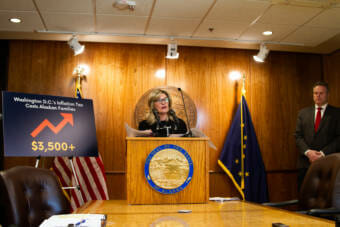
Commissioner of the Department of Revenue Lucinda Mahoney talks about the declining value of the state government’s Russian assets as Gov. Mike Dunleavy listens on Tuesday in the Capitol. (Photo by Olivia Ebertz/KYUK)
The value of investments in Russia held by the State of Alaska, including the permanent fund, has declined steeply since Russia invaded Ukraine, the state’s top revenue official said Tuesday.
Revenue Commissioner Lucinda Mahoney said the value of state-held Russian stocks, bonds and other investments has declined from $267 million at the end of last year to a current estimate of no more than $15 million.
The Russian stock market has been closed since the invasion. But Mahoney said the state plans to sell its Russian assets when it can.
“We believe that the financial conditions in Russia have and will continue to deteriorate, such that it makes it prudent to sell these securities and bonds,” she said at a news conference.
Gov. Mike Dunleavy and Mahoney said the permanent fund corporation will have to make its own decisions about selling its Russian assets. The Russian investments were less than three-tenths of 1% of the state’s assets before their value fell.
Dunleavy repeated his call last week for a series of steps aimed at punishing Russia. He also continued to criticize the Biden Administration for its handling of several proposed oil, gas and mining projects.
“Really, it’s nothing short of an attempt to snuff out the life of Alaska as a state,” he said. “And when we need these resources more now than ever, they’re doubling down on this stuff. It makes no sense at all.”
Both the governor and the revenue commissioner expressed frustration with banks that will not support drilling for oil and gas in the Arctic but continue to invest in Russia.
Dunleavy also called on the Legislature to quickly pass permanent fund dividend payments to help Alaskans deal with inflation. He said he expects the state will announce next week that its projected revenues are now billions of dollars more than projected spending.
Alaska House Finance Committee members review documents during public testimony on the committee’s draft budget on March 4, 2022, in the Alaska State Capitol in Juneau, Alaska. Pictured are Reps. DeLena Johnson, R-Palmer; Adam Wool, D-Fairbanks; Andy Josephson, D-Anchorage; Kelly Merrick, R-Eagle River; Neal Foster, D-Nome; Dan Ortiz, I-Ketchikan; and Bart LeBon, R-Fairbanks. (Photo by Andrew Kitchenman/KTOO)
A key Alaska legislative committee has drafted a state budget that would increase state spending more than Gov. Mike Dunleavy planned. It also would pay a combined permanent fund dividend and energy relief check of roughly $2,500.
The budget proposal unveiled on Friday by the House Finance Committee would spend $4.1 billion in state funding to run state government. That’s $148 million more than Dunleavy proposed.
The committee draft also includes would increase Dunleavy’s proposal by:
$50 million for public schools;
$5 million for senior and disability services;
$4.6 million for the University of Alaska;
$4 million for regional and community jails and;
$1.5 million for public radio.
The committee took public testimony immediately after presenting budget details.
Anchorage resident Trevor Storrs is the president and CEO of the Alaska Children’s Trust, a nonprofit dedicated to preventing abuse and neglect. He testified in favor of the budget.
“We must invest in our kids and the families and the agencies that care for them,” he said.
Dunleavy had proposed a dividend that would equal half of the amount the state plans to draw in permanent fund earnings. The committee proposed a similar amount but split it between the PFD and a one-time energy relief check. The future of the PFD formula remains unresolved.
The budget doesn’t include the additional $1,215 payment Dunleavy has proposed to make up the difference between what Alaskans received in last year’s PFD and what he had wanted. That proposal is in a separate bill.
Palmer resident Jean Holt said the Legislature should pay a higher dividend.
“This energy relief check is a bribe to buy our vote,” she said.
The committee plans to wait until the administration updates its revenue forecast before moving the budget along. That’s expected on March 15. If recent oil price forecasts hold up, the state will have more than $1 billion in additional revenue to budget.
After the committee and the entire House vote on amendments and the overall bill, the budget would then go to the Senate.
Saturday is the last hearing the committee will hold to take public testimony on the operating budget. It is scheduled for 11 a.m. to 2 p.m.
Juneau residents can call 907-586-9085. Anchorage residents can call 907-563-9085. Residents elsewhere can call toll-free, 844-586-9085. Alaskans also can submit testimony by email through next week.
Close
Update notification options
Subscribe to notifications
Subscribe
Get notifications about news related to the topics you care about. You can unsubscribe anytime.