Andrew Kitchenman

State Government Reporter, Alaska Public Media & KTOO

State government plays an outsized role in the life of Alaskans. As the state continues to go through the painful process of deciding what its priorities are, I bring Alaskans to the scene of a government in transition.
Mask and COVID-19 test requirements are dropped for Alaska State Capitol

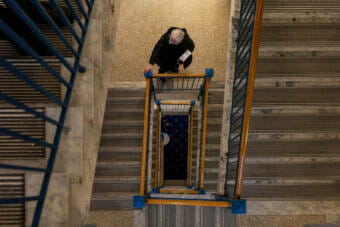
A masked woman waits in the stairwell of the Capitol in January 2021. On Wednesday, the Legislative Council voted to make masks and COVID-19 optional for lawmakers and others who work in the building. (Photo by Rashah McChesney/KTOO)

Legislators and others who work in the Alaska State Capitol are no longer required to wear masks and be tested for COVID-19. The Alaska Legislative Council voted to eliminate the mandates on Wednesday. 

The council required masks throughout the regular session last year but made masks optional during the four special sessions. It reinstated the mandate at the start of the session this year.

The Capitol was closed to the public from March 13, 2020 until June 16, 2021. But it has remained open since then. 

Cases in Juneau and throughout Alaska have fallen steeply since the session started. 

The rules will continue to require those who test positive for the virus to isolate. Individual legislators may continue to require masks in their offices. 

Alaska Senate considers different proposals to change PFD formula

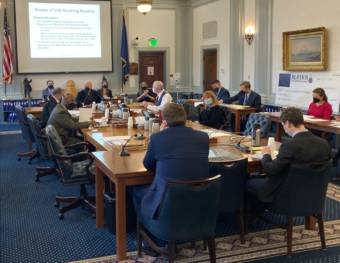
The Alaska Senate Finance Committee discusses bills that would change the formula for setting permanent fund dividends on Feb. 21, 2022, in the Alaska State Capitol. (Photo by Andrew Kitchenman/KTOO and Alaska Public Media)
The Alaska Senate Finance Committee discusses bills that would change the formula for setting permanent fund dividends on on Monday, Feb. 21, 2022, in the Capitol. (Photo by Andrew Kitchenman/KTOO and Alaska Public Media)

The state Senate could be voting as soon as next week on legislation aimed at rewriting the formula that sets the amounts of permanent fund dividends. 

A key legislative committee considered two bills on Monday that would set PFDs at a lower level than the roughly $2,500 Gov. Mike Dunleavy proposed, unless there are new taxes. His proposal is based on setting dividends at half of the annual amount the Legislature draws from the permanent fund. 

But at least some members of the Senate Finance Committee are concerned that it wouldn’t be sustainable. 

Sitka Republican Sen. Bert Stedman said it doesn’t add up. 

“There’s only so much money,” he said. “And we don’t have a printing press like they do in Washington, D.C.”

Instead, the committee considered Senate Bill 200, which would set the dividend at one quarter of the annual draw, or roughly $1,250. It’s similar to a bill the Senate passed in 2017. The House had passed a different version of the bill, which would set dividends at one third of the draw, and the two chambers couldn’t agree on a compromise.

Another measure, Senate Bill 199, would set dividends at the level proposed by Dunleavy, beginning in the fall of 2024. But under the bill, that would only happen if there were new laws that raised taxes and fees by $700 million. It’s similar to a bill the Senate briefly considered in September.

The rising price of oil has increased state revenue forecasts since Dunleavy made his latest PFD proposal last spring. But the governor’s proposal would lead the state to spend more than it brings in, if it doesn’t make other policy changes, according to a nonpartisan analysis. And that gap would grow if inflation drives up state spending or if the capital budget increases to pay for maintenance that’s been put off. 

Anchorage Republican Sen. Natasha von Imhof said the Legislature shouldn’t count on high oil prices. She recently announced that she isn’t running for re-election. 

“Just like you don’t build a church for attendance on Christmas and Easter, you don’t pass a dividend bill based on $90 [per barrel] in oil,” she said. “We need to find something that’s sustainable and affordable over time.”

Some Alaskans who called in to testify against the bill say they support larger dividends. 

“We’ve been calling and calling and calling for the past how many years now? Do you guys listen? Or do you guys have cotton swabs in your ears?” asked Magnus Sampson who called in from Dillingham.

The Senate Finance Committee is aiming to pass one or both bills this week, setting up debate by the entire Senate next week. 

Gov. Dunleavy defends state paying for settlement arising from his actions

Gov. Mike Dunleavy discusses the state of the coronavirus pandemic during a news conference at the Atwood Building in Anchorage on Thursday, Aug. 26, 2021. (Matthew Faubion / Alaska Public Media)
Gov. Mike Dunleavy discusses the state of the coronavirus pandemic during a news conference in August 2021. On Thursday, Dunleavy said it’s proper for the state government to pay to settle a lawsuit after a judge found state workers were entitled to damages for actions he took in his personal capacity. (Photo by Matthew Faubion / Alaska Public Media)

Gov. Mike Dunleavy said it’s proper for the state government to pay to settle a lawsuit after a judge found state workers were entitled to damages for actions he took in his personal capacity. 

Federal District Court Judge John Sedwick ruled in October that Dunleavy and his former chief of staff Tuckerman Babcock violated the First Amendment rights of two Alaska Psychiatric Institute doctors by requiring them to sign what they deemed a loyalty pledge. 

The Legislature must now decide whether to fund settlement payments of $495,000 in the state budget. 
Former Attorney General Jahna Lindemuth recently wrote an opinion article in the Anchorage Daily News saying that the settlement is both illegal and unethical. She said it violated a provision of the state constitution that says state money can only be spent for a public purpose and the Alaska Executive Branch Ethics Act.

Dunleavy responded on Thursday, saying the settlement is both legal and constitutional.

“We believe that if ordinary citizens that happen to want to run for office are then subject to certain court actions in their capacity of what they are – whether it’s governor, legislator, school board official – we think it makes it very difficult for folks to be able to execute their job the right way,” he said.

Lindemuth wrote that the Legislature should not fund both the settlement and the legal fees for defending Dunleavy and Babcock in their personal capacities. She wrote that if the Legislature does fund them, the issue could be taken to court. 

As oil prices and inflation rise, Dunleavy pushes for higher PFDs and bonds

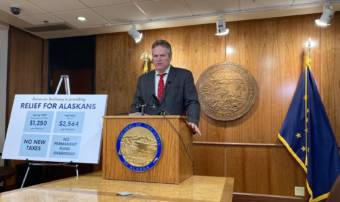
Alaska Gov. Mike Dunleavy urges the Legislature to pass his PFD and construction bond package bills during a news conference on Feb. 17, 2022 in the Alaska State Capitol. (Photo by Andrew Kitchenman/KTOO and Alaska Public Media)
Gov. Mike Dunleavy urges the Legislature to pass his PFD and construction bond package bills during a news conference on Thursday in the Capitol. (Photo by Andrew Kitchenman/KTOO and Alaska Public Media)

Gov. Mike Dunleavy said higher state revenue and inflation mean that the Legislature should pass his proposals to pay higher permanent fund dividends and to borrow money to pay for capital projects.

“We can certainly afford a PFD that the people of Alaska expect,” he said on Thursday. “And given the inflationary rates, inflationary picture that we’re going through right now, I think, you know, we’re going to really ask the Legislature to give that due consideration as soon as possible.”

The state increased its forecast for oil and investment revenue. If the forecast holds up, the state would have a roughly $1.6 billion surplus over the next year and a half. 

Dunleavy wants the state to issue $325 million in bonds to pay for construction on ports, airports, fire halls and other projects.
Dunleavy has proposed a PFD of roughly $2,500, based on using half of the state’s annual draw from the permanent fund. He also proposed an additional $1,200 dividend payment, which is the difference between the 2021 PFD that was paid out and an amount Dunleavy proposed. He said the PFD could help Alaskans deal with inflation. 

He also said it would be good to borrow now, since interest rates are low and could go up. 

Some legislative leaders have questioned whether higher dividends are sustainable. And they have raised concerns that the state shouldn’t borrow for projects that it could pay for as part of the annual budget. 


Judge rules against students who sued the State of Alaska over scholarship fund

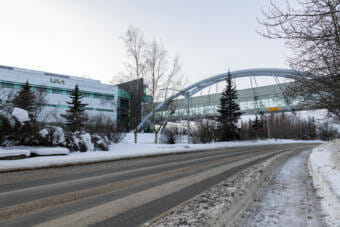
The University of Alaska Anchorage campus on Dec. 30, 2021. (Lyndsey Brollini/KTOO)

An Anchorage Superior Court judge ruled on Thursday against four university students who had sued the State of Alaska to try to maintain more than $400 million in a fund for scholarships and grants.

Judge Adolph Zeman’s ruling means that the money in the Higher Education Investment Fund will no longer be set aside in a lasting way to pay for three programs: the Alaska Performance Scholarships, which are based on students’ high school grades and test scores; Alaska Education grants, which are based on students’ financial need; and the state’s medical education program.

Gov. Mike Dunleavy has proposed funding the programs along with the rest of the budget. That can continue to happen in the future, but students won’t have the assurance that there’s a large fund set aside for them.

The money that was once in the higher education fund is now in a state savings account known as the Constitutional Budget Reserve, raising its total from roughly $1 billion to $1.4 billion.

The money was swept into savings after three-quarters of both legislative chambers failed last year to agree to keep it in the separate higher education fund. Opponents of maintaining the funding offered different arguments. Some focused on their belief that these programs should have to compete with the rest of the state budget for annual funding. Others would not vote to reverse the sweep unless the Alaska Legislature agreed to increase permanent fund dividend amounts.

Gov. Mike Dunleavy’s administration determined that the money was subject to the reverse sweep vote. Previous administrations had not taken that position.

A separate lawsuit successfully protected money in a different state account, the Power Cost Equalization Endowment Fund, or PCE. That fund pays to make the energy in high-cost areas more equal with that in the rest of the state.

The laws establishing the higher education and PCE funds used different language. The higher education fund law said that the fund is in the state’s general fund, which is used to pay the state’s budget and is subject to the annual vote. But the PCE endowment law said the PCE fund is separate from the general fund.

In the scholarship lawsuit, the legal arguments focused on whether the Higher Education Investment Fund, or HEIF, was available for the Legislature to appropriate. Judge Zeman found that it was. Under a provision of the state constitution, that means the money must be swept into the Constitutional Budget Reserve unless three-quarters of both chambers vote to reverse the sweep.

“If the legislature believes these programs should be funded, it possesses the power to establish the HEIF as a separate fund outside the general fund or to appropriate money from other sources — for example, a reverse sweep of the CBR — to fund the programs in the future,” Zeman wrote. “However, this is not within the Court’s power. The power of appropriation belongs solely to the Legislative Branch.”

The students now must decide whether to appeal Zeman’s decision.

Judge rules that 2 redrawn districts violate the Alaska Constitution

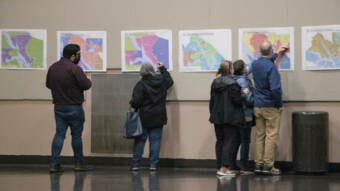
People in a large room looking at different maps on a wall
Juneau residents study proposals for new House district boundaries in the Juneau area at an open house event at Centennial Hall in Juneau on Sept. 27, 2021. (Photo by Lyndsey Brollini/KTOO)

A judge has found that the Alaska Redistricting Board violated the state constitution in how it drew the Senate districts for Eagle River and East Anchorage and for the Southeast Alaska House district that includes Skagway.

Anchorage Superior Court Judge Thomas Matthews ruled that the board must revisit how it arrived at the maps. It will either have to provide a better legal justification for the maps or redraw them.

The case is being appealed, so the state Supreme Court will have to weigh in on it before the maps are resolved.

The judge did not find that the board erred in two other issues: placing Valdez with part of the Matanuska-Susitna Borough in a House district, and placing Hooper Bay and Bethel in separate House districts.

In his decision, Matthews found that the board violated the state Open Meetings Act by apparently holding discussions in private that should have been in public and failing to adequately explain why it was meeting in private.

Matthews also found that board violated the rights of East Anchorage residents to be treated equally as those of Eagle River by drawing a district that includes both the Eagle River Valley and the South Muldoon neighborhood.

“Here, the discrimination was the result of procedures that are suggestive of underlying political motives and evidence a concerted effort to push a pairing through that split the Eagle River house districts into two senate districts amidst staunch pushback from a minority of Board members and the vast majority of public comment,” Matthews wrote in the 171-page ruling.

He found that the board failed to hold meaningful public hearings on the proposed Senate districts before adopting them, and by failing to propose Senate districts when it adopted draft House maps in September.

He wrote that a quick vote to adopt Senate districts immediately after a meeting closed to the public raised concerns.

While he stopped short of finding that the board reached a consensus in private, Matthews wrote that he saw “ample evidence of secretive process at play. Further, where the Court is left with such an impression, it is undeniable that these actions have eroded the public trust in the fairness and openness of the redistricting process.”

He also found that the board failed to take a “hard look” or to make a good-faith effort to accommodate public testimony, as required by law in how it drew the districts affecting both East Anchorage and Skagway.

Matthews wrote critically of the closing argument by board lawyer Matthew Singer in the Skagway case.

“To each of Skagway’s points, the Board replied: ‘So what?’ This is not the response the people should expect to receive from the public entity in charge of redistricting and constitutionally required to hold public hearings,” Matthews wrote.

Despite Matthews’ finding open meetings violations, he did not invalidate any board actions due to the violations. However, he noted that the Michigan Supreme Court required the redistricting commission there to disclose documents from its attorney that were discussed in a closed session. And he urged the Supreme Court to weigh in on the issue.

One of the board comments that drew Matthews’ attention was made by board member Bethany Marcum. She said during one meeting that she believed it was inappropriate for a board member to criticize another member’s proposed map during a public session and that such deliberative discussions were only appropriate during private sessions.

“To the extent that Board Members felt uncomfortable undertaking deliberative discussions in accordance with the law, that should have been considered before accepting a position on the Board,” he wrote. “The Open Meetings Act is clear that ‘all meetings’ are open to the public and all deliberations likewise be conducted openly.”

Skagway is seeking to be in the same district as downtown Juneau rather than with Juneau’s Mendenhall Valley area, as it is in the board’s map. So if the board decides to make that change, it would only affect the two House districts that include Juneau, Skagway, Haines and Gustavus.

If the board decides to make changes in the East Anchorage maps, it could affect the Senate pairings for at least four House districts, and potentially eight or more House districts.

According to a schedule ordered by Matthews, the Supreme Court could hear and issue an opinion on any appeal by April 1. That would leave two months for the board to adopt new maps and for any further appeals before the June 1 deadline for candidates to file to run for office.

The board voted on Wednesday to appeal the ruling on the East Anchorage and Skagway districts, and to defend itself in any appeals on the Mat-Su/Valdez and Hooper Bay/Bethel districts. Any appeal must be filed by Thursday.

This story was updated after the board voted to appeal the ruling. 

Site notifications
Update notification options
Subscribe to notifications