State Government Reporter, Alaska Public Media & KTOO
State government plays an outsized role in the life of Alaskans. As the state continues to go through the painful process of deciding what its priorities are, I bring Alaskans to the scene of a government in transition.
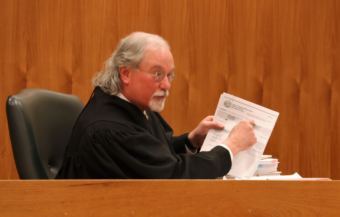
Alaska Supreme Court Justice Craig Stowers asks a question about language on an election ballot during oral argument in an election recount case in Anchorage on Jan. 4, 2019. Stowers died on Thursday. (Photo by Wesley Early/Alaska Public Media)
Stowers retired in 2020 after 11 years on the court. He was chief justice for three years, from 2015 to 2018. He was a Superior Court judge for five years before becoming a justice.
He was a park ranger in Denali National Park before studying law.
Current Chief Justice Daniel Winfree was on the Supreme Court the entire time that Stowers was a justice.
“Craig was a wonderful colleague: incredibly smart, of course, very hard working, always prepared and — with a lot of his life experiences — had lots of fun stories to tell and had a great sense of humor,” Winfree said.
Winfree also praised Stowers’ approach to his work.
“He was always very knowledgeable about the underlying facts of a case, very diligent in making sure that he understood the law, and was very accomplished in our discussions around the table, arguing our various points of view about this and that — and trying to come to a consensus,” he said. “He was just a very strong justice.”
Winfree said Stowers considered those who worked in the court system to be a family.
“He would make sure that he got around to say hello to people in the various courthouses,” Winfree said.
He said this was particularly true for the troopers who work at the courthouses.
Winfree recalled a favorite topic of conversation with Stowers was the trips he would take with his wife, Monique.
“They would talk about where they were going to go and take a vacation for a week – some cabin somewhere and maybe down on the water to do some fishing,” Winfree said.
Matt Peterson founded a law firm with Stowers in the mid-1990s. He said Stowers applied his strengths as a lawyer to being a judge.
“He really was an asset to Alaska, not just the legal community, but the entire state,” Peterson said.
One of Stowers’ more prominent opinions in recent years was when he dissented in part from the rest of the court in its decision to allow the attempt to recall Gov. Mike Dunleavy to move forward.
He agreed with the other justices’ analysis of two of the four grounds for recall. But he wrote that by allowing the two other grounds for recall to move forward, the court made it possible for recall attempts over policy differences. He wrote the decision undermined the state constitution and the separation of powers between the branches of government.
This is a detail of House District 29 in the state legislative map adopted by the Alaska Redistricting Board. It was the subject of much of the closing arguments on the last day of a trial on five redistricting cases. [Detail of screen capture from Alaska Redistricting Board site]An Anchorage Superior Court judge must decide by Tuesday whether Alaska’s new legislative district map is legal.
Lawyers for five different groups of plaintiffs who sued to block the map made their closing arguments on Friday. And they were countered by the attorneys for the board and map supporters.
Much of the day was taken up by whether the board treated residents of Valdez and the Matanuska-Susitna Borough fairly when it put them in the same district. Rather than including communities between the two in the same district, the map links them through the Chugach Mountains.

Robin Brena represented the city of Valdez. He said the board made Valdez wait to be placed into a district until after the rest of the state had been taken care of. He told Superior Court Judge Thomas Matthews that the board treated the map was like a pot of porridge.
“They fed it to all their favorite children,” he said. “They got to the two left remaining at the table: Valdez and the Mat-Su Borough. And there wasn’t anything left in the pot. Any parent would go back and rebalance the meal so that everybody got a little less, but that everybody got something.”
Stacey Stone is the Mat-Su’s lawyer. She said that at one point in the redistricting hearings, the board members said they would consider pairing Valdez with other Prince William Sound communities. But that discussion didn’t happen, at least publicly.
“The board then adjourns to executive session and something happened outside the eyes of the public, that impacted the public,” she said.
Nathaniel Amdur-Clark defended the map. He’s a lawyer for Interior organizations, including regional Native corporation Doyon and the Tanana Chiefs Conference. The organizations supported a proposed district that neighbors Valdez and stretches to include most of the Yukon River. Its district number is 36.
Amdur-Clark opposed an argument by Brena that the large, horseshoe-shaped district fails to meet a provision of the state constitution. It requires districts to be compact. He said Alaska courts have defined “compactness” differently than those in smaller states.
“Saying District 36 is not compact because it’s a big horseshoe is like saying the Aleutians district is not compact because it’s long and skinny and it reaches out towards Russia,” he said. “It doesn’t make any sense. The board is required to take into account the social and cultural geography of the state. It’s not allowed to ignore it.”
Matt Singer served as the board’s legal counsel and advocated for it on Friday. Singer said the board considered Valdez and the Mat-Su throughout the process. He said Brena was wrong to compare them to children who wait for porridge.
“But when I hear these arguments, I’m reminded of a child who’s playing well with others, and then in the end decides to kick down the sand castle because they don’t get exactly what they want,” Singer said.
Singer said the board considered every possible option for Valdez, but each presented greater problems than including it in a district with portions of the Mat-Su, including Sutton and the outskirts of Palmer.
Singer also defended the board’s process in handling the pairing of House districts into Senate seats. East Anchorage residents sued to block a much of Eagle River sharing a Senate district with the South Muldoon neighborhood. Singer said they share the same city services and shop at the same businesses.
“And it’s for those reasons, your honor, that the state Supreme Court every single time has rejected the notion that certain neighborhoods have to go together,” he said.
Holly Wells represented the East Anchorage residents. She said the lack of public input on the Senate pairings after the board adopted the map was an abuse of the process. Residents had opposed linking Muldoon with Eagle River to the board before it made the pairings.
“They can fix that in 24 hours,” she said. “It takes the board a little bit of public notice, convening a meeting and having a hard look at the Senate pairings in this area, where the board gives the voices of East Anchorage at least a little attention.”
Judge Matthews also heard the closing arguments in cases that argued for including Hooper Bay in the same district as Bethel and Skagway in the same district as downtown Juneau.
Matthews is aiming to issue his rulings on the cases by Tuesday, to allow time for the state Supreme Court to hear and issue a decision on any appeal by April 1. If the court orders new maps, the board would face a tight timeframe to finish them by the June 1 deadline for candidates to file.
Alaska State Sen. Elvi Gray-Jackson answers questions from reporters after filing to run for a U.S. Senate seat on Thursday, Feb. 10, 2022, in Juneau, Alaska. Gray-Jackson is entering as a Democratic challenger to incumbent U.S. Sen. Lisa Murkowski, who is running for her fourth full term. (Photo by Rashah McChesney/KTOO)
Anchorage Democratic state Sen. Elvi Gray-Jackson launched a campaign for U.S. Senate on Thursday, saying she would work to support access to abortion rights, voting and health care.
She is the first Democrat to join a race that includes incumbent Sen. Lisa Murkowski and Kelly Tshibaka, who are both Republicans.
“Alaskans deserve better. You know, now they have a choice. They have a choice to vote for me, somebody who understands, truly understands what Alaskans need,” she said shortly after filing for her candidacy at the Division of Elections office in Juneau.
Gray-Jackson would be the first Black U.S. senator for Alaska.
“I was the first minority to be appointed as chair when I served on the Anchorage Assembly,” she said. “I’m moving forward and looking forward to, No. 1, working hard and reaching out to Alaskans so that I can get elected to the United States Senate. And when I’m elected to the United States Senate, I’ll make history once again.”
Gray-Jackson criticized Murkowski’s votes on Supreme Court nominees and against allowing a vote on voting rights legislation.
“I’m 100% pro-choice and, you know, Sen. Murkowski is pro-choice, too. But she votes for Supreme Court justices that aren’t pro-choice,” she said. “I believe in democracy and fairness for our voters, especially our most vulnerable and marginalized voters, and she voted no on a voting rights act bill.”
Gray-Jackson also said she would focus on health care, adding that her son is among many Alaskans who don’t have access to health care due to its high cost.
She also said public safety is important to her and that she frequently sees concerns about crime on Nextdoor, a social media app connecting neighbors.
And she talked about the importance of raising wages.
“We need living wages for our hardworking men and women in Alaska,” she said. “You go to the grocery store now, a family of four used to be able to get groceries for a week for $50. Now, it’s not right what families are being charged for groceries.”
Gray-Jackson has represented Midtown Anchorage and nearby neighborhoods in the Alaska Senate since 2017. In the Legislature, she sponsored laws that made February Black History Month in Alaska and that expanded the range of health care providers who can certify that people have disabilities, allowing them to receive special license plates.
She also sponsored bills that would address the use of force by police, make Juneteenth a state holiday and aim to protect people from discrimination based on their sexual orientation and gender identity or expression.
Alaska State Sen. Elvi Gray-Jackson walks out of the Division of Elections after filing to run for a U.S. Senate seat on Thursday. (Photo by Rashah McChesney/KTOO)
Gray-Jackson, 68, grew up in Newark, New Jersey and moved to Alaska in 1982. She served in the Anchorage Assembly for nine years and has worked for Anchorage’s government and Municipal Light and Power.
Democratic candidates have struggled against Murkowski in the past, including in elections when she was challenged by more conservative candidates. In 2010, Democrat Scott McAdams lost to Murkowski even though she wasn’t on the ballot and had to run a write-in campaign. Murkowski attracted votes from Democrats who worried that voting for their party would put Tea Party-endorsed candidate Joe Miller in the Senate. Miller had defeated Murkowski in the Republican primary.
Alaska will have a new voting system this year, and Gray-Jackson said that will make a difference.
“Alaskans will now be able to vote their values,” she said.
In the general election, voters can rank up to four candidates in order of their preference. For example, progressives might rank Gray-Jackson first and Murkowski second.
Gray-Jackson wept when she reflected on the meaning of her campaign.
“Public service is my passion and I’ve been doing it for more than 30 years,” she said.
Gray-Jackson said she would continue to serve in the state Senate through the end of her term, even if there are special sessions in the summer.
In addition to Gray-Jackson, Murkowski and Tshibaka, 10 other candidates have filed with the state Division of Elections to run for the seat.
Unlike candidates for the Legislature, Gray-Jackson can continue to raise funds for her campaign during the session, which is scheduled to end by May 18. She said she’s been working with the national Democratic Senatorial Campaign Committee and the state Democratic Party.
Correction: This story has been corrected to reflect the correct location of Gray-Jackson’s district. She represents Midtown Anchorage, not downtown.
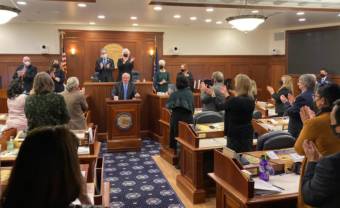
Alaska Supreme Court Chief Justice Daniel Winfree receives applause from legislators as he gives the annual State of the Judiciary address on Wednesday in the Capitol. (Photo by Andrew Kitchenman/KTOO and Alaska Public Media)
Alaska Supreme Court Chief Justice Daniel Winfree talked to the Legislature on Wednesday about the importance of protecting democracy and of maintaining the courts as an independent branch of government, in the annual State of the Judiciary address.
It was the 50th anniversary of the first time a chief justice addressed a joint session of the Alaska Legislature. Chief Justice Winfree spoke about calls for racial, economic and environmental justice then and today.
“I was one of the young ones 50 years ago criticizing the establishment and fearing for democracy’s future,” he said. “Now I’m part of the establishment. But the current pain is just as visceral now as it was then. And I find myself wondering why we haven’t made more progress in the last 50 years.”
Winfree defended the independence of the judiciary from the two other branches of government. He said legislators take their responsibility of talking with constituents seriously.
“We take just as seriously our duty to decide cases uninfluenced by our personal views,by the political left, center or right, or by prevailing public opinion,” he said. “That’s what the rule of law is all about.”
He said judges are guided by the law, as well as the facts of each case.
“Our system of government will fail if judges rule in a litigant’s favor only because of who the litigant is, or what that litigant stands for or states [as] beliefs, or if judges try to make decisions following the swirl of then-prevailing public opinion,” he said.
Winfree also described the impact of COVID-19 on the courts. He said no courthouse closed, and much court business continued throughout the pandemic.
Winfree acknowledged the long break in criminal jury trials, which restarted in January. He said it was challenging to safely accommodate the large number of people required in courtrooms for these trials.
The chief justice described some of the budget requests the court system is making. They include $1 million for computer upgrades to safeguard court information. The courts were the victim of a cyberattack last year, but Winfree said they have recovered from it, and that no personal information was taken.
Another $1 million would mean public access to courthouse counters to get information could be restored on Friday afternoons. Budget cuts in 2015 closed them.
Winfree also talked about how the court system is exploring the possibility of a new justice center in Bethel and a replacement building in Unalakleet.
“It remains our strong, strong intent to provide timely and effective judicial services in rural Alaska to the fullest extent possible,” he said. “And we will continue to look for ways to do that.”
Winfree did not address the debate over holding a constitutional convention, which Alaskans will vote on in November.
But he did talk about the current constitution. He read from a resolution by the delegates to the first constitutional convention in 1955, addressed to Alaska’s children.
“Take our constitution and study it. Work with it in your classroom. Understand its meaning and the facts within it. Help others to love and appreciate it,” he read.
Winfree became chief justice last year, and normally chief justices serve three years. But under the constitution, Winfree is required to step down next year when he reaches the mandatory retirement age of 70.
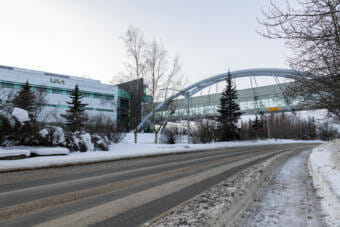
The University of Alaska Anchorage campus on Dec. 30, 2021. On Tuesday, Anchorage Superior Court Judge Adolf Zeman heard oral arguments in a lawsuit by four Alaska university students suing the state to try to keep more than $400 million in the Alaska Higher Education Investment Fund. (Photo by Lyndsey Brollini/KTOO)
An Anchorage judge will decide in the next two weeks whether more than $400 million will remain in a state fund that pays for scholarships and need-based grants for Alaskans to attend college.
Lawyers for four Alaska university students and the state government presented their arguments to Superior Court Judge Adolf Zeman on Tuesday to determine the future of the Alaska Higher Education Investment Fund. The fund was started in 2012 with $400 million.
But three years ago, Gov. Mike Dunleavy’s administration started sweeping the money into the Constitutional Budget Reserve, a state savings account, unless three-quarters of both the Senate and House of Representatives agreed to keep it in the higher education fund. That failed to happen last year.
So, in January, four students sued to maintain the fund.
Jahna Lindemuth, the students’ lawyer, argued that the state misapplied a provision of the constitution that determines what money will be swept into the Constitutional Budget Reserve each year. She served as the attorney general in the administration of former Gov. Bill Walker, an independent who is challenging Dunleavy, a Republican, in this year’s election.
Lindemuth said Dunleavy had proposed language in a bill that would have eliminated the fund, which the Legislature failed to pass. She said that it wasn’t until after that happened that the administration reached its conclusion that the higher education fund money was subject to being swept without legislation.
“The governor simply has different legislative priorities than the Legislature,” she said, adding that it was a “money grab that fundamentally violates the Legislature’s rights” under the constitution.
Assistant Attorney General Margaret Paton-Walsh represents the state in the case. She noted that the state constitution requires that unspent money in the general fund that’s available to be spent in the annual budget — also known as being “appropriated” — be swept in into the Constitutional Budget Reserve. She said that applies to the money in the Alaska Higher Education Investment Fund, which the law defines as being in the general fund.
“The Legislature is quite free to appropriate that money for any purpose that it wants,” she said. “There is no dispute about that fact.”
The judge noted that students rely on scholarships for several years, and asked Paton-Walsh if that makes the higher education fund similar to the state setting aside money for a construction project that lasts several years.
“How’s that different than a four-year education?” he asked.
She replied that with the higher education fund, the Legislature has to take two separate actions: putting money into the fund and then spending it on programs like scholarships.
But with a multi-year construction project, it only appropriates it once. And the Legislature doesn’t appropriate it again for the same construction project in multiple years.
“That money is not available for appropriation because the executive branch can spend it without any further action by the Legislature, ” she said of a multi-year construction project.
The state now considers the $422.8 million that was in the higher education fund to be part of the Constitutional Budget Reserve, which has another roughly $1 billion.
Dunleavy has proposed funding the Alaska Performance Scholarships, need-based Alaska Education Grants and the state’s medical education program in the budget for the coming fiscal year.
The money for those programs wouldn’t come from the higher education fund, but instead from the general fund, which pays for the rest of the state budget. Without the money in the Alaska Higher Education Investment, the students expressed concern that there wouldn’t be funding for the programs in future budgets.
Judge Zeman said he would issue a decision by Feb. 22. That could allow time for the case to be appealed to the state Supreme Court and resolved by the time the Legislature finishes its work on the budget.
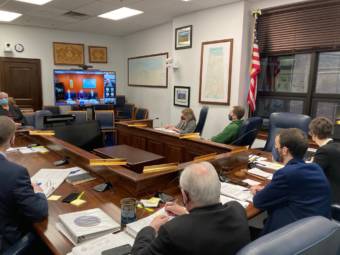
Members of the House Labor and Commerce Committee listen to U.S. Sen. Lisa Murkowski speak via teleconference on Friday in the Alaska State Capitol. Murkowski, U.S. Sen. Dan Sullivan and U.S. Rep. Don Young, all Republicans, spoke about the new federal infrastructure law. (Photo by Andrew Kitchenman/KTOO and Alaska Public Media)
Alaska’s congressional delegation told state lawmakers that the state has a unique opportunity to take advantage of the recently passed federal infrastructure law.
Rep. Don Young defended the law against Republican critics. He said it will send Alaska $6,000 per resident for transportation infrastructure, the most of any state.
“Some people within the state don’t think this is a good deal: Try something without it,” he said. “I keep telling people, just keep in mind, I had people tell me: ‘Well, we could do better, when we’re in control.’ Well, that’s nonsense!”
Young and Sens. Lisa Murkowski and Dan Sullivan, who are all Republicans, testified by videoconference before the House Labor and Commerce Committee.
Young said that if Congress hadn’t passed the law, it would have taken years for Republicans to pass their own infrastructure bill.
“It is the difference between doing something positive or talking about it,” he said.
Young proposed that legislators work with the delegation in a joint oversight committee to ensure that Alaska projects are funded and built in a timely manner.
Murkowski said it was unique for the delegation to speak to a state legislative committee, and it showed how unprecedented the law is.
She was part of a small bipartisan group of senators who spent last year working on the bill. She said it included benefits for each state, including the Alaska Marine Highway System.
“What we were trying to do was knit together an infrastructure bill that was going to be good for all of America, including those of us in the Far North,” she said.
Murkowski said the delegation and the state government must seize the opportunity provided by the bill.
“It’s a measure that I am extraordinarily proud of and I hope that as you peel this back, you begin to see exactly how these initiatives will stand to benefit all across our state,” she said.
Sen. Dan Sullivan said he opposed pieces of the bill but said it would help Alaska. He also said it was similar to a bill former President Donald Trump’s administration supported.
He said the state will receive 34% more money for its highways than in the last federal highway bill.
And Sullivan said the estimated $1.5 billion in broadband funding for Alaska is significant.
“We get some of the biggest amounts of federal funding for broadband of any state in the country – not per capita, straight-up broadband funding,” he said.
He also praised funding for military construction, the port of Nome, coastal storm damage reduction for Utqiagvik, and the Lowell Creek flood diversion project in Seward.
He also praised the bill for including changes to federal permitting that were in a Trump executive order later rescinded by President Joe Biden.
And Sullivan pushed back against those who say the bill was similar to the Green New Deal proposed by some Democrats. He contrasted the law with another bill that he said did have parts of the Green New Deal.
“The passage of this hard infrastructure bill actually helped very much in the Senate in killing the so-called Build Back Better bill,” which the delegation opposed, he said.
The state government is making plans for the funding.
Miles Baker is focused on it as the infrastructure investment coordinator in Gov. Mike Dunleavy’s office. He noted that the feds will award much of the money by competitive grant and that a large amount will not come through the state. Local governments, tribes, nonprofits and utilities also are eligible for money.
“So there’s huge coordination needed,” he said.
Baker said the administration’s immediate priority is determining what spending can be proposed during the legislative session, which must end by May 18. But the state’s eligibility for other funding won’t be clear until after the session. The bill covers a five-year time period.
Committee members expressed an interest in working with the congressional delegation on the funding.
Close
Update notification options
Subscribe to notifications
Subscribe
Get notifications about news related to the topics you care about. You can unsubscribe anytime.