Andrew Kitchenman

State Government Reporter, Alaska Public Media & KTOO

State government plays an outsized role in the life of Alaskans. As the state continues to go through the painful process of deciding what its priorities are, I bring Alaskans to the scene of a government in transition.
Gov. Dunleavy directs state to take steps to divest from Russia

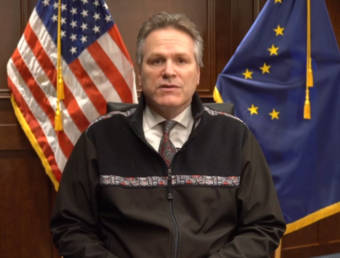
Alaska Gov. Mike Dunleavy speaks in a video response to President Joe Biden's State of the Union address. On Thursday, Dunleavy announced a series of steps to pressure Russian President Vladimir Putin over the invasion of Ukraine. (Screen capture of Office of the Governor video)
Alaska Gov. Mike Dunleavy speaks in a video response to President Joe Biden’s State of the Union address. On Thursday, Dunleavy announced a series of steps to pressure Russian President Vladimir Putin over the invasion of Ukraine. (Screen capture of an Office of the Governor video)

Gov. Mike Dunleavy announced on Thursday that the state will take steps to divest from Russia.

He also requested further actions from the federal government and Alaska businesses and individuals. 

“As a response to President Vladimir Putin’s war on Ukraine, we all need to do our part to support countries and people who believe in freedom,” he said in a statement.

Dunleavy directed state agencies to divest from Russian assets and called on state-owned corporations like the Alaska Permanent Fund Corporation to divest as well. He said both should happen “if and when appropriate.”

Before Dunleavy’s announcement, permanent fund leaders said  that they’re closely monitoring Russia and Ukraine and analyzing how to respond. The permanent fund had roughly $160 million invested in Russia in January. 

Dunleavy also directed the administration to identify Russian products or contracts for services with Russian companies for the purpose of divesting from them. 

Anchorage Democratic Rep. Zack Fields is one of a number of legislators who have been calling on Dunleavy to take similar steps in response to Russia’s invasion of Ukraine. He said the governor must follow through. 

“I think it shows that when people speak up, sometimes you force elected officials to listen,” he said.

Dunleavy, who is a Republican, called on Alaska businesses to divest from Russian companies and to stop selling Russian products. He also called on Alaskans not to purchase Russian products or services. He asked Alaska cities that have Russian sister cities to cut ties, and he asked universities to stop cultural exchange programs with Russia and to cut any contracts with Russian companies. 

Dunleavy said he would work with appropriate agencies to identify Alaska as a place of refuge for Ukrainians who pass background checks.

Dunleavy called on President Joe Biden to call a national energy emergency and expedite energy projects. Dunleavy encouraged Alaska resource development in a video response to Biden’s State of the Union address.

“We need to go all out at breakneck speed for all sources of energy to be developed,” he said.

He also called on the federal government to sanction purchases of Russian oil and seafood. Russia has banned American seafood since 2014.

The Alaska House Labor and Commerce Committee is working on a bill that committee members say will be aimed at ensuring that Russian oligarchs cannot hide their wealth in Alaska. 

Dunleavy said his decisions aren’t meant to hurt Alaskans of Russian background or to blame Russians who Putin is silencing for Putin’s actions.

House majority proposes $1,300 ‘energy relief checks’ for Alaskans

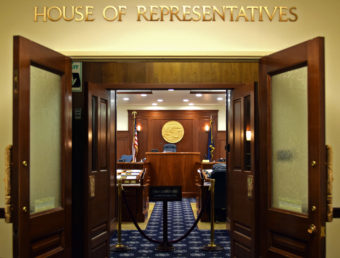
The Alaska House of Representatives entrance in the Capitol in Juneau, Feb. 6, 2015. (Photo by Skip Gray/KTOO)

The House majority caucus has proposed a $1,300 payment to Alaskans to provide relief for high fuel costs, inflation and the COVID-19 pandemic.
The House majority called its proposal on Wednesday an “energy relief check.” The money would be in addition to Alaskans’ annual permanent fund dividends.

Rep. Neal Foster, D-Nome, said the current $110 price per barrel of oil was a major reason for the proposal.

“Prices of fuel at the pump both for gasoline and heating fuel are going to go up,” he said. “As Alaskans … face these higher prices, the state of Alaska’s also going to see more revenue come into its coffers. And so we believe that we should be helping to provide Alaskans with relief.”

A $1,300 payment would cost the state roughly $840 million, according to the nonpartisan Legislative Finance Division.

The payment would be slightly larger than what Gov. Mike Dunleavy initially pitched. In December, he proposed paying Alaskans $1,215, the difference between last year’s $1,114 PFD and the amount he had wanted. He also wanted that to happen in a bill that would pass as soon as possible.

In social media posts Wednesday, Dunleavy said he’s glad the House majority has come around to agreeing with his proposal.

“The House Coalition announcement is better late than never, but the work is not yet done,” said Dunleavy, a Republican.

In addition, Dunleavy has proposed a more than $2,500 PFD this year, equal to half of the amount the state plans to draw from permanent fund earnings.

Lawmakers have yet to agree to a PFD amount.

The House Finance Committee plans to unveil its PFD plan on Friday, along with the rest of its budget proposal, including the proposed relief check.

Foster co-chairs the committee. He said the committee built its proposals based on the amount of money the state forecast to bring in last fall. The Department of Revenue is expected to announce that the state has more money available later this month in its spring revenue update.

The relief payment would be similar to the $1,200 one-time energy rebate that former Gov. Sarah Palin supported in 2008.

Rep. Cathy Tilton, R-Wasilla, leads the minority caucus. She noted that the 2008 payment also came in a year when the state followed the formula in state law to pay a larger PFD. She said the House majority proposal should go further than it does.

“It would be more proper to deal with the dividend than to deal with a check and call it an energy rebate check or energy whatever they’re calling it,” she said.

Lawmakers who support an additional payment on top of the PFD, don’t all agree on when the payments should be made.

Tilton called on the House majority to include the relief payment in a bill that’s scheduled to pass quickly. Foster said the money would be in the regular budget bill, which may not be done until late in the session in May.

The House majority caucus, which made the new proposal for an additional payment, has 15 Democrats, four independents and two Republicans. The minority caucus has 18 Republicans. There is one House member without a caucus, Rep. Sara Rasmussen, R-Anchorage.

The proposal also drew support from gubernatorial candidates Bill Walker, running as an independent, and Democratic candidate Les Gara.

The House Finance Committee has scheduled public testimony on the budget on Thursday afternoon. It will be taken from 2 p.m. to 4 p.m. on Thursday, 1:30 p.m. to 3:30 p.m. on Friday, and 11 a.m. to 2 p.m. on Saturday. People can participate by visiting a legislative information office, or by calling.

Alaska senators consider bill to protect accounts used for scholarships, ferries

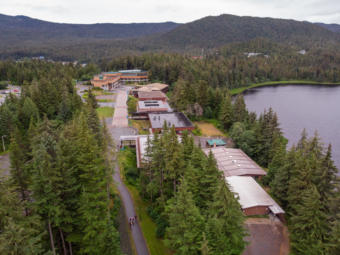
The University of Alaska Southeast campus in Juneau, shown in July 2019. On Tuesday, the Senate Finance Committee discussed a bill that is intended to protect a state account used to pay for university scholarships and grants. (Photo by David Purdy/KTOO)

The Senate Finance Committee is weighing a bill that’s aimed at protecting state accounts used to pay for university scholarships and the ferry system.

The intent of Senate Bill 224 is to keep any money in the accounts from being swept into a state piggy bank, the Constitutional Budget Reserve. 
A Superior Court judge recently ruled against university students who sued to keep more than $400 million in the Higher Education Investment Fund.

It pays for Alaska Performance Scholarships, Alaska Education Grants and the state’s medical education program, WWAMI, named after the initials of the states that participate, Washington, Wyoming, Alaska, Montana and Idaho.

The sweep grew the Constitutional Budget Reserve from roughly $1 billion to $1.5 billion.

Bethel Democratic Sen. Lyman Hoffman said at a committee meeting on Tuesday that Alaskans who rely on the scholarships and the ferries want more certainty. 

“I think these two need to be taken care of as soon as possible, particularly the Alaska Higher Education Fund, because this one has the most funds in it and to put them aside and get them unsweepable, I think, is something that the people of Alaska are looking forward to,” Hoffman said.

Dozens of other accounts wouldn’t be protected through the bill. They range from a fund for tobacco cessation programs to one that pays to maintain the Whittier tunnel. 

Wasilla Republican Sen. David Wilson said he’s concerned about that. 

“I don’t want to pick winners or losers and [be] trying to pick out, you know, this fund versus this fund – I believe we should just take action to either do them all or none,” he said.

Hoffman said he wants to start with the higher education and marine highway accounts so that the bill is less likely to get bogged down in the legislative process. 

The bill would put the accounts in a similar legal position as the Power Cost Equalization Endowment Fund, which pays to reduce the cost of power in high-cost areas. In a separate court case last year, a judge ruled that $1 billion in that fund is not subject to being swept into the Constitutional Budget Reserve. 

The House is considering two bills on related subjects. House Bill 229 focuses on protecting the higher education fund, while House Bill 57 seeks to protect all of the separate accounts.

Even if the Legislature passes any of the bills, it would need to take another step to put the money back into the accounts that’s already been swept out of them. 

It would take three-quarters of both legislative chambers to agree to draw money from the Constitutional Budget Reserve. If that doesn’t happen, the Legislature could put money into the accounts as part of the regular budget bill, but that would leave less money available for other programs.

How rising oil prices could affect this year’s PFD

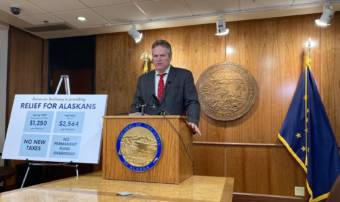
Alaska Gov. Mike Dunleavy urges the Legislature to pass his PFD and construction bond package bills during a news conference on Feb. 17, 2022 in the Alaska State Capitol. (Photo by Andrew Kitchenman/KTOO and Alaska Public Media)

This year’s budget talks are getting underway in Juneau. With the recent rise in oil prices, Gov. Mike Dunleavy is once again pushing for a higher Permanent Fund dividend for Alaskans.
Alaska Public Media’s Kavitha George spoke to state government reporter Andrew Kitchenman to break down this year’s budget and PFD talks.

Listen here:

Kavitha George: We’re in the middle of a bump in oil prices. A barrel of Alaska North Slope crude has been creeping toward $100. How is that influencing this year’s budget discussions?

Andrew Kitchenman: I’d say it’s having a big influence. But having said that, it’s almost surprising it hasn’t been larger, because we are talking about a large amount of money. Gov. Mike Dunleavy said in a recent news conference that all this money would lead to a surplus over the next year and a half of more than $1.5 billion dollars. And that’s with all of his current proposals. So it’s very helpful for the governor’s position on, for example, the Permanent Fund dividend, that we have a projected surplus that would occur even with a PFD of more than $2,500. Now, the governor also acknowledges that oil prices always go back down. So he doesn’t want to rest the case for his policy proposals just on the high current prices.

Kavitha George: So is it accurate to say that there’s a surplus in the budget this year?

Andrew Kitchenman: It’s helpful to keep in mind that whether there’s a surplus or deficit is really determined by the whole budget year because there’s always money coming in and coming out. And the budget year doesn’t end until June, and they don’t audit it until months after that. Having said that, the state has been bringing in a lot more money than it was projected to bring in. So when you project a balanced budget, sort of by definition, you appear to have a surplus when you’re bringing in more revenue than you expected.

Kavitha George: Gov. Dunleavy has warned that the price of oil will remain volatile. So why does this proposed budget seem to depend on oil prices staying higher than they have in recent years?

Andrew Kitchenman: First, I guess we could talk about how the administration projects the price. And that’s currently based on the futures market — that’s what people are paying for contracts to have oil delivered on a future date. The Department of Revenue has used the futures market since Dunleavy became governor. So it’s not a completely new thing. If anything, the forecasting method is a little more conservative since the fall than it was for the previous couple of years, when the state just assumed oil prices will go up with inflation after using the futures market for the next year. But now using the futures market for the long term, the price actually is projected to go down over time.

Part of the issue is the state has to pick a price, and it’ll build a budget around that price. It’s always gonna run the risk that if the price comes in lower, there’ll be problems.

Kavitha George: So under the governor’s current plan, what kind of PFDs can Alaskans expect this year?

Andrew Kitchenman: Well, I’m hearing that it’s gonna be higher than the $1,114 last year. How much higher would be speculation. Even if legislators were confident about oil prices, there may be some concerns that if the Legislature were to pay a big PFD this year, it would create pressure for unsustainably high dividends in the future.

I’m gonna throw a lot of numbers at you. One way of looking at it is what share of the annual draw from the Permanent Fund should be spent on PFDs. Some legislators want it to be a quarter of the draw. And that would mean a PFD of about $1,250. That’s about the average over the last 40 years for what it’s worth, without adjusting for inflation.

If it was a third of the draw, it would be about $1,660. That’s closer to the 40 year average, if you do adjust for inflation.

And some want it to be closer to about 40% of the draw, which gets you over the perhaps magical number of $2,000. I don’t know enough at this point to venture a guess as to what the final amount will be.

Kavitha George: The governor also wants a $1,200 payment on top of the PFD. How likely is that to pan out?

Andrew Kitchenman: That money is basically some extra money that would be on top of the PFD that Alaskans received last October, and it would make up the difference between what the governor wanted to pay last year and what they actually received. There’s been some skepticism from legislative leaders about this. They seen an advantage to running a surplus this year, because it would allow the state to replenish one of its savings accounts, the Constitutional Budget Reserve.

Kavitha George: A lot of this budget seems to hinge on federal relief money. How will major budget items be impacted in the future when that money isn’t available?

Andrew Kitchenman: To answer your question, I wish I had some infrastructure money to buy a crystal ball! Seriously, it’s really hard to answer, since Gov. Dunleavy moved away from large proposed cuts in the summer of 2019. It’s not been clear what it will take to balance the state budget in the long run. It’s part of why the PFD formula still isn’t resolved. The governor says the state can balance the budget with the PFD. He’s proposed no large new taxes, no large new spending cuts. But he’s baked in some assumptions, like lower than normal growth in Medicaid spending. That could be really difficult to achieve based on history. The outcome of this year’s election for governor and the legislature is going to have a large say over the long term impact.

Kavitha George: And what is the status of Alaska’s savings right now? And how is that playing into the discussion?

Andrew Kitchenman: Well, how do we define savings? In a sense, the Permanent Fund is savings. And it’s bigger than ever, it’s $81 billion. But if you think of savings as an account that you can spend money from at any time to cover near-term shortfalls, then the Permanent Fund doesn’t really fit, because there’s a law that’s supposed to limit the amount that the state draws each year.

The other big savings account, the Constitutional Budget Reserve, is only $1 billion. That’s a fraction of the state’s annual spending. So if anything, legislators working on the budget want to build up savings further and not spend them down.

Alaska lawmaker retaliates after Washington proposes tax on fuel exports

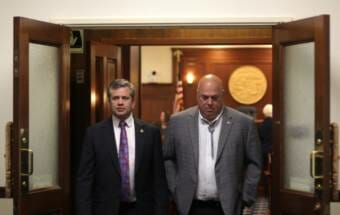
Reps. Chris Tuck, D-Anchorage, and Kevin McCabe, R-Big Lake, leave the House floor session on June 1, 2021. On Tuesday, McCabe introduced two bills that would raise taxes on Washington-based businesses, in retaliation for a Washington State Legislature plan to tax refined fuel shipped to Alaska and other states. (Photo by Nat Herz/Alaska Public Media)

The Washington State Legislature is considering a tax on fuel refined there and shipped to other states, including Alaska. In response, an Alaska House member has proposed two taxes that would hit Washington. 

The Washington legislation would increase fuel exported to Alaska, Idaho and Oregon by 6 cents per gallon. It wouldn’t affect Washington residents. 
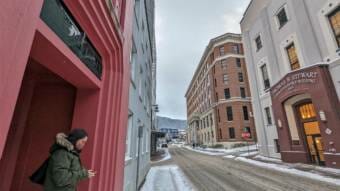
The tax would pay for projects, including public transportation and bicycle and pedestrian safety, that are intended to reduce emissions.

Washington State Rep. Jake Fey, a Democrat, said in a news conference on Feb. 8 that it would be fair to impose the tax on the states that receive fuel refined in Washington.

“All those states have lower case taxes and in terms of fairness, I think it’s only appropriate since we produce the fuels for their use that they support our climate activities and our overall activities in the package,” he said.

The proposal caught the attention of an Alaska legislator, Big Lake Republican Rep. Kevin McCabe

“They’re using our resources and buying our resources and we’re using theirs. It sort of should be a symbiotic relationship between two states,” he said. “And all of a sudden, it’s not.”

McCabe has introduced two bills in retaliation. One would add two taxes for fishing businesses per pound of fish caught or processed in the state. Alaska businesses would get a tax credit to offset the taxes. The amount of each tax? Six cents. 

The other bill would tax oil producers for the oil sent from Alaska to Washington to be refined by $15.75 per barrel. 

McCabe said he hopes his bills stop the Washington legislators from moving forward. 

McCabe said that as a conservative Republican, he doesn’t want to raise taxes on anyone. But he said he would understand the Washington proposal better if it affected Washington residents too

“If we’re all going to share in this tax, then we’re all going to share in it and then, possibly, that would be acceptable,” he said. “But just targeting three states and not their own drivers and not British Columbia, that makes it a problem.”

McCabe is in the House minority caucus. But a majority member, independent Rep. Josiah Aullaqsruak Patkotak of Utqiagvik, also is concerned about the Washington proposal. As the House Resources Committee chair, Patkotak would be in a position to hold a hearing on McCabe’s bills if they move forward.

“If we can kind of position ourselves to be able to strategically combat that – not necessarily fire with fire, but the thought that there could be fire with fire – to have them potentially, you know, reconsider their thoughts on things, then that’s some dialog I’m willing to engage in,” he said.

Patkotak noted that heating fuel prices are already locked in through the summer. And he added that much of his district, in the North Slope Borough, buys fuel that’s been refined in places other than Washington. But he said villages that could see higher costs in the long run are already paying a lot. 

“You’ve got villages that are paying $10 – some of them I think $15 – a gallon of home heating fuel or gasoline to go and hunt the land,” he said.  

The oil industry has been pushing back against the Washington bills. 

Kevin Slagle is vice president of the Western States Petroleum Association, which represents industry companies. 

He said the Washington bills are on a fast track. And he said they need to stop. He’s been watching the Alaska proposal closely. 

“When you think about trade wars between states: The folks that are going to lose the most are consumers at a time when we’re emerging from economic difficulties,” he said. “There’s a lot of challenges in the world. So it just seems like an unfortunate time to have something like this that could create a bit of a war of commerce between the states.”

This isn’t the first time Alaska lawmakers reacted to a Washington tax plan. McCabe drew inspiration from a similar proposal by former Alaska House Speaker Mike Chenault, a Nikiski Republican. In 2007, Washington had proposed a $100 fee on shipping containers bringing goods to Alaska. Chenault recalls how he later proposed a tax on oil headed to Washington to be refined.

“We didn’t think it was fair that they were going to try to tax Alaskans an extra $100 just to pay for programs and services that they wanted in their state and have somebody else pay for it,” he said.

Both sides defused the situation by dropping their proposals. Chenault said he hopes McCabe will have similar success this time. 

“It’s one way for the Legislature to send a message to another Legislature that we are watching what you do,” he said. “And we don’t appreciate what you’re trying to do.”

The Washington Senate has passed the tax legislation. The state’s House is now considering it. 

Legislative Council approves plan to spend up to $5.5M to convert Juneau building into apartments for lawmakers

Assembly Building facade
The Juneau Community Foundation donated the Assembly Building, pictured here on Dec. 17, 2021, to the Legislature in August 2021. On Wednesday, the Legislative Council approved a plan to spend up to $5.5 million to turn the building into 33 apartments for lawmakers and, potentially, others during sessions. (Photo by Jeremy Hsieh/KTOO)

A bicameral council of Alaska legislators approved a plan on Wednesday to convert a Juneau office building into housing for lawmakers during sessions. 

The Legislative Council voted 9 to 5 to approve the plan to spend up to $5.5 million to turn the Assembly Building into 33 apartments for the session. The building was donated to the Legislature last year. 

Juneau Democratic Rep. Sara Hannan, the council chair, said the city government supported the plan.

She described why: “To make sure that we have adequate housing for legislators, especially in times when there might not be housing available.”  

But opponents said the council didn’t have enough information to make the decision. The council hasn’t surveyed legislators about their interest in renting the building, which could also be used to house legislative aides or other state employees for the session. 

Dillingham independent Rep. Bryce Edgmon voted against the plan. He said he wanted more time to consider the proposal.

“I kind of wonder … that it just seems like there’s been some steps that have been skipped here,” he said.

The building would have 15 one-bedroom apartments and 18 efficiencies. 

Edgmon estimated that a third to a half of the Legislature flies out of Juneau on weekends. And he said having lawmakers stay in small apartments could encourage more of them to spend time away during sessions. 

The 33 apartments would be enough for most of the 57 legislators who live outside of Juneau. 

The council hasn’t decided what the rent for the apartments will be, but the legislative staff said it could be based on the market rate. 

The Assembly Building is diagonally across the street from the Capitol. It was built in 1932 as an apartment building but has included offices since at least the 1980s. It has a 17-space parking garage on its ground floor.

Site notifications
Update notification options
Subscribe to notifications