State Government Reporter, Alaska Public Media & KTOO
State government plays an outsized role in the life of Alaskans. As the state continues to go through the painful process of deciding what its priorities are, I bring Alaskans to the scene of a government in transition.
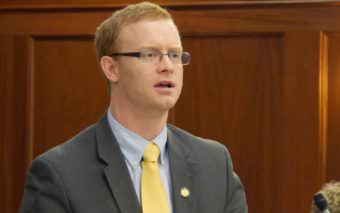
Sen. Bill Wielechowski, D-Anchorage, pauses during a comment in a Senate Finance Committee meeting at the Capitol in Juneau in March 2020. On Wednesday, the Senate passed a bill Wielechowski sponsored that would require the state to maintain the Alaska Checkbook Online website. (Photo by Klas Stolpe/KTOO)
The Alaska Senate passed a bill on Wednesday that would ensure the state maintains its website that allows the public to examine how state money is being spent.
The Alaska Checkbook Online was launched by former Gov. Sarah Palin in 2008. It allows the public to search the amount of every payment by the state and who received it. But the site went through a period for nearly a year, beginning in April 2020, when the Department of Administration took it down.
Anchorage Democratic Sen. Bill Wielechowski said he wanted to make sure that the public can access the information easily.
“We started to hear from Alaskans who said, ‘Hey, it’s clunky, it’s hard to use, but we still want to know where our money’s being spent,'” he said. “They couldn’t find it at all, it just wasn’t online.”
He sponsored Senate Bill 25, which would require that the information be posted monthly.
The bill would require that the information be searchable on the website, rather than in files that have to be downloaded first.
Wielechowski said it could prevent wasteful spending.
“Fundamentally, for the citizens, it’s just good government,” he said. “It’s government transparency. But there are also arguments made, and I’ve heard from contractors who say: ‘You know, I like to go in and look and find out what’s being bid, so that I can make a more efficient bid, save the state money, on a contract.’”
The bill also would expand the information available on the site to include all monthly revenue for each state agency. The monthly balances for state savings accounts and the permanent fund’s earnings reserve would also be required.
It would require posting annual salary, travel, relocation and per diem expense information for the leaders of the administration, the university and public corporations.
The number of employees of state agencies for each of the last 10 years would also be posted.
Wielechowski sponsored a similar bill shortly before the Palin administration launched the website. The Senate passed it in 2008, but the House didn’t.
The House now will decide whether to pass the new bill and send it to Gov. Mike Dunleavy to sign or veto.
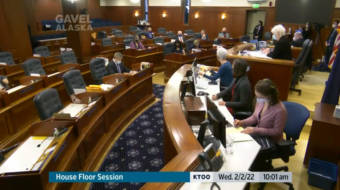
The Alaska House of Representatives is largely empty during a technical session on Feb. 2, 2022 due to many of its members being exposed to someone who tested positive for COVID-19 on Wednesday in the Capitol. (Screen capture of Gavel Alaska)
Leaders of the Alaska House of Representatives canceled the regular floor session on Wednesday, due to a large portion of representatives being exposed to COVID-19 over the last day.
Instead, the House held a technical session without normal legislative business.
House Speaker Louise Stutes, a Kodiak Republican, said in a statement that contact tracing was ongoing. She said the decision was made “in an abundance of caution.”
A spokesperson for the House majority caucus said that roughly half of the House members were close contacts of a positive case.
As of Wednesday morning, the Legislature’s testing contractor was still determining who had to quarantine, based on their vaccination status, according to the spokesperson.
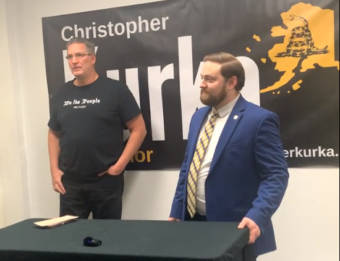
Paul Hueper, left, of Homer and candidate for governor Rep. Christopher Kurka attend Kurka’s announcement of Hueper as his running mate in Wasilla on Monday. (Screen capture from Kurka for Governor Facebook page)
Republican state Rep. Christopher Kurka announced his running mate in his bid to be Alaska’s next governor. Paul Hueper of Homer will be the lieutenant governor candidate on a ticket with Kurka.
Back in April, Hueper made the news when his house in Homer was raided by the FBI after investigators mistakenly identified his wife as a participant in the Capitol riot.
Kurka made the announcement on Monday in Wasilla.
Hueper and his wife Marilyn own the Homer Inn and Spa. Hueper described himself as a spirit-filled Christian and said he wants to be an immovable rock in his principles. He also said that if oppression from the federal government doesn’t change, Alaska will evolve into “the next Cuba.”
“If we don’t wake up, we’re going to lose this republic, but more importantly we’re going to lose this country of Alaska,” Hueper said. “We really are our own country. We have to start thinking in terms of independence from the federal government.”
Hueper has said he and his wife went to Washington, D.C. for the Jan. 6, 2021 protest and went to the Capitol lawn, but did not go inside the building. Hueper described the raid on their house and said seven guns were pointed at his head. He also described how the couple has since appeared on national conservative media outlets.
Hueper criticized Gov. Mike Dunleavy for health mandates early in the pandemic, and he said Alaskans are tired of compromise. He spoke in support of the Pebble Mine.
And he criticized the current system for selecting judges in the state, particularly the appointees of the Alaska Bar Association on the council that nominates judicial candidates for the governor to choose from.
“Since when does the fox get to guard the henhouse?” Hueper said.
Kurka said one of the primary reasons he chose Hueper is their shared passion for election integrity.
“Because of the incredible role that the lieutenant governor has in overseeing the Division of Elections, we have to have somebody who is dedicated to cleaning up the disaster that has become our Division of Elections,” he said.
Candidates for governor have until June 1 to choose their running mates.
Rep. David Eastman, R-Wasilla, speaks during a House floor session in March 2017. (Photo by Skip Gray/KTOO)
The Alaska House of Representatives did not take action on Monday on a proposal to punish Wasilla Republican Rep. David Eastman for his membership in the Oath Keepers organization. The Oath Keepers’ leader Stewart Rhodes has been charged with seditious conspiracy for his actions related to the storming of the U.S. Capitol on Jan. 6, 2021.
The Anchorage Daily News reported last week that members of the largely Democratic majority caucus were discussing whether Eastman violated a provision of the state constitution. It prohibits anyone “who advocates, or who aids or belongs to any party or organization or association which advocates, the overthrow by force or violence of the government of the United States or the State” from holding public office.
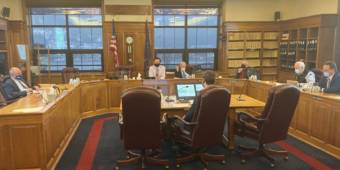
Earlier in the day on Monday, a committee voted to recommend the punishment, but House leaders held off on taking a vote after Eastman objected. He raised a concern that any action related to the Select Committee on Legislative Ethics was legally required to be taken separately.
Minority leader Rep. Cathy Tilton said her caucus was ready to vote on the floor on Monday. She said members weren’t given any written information about why the majority leaders planned to punish Eastman. She said he hasn’t been afforded due process.
“I believe that when you start to look at what memberships a person may belong to, it’s a very slippery slope that the Legislature is considering setting a precedent for,” she said.
Eastman has called the recent indictments of Rhodes and other Oath Keepers leaders “politically driven.”
Eastman attended the protest that preceded the riot at the Capitol. He has said that he didn’t enter the building. He has not been charged with any crimes related to the insurrection and no evidence has emerged to link him to the riot.
Rhodes and 18 other members of the Oath Keepers were charged on Jan. 13. The federal indictment said they plotted to disrupt the electoral process and endangered former Vice President Mike Pence. Eastman told NPR in an interview in October that he didn’t support any of the actions related to the storming of the Capitol.
Eastman was listed as a “life member” of the Oath Keepers in a list an anonymous hacker purportedly took from the Oath Keepers’ web servers. In a social media post on Sunday, Eastman said his connection with the Oath Keepers was slight, that he applied for membership more than a dozen years ago and he never attended a meeting.
Eastman serves on the House rules, judiciary and state affairs committees, as well as the Special Committee on Ways and Means. He also is an alternate on the Select Committee on Legislative Ethics.
The federal indictment described the Oath Keepers as “a large but loosely organized collection of individuals, some of whom are associated with militias.” It said “some members of the Oath Keepers believe that the federal government has been coopted by a cabal of elites actively trying to strip American citizens of their rights.”
House members didn’t debate Eastman’s status. But in floor remarks, members from both caucuses indirectly referred to the issue.
Anchorage Democratic Rep. Ivy Spohnholz is a member of the majority. She said the country has lasted because of the strength of its institutions, as well as free and fair elections. She read the oath of office legislators take.
“I thought it was important to remember this office that we’re called to, to sort of inspire us to remember that our duty is always first to our country and to our state, and everything else comes after that,” she said.
Nikiski Republican Rep. Ben Carpenter is a member of the minority. He talked about the importance of the First Amendment freedoms of speech and of association.
“And I think on this day, of all days, maybe we should continue to think about if you can remove, it’s only a matter of time … before somebody else gets removed, from some other non-popular topic,” he said.
Eastman is in his third term in the House. In 2017, he became the first member of the chamber to be censured after he said that some women – including those who live in villages – are glad to become pregnant so they can receive Medicaid-funded travel to have abortions.
The House tabled action on the motion to remove Eastman from committees. That means the action was postponed but could be taken up again later.
Editor’s note: This story has been updated to clarify the action taken by the House and to add reaction from lawmakers.
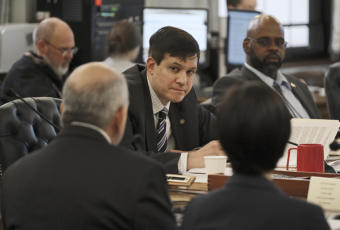
The House Finance Committee meets to discuss Gov. Mike Dunleavy’s budget proposal in the Capitol on Thursday (Photo by Andrew Kitchenman/KTOO and Alaska Public Media)
Alaska’s state government has more money flowing into it than it’s had in years. High oil prices, permanent fund growth and federal relief have allowed Gov. Mike Dunleavy to propose a budget that does not include large cuts or draw from savings.
But as lawmakers begin their work on the budget, some are raising concerns about how sustainable the governor’s plan is, and that could have big implications on the size of permanent fund dividends.
Dunleavy’s budget proposal depends on oil prices staying higher than they have in recent years. In his State of the State address, Dunleavy said the state shouldn’t count on this continuing.
“As Alaskans, we know the price of oil is volatile,” he said. “In just the past two years we’ve seen prices go from negative to nearly $90 per barrel. We know better than to take current prices for granted, and we must continue to hold the line on state spending without sacrificing core services, and that includes the PFD.”
Dunleavy has proposed a 50-50 PFD — that’s a change to the PFD formula that would pay dividends that are half of the annual amount the legislature draws from the Permanent Fund. This year, that would be more than $2,500.
He’s also proposed paying another $1,200 to make up the difference between the dividend he proposed last year and the one that got paid out.
The 50-50 PFD would be larger than what Alaskans have gotten in recent years. But it’s smaller than what Alaskans would receive under the formula that’s currently in state law — about $4,000. Critics of the current formula point to how much money that would spend down in the permanent fund’s earnings reserves.
Dunleavy’s administration has said the state can have balanced budgets in the long run and still pay the PFDs he’s proposed.
It could also help legislators campaigning for re-election. But some legislative leaders are not rushing to embrace the plan.
Rep. Bryce Edgmon said in a recent House Finance Committee meeting that it’s not realistic to pay large dividends and expect balanced budgets. He’s a Dillingham independent who caucuses with the mostly Democratic House majority.
“I’m a little uncomfortable when I hear the statement that, oh, in a few years, the governor’s 50-50 works out,” he said. “Well, to me that’s not complete. There’s so many other factors that we need to talk about before we can get to that statement.”
The Legislature has struggled to agree on changes to the dividend formula for six years.
Edgmon said this year’s dividend will lead to political pressure for the future.
“And that creates expectations that we need to grapple with in ensuing years, depending on whatever we do with the permanent fund dividend,” he said. “And I want to point that out, because that’ s what drives what happens in this building. And it has driven what’s happened in this building for some time now.”
One concern about setting dividends this year is that hundreds of millions of dollars in federal aid won’t be around in the future. Nonpartisan budget analysts have said that without the federal relief, Dunleavy’s proposed budget would have a $348 million deficit. And the budget also relies on more than $100 million in other forms of federal aid that are limited to the next few years.
Nome Democratic Rep. Neal Foster said he wants to consider the effect on budgets beyond next year. Citing Dunleavy’s proposed increases to public safety spending, Foster said the state shouldn’t count on the federal relief to pay for services that would continue well beyond the next budget.
“So I think we’re going to put a lot of emphasis on trying to balance the budget without those funds,” he said.
Foster co-chairs the House Finance Committee, which works on the budget. He noted that the Dunleavy’s administration’s 10-year-budget plan includes deficits in some future years.
“We want to create a budget that’s hopefully going to be more structurally sound, so that we’re not seeing those same deficits and at least minimize those as much as possible,” Foster said.
Another concern is that, outside of the permanent fund, the state has less in savings than at any point in more than a decade. That’s a major potential problem for a state government that relies on investments and oil, which are more volatile sources for its budget than other states do. So legislators are considering saving for the future.
Sitka Republican Sen. Bert Stedman said the extra money won’t last forever — and may not last beyond this year.
“So we need to be careful that we don’t get too euphoric at $80 per barrel and end up making our position worse in a couple years,” said Stedman, co-chair of the Senate Finance Committee.
Stedman said the Legislature must look beyond the next budget and the upcoming election.
There’s another factor that Dunleavy’s long term plan relies on: reductions in the state budget that the governor has not yet made clear.
The Legislature hasn’t settled on a PFD amount until toward the end of the session in recent years. And with the various pressures on the state budget in the long term, that process may play out again this year.
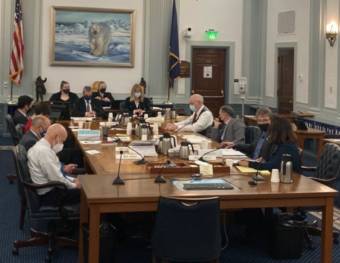
The Legislative Budget & Audit Committee meets shortly before voting to approve hiring a law firm to investigate the firing of Angela Rodell as the executive director of the Alaska Permanent Fund Corp. on Thursday in the Capitol. (Photo by Andrew Kitchenman/KTOO and Alaska Public Media)
A committee of the Alaska Legislature will hire a law firm to investigate the recent firing of Angela Rodell from her position as executive director of the Alaska Permanent Fund Corporation.
Legislative Budget and Audit Committee chair Sen. Natasha von Imhof, an Anchorage Republican, explained the decision at a committee meeting on Thursday.
“It is this committee’s goal that the fund is protected from political intervention or manipulation to ensure the fund’s continued growth and sustainability,” she said.
The investigation will examine the circumstances of Rodell’s firing and whether there were improper actions or undue political influence by board members or by Gov. Mike Dunleavy’s administration.
The permanent fund’s board fired Rodell on Dec. 9.
Dunleavy has said he had no knowledge of or influence over the firing. Board chair Craig Richards has said Rodell was an at-will employee and cited negative evaluations of Rodell’s performance. He has declined to provide details, saying it’s a confidential personnel matter.
The committee also authorized issuing subpoenas in the investigation. Von Imhof said she plans to keep a hands-off approach but will work with the investigators to decide if people who decline to talk should be compelled to by subpoena.
Rodell’s firing has drawn scrutiny from lawmakers who have noted the fund grew by $30 billion while Rodell led it.
The committee plans to hire lawyers Howard Trickey and Christopher Slottee of the Anchorage firm Schwabe, Williamson & Wyatt. The contract, which the committee plans to finalize next week, will be for up to $100,000.
The committee was unanimous in supporting the investigation and subpoena authority.
Von Imhof said she hopes the investigative report will be completed before the end of the legislative session, since there may be legislation proposed as a result of the report.
Close
Update notification options
Subscribe to notifications
Subscribe
Get notifications about news related to the topics you care about. You can unsubscribe anytime.