Andrew Kitchenman

State Government Reporter, Alaska Public Media & KTOO

State government plays an outsized role in the life of Alaskans. As the state continues to go through the painful process of deciding what its priorities are, I bring Alaskans to the scene of a government in transition.
Alaska Legislature to support students’ lawsuit to maintain scholarship fund

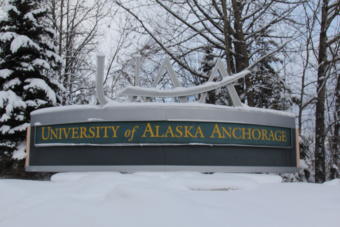
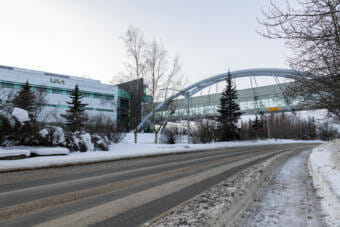
A sign on the campus of the University of Alaska Anchorage. On Monday, the Alaska Legislative Council voted to file a briefing in support of a lawsuits by university students to preserve funding in the Higher Education Investment Fund. (Photo by Tegan Hanlon/Alaska Public Media)

The Alaska Legislature is supporting the lawsuit by university students against Gov. Mike Dunleavy’s administration to protect a fund that pays for scholarships.

A joint council of the House of Representatives and Senate on Monday approved filing a legal brief backing the lawsuit.

The Alaska Higher Education Investment Fund has held more than $400 million. Each year, money from the fund pays for Alaska Performance Scholarships, need-based Alaska Education Grants and the state program for medical students, known as WWAMI.

Dunleavy’s administration has said that the money in the fund must be swept into a state savings account if three-quarters of both legislative chambers don’t vote each year to maintain the funding. That vote failed last year.

Kodiak Republican Sen. Gary Stevens said emptying the fund would leave students uncertain about whether the scholarships would be available.

“The medical students are on a long-term program, and for them not to know from year to year to year how they’re going to be supported would be quite devastating,” he said.

Dunleavy has said that he supports funding the scholarships.

The Legislative Council’s vote to support the filing was 12 to 1.

Alaska lawmakers grill Permanent Fund Corp. chair Richards over firing of executive director Rodell

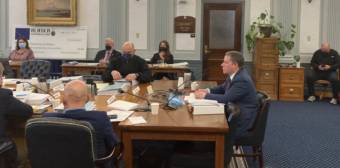
Alaska Permanent Fund Corp. board of trustees chair Craig Richards, right, provides testimony to the Legislative Budget and Audit Committee on Jan. 17, 2022, in the Alaska State Capitol in Juneau. (Photo by Andrew Kitchenman/KTOO)
Alaska Permanent Fund Corp. board of trustees chair Craig Richards, right, provides testimony to the Legislative Budget and Audit Committee on Monday in the Capitol. Richards talked with committee members about the firing of former corporation executive director Angela Rodell. (Photo by Andrew Kitchenman/KTOO)

Since the Alaska Permanent Fund Corporation board voted to fire executive director Angela Rodell in December, some state lawmakers have been concerned that the decision was politically motivated. 

On Monday, members of the Legislative Budget and Audit Committee met with the corporation’s board of trustees chair, Craig Richards, with the intent to better understand the decision. Richards maintained that Rodell was an at-will state employee but declined to give details about why she was fired. A corporation lawyer noted that Rodell has talked about suing the board. 

Richards said the meeting with lawmakers itself was political. 

“You brought up the chairman of the board to grill me pretty good, I might say, about essentially a personnel decision involving an at-will employee,” he said. “It’s your right to do it, but … you know, there’s politics going both ways here.”

Soldotna Republican Senate President Peter Micciche said the corporation should be focused on growing the fund. And he said he’s concerned that board members are straying from that focus.

“Do we actively separate politics from maximum returns, which is your mission, your vision?” he said. “Because a lot of this sort of reeks of something else.” 

Micciche pointed to recent comments by a trustee as a source of concern. Trustee Lucinda Mahoney said she opposed an increase in the financial incentives paid to investment managers at a time when the Legislature has paid for smaller permanent fund dividends than what would be paid under the formula in a 1982 state law.

Gov. Mike Dunleavy has proposed a change to the dividend formula that would make them lower than the amount in the current formula but higher than have been paid over the past six years. 

The fund has more than $80 billion. For more than 30 years, the main way that money was spent from the fund was for permanent fund dividends. But since 2018, it’s paid for most of the state budget. And the competition between paying for dividends and for state services has been controversial.  

Anchorage Democratic Rep. Ivy Spohnholz pointed to the large growth in the fund and pointed out that the corporation was recently named one of the best places to work by a trade publication. 

“It’s really difficult for us to understand what is the problem with her performance if she’s meeting all of these benchmarks?” Spohnholz said of Rodell.

In response to Richards’ comment that the meeting was political, Spohnholz said that while the Legislature is political by nature, the trustees shouldn’t be.

The fund grew by $30 billion during Rodell’s six years leading the corporation. 

Richards said the growth shouldn’t be credited to Rodell, who didn’t manage investments. 

Nome Democratic Rep. Neal Foster said Rodell would have been held responsible if the fund had done poorly. 

“I just wanted to say that I think she deserves some of the credit,” Foster said.

Richards acknowledged his point: “And I apologize if that was either exactly what I said or what was taken by it. As the executive director, she was a critical part of the team, and she did a lot of things very well that contributed to the fund’s success — some of the administrative stuff was really good for the fund. And that helped the fund, and it contributed to the fund. My point was only that her responsibility was not the direct supervision of the investments.” 

While Richards didn’t give details of why the board fired Rodell, he did say he was concerned by a proposal Rodell made a few years ago to combine her position with that of the chief investment officer. 

“That was the incident in which, for me, huge red flags went up,” he said.

Richards said firing Rodell was appropriate. He pointed to negative reviews in her personnel file from some trustees that date back four years. 

“I am truly shocked that I am here,” he said. “This is, this is a new one to me, OK? We have a at-will employee that reports to the board who years of documented evidence demonstrates that there were trust problems going both ways between the board and the executive director.”

Anchorage Democratic Rep. Andy Josephson said Rodell may be able to win a lawsuit against the state. 

“And I would rather have paid her to do the capable work she was doing than paid her through an operating budget in a case called Rodell v. Alaska,” he said.

Committee chair Sen. Natasha von Imhof, an Anchorage Republican, said the committee would take whatever time is needed to fulfill its oversight duties as it continues to look into Rodell’s firing.

Richards said it would be best for the permanent fund to “move on.”

The first day of the legislative session is Tuesday.

Alaska Legislative Council seeks to fund per diems after Gov. Dunleavy veto

The Alaska State Capitol in Juneau hosts budget negotiations on a rainy day, April 15, 2021. (Photo by Andrew Kitchenman/KTOO and Alaska Public Media)
The Alaska State Capitol in Juneau hosts budget negotiations in April 2021. On Thursday, the Legislative Council voted to transfer money to pay per diems during this year’s session. (Photo by Andrew Kitchenman/KTOO and Alaska Public Media)

A joint House-Senate council of the Alaska Legislature voted on Thursday to pay per diems during the legislative session scheduled to start next week. 

The payments to lawmakers from outside of Juneau supplement their salaries and cover their living expenses during the session. They receive $293 per day. 

Gov. Mike Dunleavy had vetoed the payments in June. He said it didn’t make sense for legislators to receive the money until they’ve resolved the future of permanent fund dividends. 
In December, he proposed restoring the $2 million in per diem funding in a bill that supplements the current budget. But that bill would also pay an additional $1,215 PFD, to make up for the difference between last year’s dividend and the amount he proposed. Legislators expressed concern last year that larger dividends would require drawing more than planned from the permanent fund.

The Legislative Council voted 12 to 1 to transfer money from capital funds to the Legislature’s account for salaries and allowances. 

Anchorage Democratic Rep. Matt Claman voted for the transfer. He said delaying it would hurt some legislators.

“A reduction in per diem – or not paying, getting per diem started right away – really disadvantages those legislators that actually bring their families to Juneau,” he said. “And I think it’s really essential for some of the families that do have kids that we have those representatives and senators with us.”

Wasilla Republican Rep. Cathy Tilton was the only council member to vote no. She said the transfer wasn’t needed to pay per diems because the Legislature could pass the governor’s supplemental bill. 

She also has supported the governor’s plan to pay larger dividends.

“There are also other things in that supplemental that should be taken care of immediately as well,” she said.

The council plans to refill the capital funds if the supplemental bill passes.  

Legislators can receive roughly $35,400 in per diems for a 121-day session, in addition to salaries of $50,400. 

The State Officers Compensation Commission is scheduled to discuss a proposal on Tuesday that would increase lawmakers’ salaries to $64,000 while cutting their per diems to $100. The combined change would decrease the overall amount of money that lawmakers take home. If the commission approves the changes, they would go into effect next year unless the Legislature votes to block them. 

After the vote, an internet outage disrupted the council meeting. The council plans to meet again before the session starts to discuss the COVID-19 safety rules for the Capitol building. 


Alaska legislators seek to change campaign contribution limits, permanent fund trustees

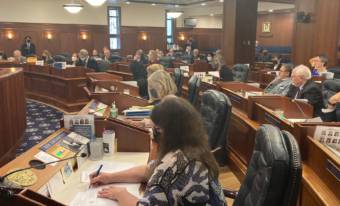
The Alaska House of Representatives meets for the first day of the Legislature's third special session this year in the Alaska State Capitol in Juneau on Aug. 16, 2021. (Photo by Andrew Kitchenman/KTOO and Alaska Public Media)
The Alaska House of Representatives meets for the Legislature’s third special session of 2021 in the Capitol. On Friday, the first batch of pre-filed bills for 2022 was released. (Photo by Andrew Kitchenman/KTOO and Alaska Public Media)

Bills to bring back political campaign contribution limits and change how Alaska Permanent Fund Corporation trustees are appointed were among the first batch of legislation filed ahead of the session. 

There were 43 bills and five constitutional amendments proposed by House members 15 bills and one amendment proposed by senators.

Anchorage Republican Sen. Roger Holland proposed Senate Bill 145, which would prevent legislators from receiving per diem payments if they fail to pass a budget by the 121st day of the regular session. 

“There’s incredible motivation, or there could be incredible motivation, for people not to finish the budget on time to collect per diem,” he said.

Per diems would resume after they pass the budget, but would not be paid retroactively to cover the time between the session end and the budget passing. 

Legislators passed a law in 2018 saying they couldn’t receive per diems until after they pass a budget. But lawmakers and the Legislature’s legal adviser interpreted it to mean that they could be paid per diems retroactively once they passed the budget. The law’s sponsor said that wasn’t the intent of the law

Legislators’ per diems could be reduced under a recent proposal by the State Officers Compensation Commission. 

Different bills would raise legal limits on campaign contributions to individual candidates. That previous limit of $500 was struck down by a judge for being too restrictive. Anchorage Reps. Andy Josephson, a Democrat, and Calvin Schrage, an independent, and Anchorage Democratic Sen. Bill Wielechowski proposed the bills.

Schrage said his bill would allow the Legislature and the public to affect what the new limits should be. The Alaska Public Office Commission staff has proposed limits that could go into effect this year.

“With the recent court ruling, it’s incredibly important that Alaskans have a chance to weigh in on those APOC limits and, you know, as legislators representing our constituents in Alaska, I think that we should address this issue,” he said. 

Another measure, House Bill 251, would create a new committee that would appoint the public members of the permanent fund board of trustees. The governor currently appoints all of the board members, but the bill would give legislative leaders a say. The bill also would expand the number of public members, from four to six, and increase the length of their terms from four years to six years. Josephson proposed the bill. 

Other bills include measures to protect the fund that pays for university scholarships and grants, as well as for medical education; increase the pay of state workers; and change the permanent fund dividend formula. 

Few pre-filed bills have become laws in recent years. The session is scheduled to begin on Jan. 18. 

Omicron wave hit Alaska this week, state health leaders say

Alaska Chief Medical Officer Dr. Anne Zink discusses the state of the coronavirus pandemic during a news conference at the Atwood Building in Anchorage on Thursday, Aug. 26, 2021. (Matthew Faubion / Alaska Public Media)
Alaska Chief Medical Officer Dr. Anne Zink discusses the coronavirus pandemic during a news conference at the Atwood Building in Anchorage in August 2021. On Thursday, Zink said there had been a clear increase in Alaska over the last 24 hours in cases with the omicron strain of the virus. (Matthew Faubion/Alaska Public Media)

The vast majority of cases of COVID-19 in Alaska this week are from the rapidly spreading omicron strain, state health leaders said on Thursday.

They said that over the past five days, between 80% and 95% of cases screened by the state public health lab have had a marker associated with omicron.

State Chief Medical Officer Dr. Anne Zink said there has been a significant increase in cases over the past 24 hours. 
“It’s pretty clear that omicron is here and spreading quickly across the state of Alaska,” she said.

State leaders expect to report a large increase in the total number of COVID-19 cases statewide on Friday. 

Despite the increase in cases, hospitalizations have not gone up. Zink said hospitals’ biggest problem is staff members becoming sick with the virus.

“We’ve been seeing nationally, as well as internationally, not the same rate of hospitalization and severe illness with omicron as we did with delta, but still in many states an increase as cases so quickly increase, so we’ll continue to follow and watch this closely moving forward,” she said.

Zink said that at the same time cases are increasing, the amount of monoclonal antibodies allocated by the federal government to Alaska has dropped.

“We are very limited in our supplies at this time, with significant demand,” she said.

The state is changing how it’s reporting COVID-19 data.  It will be emphasizing weekly changes, rather than daily numbers. In addition, state officials said that hospitalization and death statistics are more accurate than case counts. 

Zink said public health officials around the world are discussing what information is most useful, especially as more people have had the disease and have been vaccinated against it. 

“We will see more people who have mild or asymptomatic disease who are not ending up at the hospital and are not ending up overwhelming our health care systems,” she said. “And that is kind of the natural progression through a pandemic, as this has less and less impact on the population as a whole.” 

State Epidemiologist Dr. Joe McLaughlin is tracking how omicron has spread in other parts of the world. In the first place where there’s data — South Africa — cases peaked less than three weeks after they first started to spread rapidly, then fell quickly. McLaughlin expressed hope that the omicron wave of infections will be shorter than previous waves of the disease. 

University of Alaska students sue to protect fund for scholarships, medical education

The University of Alaska Anchorage campus on Dec. 30, 2021. Four students sued on Tuesday, seeking to maintain a fund that pays for scholarships. Two attend the Fairbanks campus, one attends UAA and one is a medical student. (Lyndsey Brollini/KTOO)

Four University of Alaska students are suing the state government in an attempt to maintain a fund that pays for scholarships. 

The Alaska Higher Education Investment Fund has been under threat of being emptied of more than $400 million as a result of legislative budget fights. It pays for Alaska Performance Scholarships, need-based Alaska Education Grants and the state program for medical students, WWAMI.

Riley von Borstel of Seward is one of the students who sued. She’s the student body president at the University of Alaska Fairbanks. She said the scholarships are essential for her and other students. 

“If this funding weren’t available to students anymore, I think the University of Alaska System would see a significant decline in enrollment amongst Alaskan students,” she said. “I think many of them would decide not to attend school in Alaska if this funding weren’t available.”

Students Madilyn Short, Jay-Mark Pascua, Kjrsten Schindler and von Borstel filed the lawsuit on Tuesday against Gov. Mike Dunleavy, the Office of Management and Budget and the Department of Administration.

According to the Dunleavy administration, the money in the fund must be swept into state savings account if three-quarters of each legislative chamber doesn’t vote each year to maintain the funding. And this vote failed last year. 

Another lawsuit, filed by the Alaska Federation of Natives and 17 other plaintiffs, successfully protected the Power Cost Equalization Endowment Fund, which also has been threatened by the legislative disputes. That fund pays to lower the cost of electricity in high-cost rural areas. 

In the new lawsuit, lawyers for both sides jointly asked that a judge hear arguments in the case quickly and issue a ruling by Feb. 22, leaving time for an appeal and for the Legislature to take the ruling into account in the budget. 

Dunleavy said in a statement that he supports funding the scholarships. 

University of Alaska Interim President Pat Pitney wrote in a letter to students that the university supports the lawsuit. 


Site notifications
Update notification options
Subscribe to notifications