Andrew Kitchenman

State Government Reporter, Alaska Public Media & KTOO

State government plays an outsized role in the life of Alaskans. As the state continues to go through the painful process of deciding what its priorities are, I bring Alaskans to the scene of a government in transition.
Commission votes to increase Alaska legislators’ salaries but lower overall compensation

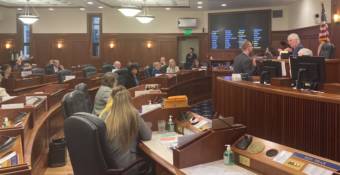
Alaska House of Representative members attend the first floor session of the second special session this year on June 23, 2021, in the Alaska State Capitol in Juneau. House Speaker Louise Stutes, R-Kodiak, on the far right, talks with Rep. David Eastman, R-Wasilla, about comments he was making on the floor. (Photo by Andrew Kitchenman/KTOO and Alaska Public Media)
Alaska House of Representative members attend the first floor session of the second special session of 2021 in June in the Alaska State Capitol in Juneau. A state commission voted for a preliminary plan on Tuesday that legislators receive higher salaries but lower per diems. (Photo by Andrew Kitchenman/KTOO and Alaska Public Media)

Alaska lawmakers would receive significantly higher salaries but reduced overall compensation under a plan that could go into effect soon. And that’s raising concern with at least some lawmakers from both major parties. 

Legislators could see their salaries increase from just over $50,400 now to $64,000 under a preliminary plan adopted on Tuesday by the State Officers Compensation Commission. The commission can recommend changes to lawmaker pay, as well as that of the governor, lieutenant governor, and commissioners of state departments. 

Sen. Johnny Ellis in the Alaska Senate chambers, March, 7, 2016. (Photo by Skip Gray/360 North)
Johnny Ellis, then a senator, speaks in the Alaska Senate chambers in March 2016. Ellis chairs the State Officers Compensation Commission, which voted on Tuesday to increase legislators’ salaries while reducing per diems. (Photo by Skip Gray/360 North)

Commission Chair Johnny Ellis, a former state senator, voted for the plan. He pushed back against a lower salary increase. He said Alaska legislators outside of Juneau face a unique challenge in maintaining two places to live. 

“It’s a hotel room, or it’s an apartment, or it’s a room in a private home in downtown Juneau,” he said. “That’s what we’re talking about. You have to maintain your place of residence in your district and you have a place to live in an expensive Juneau accommodation. That’s the reality of two households.”

The plan would also cut the amount legislators receive to cover their expenses during legislative sessions, known as per diems. The amount paid per day would drop from $293 to a maximum of $100, and legislators would only be reimbursed for documented expenses. 

Commission member Lee Cruise voted against the plan. He wanted a lower salary increase and an annual per diem limit to reduce what legislators receive for expenses. He pointed out that Alaska’s legislative salaries are already above the national average. 

“Why do they need so much more? No one has explained this to me,” he said. “No one has truly justified this to me. I just want a true justification for why they need more because I don’t believe it’s there; $50,000 is a lot of money.” 

Alaska legislators would move from having the 12th-highest salaries to the ninth-highest. 

But the overall amount they are paid would likely go down, compared to what they’ve received over the past 12 years. That’s because combined salaries and per diems have averaged nearly $80,000 over that period. 

Legislators from both parties expressed concern about the potential change to per diems. 

Juneau Democratic Rep. Sara Hannan doesn’t receive per diems, since the commission eliminated them for local legislators before she was elected. 

But she’s concerned that the proposed maximum won’t cover hotel bills that can be well over $200 per day during the cruise ship season. 

“So $100 per day — if it were the top season in the summer —  that doesn’t get you a room anywhere, let alone any meals,” she said. “And we do need to cover the cost of people having to live away from their workstations.”

Wasilla Republican Rep. David Eastman opposes the changes. He said it would reward lawmakers who miss session days since the salaries would be higher while they would receive less for each day in Juneau. And it would make it harder for legislators like him with families with children to cover their costs. 

“Before COVID, my family would always come with me to Juneau,” he said. “I have four small kids and it was important for us as a family to spend that time together. But with this new per diem policy, that basically prevents families like mine from coming with me to Juneau.”

The commission is scheduled to decide whether to adopt the plan as a set of final recommendations on Jan. 18. Under state law, they would go into effect unless the Legislature votes to block them. 

Eastman said he doesn’t expect there will be enough votes in the Legislature to block the changes. 

Gov. Dunleavy issues disaster declaration for Interior Alaska and Mat-Su storms

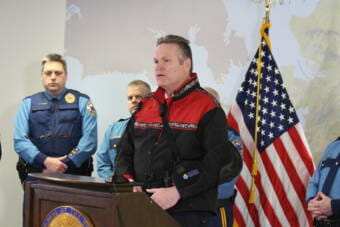
Gov. Mike Dunleavy discusses his 2022 budget proposal at a press conference on Dec. 15, 2021. (Wesley Early/Alaska Public Media)

Gov. Mike Dunleavy declared a disaster emergency on Monday for some areas in Alaska affected by severe winter storms.

Dunleavy’s declaration covers the Copper River and Delta/Greely areas, as well as the Fairbanks North Star, Denali and Matanuska-Susitna boroughs.

Extreme winds and cold temperatures have affected the areas. At one point over the weekend, 20,000 households in Mat-Su lost power. 
Dunleavy says now is the time to check in with neighbors and stay off the roads if possible. 

The declaration activates a program that provides assistance to individuals or families to meet disaster-related necessary expenses and serious needs. 

The Mat-Su Borough and American Red Cross established shelters at the Menard Sports Center in Wasilla and Palmer High School, in Palmer. 

A contingent of National Guard soldiers and airmen are activated in Fairbanks to assist the borough with any transportation needs.

This story has been updated to show that the Red Cross changed the shelter location in Palmer. 

Proposal would cut Alaska legislators’ daily allowance during sessions

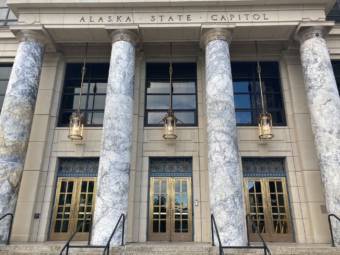
The Alaska State Capitol doors have required key cards to unlock throughout the 2021 legislative session, June 16, 2021. (Photo by Andrew Kitchenman/KTOO and Alaska Public Media)
The Alaska State Capitol on June 16, 2021. A state commission is considering proposals that would reduce how much legislators receive to cover their expenses during legislative sessions. One proposal would increase their salaries, while the other would not. (Photo by Andrew Kitchenman/KTOO and Alaska Public Media)

A new proposal would cut most of the amount of money Alaska lawmakers receive to cover expenses to live in Juneau during the legislative session. 

A member of a state commission that can change legislators’ pay proposed on Thursday that their expenses be limited to $12,000 per year. Legislators have averaged $29,481 in session expenses — known as “per diems” — over the last 12 years. 

Lee Cruise, a member of the State Officers Compensation Commission, made the proposal. He said legislators are paid too much. 

“We’re grossly overpaying our representatives, to the point where it’s, honest to god, it’s disgusting,” he said.

Cruise rejected the idea that the public should pay legislators for meals beyond what they receive in their salaries. Since 2011, Alaska legislators’ salaries have been $50,400 per year. 

“We do not need these people to live well,” he said. “We need them to live. The general public lives, they don’t live well.”

He notes that Alaska legislators’ are paid more than the national average. And he emphasizes that legislators are only required to work during the legislative session.

Under state law, the commission has the power to recommend changes to the salaries of legislators, the governor, lieutenant governor and the commissioners of state departments. Those changes go into effect unless the Legislature and governor reject them. 

Commission Chair Johnny Ellis floated the idea of raising legislators’ salaries. 

Ellis is a former state senator. He says being in the Legislature is more than a part-time job

“Living in your home district across the state and living in Juneau for an extended – at least 121 days under the constitution – the $50,400 has not kept up,”  he said.

Ellis said he has heard from members of the public that they would like to have legislators work for free. 

Cruise said it would be “absurd” to increase their pay. 

The commission also is considering a proposal that would shift how legislators are paid, with less of the money coming from per diems and more in salary. It would keep overall compensation, including salaries and living expenses, similar to what it has been in recent years.
Salary increases for the lieutenant governor and state commissioners are also being considered by the commission. That increase would cover some of the hikes in the cost of living in recent years. 

The pay for the governor and lieutenant governor has not changed since 2011. Commissioners’ pay last changed in 2015. Gov. Mike Dunleavy told the commission he opposed changing the governor’s salary. 

The commission is inviting legislators to respond to both proposals. And it will also be taking public comment on the proposals. 

The commission is scheduled to hold its next meeting on Jan. 4. The deadline for it to propose changes to the Legislature is Jan. 28. 


Gov. Dunleavy’s latest budget would fund $2,500 PFDs, public safety initiatives and big infrastructure projects

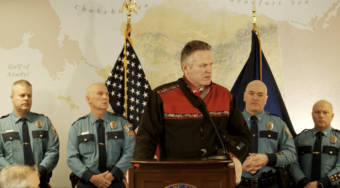
Gov. Mike Dunleavy discusses his 2022 budget proposal at a press conference on Dec. 15, 2021. (Wesley Early/Alaska Public Media)

Gov. Mike Dunleavy has proposed a budget for the next fiscal year that would keep state spending similar to the current budget, while increasing the size of permanent fund dividends.

Higher oil prices, lower pension obligations and large amounts of federal funding would allow the state to increase PFDs without spending down state savings for the first time in a decade, according to the Dunleavy administration.

Dunleavy said the state is in a better position than it was when he proposed deep cuts in his first budget. 

“We’ve done our best to contain the size of government and refocus where we want to put revenue and funding, especially in the areas of public safety, transportation and the things we’ve lined-out today,” he said a press briefing on Wednesday

He emphasized that the budget would spend less state money than the budget when he entered office. That doesn’t include the permanent fund dividend.

Dunleavy is proposing a roughly $2,560 permanent fund dividend. That amount is based on what’s known as the 50/50 dividend formula; it’s equal to half of what the state would draw from the permanent fund under a 2018 state law. It is the first of Dunleavy’s budgets that doesn’t include a PFD under the formula in a 1982 law, which is projected to be roughly $4,200.

Dunleavy repeated his call to amend the constitution to include the PFD.

“We’re having a tough time getting the Legislature to agree,” he said. “Nonetheless, we believe that most Alaskans would feel that a 50/50 is fair, we hope. And if not, we would find out at the polls when they vote on the constitutional amendment.”

Dunleavy continues to call for an additional $1,215 PFD payment to increase the amount paid this year, which was $1,114.

Dunleavy’s proposed budget includes funding for several public-safety-related programs, as well as $25 million to revive a proposed Juneau Access road north from the city. It also includes $175 million for port infrastructure for the Knik Arm, as well as $10 million for a deep draft port in Nome.

It includes another $10 million increase for what Dunleavy calls “statehood defense:” legal costs related to challenging actions by the federal government. Dunleavy cited state opposition to federal vaccine mandates and state support for oil, mining and other resource development as areas for statehood defense.

Legislative leaders in both chambers say they will scrutinize the proposed budget. Sitka Republican Sen. Bert Stedman, who co-chairs the Senate Finance Committee, said he wants to ensure that the state builds its savings while paying a fair PFD.

“It appears to me that they’ve spent all the funds they can get their hands on,” Stedman said. “Like a bunch of drunken monkeys putting a budget together in a case of euphoria.”

Dillingham independent Rep. Bryce Edgmon said legislators will question whether the state needs to take on long-term debt through a bond when a large amount of federal infrastructure money is on its way. He called the budget “aspirational.”

“It’s got a little bit in it for everybody, it seems,” he said. “Along with some pretty big-ticket items that I think are going to get heavily scrutinized by the finance committees in the Legislature, relative to: ‘OK, how do we fund it? You know, where does the money come from?'”

House Speaker Louise Stutes, R-Kodiak, said in a statement that one-time federal funding doesn’t fundamentally change the state’s “fiscal reality.”

Other items in the budget include funding to cover the full state costs for reimbursing municipalities for school bond debt, funding rural school construction and paying for community assistance – all of which had been funded at less than the full level in Dunleavy’s previous budgets. There’s also $55 million in the plan to replace the Napakiak School, due to erosion from the Kuskokwim River. And it revives Dunleavy’s proposal to split the Department of Health and Social Services into two: a Department of Health and a Department of Family and Community Services.

Dunleavy emphasized that the budget would spend less state money than the last budget proposed by his predecessor, former Gov. Bill Walker, who is running against him in the election next year.

This story has been updated with comments from the governor and legislators reacting to the budget.

Dunleavy announces wide-ranging ‘People First’ Initiative to address public safety in Alaska

Gov. Mike Dunleavy (left) and Alaska Attorney General Treg Taylor (right) at a press briefing on Dec. 14, 2021. (Screenshot)

On Tuesday, Gov. Mike Dunleavy announced a series of steps intended to reduce Alaska’s rates of domestic violence and sexual assault.

During a press briefing announcing his “People First” initiative, Dunleavy said the rates of these crimes remain high despite previous efforts to reduce them. He said he’s hopeful that this time will be different and that his administration should be judged on the outcomes.

“I think we’ve run out of reasons or excuses, to be honest with you,” he said. “And I’m not diminishing initiatives done in the past. I think there were some real attempts and genuine attempts to work on this.”

Dunleavy plans to introduce a bill that would increase criminal penalties related to domestic violence and sexual assaults, and to expand the range of offenses defined as domestic violence. He plans to launch new programs to assist victims of these crimes.
“The bill equips the Department of Law with additional resources and support needed to better protect victims and to bring perpetrators to justice,” said Attorney General Treg Taylor.

Dunleavy also plans to launch a new Missing and Murdered Indigenous Persons Council. And he’s asked for legislation to better define sex trafficking and to allow sex trafficking victims to expunge their records.

The administration will focus more state efforts on reducing the number of children receiving foster care and on aiding the transition of foster children to getting jobs.

The initiative also includes the creation of a statewide homelessness coordinator and a new database that would track homelessness and draw from different sources to better coordinate the state response.

On Wednesday, Dunleavy will announce his state budget proposal for next year. He said the initiatives he announced on Tuesday will cost “millions” of dollars, but that the overall budget would keep state spending below the level it was at when he took office.

Four lawsuits challenge Alaska Redistricting Board’s new legislative map

The Alaska Redistricting Board took the final legal steps to adopt this legislative district map on Nov. 10, 2021. (Screen capture from Redistricting Board website)
The Alaska Redistricting Board took the final legal steps to adopt this legislative district map on Nov. 10. Four lawsuits were filed against the board challenging the map by the deadline on Friday. (Screen capture from Redistricting Board website)

Four lawsuits have been filed against the Alaska Redistricting Board, seeking to change parts of the legislative map it adopted last month. Each lawsuit argues that communities were wrongly placed in the same district with other communities they have little in common with. 

Three of the lawsuits were filed by municipalities. 

Skagway argued in its lawsuit that it has much closer ties to downtown Juneau than it does with the Mendenhall Valley area of Juneau. But the new map includes Skagway and its neighbor Haines with the Mendenhall Valley. 

Both the Matanuska-Susitna Borough and the City of Valdez argue in their suits that they shouldn’t share district boundaries with each other.

The legislative districts drawn for Mat-Su have more residents than those in other parts of the state.

Mat-Su Borough Manager Michael Brown said the board could have used its mapping programs to draw districts with more even population numbers. 

“It doesn’t make a lot of sense,” he said. “It doesn’t have to be that way. And with the technology that exists today, it’s pretty easy to draw these lines and know exactly where you are.”

Valdez City Manager Mark Detter said it makes more sense for Valdez to be in a district with the Richardson Highway communities or those around the Prince William Sound than to be in one with part of Mat-Su. 

“We don’t share many commonalities, socioeconomically, or obviously in terms of our geography,” he said.

While the three lawsuits filed by municipalities focused on House districts, the fourth lawsuit focused on the Senate districts, which pair two House districts together. 

In particular, a lawsuit by three Anchorage residents raises a series of concerns about the board’s pairing two parts of Eagle River with the South Muldoon and Joint Base Elmendorf-Richardson neighborhoods. The lawsuit said the two Eagle River House districts could have been paired together into one compact Senate district. 

Joelle Hall is a member of a coalition, Alaskans for Fair Redistricting, that is providing financial support for the lawsuit. Hall is also the president of the  Alaska AFL-CIO state labor union federation. 

“Folks came out on the record and said, ‘Absolutely do not pair Eagle River with East Anchorage. We’ve seen it before. We don’t like it. Don’t do it again,’” she said.

She also said a comment by board member Bethany Marcum that the Eagle River Senate districts would provide the area with more representation was inappropriate. 

“Well, that’s unconstitutional,” she said. “You’re not supposed to be thinking about giving one community more representation versus another.”

She also says the board failed to provide the public with enough time to comment on the Senate pairings. 

Hall said it’s possible that if the lawsuit is successful, the Senate pairings could be changed ahead of this year’s election. She said it’s unlikely that the House districts will change before the election because of the complexities of drawing new district boundaries. 

In a brief emailed statement, the board said it will review the challenges and “respond through the court system as contemplated by the Alaska Constitution.” It said it wouldn’t be appropriate to comment further. 

Site notifications
Update notification options
Subscribe to notifications