
State Government Reporter, Alaska Public Media & KTOO
State government plays an outsized role in the life of Alaskans. As the state continues to go through the painful process of deciding what its priorities are, I bring Alaskans to the scene of a government in transition.
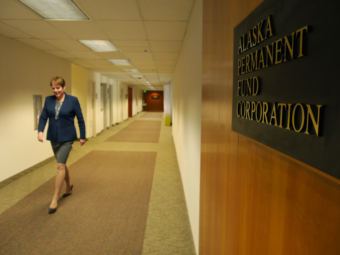
As the sun rises, Alaska Permanent Fund Corporation CEO Angela Rodell gives an early morning overview of the Permanent Fund and how the corporation invests on Tuesday, Jan. 30, 2018, in Juneau. (Rashah McChesney/Alaska’s Energy Desk)
Legislators say they want to know why the Alaska Permanent Fund Corp.’s board of trustees voted Thursday to remove its chief executive, Angela Rodell, effective immediately and with no explanation.
All five trustees appointed or reappointed by Gov. Mike Dunleavy voted to dismiss Rodell, while the only trustee who wasn’t a Dunleavy appointee — Bill Moran of Ketchikan — voted against it.
Anchorage Republican Sen. Natasha von Imhof said Alaskans deserve answers about Rodell’s sudden removal. She said she hopes to have the trustees at the Legislative Budget and Audit Committee meeting in January to get clarity.
“What direction do the trustees want to take the fund?” von Imhof said. “And I think Alaskans should be given answers to these questions, particularly for such a high-profile position. And to me, it’s just so curious, especially given the tremendous performance of the fund under Ms. Rodell’s leadership.”
Rodell had led the corporation since 2015. Under her leadership, the Permanent Fund has grown from $51 billion to $81 billion. Also, the fund began paying for most of the state budget. Before joining the corporation, Rodell was the revenue commissioner under then-Gov. Sean Parnell.
The trustees removed Rodell at the end of two days of meetings. They closed parts of both meetings to the public to discuss the annual evaluation of Rodell’s performance as executive director.
After returning from the second closed session on Thursday, it took the trustees just over two minutes to remove Rodell, name corporation Chief Financial Officer Valerie Mertz as the acting executive director and end the meeting. There was no public discussion.
Board chair Craig Richards did not return a request for comment on Thursday, and Rodell could not be reached.
Two legislative leaders sent a letter to Richards on Friday, seeking an explanation for the board vote. Sen. Gary Stevens, R-Kodiak, and Rep. Bryce Edgmon, I-Dillingham, said they wrote to express their “grave concern over the sudden and inexplicable termination” of Rodell.
“Ms. Rodell’s track record is nothing short of exemplary, she has always been a steadfast professional, and did everything within her power to shield the Fund from outside political interference,” wrote the two legislators who chair the House and Senate rules committees. “We strongly believe that the public and legislature deserve an explanation for the action the board took yesterday. We eagerly await your response.”
In September, Rodell and some of the trustees differed over the corporation’s proposed budget, with Rodell asking them whether they were committed to the permanent fund’s independence.
Rodell has also publicly advocated for following the rules that limit the state’s annual draw from the fund’s earnings. She has noted that following those rules is the longstanding position of the board itself. As recently as 2020, the trustees passed a resolution that called the rules “essential.”
But Dunleavy has said that the state can afford to draw more than that limit, noting the recent stock market growth. He has proposed paying larger permanent fund dividends, and to put the dividend and an annual limit to draws in the state constitution. Neither legislative chamber has voted to send Dunleavy’s proposed constitutional amendment to a vote of the people.
Von Imhof said with the highest inflation in decades, it’s critical that the fund’s investment decisions are prudent.
“It’s extremely important for the permanent fund to be independent and that it does not become politicized,” she said.
Anchorage Democratic Rep. Andy Josephson said he was deeply concerned about Rodell’s removal.
“I think that her reputation is stellar,” he said. “And she’s known for her intelligence and candor. She’s appreciated by both sides of the aisle. And she’s been successful at what she does. And she’s trusted.”
Josephson said Rodell’s removal will only make him “more intransigent” in supporting following the rules limiting draws from permanent fund earnings.
Josephson is considering drafting a bill to change how the permanent fund’s trustees are appointed. He said allowing the governor to appoint all of the trustees — as under the current system — gives one person too much power.
Alaska Permanent Fund Executive Director Angela Rodell at the corporate office, March 14, 2016. (Photo by Skip Gray/KTOO)
The Alaska Permanent Permanent Fund Corp. board of trustees voted 5-1 on Thursday to remove Executive Director Angela Rodell from the position, effective immediately.
It’s not clear what led to the change in leadership. There was no public discussion of why the board removed her before or after the vote.
The vote came quickly after the board ended a closed session to discuss the annual performance review of Rodell’s work. The board held a similar session focused on Rodell yesterday.
Corporation Chief Financial Officer Valerie Mertz was appointed to serve as the acting executive director. Mertz has been the CFO since 2012.
Rodell had served as the head of the corporation since 2015. The fund grew from $51 billion to $81 billion during her tenure.
Rodell asked whether the board was committed to building the corporation’s capacity to manage its investments using its own employees. She said an alternative would be to end the corporation as a separate body and move the permanent fund to be under the control of the Department of Revenue.
The two members of Gov. Mike Dunleavy’s cabinet who are trustees – Mahoney and Natural Resources Commissioner Corri Feige – voted against the corporation’s budget proposal in September.
At the September meeting, Mahoney had proposed cutting $900,000 in employee pay from the $218 million budget proposal. She expressed concern with what she said were the “optics” of paying corporation employees more during a period in which the Legislature has paid for smaller permanent fund dividends than what would have been paid under the formula in a 1982 state law.
William Moran was the sole vote against removing Rodell. He had served as the board’s chair for one year, through the late September board meeting. Craig Richards replaced him as the chair.
The trustees who voted for Rodell’s removal were Steve Rieger, Ethan Schutt, Feige, Mahoney and Richards.
This story has been updated with additional information.
Alaska Gov. Mike Dunleavy, Lt. Gov. Kevin Meyer and Rose Dunleavy talk before the open house at the Governor’s Mansion on Dec. 7, 2021, in Juneau. (Photo by Andrew Kitchenman/KTOO and Alaska Public Media)
Less than a year before the next gubernatorial election, both Lt. Gov. Kevin Meyer and Gov. Mike Dunleavy have to decide if they’ll run together again – even as they face a new election system, and questions from some Alaska conservatives about Meyer’s handling of the last one.
In May, Meyer was the first major-party candidate for any office in Alaska to file a letter of intent to run next year. But he doesn’t get to decide whether voters will have a chance to vote for him again. That’s Dunleavy’s call.
Dunleavy hasn’t made an announcement about what his plans are for the ticket, but Alaskans could learn soon. Dunleavy and Meyer released a joint statement through Dunleavy’s campaign on Wednesday saying they will be making an announcement before the holidays.
In the past, candidates for governor and lieutenant governor ran separately in the primary, then formed joint tickets in the general election.
Meyer said last week that, “as of right now,” Dunleavy said he wanted Meyer to be his running mate. But he acknowledged that could change.
Dunleavy could take heat from supporters regardless of what he decides. Meyer is at the center of criticism from conservative voters in places like the Matanuska-Susitna Borough, a stronghold for Dunleavy in the 2018 election. That’s because in Alaska, the lieutenant governor oversees elections. And conservatives are unhappy with how last year’s election was conducted.

But Meyer said he deserves another term, and he defended how the state handled the election in a wide-ranging interview.
He said he wants to finish the work he started over the past three years, with a focus on the economy and on Arctic issues.
Meyer previously served in the state Senate and House, as well as the Anchorage Assembly. He said his experience has prepared him to fill in as governor if needed.
“You want to make sure that the lieutenant governor — the second-in-command — is able and willing and can step up without any difficulty,” he said. “And I think my 30 years in elected office gives me that experience that, so far, I haven’t seen any other lieutenant governor candidates have.”
Meyer defeated five rivals for the Republican nomination for lieutenant governor in 2018, to join a ticket with Dunleavy, who separately won the Republican primary for governor.
Voters make their way to the polls despite a blizzard on Nov. 3, 2020, in Bethel. (Photo by Katie Basile/KYUK)
One voter who doesn’t plan to support Meyer – or Dunleavy – this time is Mat-Su resident Dave Maxwell. He’s a retired electrician who prepared an online petition that calls for an audit of the last election, with a focus on Ballot Measure 2.
He said he believes there were many things wrong with the election. They include the state’s use of Dominion Voting Systems machines to count ballots. Maxwell emphasized that Alaskans told Meyer about their concerns with Dominion well before the election.
Maxwell said Meyer would have to do a lot to earn back voters’ trust.
“Kevin Meyer and his staff have lost the trust, the faith, they have lost faith in terms of this citizenship: We don’t trust them anymore,” he said. “How do you think you’re going to get that back? Just by making the next move the right move? How about, just go back and fess up what you did, and try to restore the relationship. Then, make the next move.”
Maxwell wants an election audit to go deeper than the recount Meyer ordered of Ballot Measure 2 — Maxwell wants investigators to take steps like examining whether the ballots that were counted were really ballots.
“How about a forensic audit? We treat this thing like a crime scene,” he said. “Not just go back and just … well, one, two, three. I’m sorry, that’s not what we’re looking for. We suspect a crime scene just like they have seen in Michigan, Wisconsin and Florida, just to name a few.”
Maxwell would like to see Dunleavy drop Meyer from the ticket. But he also said Dunleavy – who he once supported – should drop out of the election as well. He said there were many reasons, including Dunleavy’s handling of COVID-19.
Through Thursday evening, Maxwell’s petition had 278 signatures.
Conservative supporters of former President Donald Trump have been demanding audits of the 2020 ballots and questioning the use of Dominion machines in states across the country. Trump has spread a conspiracy theory that Dominion altered ballots, which election experts have said is false.
And nonpartisan voting experts have said state officials overseeing elections are under attack across the country based on lies told by Trump and people surrounding him.
David Becker heads the nonprofit Center for Election Innovation and Research based in Washington, D.C. Becker has done work for Alaska and other states on election accessibility and security.
Becker said there was more scrutiny and transparency in the 2020 election in both Alaska and nationally than ever before. He said the election system in Alaska and other states is the gold standard around the world, including the state’s reliance on paper ballots that can be audited.
“The 2020 election, by any objective measure, was the most secure election in American history, and in every state’s history,” Becker said.
Voters sign for their ballots at the Auke Bay precinct on, Nov. 3, 2020, in Juneau. (Photo by Rashah McChesney/KTOO)
He said Alaska had a “very successful” election, and credited Meyer with handling it – as well as post-election concerns – in a fair way.
Becker said there could be ways to improve how ballots are audited. But he said elected officials should talk with voters honestly about the strengths of the voting system. And he said those who lie about election results are doing the work of countries that want Americans to distrust elections to undermine the country.
“They need to be accountable for their lies and their incitement,” Becker said. “There need to be investigations. There need to be prosecutions. There needs to be jail time. And there needs to be civil judgments and penalties.”
Becker cited attacks on Dominion machines as an example, noting that investigators have disproved allegations repeatedly. And he noted that prominent people who’ve attacked Dominion are facingdefamation lawsuits.
Meyer said every allegation made regarding Alaska’s election has been investigated or is under investigation. He encouraged those who have questions about the process to become election workers or observers.
But he also said some concerns reflect misinformation voters have received.
“We were geared up for the misinformation coming from international sources,” he said. “But what has surprised me the most – and probably caught me off-guard the most – was the misinformation we’re getting from domestic sources.”
Meyer said it’s been shocking.
“I mean, there’s a movement here, in all 50 states, to still challenge the 2020 election,” he said. “And we have found no evidence to indicate any fraud in the election, at least in Alaska.”
Meyer said that Dominion machines were chosen based on the state procurement processes and that the machines aren’t tied to the internet. And he noted that he ordered a hand count of the Ballot Measure 2 results, which did not change the outcome. He added that a nonpartisan state review board certified the election results.
Meyer said it bothers him that election workers who are dedicated to their work have faced criticism over the election.
He has proposed some changes to the election system that would require the Legislature to pass a new law. They include increasing the number of ballots that are audited.
Meyer said that he and Dunleavy have a relationship that’s typical for a lieutenant governor and governor.
When Meyer was asked on Friday whether Dunleavy has told whether he plans to have him be his running mate, he said:
“Yes, he has asked me, and I said yes,” Meyer said. “Now, you know, things may happen between now and June 1. But as of right now we’re running as a team.”
Independent former Gov. Bill Walker of Anchorage has picked Heidi Drygas of Juneau to serve as his running mate.
Libertarian Billy Toien has chosen Shirley Rainbolt. Democratic former Rep. Les Gara and Republican Rep. Christopher Kurka have not announced their running mates.
Kurka and a prominent supporter, Joe Miller, have criticized the election administration. Miller has said that he still has questions about a hack of the state’s voter registration system before the election.
Meyer said the FBI and the U.S. Department of Homeland Security’s Cybersecurity and Infrastructure Security Agency investigated the hack and found no evidence of any fraud. He said both his office and the Division of Elections have made data security their top focus.
Meyer said he’s concerned that statements like Miller’s may undermine Alaskans’ trust in elections.
“Anybody can say that. That’s a very open, subjective comment,” he said. “But I’m going to go with what the FBI and CISA – Homeland Security – had told me, in that none of this information was used in a fraudulent manner.”
Meyer’s oversight of elections will be put to another test this year, as the state puts its new election system into practice.
Gov. Mike Dunleavy and Juneau Mayor Beth Weldon speak just before the governor’s holiday open house began on Tuesday at the Governor’s Mansion in Juneau. Alaska First Lady Rose Dunleavy is on the left. It was the first open house in two years, due to the pandemic. (Andrew Kitchenman/KTOO and Alaska Public Media)
On Tuesday, Gov. Mike Dunleavy and his wife Rose hosted the first holiday open house at the governor’s mansion in two years.
The open house has been held every year since 1913, except for two years during World War II and last year, due to the COVID-19 pandemic.
This year’s crowd was smaller than usual.
The tree outside the governor’s mansion is a 14-foot-tall pine from Etolin Island near Wrangell. It’s decorated with ornaments made by students from the Ketchikan Gateway Borough School District.
Masks were available at the door, though most of the early visitors were not wearing them, nor were the Dunleavys.
Because organizers weren’t sure how many people would be here, there were 11,000 cookies. Usually there would be roughly 15,000. And they were individually wrapped this year rather than arranged on trays.

Dunleavy was asked by a reporter before the open house what his Christmas wish was this year. It had to do with the upcoming legislative session.
Dunleavy said he wished “that we can all come together and tackle some of the most difficult issues that Alaska’s faced over the last couple years. I think we’ve worked well together on this virus issue and a whole host of other issues. We just have a few issues that are still pending in the Legislature. And I think if we get those settled, Alaska’s going to be in great shape.”
The first day of the session is scheduled for Jan. 18.
The MV LeConte sits at the dock in Angoon on March 28, 2019. Late on Friday, the ferry system added sailings for the LeConte, as well as the MV Kennicott, to help fill in the gap caused by a delay in return of the MV Matanuska. Legislators and aides made changes or rebooked ahead of the start of the legislative session. (Photo by Nat Herz/Alaska’s Energy Desk)
Some Alaska lawmakers and aides who normally take a ferry to Juneau for the legislative session were scrambling to make travel plans when they found out the Matanuska would not be back in service before the new year as planned.
Late last week, the Alaska Marine Highway System had no sailings from Haines to Juneau for January. The ferry system is how many legislators get themselves and their vehicles to Juneau for the session.
Over the weekend, though, new trips were added for the LeConte and Kennicott and everyone who had planned to go from Haines to Juneau was rebooked.
Rep. Andy Josephson, a Democrat, usually packs up what he needs for the session in his car, and drives from Anchorage to Haines and takes a ferry to Juneau. He changed his plans and will ship the car from Whittier and fly to Juneau.
He said he will miss his annual routine.
“I’m not one who’s objected to having to do it that way, and make the drive through the Yukon and British Columbia,” he said. “I got some satisfaction out of it.”
Juneau Democratic Sen. Jesse Kiehl said the ferry system should be prepared to avoid situations like what happened last week. He said he appreciates that the system rebooked passengers for other trips, but it’s too late for those who had to make alternative travel plans.
“That is a good adjustment,” he said. “Now, it’s cold comfort if you’re a citizen who bought all their plane tickets and hotels and now has to change all their reservations and stay extra nights somewhere.”
The first day of the legislative session is scheduled for Jan. 18.
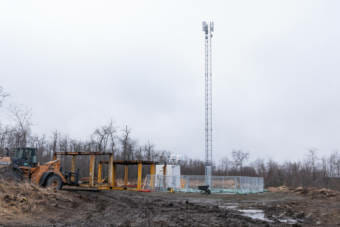
Akiak is a small Yup’ik community on the Kuskokwim River in Western Alaska. The rural village has never had access to affordable high-speed internet, but all of that will change this fall when every resident gains access to broadband internet through low Earth orbit satellites. A state task force report on expanding broadband across Alaska was publicly released on Friday. (Katie Basile/KYUK)
Providing every Alaskan with a high-speed internet connection is a challenge, considering the state’s far-flung geography and extreme weather. But the new federal infrastructure law has $1.5 billion for broadband in Alaska. And that could help the state reach its goal.
Hallie Bissett, the chair of Gov. Mike Dunleavy’s task force on broadband, said the amount of money coming into Alaska is a huge opportunity to connect the state.
The task force just wrote a report that could help the state decide how to spend that $1.5 billion.
Bissett said the first step will be to connect some communities using satellites.
“We have so many villages that are still not even getting … basic service,” she said.
Eventually, the goal is to connect communities across the state with fiber-optic cables.
One of the hoops the state must jump through is to establish a new broadband office, as required by federal rules. Bissett said the office will also be important to making sure all broadband money is spent effectively. And broadband money won’t just be coming from the federal infrastructure law. Another opportunity will be for the state to work with tribal organizations, which are also receiving federal broadband funding.
The task force report said federal funding should be used to make the costs to internet customers equitable because some communities will be more expensive to connect.
It will take some time for the new federal infrastructure money to reach communities. First, the federal government must map existing internet connections, down to the individual buildings. That may not be done until late in 2022 or early in 2023.
Bissett said the best guess now is that it will take up to 10 years to connect the entire state with broadband.
“I think the real goal here is to get individual service out for every single citizen,” she said.
Other task force recommendations include streamlining state permitting for broadband projects and establishing a board to advise the state on broadband, as well regional broadband planning committees to work with local government, Native leaders and the general public.
One area where broadband can make a difference is in schools. State Education Commissioner Michael Johnson served on the task force. He says broadband access is essential to students.
“You can teach well without technology, but technology extends the benefit of access to content,” Johnson said. “Technology extends the benefit of a great teacher to more and more kids.”
Dunleavy now must decide what to do with the task force’s recommendations.
Close
Update notification options
Subscribe to notifications
Subscribe
Get notifications about news related to the topics you care about. You can unsubscribe anytime.