Andrew Kitchenman

State Government Reporter, Alaska Public Media & KTOO

State government plays an outsized role in the life of Alaskans. As the state continues to go through the painful process of deciding what its priorities are, I bring Alaskans to the scene of a government in transition.
New Alaska Senate map takes shape, with Eagle River gaining a senator

Alaska Redistricting Board Chair John Binkley addresses the public at the end of an all-day meeting on Nov. 8, 2021, in the board office in Anchorage. The board decided on state Senate district boundaries during the meeting. (Photo by Andrew Kitchenman/KTOO and Alaska Public Media)
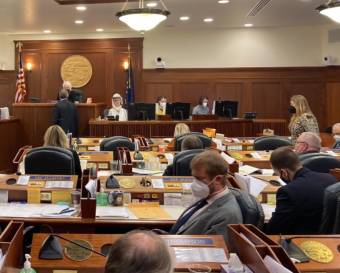
Alaska Redistricting Board Chair John Binkley addresses the public on Zoom at the end of an all-day meeting on Monday in the board office in Anchorage. Board members Bethany Marcum and E. Budd Simpson are on the left. The board decided on state Senate district boundaries during the meeting. (Screen capture of Zoom stream)

The Alaska Redistricting Board spent Monday drawing the district lines for the state Senate. 

The board, which was required to pair House districts to set the Senate boundaries, chose a Senate map for Anchorage drawn by board member Bethany Marcum. 

Marcum, who was appointed to the board by Gov. Mike Dunleavy, said she started her Anchorage map by combining the House district that includes Joint Base Elmendorf-Richardson with one that includes part of Eagle River. 

That means heavily Republican Eagle River, currently represented by Sen. Lora Reinbold in the Senate, will now be represented by two senators.

The map puts Democratic Senators Tom Begich and Elvi Gray-Jackson into the same Senate district. Republican Senators Mia Costello and Natasha von Imhof also were moved into the same district. 

The five Senate districts representing coastal Alaska from the Arctic to Southeast will remain similar to their current boundaries. But Seward was split off from the Bear Creek area immediately north of the city and placed in a Senate district with Kodiak and Homer. 

Chevak moves from the Senate district that also includes Nome and Utqiagvik to the district that includes Bethel and Dillingham. And Yakutat moves from a district that stretches west to Kodiak to one stretching south to Ketchikan.

North Pole’s House seat will now share a Senate seat with Eielson Air Force Base instead of with Chena Ridge, as it does under the current map. And the rural Interior will share a Senate seat with the Ester and College areas west of Fairbanks rather than communities in the western part of the Fairbanks-North Star Borough. 

The map is based on the U.S. census completed last year and will be used for the first time in the open primary next year. However, it could face a legal challenge. The board has been sued over redistricting maps in the past. 

The board still must decide which areas that held Senate elections last year will have to hold new elections next year. Senate terms usually last four years, but are shortened when district lines change significantly during redistricting. The deadline is Wednesday.

Alaska Redistricting Board chooses map that emphasizes compact districts in Anchorage

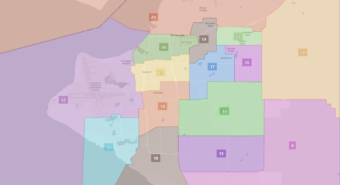
The Alaska Redistricting Board adopted this map for the Anchorage districts in the House of Representatives on. Board member Nicole Borromeo drew the Anchorage map. The board also voted 4-1 to adopt a statewide House map on Nov. 5, 2021. The numbers may be changed on Monday. (Screen capture of Alaska Board of Elections website)
The Alaska Redistricting Board adopted this map for the Anchorage districts in the House of Representatives on Friday. Board member Nicole Borromeo drew the Anchorage map. The board also voted 4-1 to adopt a statewide House map. The district numbers in the map may be changed on Monday. (Screen capture of Alaska Board of Elections website)

The Alaska Redistricting Board adopted a new map for the Alaska House of Representatives districts on Friday. 

The board voted 4–1 in favor of the map. 

The map is based on last year’s U.S. census. It could affect who controls the House for the next decade. 

Board member Nicole Borromeo drew the Anchorage portion of the map. She said she aimed to draw compact districts while staying within legal limits for population differences. 

“The Supreme Court has said: ‘Focus on compactness and contiguity,’ and, then, other things as well,” she said.

Borromeo was appointed by former Alaska House Speaker Bryce Edgmon, a Dillingham independent.

Board member E. Budd Simpson voted for Borromeo’s Anchorage proposal rather than an alternative proposed by board member Bethany Marcum. Simpson and Marcum are Gov. Mike Dunleavy’s appointees to the board. 

Simpson said the benefits of more compact districts in the final map make it more likely to withstand a legal challenge than Marcum’s proposal. 

“The districts are kind of more square and (have) fewer odd corners and things like that,” he said. 

Marcum was the only member to vote against the final map. 

“There are parts of this map that I think are very good. But in all good conscience, I know there are parts that are not the best that they could be,” she said.

Several members of the public criticized the adopted map for including the Goldstream area in a rural Interior district, rather than a district based around Fairbanks. 

The board plans to determine which House districts will be paired to form Senate districts on Monday. It also must decide which Senate districts that held elections last year must hold new elections next year because their boundaries have changed too much. Senate terms usually are four years, with half of the seats up for election every two years.

The board must finish its work by Wednesday. 

CORRECTION: This story has been corrected to reflect the fact that Borromeo was appointed by former Alaska House Speaker Bryce Edgmon.

Fourth special session ends quietly for Alaska Legislature

Dunleavy hasn’t proposed a tax. And it’s not clear how his plan  would pay for both larger PFDs and the budget, beyond the next couple o f years. What he has proposed is a one-time, three-billion-dollar draw from permanent fund earnings. That’s projected to be enough to cover the budget and this year’s and next year’s dividends at the level he proposes, maybe a third year. 
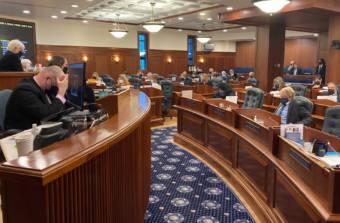
The Alaska House of Representatives meets on Oct. 4, the first day of the fourth special session, in the Capitol in Juneau. The session ended on Tuesday, more than three weeks after either chamber held a regular floor session. (Andrew Kitchenman/KTOO and Alaska Public Media)

Tuesday was the last day of the fourth special session for the Alaska Legislature this year.

It ended quietly, with neither the Senate nor the House of Representatives meeting. 

The Senate held just one regular floor session during the special session, on its first day. A majority of senators weren’t in Juneau for the rest of the time. 

The House held two regular floor sessions, on the first and ninth days of the special session. Most House members also returned to their home districts.

There were also relatively few committee meetings over the 30-day special session. 

In calling the fourth special session, Gov. Mike Dunleavy asked for the Legislature to fund another permanent fund dividend payment, of roughly $1,200. Legislators had funded a PFD of $1,114 in the third special session. 

Dunleavy also called for the Legislature to enshrine the PFD in the state constitution and to lower the state’s limit on spending. 

Legislative leaders expressed concern about the effect of a second PFD payment on the permanent fund, saying the state should not draw more than planned from fund earnings without agreeing on a long-term budget plan. 

Dunleavy has said that he doesn’t plan to call a fifth special session this year.

Higher oil price could affect debate on Alaska’s long-term budget plan

Rep. Dan Ortiz, I-Ketchikan, speaks during a House floor session in Juneau on March 29, 2019.
Rep. Dan Ortiz, I-Ketchikan, speaks during a House floor session in Juneau in March 2019. Ortiz said on Tuesday that the improved state revenue forecast will likely reduce support for new taxes. (Photo by Skip Gray/360 North)

Ketchikan independent Rep. Dan Ortiz has been looking at a proposal that would rewrite the formula for setting permanent fund dividends, while also adding taxes. But with the recent price of oil raising state revenue, he said the case for taxes is harder to make. 

“It’s always going to be a lift for legislators to come to a consensus on added revenue — or a tax, passing a tax — and with this new revenue forecast, I think it makes it that much more difficult,” he said. 

The new revenue forecast is a preliminary report the state Department of Revenue released on Friday. It forecasts higher oil prices will add $1.2 billion to the budget this year. And if those prices hold up, an average of $1 billion in additional revenue would come in every year, compared with the spring forecast

That could be enough money to pay for Gov. Mike Dunleavy’s PFD proposal, without a new tax, or substantial state budget cuts, based on a computer model that nonpartisan budget analysts use. But lawmakers have noted that the price of oil is unpredictable.

Ortiz said that even with the higher forecast, he’s not more likely to back Dunleavy’s PFD proposal. He said it must be weighed against the state’s other needs and the importance of protecting the permanent fund. 
“To put a quote ‘long-term fiscal plan’ on the basis of recent oil price increases holding? To me? No,” he said. “No, I just don’t think that that’s sound policy.”

While the House majority caucus that Ortiz is a part of has largely opposed Dunleavy’s PFD proposals, most minority caucus Republicans support them.

Nikiski Republican Rep. Ben Carpenter said that while oil prices are unpredictable, the Legislature has to begin somewhere in analyzing policy choices. 

“You know, it’s been a number of years since we’ve had real high oil prices,” he said. “And maybe people have forgotten what it’s like to have those large revenue streams coming in from the oil companies.”

Carpenter said he hopes that more revenue even in the short term can allow legislators to consider the long term. 

“When we don’t have enough money to go around for the budget and difficult decisions have to be made, that raises the blood pressure of all of the decision-makers,” he said. “It makes conversations more difficult and emotions get high.”

Brian Fechter, the state’s deputy revenue commissioner, worked on the forecast. Fechter said the state is more confident in the short-term forecast. 

He said more detailed information will be included in the final forecast, which is scheduled for December.

Fechter said the department knows that oil prices can turn on a dime. But he said that even short-term price increases can bring long-term benefits. 

“A higher oil price means higher royalties, which means more money is getting deposited into the permanent fund, which benefits us in those future years,” he said.

Dunleavy also said he understands oil prices are volatile.

“I’ve been here long enough to experience it, since the ’80s,” he said.

But he said a day before the forecast was released that some lawmakers skeptical of relying on high oil prices were already opposed to his proposals. 

“Nobody knows what tomorrow’s going to bring,” he said. “We didn’t predict a pandemic. We can’t predict earthquakes. We understand that. We do our best guesses and our best estimates.”

With the fourth special session coming to an end on Tuesday, lawmakers are looking toward the next regular session.

Fairbanks Republican Rep. Bart LeBon said the revenue estimates can help. But at the end of the day, he said, the Legislature will have to weigh the state’s needs each year whatever the price of oil is.

“Today, we’re north of $80. A year from now, we could be under $50,” he said. “I just don’t know how to predict the future trends in the price of oil.”

The first day of the next regular session is Jan. 18.

Rise in oil prices could add $1.2B in state revenue for Alaska, preliminary forecast says

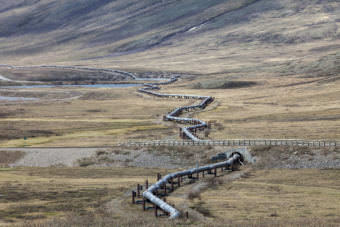
An above-ground section of the Trans-Alaska Pipeline System near the Toolik Lake Research Station in the North Slope Borough. (Photo by Rashah McChesney/Alaska's Energy Desk)
An above-ground section of the Trans-Alaska Pipeline System near the Toolik Lake Research Station in the North Slope Borough. (Photo by Rashah McChesney/Alaska’s Energy Desk)

The recent increase in oil prices could lead to the state government receiving $1.2 billion in revenue more than expected this year.

That’s according to a preliminary revenue forecast released by the state Department of Revenue on Friday. The final forecast will be made in December. 

While the state forecast in March that oil would average $61 per barrel this year, the update forecasts it at $81.31. The current price is $85.50 per barrel. 

The preliminary report also forecasts an increase in daily North Slope oil production of nearly 30,000 barrels this year, compared with the spring forecast. 

But it forecasts a slight decline in production for the rest of the decade, compared with the spring. The state says that’s due to “increased uncertainty for large projects caused by federal litigation and financing issues.”

Alaska Legislature breaks record for days in session, with frustration rising to the surface

The Alaska House of Representatives meets on the first day of the fourth special session of the year, on Oct. 4, 2021, in the State Capitol in Juneau. The House passed a resolution that would have allowed the Legislature to leave Juneau for up to eight days, but the Senate didn't consider the measure. (Photo by Andrew Kitchenman/KTOO and Alaska Public Media)
The Alaska House of Representatives meets on the first day of the fourth special session of the year, on Oct. 4, in the Capitol. On Thursday, the Legislature was in session for its 212 day of the year, breaking a record set in 2017. (Photo by Andrew Kitchenman/KTOO and Alaska Public Media)

The Alaska Legislature set a record on Thursday for the number of days that it’s been in session in a year — 212. But that doesn’t mean lawmakers have been in the Capitol lately. There’s an impasse on what changes should be made to balance the state’s budget in the long term. 

Senate President Peter Micciche says he has been away from home so much this year, his  7-year-old daughter Stella looks older. 

“She looked different when I got home,” he said. “A 7-year-old changes a lot in seven months. We’ve been gone a long time, and I don’t have a lot to show for it. And I think it’s because we keep trying to grind it out here in Juneau in the Legislature. And that method is not working.”

After the 121 days of the regular session, Gov. Mike Dunleavy has called the Legislature into four special sessions. The Legislature passed the budget in the first 30-day special session in May and June. It came back for the six-day second special session in late June to avoid a partial state government shutdown. It voted to fund a permanent fund dividend in the third special session, which was also 30 days.

The fourth started on Oct. 4 and must end by Tuesday. Altogether, the 212 days in session breaks the previous record of 211 days set in 2017. Lawmakers spent the bulk of their time in Juneau during the regular and first three special sessions, but nearly all have been home during this session.

Micciche, a Soldotna Republican who is in Juneau, said senators needed time away from the Capitol. 

“You hear all of these people sort of receding back into those camps, which tells me that this special session drove people apart. Our job as 60 legislators and the governor’s office is to bring those people back together,” he said. 

Micciche said he plans to talk to all 20 senators between now and the regular session, which starts on Jan. 18. And his goal is to find enough common ground for legislation that can pass. He said insisting on holding votes for bills that don’t have support is political.

“We can put bills on the floor that don’t have adequate support. And we can watch them flounder,” Micciche said. “And we can let people mark each other on the record. Coming on an election year, that’d be handy: ‘This guy voted no on this thing.’ ‘This guy voted yes on this thing.’ Or, we can work together to actually deliver some results for the people of Alaska.”

Some of the senators in Micciche’s caucus wanted the Legislature to act on the agenda Dunleavy laid out for the session. 

Palmer Republican Sen. Shelley Hughes said it’s disturbing that the Legislature is breaking the record for the number of days in session without passing more bills. 

“I’m frustrated and I’m embarrassed,” Hughes said. “Had we accomplished what we set out — the task we were handed — which is to settle the fiscal matters and to fix the problem that’s before us, then, it’s like, ‘Whew, that many days, but at least we got the job done.’” 

Fellow Republican Sen. Roger Holland of Anchorage shared a similar perspective as Hughes. 

Holland has spent 30 years in the U.S. Coast Guard Reserves. And he said he saw the long session as a deployment. But it’s a deployment that ended without a sense of accomplishment. 

Both Holland and Hughes recently signed a letter asking for the Senate Finance Committee to take action on Dunleavy’s proposal to pay a second permanent fund dividend of roughly $1,200. 

“Sadly, this is just another do-nothing, get-nothing-accomplished, kick-the-can-down-the-road Legislature, and I’m ashamed to be a part of it,” he said. “I’m having great difficulties with remaining in the Senate Majority.”

Anchorage Democratic Rep. Ivy Spohnholz has been active this year, chairing the new House Special Committee on Ways and Means. The committee is considering long-term budget proposals, remaining active during the fourth special session. 

Spohnholz said her goal is to lay the groundwork for the regular session.

“It has been a tiring experience,” she said. “We’re supposed to be a citizen Legislature with essentially a 121-day session. And we’re now had four additional months tacked onto that, which has been — yeah, that’s been a challenge.”

Spohnholz said Dunleavy could engage more with lawmakers. 

“It’s the governor that’s called all of these special sessions,” she said. “And if the governor wants to get his legislative agenda passed, it behooves him to, you know, participate in the process.”

The cost for holding the ongoing sessions is adding up. The first three special sessions have cost an additional $1.76 million, according to the nonpartisan Legislative Affairs Agency. And the preliminary costs for the fourth special session through Tuesday were another $125,000. 

North Pole Republican Rep. Mike Prax said at this point, it will probably take another election before the Legislature acts on a long-term budget plan. He wanted more votes to be held on Dunleavy’s proposals, so voters would know where legislators stand. 

Prax decided to stay home for the fourth session, noting that it’s harder for Fairbanks area lawmakers to commute to Juneau than it is for those in Anchorage.

“You can go down there. People are playing that game: They go down there in the morning, and come back in the afternoon,” he said. “But to get back and forth to Fairbanks, it takes two days to be down there.  The flights don’t connect and you can’t get back and forth. It’s a huge waste of time and money.”

Dunleavy said he’s done what he could do. 

“The product that’s going to come out of this session is zero,” he said. “Not a thing. And we all know that there are issues that need to be solved. And we provided an opportunity for those issues to be solved.”

Dunleavy said some legislators have asked him to do “everything.” 

“Personally, I think the Legislature should start looking at folks that can negotiate solutions to these issues,” he said. “Right now just seems to be a whack-a-mole scenario, where somebody comes up with an idea and somebody says ‘it’s not going to work’ or ‘we need more time.’ Or ‘we’re tired.’ Or ‘we’re waiting for springtime.’ Or something.” 

Dunleavy said he won’t call a fifth special session. He said it would be pointless.


Correction: This has been updated to reflect the correct first day of the next regular session.

Site notifications
Update notification options
Subscribe to notifications