State Government Reporter, Alaska Public Media & KTOO
State government plays an outsized role in the life of Alaskans. As the state continues to go through the painful process of deciding what its priorities are, I bring Alaskans to the scene of a government in transition.
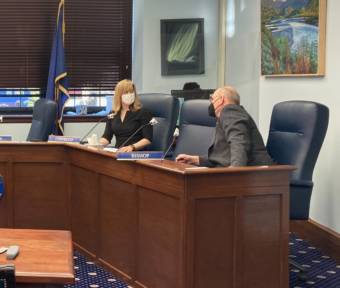
Sen. Mia Costello, R-Anchorage, and Sen. Click Bishop, R-Fairbanks, talk before a committee meeting in April in the Capitol. On Monday, Costello was one of six Republican senators who sent a letter to Bishop and fellow Senate Finance Committee co-chair Sen. Bert Stedman, R-Sitka, asking them to allow a vote on a bill that would pay an additional roughly $1,200 in permanent fund dividends this year. (Photo by Andrew Kitchenman/KTOO and Alaska Public Media)
A group of six Republican state senators sent a letter on Monday asking two powerful Republican senators to allow a vote on a bill to fund a second permanent fund dividend this year of roughly $1,200.
The unusual letter to Senate Finance Committee co-chairs Bert Stedman and Click Bishop said “action must be taken” on Senate Bill 4001, requested by Gov. Mike Dunleavy.
The letter was signed by Sens. Shelley Hughes of Palmer; Mia Costello and Roger Holland of Anchorage; Robert Myers of North Pole; Lora Reinbold of Eagle River; and Mike Shower of Wasilla.
The letter said: “Continued inaction opens our caucus to being viewed as a ‘do nothing’ caucus.”
Hughes said she supported sending the letter because she wanted her position to be clear. And she said time is running out to pass the PFD proposal from Dunleavy.
“We saw a window of opportunity beginning to slam shut,” she said. “And we felt like maybe we could pry it open.”
Stedman and Bishop have opposed drawing more earnings than planned from the Alaska Permanent Fund to pay higher dividends. They say the state should follow a law that limits the annual draw from the fund’s earnings. Stedman didn’t immediately respond to a request for comment and Bishop declined to comment.
Hughes said concern over fund earnings is why she supports amending the state constitution to both guarantee the PFD and protect fund earnings.
Dunleavy has proposed an amendment that would pay dividends based on half of the annual draw from the permanent fund. For this year, that amount would be more than $2,300. He has proposed the second PFD payment to make up the difference between the $1,114 PFD that’s already passed and that amount.
The committee chaired by Stedman and Bishop advanced a bill during the third special session that would have paid PFDs in the amount requested by Dunleavy in three years. But the bill also required $700 million in new taxes before the state would pay higher PFDs. Without the taxes, PFDs would be roughly $1,300, according to the bill.
The Senate hasn’t had enough members present to hold a regular floor session since the first day of the fourth special session. The fourth special session must end by Nov. 2.
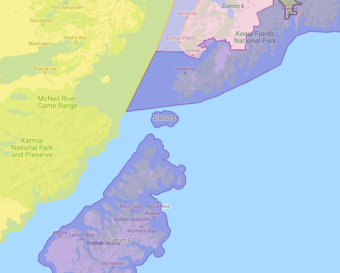
This map shows how under one proposal, residents near Homer would share the same Alaska House of Representatives district as Kodiak. The communities are to the right of Homer in the upper part of the map. (Screen capture of Redistrict Board site)
Under the state’s redistricting process, oneproposal would have residents near Homer in the same legislative district as Kodiak, which is 140 miles away by water.
The concerns they are raising reflect a challenge for the state’s Redistricting Board as it draws district lines.
A series of communities stretch northeast from Homer off of East End Road, including Fritz Creek and Fox River. To get to those communities from anywhere else requires driving through Homer.
Homer area resident Laurie Benson said it makes no sense to include them in Kodiak’s House of Representatives district.
“These areas are economically and socially tied to Homer, go to school here, work here, use our harbor, use our airport,” she said. “They’re part of the Homer community and should have the same legislative representative.”
Benson was among those the Redistricting Board heard from on Wednesday when it held a nearly six-hour public hearing. It was open to Alaskans calling in from across the state, but most of the callers were from these communities near Homer.
Benson’s point about the area being socially and economically integrated is important in redistricting because the state constitution says that’s a key factor for drawing district lines.
Lidia Martushev is from Voznesenka, a village near Fox River settled by Old Believer Russian Orthodox Christians. She said her community is inseparable from Homer.
“We are a part of the Homer community,” she said. “We do all of our shopping there. My daughter is going to preschool in Voz(nesenka) School, and she is part of the Kenai Peninsula School District. My husband fishes in Cook Inlet.”
Residents of rural Interior Alaska, hundreds of miles away, know about the downside of being split off from similar, neighboring communities. Currently, western Interior villages are in three different House districts. And they’re all separate from a district that includes most of the rural Interior population.
Christopher Simon said this has caused problems. He’s a Fairbanks resident, originally from Huslia on the Koyukuk River.
“The Koyukuk River villages have been fairly split up for numerous years. And as a result, we are marginalized in the political process,” he said. “We have some of the villages that are with the northern district, some of the villages that are with the northwest district. And we are an afterthought to many of the issues. And we would like our own representative from our region to represent our interests and the things that we value.”
But it’s a challenge for the board to keep one area together without affecting others. The reason why the board is considering splitting the communities near Homer has to do with drawing Kodiak’s district boundaries.
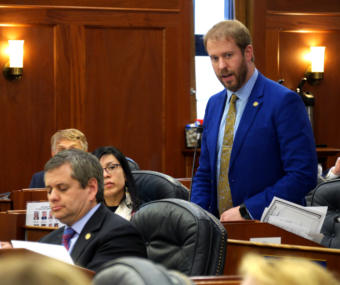
Kodiak is more than 5,000 people short of the ideal population it would need to have its own district. The target is 18,335 — that’s the state’s population of 733,391 divided by the 40 House districts.
Peter Torkelson, the Redistricting Board’s executive director, said a community’s sense of identity doesn’t always line up with district boundaries.
“While Kodiak is certainly a borough, a city — it’s a unique place, it’s a beautiful place — it doesn’t have enough folks to have their own dedicated state representative,” he said.
For the past decade, Kodiak has shared a district with Cordova and other Prince William Sound communities, as well as parts of the Kenai Peninsula Borough that are off the road system.
But due to population changes, even with these communities, it’s still roughly 1,200 people short of the population goal. And it’s not clear where those people would come from. The Homer area is one idea.
But the alternatives have their own problems. And walking through them shows how complicated redistricting is.
First off, Kodiak, like much of Alaska, doesn’t have a lot of next-door neighbors. Torkelson said this puts Alaska’s Redistricting Board in a somewhat unique position compared to its counterparts in the Lower 48.
“Alaska courts have recognized that redistricting in Alaska is a ‘herculean task,’” he said. “And part of that, the courts have noted, is just Alaska’s immense and rugged geography.”
Drawing from anywhere north or west of Kodiak would lower the population of the district that includes the Aleutians and Bristol Bay. And that district is also short of people. If it or any of the other western districts were to add population, they would again split the rural Interior in a kind of chain reaction.
Torkelson said these kinds of interlocked changes can’t be avoided.
“We often hear things like, ‘If you could just make this one change.’ ‘If you could just change this one spot, then my concern might be addressed.’ And the board’s very sympathetic to that, but the reality of redistricting is that there is no such thing as ‘one change,’” he said. “Every district is connected. If you push one place, someplace else must get bigger. If you pull in, another has to go out. I heard one testifier describe as like squeezing a balloon.”
The board could add Valdez to the Kodiak district — but only if the district didn’t also include Cordova, because that would be too many people. And where would that leave Cordova? It’s too big to be added to a Southeast Alaska district. And it’s fairly different from the Copper River Valley communities on the road system to its north.
Another idea for the Kodiak-based district is to add Seward and its neighboring communities. But through another chain reaction, that could require splitting off part of south Anchorage — including Girdwood — to be added to another, very different district based in the northern Kenai Peninsula.
Those are the complications arising from just one district. And the board has to draw the lines for 39 others by the Nov. 10 deadline.
Alaskans will have another chance to call in to give testimony to the Redistricting Board on Oct. 30
The board also is holding in-person hearings around the state and is asking that written testimony be submitted through its website.
Rep. Grier Hopkins, D-Fairbanks, speaks during a House floor session in March 2019. Hopkins proposed a new formula to set permanent fund dividends during the fourth special session this year. It would pay for part of the dividends by directly drawing from the state’s oil and gas royalties. (Photo by Skip Gray/360 North)
Members of the Alaska House of Representatives have been discussing different ideas on changing the formula that sets permanent fund dividends. While the Senate has discussed a bill that would link larger PFDs to more state taxes, the House bills are just focused on dividends.
Under three of the proposals, dividends would be bigger than the checks Alaskans have gotten in recent years. But they would still be smaller than what Gov. Mike Dunleavy wants.
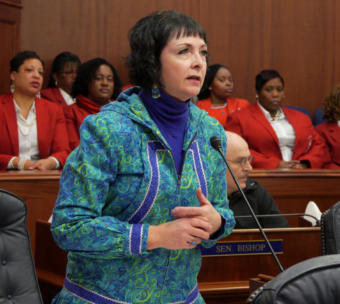
Each of the proposals seeks to solve the state’s budget problems in different ways.
A plan by Fairbanks Democratic Rep. Grier Hopkins, House Bill 4009, would draw from two sources to pay PFDs. One would continue to be the permanent fund with one-quarter of the annual draw going to PFDs. But the other source would be the state’s oil and gas royalties. Half of that money would go to dividends.
“I believe our dividend needs to be more sustainable and more accurately reflect the health of Alaska’s economy,” Hopkins said. “When oil goes up, the dividend should go up. It shouldn’t be solely reliant on the wealth of Wall Street and outside investments, done very well by our permanent fund corporation.”
Hopkins’ proposal would lead to an annual deficit of roughly $400 million over the next nine years, according to a nonpartisan analysis. He said his bill should be part of a larger package that also includes new revenue for the state.
Hopkins also has proposed a constitutional amendment that would guarantee that dividends be paid based on the formula in state law. He said there’s an advantage to not putting a specific PFD formula in the constitution; it would allow the state to respond to changes in the future.
Another proposal is from Eagle River Republican Rep. Ken McCarty, House Bill 4010. It splits the difference between other proposals and would base dividends on 35% of the annual draw from the permanent fund.
It also would guarantee funding for the capital budget, which pays for construction projects and road building and maintenance.
“Over the years, we have made cuts in the budget, but those cuts have been at the cost of capital improvements: fixing roads, bridges, docks — infrastructure,” he said. “And we can’t keep doing that.”
Like with Hopkins’ proposal, McCarty’s bill would leave a gap between what the state spends and what it brings in, under the current state forecast for future revenue. But McCarty expressed hope that the recent increase in oil revenue would pay for his proposal in the long run.
And he said his proposal would require no large new taxes or spending cuts while providing a dividend similar to what Alaskans have received in the past.
Anchorage Democratic Rep. Ivy Spohnholz chairs the House Special Committee on Ways and Means, which introduced a third proposal, House Bill 4003, that would base dividends on a quarter of the annual draw from the permanent fund.
When combined with bills that raise tax revenue, the proposal is projected to lead to the state bringing in more revenue than the current spending level.
She said the Ways and Means proposal would allow the state to address other needs.
“We’re falling behind in our educational outcomes. We’re not doing the kinds of public safety that we would like to do. We’re not addressing a growing deferred maintenance backlog throughout the state of Alaska, so our infrastructure is starting to crumble,” she said.
Spohnholz’s committee has held hearings on all three PFD proposals.
She said her goal is to hold a hearing on every bill that would demonstrate meaningful progress on the state’s long-term budget situation. And she hopes the committee can identify potential issues where legislators can reach a consensus.
Dunleavy has proposed paying out half of the annual draw from the permanent fund in dividends. He hasn’t proposed measures this year to balance the budget in the long term. Spohnholz said that if the governor wants the Legislature to pass his PFD proposal, the governor should also propose some combination of new revenue like taxes and spending cuts to pay for it.
The next meeting is scheduled for Friday. The committee plans to discuss the potential state deficits that would result from different dividend plans.
Sen. Shelley Hughes, R-Palmer, speaks introduces guests during a Senate floor session in Juneau in February 2019. Last week, Hughes said she’s hopeful that if the Senate were to pass bills during the fourth special session, there may be momentum for more in January. Senate committees did not meet during the first half of the session, which must end by Nov. 2. (Skip Gray/360 North)
Alaska state senators are split over Gov. Mike Dunleavy’s plans to change the dividend and how to pay for it. The fourth special session is halfway over, and while some House committees have met, none have met in the Senate.
Palmer Republican Sen. Shelley Hughes is frustrated the Senate isn’t meeting. She wants to start passing major bills now because she said it will be tough to do it next year.
“If we can get one or two moving, perhaps in January, the momentum would be there to continue,” she said. “But I think it’s going to be incredibly difficult in an election year.”
Hughes said the amount of taxes needed to pay for the budget isn’t clear. For example, in December, the state will update its forecast for how much oil revenue it expects in the future.
“To do our proper job, we have to look at the revenue forecast, and we have to look at the growth of the permanent fund and how much larger that draw would be,” she said.
Hughes supports drawing an additional $1 billion during each of the next two years to balance the budget. It’s balanced now, but at a much lower dividend level than what Dunleavy proposed, which Hughes supported.
Not all senators agree with the approach supported by Hughes and other Republicans who are in alignment with Dunleavy on the PFD. There are two other groups of lawmakers in the legislature with their own ideas about how to balance the budget and fix the PFD.
Another group of Republicans is also skeptical of substantial amounts of new taxes. But they point to current revenue forecasts that say the budget wouldn’t balance with higher dividends and no major new taxes.
Sitka Republican Sen. Bert Stedman is in that group. He wants to protect $30 billion in permanent fund earnings that aren’t currently protected in the constitution. But he isn’t eager to put the PFD in the constitution, at least for now.
“In my opinion, we should rewrite the formula and run it for a couple of years, see how it works,” he said. “And if it looks like it’s a stable concept that’ll last for, you know, several decades like the last formula, then we can talk about doing something like that at that time. But it’s far too early to do that.”
Stedman said the Finance Committee that he co-chairs will consider bills that would set the dividend formula at different levels. But he said that can happen during the next regular session, in January.
The third group of legislators — mostly Democrats — is more open to introducing new taxes as part of a package that would pay for larger dividends. Anchorage Democratic Sen. Tom Begich has re-introduced tax proposals that were considered by the Legislature in the past, like increasing oil taxes. He acknowledged that larger taxes aren’t popular but said they’re needed to reach an agreement.
“That is what I am kind of looking for, from my colleagues: the willingness for them to see the bigger picture, ” he said.
The taxes that Begich proposed would be enough to allow for the state to pay for dividends at an amount that’s higher than in recent years but lower than what Dunleavy has proposed. To pay for Dunleavy’s proposed amount, Begich said a statewide tax like a sales tax would be needed. But he said the tax could be repealed if oil and permanent fund revenue grew enough.
But he said counting on higher oil prices would be irresponsible. A working group of legislators laid out how much money the state would need, as well as other assumptions like how much revenue the state would bring in. And Begich said it would be hard to reach a compromise if lawmakers stray from those assumptions.
“It doesn’t matter what the price of oil is today because you have to base it on the agreed-upon consensus on those assumptions,” he said.
If the Department of Revenue bases its December revenue forecast on oil at $75 per barrel, similar to the oil futures market in recent days, then the state budget could be in balance over the next nine years at Dunleavy’s proposed PFD amount.
Senate President Peter Micciche is trying to sort out how to get the three groups to agree on a set of major policy changes — or at least the 11 senators needed to pass bills.
Micciche, a Soldotna Republican, said a new committee could help make that happen. He wants it to include senators from the working group and others.
“I think we’re going to need some representation from the various schools of thought,” he said. “Or you’re going to have the same problem. You’re going to have things headed in one direction that can’t get 11 votes, or the other direction that can’t get 11 votes.”
He said that if the Legislature lowered the state’s spending limit, it could allow for new, temporary taxes. Micciche praised the working group, which had legislators from both the Senate and the House. But he said that from this point forward, each body should pass its own version of major changes and then work out compromises.
“It’s tough enough with 20 senators,” he said. “It’s nearly impossible with 60 legislators. So if you have the two statements — or two positions — of a bill that passes, I think that’s something much easier to work.”
The Senate has only had enough members to hold a regular floor session once in the fourth special session. That happened on its first day. That would be needed again to pass Micciche’s proposal for a new special committee that has the power to pass bills. But a group of senators also could meet to work on a compromise that it would recommend to the others.
The Alaska State Capitol, on June 2, is hosting the fourth special session of the year. Two state senators have tested positive for COVID-19 and a third was undergoing testing, Senate President Peter Micciche said on Tuesday. (Nat Herz/Alaska Public Media)
Two Alaska state senators have tested positive for COVID-19, and a third was undergoing testing, Senate President Peter Micciche said on Tuesday.
The two who tested positive were Lora Reinbold, R-Eagle River, and David Wilson, R-Wasilla, the Anchorage Daily News reported.
Micciche said he had no indication that they wouldn’t fully recover.
The three senators have not had close contact with anyone currently working in the Capitol, according to Micciche’s office.
He said the illnesses have contributed to difficulty in having a majority of the Senate present to hold a regular floor session. A session scheduled for Tuesday was a brief technical session. The next Senate floor session is scheduled for Friday.
The Alaska House of Representatives meets on Monday in the Capitol. It was the only regular floor session of the week. Lawmakers are divided on what steps to take to close the long-term gap between what the state spends and what it brings in. (Photo by Andrew Kitchenman/KTOO and Alaska Public Media)
The Alaska Legislature didn’t hold a single meeting during the first week of the fourth special session. It has been gridlocked all year over the future of permanent fund dividends. The Legislature has struggled with the issue for six years. Nearly all legislators say they would support a compromise. What isn’t clear is whether that compromise exists.
A closer look at what happened during the last special session can shed light on why things seem stuck during this one.
At the end of the third special session, the Senate Finance Committee put forward a major bill that would balance the state budget and allow permanent fund dividends at the level proposed by Gov. Mike Dunleavy, though that would take three years.
But the Senate hasn’t passed the bill yet. Supporters of Dunleavy’s budget plan criticized it. For one, because it wouldn’t put the PFD in the state constitution. Also because it wouldn’t lower the state’s spending limit. And finally, because it would increase taxes more than they’re comfortable with.
“I’ve said the ‘t-word’ enough, and I hate the word ‘revenue.’ It makes it sound like a business,” Wasilla Republican Sen. Mike Shower said during a debate over the bill. “We’re not making money here. We’re taking money from people here to do taxes. I got it.”
Shower was referring to $700 million in taxes that the Finance Committee said made the bill pencil out.
Dunleavy hasn’t proposed a tax. And it’s not clear how his plan would pay for both larger PFDs and the budget, beyond the next couple of years. What he has proposed is a one-time $3 billion draw from permanent fund earnings. That’s projected to be enough to cover the budget and two years of PFDs, with the potential for a third year depending on the fund’s growth.
Some legislators oppose the one-time draw from permanent fund earnings, which would not only give up $3 billion now but also the roughly $200 million a year it could generate every year forever. But they really don’t want to do it if it won’t solve the long-term problem.
Sitka Republican Sen. Bert Stedman co-chairs the committee that put forward the bill. He also is skeptical of new taxes. But he said they’re necessary if the state is going to pay bigger dividends. So during the Sept. 14 Senate session, he criticized a proposal to lower the new tax number in the bill.
“It would put us in a position where we’d have a continuation of a structural deficit,” he said. “It wouldn’t fix the problem.”
Nonpartisan analysts project a $7 billion gap over the next nine years. And paying for it is at least part of why the Legislature has not been able to agree on a change to the permanent fund dividend formula in the seven years since oil prices fell.
Dunleavy and legislators who want higher PFDs but don’t want a major tax also want spending cuts. But neither the governor nor most legislators who have said they wanted cuts have proposed cutting state services on a large scale. At least not since Dunleavy reversed his positions on budget vetoes in August 2019. That came after a public backlash to the cuts he had pursued earlier that year.
And that’s important to House Speaker Louise Stutes of Kodiak. She’s a Republican who is part of a mostly Democratic caucus. Stutes said that if there are going to be much higher dividends, they have to be paid for. And not with a one-shot drawdown in permanent fund earnings.
“I mean, it’s easy to say, ‘I want spending cuts,’ just like it’s easy for me to say, ‘I would love to have a big, huge PFD’,” she told reporters in the middle of the third special session. “The question is: Where are the spending cuts going to come from? Or how are you going to pay for the big PFD? Show us. If you want spending cuts, show us how you’re going to provide for those.”
Dunleavy responded on Sept. 14, pointing first to the size of the permanent fund — currently $81 billion — and why he proposed the $3 billion draw.
“We offered that because we didn’t want businesses impacted by taxes in a business recovery period,” he said. “We offered that because people didn’t want huge cuts in government during a pandemic … recovery period. We offered that because the people of Alaska could have injected hundreds of millions of dollars into the local economy — all win-wins. We offered a solution.”
Dunleavy and many of the legislators that support larger dividends have said there’s a model for how the Legislature could solve the problem. That’s the working group that met this summer, made up of members from both chambers and all four caucuses.
The group reached consensus on dividends at the scale Dunleavy has proposed. And it endorsed the concept of putting the dividend in the state constitution.
Rep. Jonathan Kreiss-Tomkins, a Sitka Democrat, co-chaired that group. He said it took a lot of time and careful communication to overcome distrust and reach the consensus, and he thinks a solution is possible.
“There is a cynicism out there that nothing is ever possible, like, ever,” Kreiss-Tomkins said. “And I just don’t think that has to be.”
There are other proposals out there that could close much of the gap.
Anchorage Democratic Rep. Geran Tarr has been among the first legislators to introduce budget bills, in the third and fourth special sessions. One of the bills would introduce a 2% statewide sales tax. Another would raise the minimum amount that oil and gas companies have to pay in production taxes.
Tarr said the sales tax would spread the burden more fairly than PFD cuts, including raising more money from out-of-state visitors. She also proposed that the sales tax wouldn’t apply to some essential costs.
“I really stumbled on that — how could we achieve something that wasn’t a disproportionate burden to our small and rural communities,” she said. “So exempting food, medicine and heating oil as basic necessities and essentials felt like a really good place to start.”
Tarr said a long-term way to reduce state spending would be to support more early intervention through social services for children.
“What I try to talk to people about is looking at it in a systemic approach: If we cut programs today, it will not reduce the demand for that program and often the outcome is more costly,” she said. “What we need to do is reduce the demand for that program, and that will naturally bring savings.”
Tarr has worked with Republicans on some votes — including supporting drawing from permanent fund earnings to pay for larger dividends. However, she’s also an outlier in the Legislature, and spent several days outside of either caucus earlier this year.
But for now, it’s not clear if any bills have enough support to pass this special session. The first committee meeting on any bills is scheduled for Wednesday, when the House Special Committee on Ways and Means is scheduled to consider a bill that would change the PFD formula. That would be on the 10th day of the special session, which must end by its 30th day, Nov. 2.
Close
Update notification options
Subscribe to notifications
Subscribe
Get notifications about news related to the topics you care about. You can unsubscribe anytime.