State Government Reporter, Alaska Public Media & KTOO
State government plays an outsized role in the life of Alaskans. As the state continues to go through the painful process of deciding what its priorities are, I bring Alaskans to the scene of a government in transition.
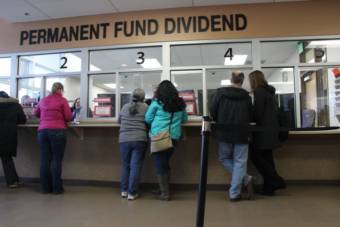
Alaskans file their Permanent Fund dividend applications in downtown Anchorage in March 2016. The 2021 PFD will be (Rachel Waldholz/Alaska Public Media)
This year’s permanent fund dividend will be $1,114, the Department of Revenue announced on Thursday.
Alaskans who filed electronically and chose direct deposit will receive their PFDs the week of Oct. 11. Those receiving a paper check will start to receive their dividends the week of Oct. 25.
The amount is $14 higher than the number estimated by the Legislature. Lawmakers set the budget for PFDs before they knew how many people would receive them.
The state estimated that 643,000 Alaskans will receive dividends.
The portion of applications filed electronically was 90 percent, which is a record, according to the department.
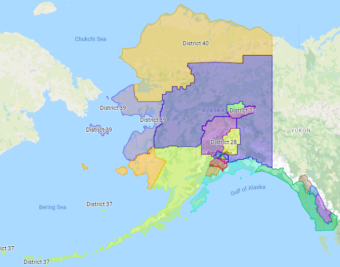
This draft map was one of two prepared by the state Redistricting Board. The board has since revised the drafts and will be holding 20 meetings around Alaska over the next seven weeks to solicit feedback before adopting a final map. (Screen capture of Redistricting Board site)
Every 10 years, states redraw their political district maps to keep them up-to-date with shifts in population, as reflected in the census. In Alaska, a five-member redistricting board draws the map. And where the board draws the lines will have big implications on who gets elected.
The process kicked off earlier this month when the Redistricting Board produced two draftmaps. And they drew a lot of criticism during public testimony at a board meeting on Friday.
Anchorage resident Emily Becker was among the critics.
“Despite your claims to be apolitical, both of these versions seem really nakedly political, with some very odd zigs and zags that just so happen to put bipartisan majority members against each other,” she said.
Others repeatedly pointed out what Becker called zigs and zags — like in Juneau, where a draft district line dips into Democratic Rep. Andi Story’s Auke Bay neighborhood and puts her house in the same district as fellow Democratic Rep. Sara Hannan.
In one draft, the bulk of the downtown Anchorage district currently represented by Zack Fields added not only the neighborhood immediately south of downtown, but also extended to the west, in the process including the homes of Harriet Drummond and Matt Claman — like Fields, all Democratic representatives. The same map put Democratic Reps. Ivy Spohnholz and Liz Snyder in the same district.
The map doesn’t have any Republicans who would have to share districts like this.
If the board adopts a final map that’s similar to this draft, it could wind up in court. And the courts will be holding the map up against the standards in the Alaska Constitution. It says districts have to be compact and contiguous — so that all of the parts are next to other parts — and contain as much as practicable a relatively integrated socio-economic area.
Peter Torkelson is the board’s top staff member and a former aide to the state Senate’s mostly Republican majority. He said the process that went into the draft maps wasn’t political.
“We did not include any political data in this conversation,” he said. “It’s blind to election results, to party, registration, statistics and to incumbent locations. It’s just not on the map, and in my experience, it played absolutely no factor in any of the maps that have been brought forward to date.”
Three of the five board members were appointed by Republicans — Gov. Mike Dunleavy picked former aide Bethany Marcum of Anchorage, who once served as an aide when Dunleavy was in the state Senate. Marcum suggested the Anchorage draft that combines five Democrats in two districts. Dunleavy also appointed E. Budd Simpson, a Juneau lawyer. And former Senate President Cathy Giessel chose Fairbanks businessman John Binkley, a former legislator who’s serving as the board chair.
Former House Speaker Bryce Edgmon, a Dillingham independent and former Democrat, appointed Anchorage resident Nicole Borromeo, the executive vice president and general counsel for the Alaska Federation of Natives. Former Alaska Supreme Court Chief Justice Joel Bolger named Melanie Bahnke, president and CEO of the Nome-based regional nonprofit Kawerak.
The process allows for outside groups to submit their own maps, which the public can weigh in on and the board can consider.
While many legislators will be keeping an eye on the process, Anchorage Democratic Sen. Tom Begich is more involved than most — not only has he served as an expert witness in court in previous redistricting cycles, his caucus drew up its own proposed map.
Begich said the board’s draft maps had unnecessarily high differences between the populations in urban districts, as well as within Southeast Alaska.
“I’m not sure why that is,” he said. “So I think a better map can be drawn, and I think that’s what the board is looking for. And so I’m hopeful that through the process a better map will be drawn.”
The state Supreme Court in past rulings set up a process where the board must first draw a map that first meets the requirements of the state constitution before taking into account the federal Voting Rights Act.
The Voting Rights Act has required the state to submit its map for forty years to the U.S. Department of Justice, due to the state’s history of discrimination against Alaska Native voters. This will be the first time in several decades that Alaska won’t have to do that, due to a U.S. Supreme Court ruling that invalidated portions of the law.
Begich noted that the federal government is working on new ways to enforce voting rights, given the court’s ruling. So the state will still have to ensure that it doesn’t violate the federal law.
“It’s important,” he said. “It’s less important because of the federal changes than it was.”
Other groups proposed their own maps. It’s a complicated undertaking. Any time one boundary changes, it can force a cascading set of changes on other districts. And it can be challenging to defend those changes.
Randy Ruedrich has experience working on maps. He’s a former Alaska Republican Party chairman who is affiliated with a group that’s submitted its own map, Alaskans for Fair and Equitable Redistricting.
Like Begich, Ruedrich emphasized that the state will be in a stronger legal position if it keeps district population sizes as close as possible.
But his group drew a very different map than the Senate Democrats. For example, he tried to make a case for including a heavily Republican portion of the Kenai Peninsula Borough in the same district as part of South Anchorage.
“To balance our population, we go back to the 1984 map — where the Supreme Court approved the use of South Anchorage and North Kenai shore, as both being oil industry-affiliated areas … as an adequately socioeconomically integrated district.”
Other third-party groups have submitted their own maps.
They include a group affiliated with organized labor, public interest and Alaska Native organizations, Alaskans for Fair Redistricting. Joelle Hall serves as the group’s chair. She is also the leader of the Alaska AFL-CIO, the state’s labor union federation.
Hall said her group would like to see a map that both maintains neighborhood lines in urban areas and that keeps election outcomes uncertain.
“The goal is to create a map that is competitive,” she said. “We think Alaskans are best-served when the fate of a district is not a foregone conclusion, where there’s a competition for ideas that’s available in each district.”
One of the draft maps keeps five districts in the Fairbanks North Star Borough that have larger populations than the statewide average. Democrats in that region also said that it combines areas that have nothing in common.
Some groups proposing their own maps are seeking to keep all of the rural Alaska Native communities in the Interior in the same district, something that the state’s current legislative map doesn’t do.
They include a coalition of Alaska Native regional corporations Doyon Limited and Ahtna Incorporated along with Tanana Chiefs Conference, Fairbanks Native Association and Sealaska. The coalition’s map combines the Interior villages with a portion of the Fairbank North Star Borough.
Doyon Senior Vice President Sarah Obed said the coalition tried to balance many factors.
“Our map represents our best effort to bring these different needs and interests together,” Obed said.
The board will be taking its own revised draft maps as well as some of those proposed by other groups to 20 public meetings around Alaska, seeking public feedback before it adopts a final map later this fall. But that doesn’t ensure that the board’s final map will remain the legislative map for the next 10 years. The courts may require that it be rewritten based on legal challenges.
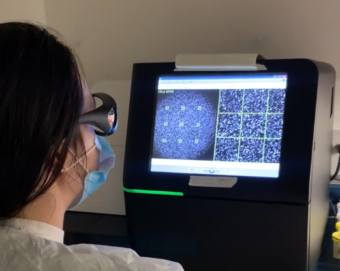
Stephanie DeRonde, a state microbiologist, uses an Illumina sequencer to analyze strains of the virus that causes COVID-19 at the Fairbanks public health lab on Wednesday, November 4, 2020. (Alaska Department of Health and Social Services/screengrab)
Adam Crum, the commissioner of the Department of Health and Social Services, said the department delayed the announcement to avoid interfering with a criminal investigation.
“It is a fair statement to say that any Alaskan could have been compromised by this,” he said.
The security breach violated state and federal privacy laws. The state does not know how many people’s data was accessed. The Department of Health and Social Services is urging all Alaskans who have provided data to the department to act to protect themselves from identity theft.
The department found evidence that the cyberattackers took some data, but they don’t know what they took.
The state is making free credit monitoring available to any Alaskan concerned about the breach. On Tuesday, the state will launch a toll-free hotline to answer questions and help people to sign up for credit monitoring. The number will be on the department’s website.
All Alaskans who’ve applied for permanent fund dividends will receive an email between Sept. 27 and Oct. 1 with a code to sign up for the credit monitoring.
The state also cautioned Alaskans to monitor their online accounts for unusual activity. Incidents of identity theft can be reported to the Federal Trade Commission.
State officials said they used the PFD application list because the contact information is current, but that the dividend division wasn’t affected by the breach. They said most Alaskans’ lives are touched by one DHSS program or another, so it made sense to reach many people through the PFD applications.
When department leaders last publicly discussed the attack in early August, they said there was “no current evidence that Alaskans’ protected health information or personally identifiable information was stolen.”
Department Chief Information Security Officer Thor Ryan said it was worded to acknowledge that the investigation wasn’t complete.
State officials said it was up to law enforcement to delay the announcement. They also did not disclose which agencies are conducting the investigation, saying they were asked not to.
The federal Health Information Portability and Accountability Act requires that any breach be disclosed no later than 60 days after it’s discovered.
Department technology officer Scott McCutcheon said there’s no sign that attackers are still accessing department data, or that they had accessed any other state government department’s information.
The department is still recovering from the attack, restoring different services. State security contract Mandiant recommended that the state not use backup files to rebuild its sites, so it’s building the services “from the ground up,” McCutcheon said.
Crum said responding to the breach required that workers rely on paperwork. He also said the department has been focusing on both the security breach and the pandemic response.
“We recognize every single day the burden this has put on our citizens, not to mention my employees,” Crum said.
Crum acknowledged the delays, comparing it to rebuilding a plane while flying it.
“We know that these systems being down has put a burden on the general public in an already tough year,” he said. “But this is something that we’re continuing to grind through. We are working to get them up online as fast as possible, while also protecting for future attacks.”
The department is working with Mandiant to assess how to improve its security.
The department said the attackers potentially had access to the following types of individual’s information: full names; dates of birth; Social Security numbers; addresses; telephone numbers; driver’s license numbers; health information; financial information; and historical information concerning a person’s interaction with DHSS.
Editor’s note: This story has been updated with more information from the Department of Health and Social Services.
Gov. Mike Dunleavy discusses the state of the coronavirus pandemic during a news conference at the Atwood Building in Anchorage on Thursday, Aug. 26, 2021. (Matthew Faubion / Alaska Public Media)
Gov. Mike Dunleavy yesterday issued his most forceful message yet asking Alaskans to be vaccinated against COVID-19.
“I strongly urge folks to get a vaccine — strongly urge them to do that,” Dunleavy said.
Dunleavy made the remarks while discussing the failure of legislation he proposed that was intended to ease the strain on hospitals from the recent surge in cases.
Hospitals asked Dunleavy to issue a disaster declaration. He declined to do that, and instead proposed the legislation, which would have increased access to telehealth care and temporarily relaxed some rules hospitals have to follow.
The Alaska State Capitol in Juneau in April. On Tuesday, the third special session ended with the Legislature setting the 2021 permanent fund dividend at $1,100. But Gov. Mike Dunleavy called the body into a fourth special session starting on Oct. 1, saying he wants lawmakers to add to the PFD amount. (Photo by Andrew Kitchenman/KTOO and Alaska Public Media)
Alaskans will receive a permanent fund dividend of $1,100, but lawmakers aren’t done talking about it yet.
Gov. Mike Dunleavy called the Legislature into a fourth special session starting on Oct. 1. He issued the call on Tuesday after the Legislature passed a bill setting the PFD amount for this year.
The Permanent Fund Dividend Division estimates PFDs could be paid in roughly 30 days, which would make them slightly later than the usual early October payment.
Supporters of the $1,100 dividend amount said it is the most the state can afford and still follow a law that limits what the state can draw from permanent fund earnings each year.
A majority of senators who voted on the bill on Tuesday supported a larger PFD, of $2,350. But the Senate settled for the lower amount after House Speaker Louise Stutes announced that the House wouldn’t hold a floor session.
Essentially, lawmakers ran out of time. Legislative rules require that lawmakers have a day to consider bills. If the Senate sent a bill over to the House that was different from what the House passed, the session would have ended before the House could have voted on it. This rule can be set aside if two-thirds of a chamber agree to it, but Stutes said there weren’t enough votes to do that.
Dunleavy put one item on the next special session agenda — a bill or bills to address a fiscal plan. He also said that he wants the Legislature to pass what he called “the rest of this year’s PFD.” He said the $1,100 amount was a “partial PFD.”
Gov. Mike Dunleavy talks with reporters on Tuesday in the cabinet room in the Capitol. He discussed several issues related to the end of the third special session of the year. He called for a fourth special session later in the day. Dunleavy spokesperson Jeff Turner is on the left. (Photo by Andrew Kitchenman/KTOO and Alaska Public Media)
Earlier in the day, Dunleavy told news reporters that the Legislature should take responsibility for not passing a plan to balance the budget.
“At what point does this Legislature behave like a Legislature is supposed to, and come up with ideas to solve the plan?” Dunleavy said. “Because right now, it appears that the only idea is to do nothing and have no result.”
Stutes, a Kodiak Republican, said “the majority if not all” of her caucus is interested in taking action on a long-term plan. The House majority has 15 Democrats, four independents and two Republicans, including Stutes.
“I am interested in a solid fiscal plan, so we’re not facing this PFD fight every year — it’s just craziness,” she said. “We need to come together as a body, and we need to come together as a Legislature, and resolve these issues.”
Stutes has expressed concern that Dunleavy’s proposals do not close the gap between what the state spends and what it brings in over the next decade.
Wasilla Republican Sen. Mike Shower speaks on Tuesday in the Capitol. Shower proposed an amendment to a bill to fund permanent fund dividends that would have set the PFD at $3,800. The amendment failed. (Photo by Andrew Kitchenman/KTOO and Alaska Public Media)
During the Senate floor debate, Wasilla Republican Sen. Mike Shower proposed paying $3,800 dividends. He wanted to follow a formula for calculating the annual payments that the state used for decades until 2015, after oil prices crashed.
“I believe that we should do the right thing. I believe we should help our citizens with our money,” he said. “And I believe it is appropriate to do so until this Legislature changes the statute.”
But Shower’s proposal would require that the Legislature spend $2.5 billion more from permanent fund earnings than it already has. Opponents say that once the Legislature starts to draw more than planned from permanent fund earnings, it won’t stop until there are no earnings left.
Fairbanks Republican Sen. Click Bishop said a higher dividend would help the state’s economy for four or five months. But he said staying within the planned draw would allow the permanent fund to continue to grow for future generations. And that would extend the benefits of the state’s oil wealth after the state’s economy no longer relies on oil.
“Keep in mind that we want to preserve our reservoir, to keep our founding fathers’ vision intact so they pump into perpetuity,” he said. “How we get there: That’s the debate.”
Legislative budget negotiators first tried to pass a budget with a $1,100 dividend in June.
But the proposal ran into problems. Most of the money wasn’t available after legislators couldn’t agree on spending the money to fund it. Dunleavy vetoed the rest.
During the special session that just ended, Dunleavy asked the Legislature to consider his proposals to amend the state constitution to include the PFD and to lower the limit on state spending.
He later added the bill to fund dividends and other items. He supported a dividend of $2,350, which is half of the amount lawmakers draw from permanent fund earnings each year.
The special session ended with another major issue left unresolved. A bill that aimed at easing the strain on hospitals from the COVID-19 surge died in the House. The bill would have increased access to telehealth care and temporarily eased some rules that hospitals have to follow. But it became stuck in a dispute over an amendment to the bill that hospital advocates said would make things worse.
The amendment would have required all patients to be able to have a person who supports them present during any treatment. Hospitals have had some restrictions on visitors at some points during the pandemic, in order to reduce the spread of the coronavirus among patients and hospital staff.
The Senate also started to debate amendments to a bill that would change the PFD formula. It would increase the dividend to $1,300 over three years, then make it half of the draw if the state adds $700 million in taxes or other revenue to both balance the budget and pay for higher dividends. The bill could be debated more during the next special session.
The Alaska State Capitol in June. On Tuesday, the Legislature’s third special session ends. (Photo by Andrew Kitchenman/KTOO and Alaska Public Media)
The legislative special session is scheduled to end on Tuesday, and several items are not resolved — including a bill setting the amount of this year’s Alaska Permanent Fund dividend and another bill to set future PFDs.
The Senate Finance Committee is considering a bill that would fund permanent fund dividends at $1,100 this year. However, Gov. Mike Dunleavy’s administration has said that nearly half of the money isn’t available. The governor has called for dividends to be more than double that size and to pay for them by drawing more than planned from permanent fund earnings.
Even that amount is less than what some Alaskans who provided testimony on the bill want. They want the state to pay dividends under the formula in a 1982 state law. That would be roughly $3,800.
Pleasant Valley resident Michael Kramer was among them. He said the royalties that built the fund would be in private hands if the state didn’t own the land.
“I expect to get my whole dividend, not: You take it and think what you do is better for it than what I can do with my own money,” Kramer said. “If you didn’t want to do that, you could give us back our mineral rights to all of our property.”
The Senate Finance Committee also discussed a bill that would set dividends in the long term. The bill would scale up dividends from $1,100 to $1,300 over the next three years. Then it would make dividends equal to half of the annual draw, which currently would amount to $2,350.
But the larger amount would depend on agreeing to add new annual taxes or other revenue totaling $700 million. If this didn’t happen, dividends would grow from $1,300 based on inflation, under the bill.
The Alaska Permanent Fund Corporation board has said the state should not spend more than 5% of the fund’s value each year. Larger dividends would require drawing more than that level unless the state offsets the money with taxes or spending cuts.
Corporation Executive Director Angela Rodell said it becomes harder to invest the fund’s money when the corporation doesn’t know how much the state will spend from fund earnings each year.
“You’re taking money out of some of the highest, best-performing assets of the fund, and putting them into lower-risk, lower-returning assets,” she said.
Close
Update notification options
Subscribe to notifications
Subscribe
Get notifications about news related to the topics you care about. You can unsubscribe anytime.