
Andrew Kitchenman

State Government Reporter, Alaska Public Media & KTOO

State government plays an outsized role in the life of Alaskans. As the state continues to go through the painful process of deciding what its priorities are, I bring Alaskans to the scene of a government in transition.

Housing and schools are obstacles for Alaska military families, leaders say

Eielson Air Force Base hosts F-35 fighter aircraft on April 21, 2020. On Tuesday, Air Force Lt. Gen. David Krumm told Alaska legislators that housing and school concerns are obstacles to attracting military families to parts of the state. (Sean Martin/354th Fighter Wing)

Military leaders in Alaska told state lawmakers on Tuesday that a lack of housing and concerns about schools make it hard to attract military families to the state. 

Air Force Lt. Gen. David Krumm said the Air Force isn’t allowing service members to bring their families to Eielson Air Force Base near Fairbanks due to a lack of housing. He said the Air Force is working at every level of government to address the problem. 

“But we’d really love your help in making sure that builders are incentivized to build homes,” he said. “We are bringing people. We want them to bring their families.”

Krumm pointed out that there will be a demand for Air Force members at Eielson, with F-35 fighter aircraft based there.

Krumm and other military leaders spoke to the Legislature’s Joint Armed Services Committee at an annual meeting that was delayed by COVID-19. 

Krumm said he’s also focused on schools and childcare to improve the quality of life for Air Force families in the state. He cited the low number of teachers and counselors per student compared with some other states as being sources of concern for military families. 

And he said many other states make it easier for military spouses to work by being more flexible in accepting professional licenses from other states. 

Army Maj. Gen. Brian Eifler also talked about the importance of housing. He pointed to improvements the Army is planning for the barracks at Fort Wainwright in Fairbanks, including a new building planned by 2030.

And Coast Guard Rear Adm. Nathan Moore said the pandemic has been particularly difficult for those stationed in parts of the state that are far from military bases. 

“We certainly feel like our Coast Guard men and women that are in these remote locations have had a rough year and a half,” he said. “The COVID restrictions have been tough on people, both from a resiliency standpoint (and) a mental health standpoint.”

The leaders also address lawmakers’ questions about COVID-19 vaccinations.

Krumm said the Air Force is educating members on the vaccine, which has been ordered for all members except those who have valid medical or religious reasons for not receiving it. He says 2-2.5% of Air Force members in the state are seeking exemptions.

Krumm also says COVID-19 restrictions imposed on the military in the state have helped. 

“We have proven that we have minimized the spread of COVID-19 on our installations when we implement mitigation measures,” such as wearing masks and maintaining social distancing, Krumm said. 

More National Guard members have asked for vaccine exemptions. Maj. Gen. Torrence Saxe, the Alaska National Guard adjutant general, said 5-10% want exemptions so far.

Wasilla Republican Sen. Mike Shower said it’s important to him that military members aren’t “kicked to the curb” and denied future benefits if they refuse the vaccines.

COVID testing requirements will return to Alaska Capitol amid recent surge

Sen. Jesse Kiehl gets a COVID-19 test on Saturday, Jan. 23, 2021, in Juneau, Alaska. Regular testing and daily screening is a requirement for working the state capitol this session. (Photo by Rashah McChesney/KTOO)
Sen. Jesse Kiehl gets a COVID-19 test in January 2021 at the Alaska Capitol Building. The Legislative Council updated its COVID-19 safety policy on Tuesday in response to the surge in cases. People working at the Capitol will be required to be tested every four days and to isolate if they test positive. (Photo by Rashah McChesney/KTOO)

Legislators and others who work in the Capitol will again be required to be tested for COVID-19 regularly. 

The Legislative Council, which is responsible for the Capitol, updated its COVID-19 safety policy on Tuesday in response to the recent surge in cases. 

Juneau Democratic Rep. Sara Hannan is the council’s chair. She says the update will improve safety while minimizing costs.

“I feel like it is a step in the right direction and contemplates the movement of people who are regularly coming in and out of the building,” she said.

The updated policy requires those who work in the Capitol to be tested every four days and to isolate if they test positive.

The new policy doesn’t affect members of the public, who are required to wear a mask in the Capitol and to screen themselves for symptoms before entering the building. 

The council voted 10 to 3 in favor of the testing. Eagle River Republican Sen. Lora Reinbold was among the no votes. 

“We are constitutionally required to be at the Capitol,” Reinbold said. “And I don’t want to be put in a box where I’m not allowed to represent people if I don’t follow something, you know, such as cycling testing every four days to access the Capitol. I think this is just about the most unconstitutional thing I’ve ever seen.” 

Reinbold has been banned by Alaska Airlines for refusing to wear a mask. 

The new policy will not require those who work in the Capitol to provide proof that they have been tested. The council considered reinstituting screening at the door to verify that people have been tested. But the members decided against it, noting both the cost and the possibility that lawmakers may not spend much time in the Capitol this special session, which must end by Nov. 2. 
The next floor sessions are scheduled for Friday. 

Alaskans continue to weigh in on proposed maps by Redistricting Board

Alaska Redistricting Board open house
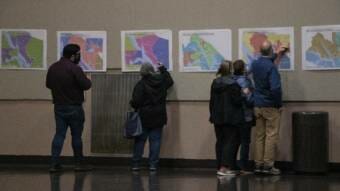
Juneau residents study map proposals by the Alaska Redistricting Board at an open house event on Sept. 27. The board is hosting public hearings across the state and stopped in Anchorage on Monday. (Lyndsey Brollini/KTOO)

Which Anchorage neighborhoods should share the same legislative districts was the focus of a hearing on Monday.

The Alaska Redistricting Board held its first public hearing in the state’s largest city since adopting draft maps last month. Anchorage includes all or part of 16 of the 40 districts in the Alaska House of Representatives.
A few residents spoke in support of a map drawn up by a group of organized labor, public interest and Alaska Native organizations, Alaskans for Fair Redistricting.

Anchorage NAACP President Kevin McGee said he likes that group’s map. He’s concerned that some of the other maps the board is considering wouldn’t meet standards in the state constitution.

“We should also recognize the imperative to protect minority voters’ franchise in Southcentral Alaska,” McGee said. “Attempts at partisan gerrymandering would come at the expense of meeting constitutional obligations.”

Other residents spoke in favor of a map by a different group that includes former state Republican Party Chair Randy Ruedrich, Alaskans for Fair and Equitable Redistricting, which has a similar name to but is distinct from the labor-backed group. 

Bruce Schulte said this map does a better job than others of considering drainage areas and other geographic features that the constitution says the board can use. He singled out a district that would have Campbell Creek and Seward Highway as its borders. 

“I know those are fairly significant boundaries,” he said. “I think that the resulting district reflects a sort of consistent demographic and interest.”

Others called for the board to focus more on Senate district boundaries. In two draft maps adopted by the board, the House districts have not been paired up into Senate districts. 

Steve Aufrecht said the board announced the Senate districts at the last minute in the past.

“There was no time whatsoever for anybody to make comments on those Senate pairings,” he said. “I know you’re going to want to get it done as late as you can. But try to leave some time, so that people can see the Senate pairings and make comments.”

Board member Nicole Borromeo said the board may hold a meeting focused on the Senate districts. She asked Alaskans to bring their own ideas to the series of public hearings in communities around the state. 

“Don’t just tell us what’s wrong with a map. Please offer a suggestion if you have one. And if you don’t have one, that’s OK. It’s more than sufficient to alert us to the problem,” Borromeo said.

The board plans to hold a total of more than 20 hearings. It must adopt its final map by Nov. 10.  

Alaska’s fourth special session begins with legislators unable to agree on when to meet

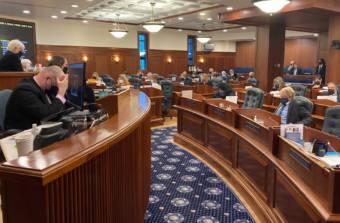
The Alaska House of Representatives meets on the first day of the fourth special session of the year, on Oct. 4, 2021, in the State Capitol in Juneau. The House passed a resolution that would have allowed the Legislature to leave Juneau for up to eight days, but the Senate didn't consider the measure. (Photo by Andrew Kitchenman/KTOO and Alaska Public Media)
The Alaska House of Representatives meets on the first day of the fourth special session of the year on Monday in the Capitol. The House passed a resolution that would have allowed the Legislature to leave Juneau for up to eight days, but the Senate didn’t consider the measure. (Andrew Kitchenman/KTOO and Alaska Public Media)
The Alaska Legislature began its fourth special session of the year on Monday. There are big disagreements between lawmakers on major policies. But it’s also not clear if they can even agree on how frequently to meet over the 30-day session. 

The House passed a resolution that would have allowed both chambers to spend more than a week away from Juneau. The resolution would have required both chambers to convene at least once by Oct. 12. 

But the Senate did not consider the resolution. Instead, it adjourned until Friday. That means both chambers are scheduled to hold their next floor session on Friday.

None of the Legislature’s standing committees have announced that they’re meeting this week, so there may not be any work carried out in public on the session’s agenda for at least the next three days. 

More than a quarter of the Legislature — 16 of 60 lawmakers — was absent, including nine of the 20 senators.

Gov. Mike Dunleavy has put bills on the agenda to put the permanent fund dividend in the constitution, lower the state’s spending limit and increase revenue. He also asked the Legislature to pass funding for another permanent fund dividend in addition to the $1,114 PFD it passed last session. 


Permanent Fund Corporation CEO raises questions after trustee proposes cutting staff pay

Alaska Permanent Fund Executive Director Angela Rodell at the corporate office, March 14, 2016. (Photo by Skip Gray/KTOO)

The Alaska Permanent Fund Corporation’s top executive has asked whether corporation trustees are committed to the corporation’s independence.

Corporation Executive Director Angela Rodell raised questions after a corporation trustee proposed cutting the amount paid to corporation staff in the annual budget. She asked whether the board is committed to building the corporation’s capacity to manage its investments using its own employees. But she said the issues are larger than the budget.

“Should we continue to be building this agency, or is it time to put our hands up and go, ‘Maybe it’s time to shrink this. Maybe it’s time to move it over, back to Department of Revenue. Maybe it’s–’ And how do we think about that? So it’s bigger, it’s more philosophical. It’s just trying to understand where we want to go with this organization,” Rodell said.

Two members of Governor Mike Dunleavy’s cabinet who are trustees — Revenue Commissioner Lucinda Mahoney and Natural Resources Commissioner Corri Feige — voted against the corporation’s budget proposal.
Mahoney had wanted to cut $900,000 in employee pay from the $218 million budget proposal.

The budget had been prepared by corporation staff members and had been discussed by trustees in previous meetings.

Mahoney would have eliminated $600,000 of a proposed $1.6 million that could be paid to permanent fund employees as incentives for reaching certain goals. And her proposal would also eliminate two new positions proposed in the budget.

Mahoney questioned whether two new positions were needed, since they would work on the corporation’s operations and wouldn’t manage investments. And she said she was concerned about the “optics” of paying corporation employees more during a period in which the Legislature has paid for smaller permanent fund dividends than what would be paid under the formula in a 1982 state law.

“It’s  difficult for me to support that in a time where we have had exceptional improvement, exceptional increase in the value of the permanent fund. And we have many citizens in our community who are receiving a dividend that is significantly less than the statutory amount,” she said.

The board did not adopt Mahoney’s proposal before passing the budget.

Even with Mahoney’s proposed cut, the incentive pay would have been higher than this year. She also raised a concern that the incentive pay increases the gap between what corporation employees are paid compared with other state government employees with similar responsibilities.

Trustee Ethan Schutt said the board should not put itself “in play” in state politics. And Trustee Steve Rieger said non-investment positions would be needed as the corporation adds investment staff.

Rodell said the trustees’ discussions raised questions about the corporation’s strategic plan. She said that a lot of work went into the incentive compensation proposal, as well as other aspects of employee pay proposed in the budget. And she suggested that uncertainty over paying for staff positions makes it harder to plan and to build the staff.

Mahoney said that when she has worked for organizations that didn’t receive all of the money they hoped for to achieve their goals, their leaders continued to work under the same strategic plan.

“Is there something I’m going to change about my strategic plan? And the answer usually was, ‘No.’ Because I’m still, as a leader, going to try to work really hard to achieve those goals,” she said. “And so, the execution of working on the strategic plan is maybe a little bit different, but I don’t know that the strategic plan itself actually changes.”

The board’s proposal for the budget is just the first step in the annual process. Dunleavy’s administration must decide what amount will be proposed to the Legislature. Then the Legislature determines what level it wants to fund the budget. And Dunleavy can either sign that amount into law or veto parts, like the rest of the state budget.

Rodell has held the corporation’s top staff position since 2015. She previously served as a trustee when she was the revenue commissioner in former Gov. Sean Parnell’s administration. She has tried to steer the corporation away from the political battles over dividends, while publicly defending the board’s long-held goal of limiting the amount the state draws from the fund each year.

Dunleavy has proposed drawing an additional $3 billion beyond the amount recommended by the board, which would allow the state to pay for both the budget and higher dividends over the next few years. A majority of lawmakers in both chambers have been concerned that spending more than planned would threaten the future of the permanent fund’s earnings reserve.

Board Chair William Moran’s year as board chair ended at the meeting, and the board elected former state Attorney General Craig Richards as its new chair, and Mahoney as its vice chair.

The fund has grown from $51 billion to nearly $81 billion during Rodell’s six-year tenure.

This story has been updated with additional information that was inadvertently cut in the original version.

Alaska Speaker of the House asks Gov. Dunleavy to cancel special session during COVID-19 surge

State Rep. Louise Stutes, R-Kodiak, leaves the House floor after being sworn in during the first day of the 32nd Legislative Session on Tuesday, Jan. 19, 2021 in Juneau, Alaska. (Photo by Rashah McChesney/KTOO)

Alaska House Speaker Louise Stutes urged Gov. Mike Dunleavy on Friday to cancel the special session scheduled to start on Monday, citing the COVID-19 surge.

“I think that we should be doing everything possible to help prevent the spread of COVID, and gathering all of the legislators and their staff — so you’re talking, you know, 150, 200 people — together in the Capitol needlessly just doesn’t make sense,” Stutes said.

She pointed out that Alaska is leading the nation and is among the leaders worldwide in the spread of the virus recently.

In response to a question about Stutes’ position, a Dunleavy spokesperson said the governor is not cancelling the special session. 

Stutes said she spoke with the governor about her concern last weekend and hadn’t heard back from his office in recent days. She said the House majority caucus decided to put their position on the record in the form of a letter from her to Dunleavy.

“Why — when the governor has asked his departments to work from home — why would he bring 57 legislators to Juneau?” she said.

She wrote in the letter to the governor that there isn’t a consensus on the items that Dunleavy has made the focus of the session, which include enshrining the permanent fund dividend in the state constitution, lowering the limit on state spending and raising taxes or other revenue.

She said a special session is not necessary for the Legislature to continue its work on a long-term plan for the state budget. She said committees can continue to meet ahead of the regular session in January, and that the Legislature could call itself into a special session if it reaches agreement on the issues.

Stutes also said a fourth special session would be incredibly costly.

This is a developing story and will be updated when more information becomes available.

Site notifications
Update notification options
Subscribe to notifications