Elizabeth Jenkins, Alaska's Energy Desk - Juneau

Panelists see local solutions as best approach to AK budget woes

State budget pessimists warn that fewer barrels and a growing budget deficit could turn the state into an economic wasteland. But as some Juneau residents have learned, things could still turn around.

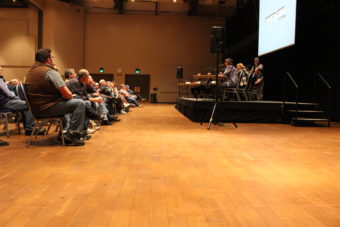
In a packed a ballroom at Centennial Hall Wednesday evening, a panel of two oil and gas consultants and two economists debated Alaska’s fiscal future.

Some of the more dire predictions inspire comparisons to Mad Max, a late 70s apocalyptic thriller in which oil reserves have been depleted, financial chaos and famine have set in, and roving biker gangs are the only law.

A warning from the movie’s trailer: “In the future, cities will become deserts, roads will become battlefields, and the hope of mankind will appear as a stranger.”

https://www.youtube.com/watch?v=c4TdPxOXuYw

In Alaska, fewer barrels of oil are being produced and the price has dropped to under $50 a barrel — about half of what it used to be. The state is expecting a deficit of $3 billion next year.

And with deeper cuts comes a loss of jobs and school funding.

“It’s not going to take 10 or 15 years. I think two or three years, you’ll see a noticeable drop in Alaska’s population,” Larry Persily said. He, along with a panel of three, spoke at Juneau’s Forum on Alaska’s Fiscal Future.

Persily worked for the Obama Administration on Alaska’s natural gas pipeline and now works for the Kenai Peninsula Borough. He said the proposed LNG pipeline offered a glimmer of hope that could add $1.2 billion a year into the budget.

“But in and of itself, it is not going to solve our problem,” Persily said.

A big topic of conversation at the forum was the possibility of a state income or sales tax. But some of the panelists agreed a sales tax could be regressive and hurt struggling people.

Brad Keithley, a consultant firm that focuses on oil, gas and policy matters, said that’s what adding state taxes would do.

“Think about this for a second. If we’re going into a recession, the last thing you want to do is reduce personal incomes,” Keithley said. “The last thing you want to do is take money out of the private economy. Take money out of people’s hands. That’s what taxes do. ”

Persily sees it differently.

“You look at taxes as taking money out of individuals’ hands. I look at taxes as a way of paying for community services, “Persily said. “That’s how it works. That’s how communities work.”

Open seats were scarce at the Juneau's ficscal forum. (Photo by Elizabeth Jenkins/KTOO)
Open seats were scarce at the Juneau’s ficscal forum. (Photo by Elizabeth Jenkins/KTOO)

Persily said some people could also afford a reduced PFD check or forgoing it altogether. I asked Josh Warren an attendant at the forum, what he thought of that.

“I love my PFD. I’ve gotten it every year since I was born here. But if that’s what the state needs to educate children, then I think that’s OK,” Warren said.

Juneau has a 5% city sales tax. Places like Anchorage and Fairbanks don’t.

To help with the fiscal crisis, panelists advised municipalities to come up with solutions on their own. Brad Keithley said that meant “thinking local.”

“Because the state’s not going to be riding over the hill to build the next school, to build the next AstroTurf football field, to build the next UAF athletic arena, to build the next crime lab. They’re not going to ride over the hill to do that,” Keithley said.

There’s nothing apocalyptic about that.

Pat Race's fiscal gap graph
(Illustration courtesy Pat Race)

With federal funding for Planned Parenthood uncertain, Juneau residents rally

A crowd of about 30 gathered on the steps of the capitol. (Photo by Elizabeth Jenkins/KTOO)
Rally goers gathered at noon on the capitol steps. (Photo by Elizabeth Jenkins/KTOO)

A crowd gathered on the capitol steps Tuesday to show their support for Planned Parenthood. In recent weeks, Republican lawmakers in Congress have tried to strip the organization of its federal funding.

Rally goers clutched signs that said, “Have your children by choice not chance”, “Grandpas support Planned Parenthood” and, of course, a sign to honk “if you love Planned Parenthood.”

Dave Sturdevant borrowed his wife’s hot pink scarf for the rally. He blended into a sea of pink shoes, T-shirts and knitted hats that the crowd of about 30 was encouraged to wear.

“It’s about 90 percent senior citizens like myself. You have senior citizens well past reproductive age out here to support the cause for younger women and families,” he said.

There are four Planned Parenthood clinics in Alaska. They provide STD and cancer screenings for men and women, pap smears, sex education and LGBT services. And yes, three of the clinics provide abortions.

Planned Parenthood has been in the headlines lately because of a sting video showing affiliates discussing the harvest of aborted fetal parts. And conservative Republicans are using the controversy to justify defunding federal dollars. Jessica Bogard skipped her lunch break to attend the rally.

“Today is important because the decisions being made have a deadline and a vote. And so we need to make our opposition to the decisions being made to unfund or defund known today,” she said.

Inari Kylanen brought her child to the rally. She said it's important for her daughter to have choices. (Photo by Elizabeth Jenkins/KTOO)
Inari Kylanen brought her child to the rally. She said it’s important for her daughter to have choices when she grows up. (Photo by Elizabeth Jenkins/KTOO)

A bill to defund Planned Parenthood failed to get enough votes in the Senate. But a potential government shut is looming if lawmakers can’t come to an agreement in the House.

Last week, Alaska’s U.S. Sen. Lisa Murkowski voted against a bill to defund Planned Parenthood, and she said she doesn’t support a government shutdown. She was one of eight Republicans to vote against the bill.

Bogard says she’s happy the senator voted with the Democrats.

“But I don’t think it’s a party  issue, it’s a health issue,” Bogard said. “And if you view it that way, the decision is clear. You keep funding Planned Parenthood.”

A woman in an SUV drove by the rally, rolled down her window and shouted “no government funding for private business.” The crowd quieted for a minute before the chanting picked back up.

Amanda Krafft said she thinks most of the reaction to the rally has been positive.

“Maybe only just a couple people have not waved or just looked,” Krafft said. “Maybe one or two stink eyes. But that’s okay. That’s alright.”

Krafft leads the next chant of “Reproductive rights for all! Hurrah, hurrah!” She said she came up with it on the fly.

Juneau School Board candidates split on STEM charter school

Juneau District School Board candidates answer questions from KTOO's reporter Lisa Phu and the Juneau Empire's managing editor Charles Westmoreland during a Juneau Votes! debate at the @360 Studio on Monday. The candidates from left are: Jason Hart, Josh Keaton, Emil Mackey, Jeff Redmond and Andi Story.
Juneau School Board candidates answer questions during a Juneau Votes debate @360 on Monday. The candidates from left are: Jason Hart, Josh Keaton, Emil “Robert” Mackey, Jeff Redmond and Andi Story. (Photo by Michael Penn/Juneau Empire)

Listen: School Board Candidate Debate
7 p.m. Thursday, Oct. 1
KTOO-FM 104.3

Attend: Juneau Assembly Candidate Debate
5:30 p.m. Tuesday, Sept. 29
Egan Lecture Hall, University of Alaska Southeast

At Monday’s Juneau School Board debate, candidates expressed their opinions on everything from a STEM charter school to a Tlingit immersion program and Planned Parenthood.

Voters get three picks on the Oct. 6 ballot for Juneau School Board but five candidates expressed why they’d make the best fit.

One of the topics that divided the panel with one undecided was the proposed Summit STEM Charter School. It focuses on science, technology, engineering and math based curriculum. Josh Keaton, a NOAA fishery biologist, was reluctant to back it.

“I personally feel that STEM should be involved in all schools,” Keaton said. “So whether another charter school is needed and the financial drain that might happen, I’m not decided at this point in time.”

Emil “Robert” Mackey said he wasn’t a fan of charter schools and proposed an alternative. Mackey pointed out Juneau-Douglas High School isn’t at full capacity.

“If we could, though, create an enhanced curriculum at that high school and attract students that then would opt in to that alternative curriculum using a magnet model, I think that would be a lot better than using a charter school model,” Mackey said.

But Jeff Redmond said he supported it and wondered how it might be good for schools overall.

Juneau District School Board candidates answer questions from KTOO's reporter Lisa Phu and the Juneau Empire's managing editor Charles Westmoreland during a Juneau Votes! debate at the @360 Studio on Monday. The candidates from left are: Jason Hart, Josh Keaton, Emil Mackey, Jeff Redmond and Andi Story.
Juneau School Board candidates. (Photo by Michael Penn/Juneau Empire)

“The data that we can collect from the these alternatives could be useful to bring back to the main curriculum,” Redmond said.

As for the rest of the candidates, incumbent Andi Story said no on the charter school while candidate Jason Hart said  yes.

But when Story was asked during the Q&A if she would support a K-12 Tlingit language immersion school, she said yeah. “Very much.”

“It’s something we owe the first people of where we live in this place. … What I’d want to do is work with our partners who really want that. And see how can they see that happening,” Story said.

Hart, on the other hand, said no.

“I think having that be a class that can collaborate with UAS would probably be the best way to go about it. In reality, I don’t see how we could have a school that’s taught that way,” Hart said.

 The other candidates echoed the same sentiment, wondering if a Tlingit immersion preschool was more feasible. But for 20-year old David Russell-Jensen who asked the question, it wasn’t enough.

“If you look at the Hawaiian model for their immersion schools in Hawaii, they teach every single concept in Hawaiian,” Russel-Jensen said. “I mean, sure you might have to make up new words for some concepts. But it’s entirely possible. It’s a living language, it’s dynamic.”

There was one topic all the candidates agreed on, however. Planned Parenthood should have a presence in the schools.

The debate was organized by Juneau Votes, KTOO and the Juneau Empire.

McGivney’s Sports Bar coming to downtown


David McGivney and Tracy LaBarge sit outside their other establishment, Tracy's King Crab Shack. (Photo by Elizabeth Jenkins/KTOO)
David McGivney and Tracy LaBarge sit outside their establishment Tracy’s King Crab Shack. (Photo by Elizabeth Jenkins/KTOO)

One of  Juneau’s restaurant empires is continuing to expand, now with another downtown location, a Lemon Creek seafood processor and even a possible foray into marijuana.

When the Goldbelt Hotel was sold, the new owners didn’t want to take over the restaurant. So they approached seasoned restaurateurs Tracy LaBarge and David McGivney.

The interior of Coho’s Bar and Grill has been completely gutted, and along with the changes, a fresh identity: McGivney’s.

“It’s the name nobody can pronounce,” Tracy LaBarge says with a laugh. “It’s Dave’s last name.”

If it sounds familiar, it’s because there’s already a McGivney’s in the valley. That location will remain open and the downtown branch will boast more of what those customers love: sports memorabilia and TVs to watch the game.

“The good part for the downtown location is its bigger space,” said Dave McGivney. “One of the things we tend to hear continuously since we opened the valley location is there’s just not enough room, space-wise. So it’s actually triple the size.”

Back when Floyd Mayweather boxed Manny Pacquiao in the fight of the century, the valley McGivney’s screened the match for 50 bucks a head and sold out. With a bigger location, the pub can host more events and it might fill a gap. Major League Soccer used to be shown at Silverbow but the bakery recently sold and it’s unclear if it’ll continue with the tradition. McGivney’s, however, has plans to screen the sport.

“I played soccer for 10 years when I was younger,”McGivney said. “Our slogan is ‘Every game. Every day.’ And I try to hold true to that and if anybody ever comes in our location, McGivney’s Sports Bar and Grill, that game will be on.”

The business partners say the food will feature an embellished McGivney’s menu with staples, like poutine and short ribs.

“Shepherd’s pie is going to be there. Some of the old traditions. Burgers. Our gyros. But there will be more.” he said.

The downtown McGivney's will be triple the size. (Photo by Elizabeth Jenkins/KTOO)
The downtown McGivney’s will be triple the size of the valley location. (Photo by Elizabeth Jenkins/KTOO)

They’re tight-lipped about what else they’ll be serving. The menu is being finalized and they might have increased ingredient options.

The pair recently purchased a fish processor, Horst Seafood. Plans are in the works to supply their other restaurant, Salt, with hard-to-find items.

“We will look into more exotic seafood, like sea cucumbers, geoduck and herring roe,” he said. “Different things that our chef Lionel likes to experiment with. Plus, we have some other products we want to try.”

Between their string of restaurants, McGivney and LaBarge will employ about 160 people. They credit their success to taking calculated risks, a skill they’re interested in adapting for another growing industry in Alaska: marijuana.

“You know at the end of the day, business is business. In regards to what product you’re selling, it doesn’t really matter,” he said.

For now, that product is a sports pub.

LaBarge and McGivney acknowledge other Juneau restaurant owners are doing the same: opening multiple locations and building their own empires.

“I mean, there’s always a friendly competition, I think, but that’s never been what we’re about,” LaBarge said. “I think there’s room for everyone. I think there’s a lot in this community to offer and I’d like to see more businesses come out. Not just restaurants but other types of business because I think it brings more people out in the end.”

McGivney’s Sports Bar and Grill is expected to open in the Goldbelt Hotel sometime in November.

Juneau Assembly extends pot business moratorium

The Juneau Assembly voted Monday to extend a moratorium on permitting marijuana establishments in Juneau. There were no dissenting votes and no one from the public testified.

The ordinance extends the moratorium to Dec. 31 and gives the city more time to adopt new land use regulations following last fall’s successful ballot measure to legalize marijuana.
Gastineau Apartments demolition pushed back to April

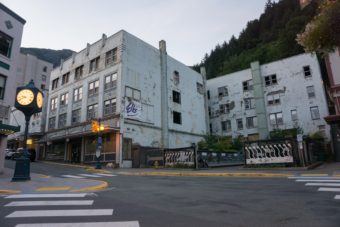
Inside the burned out Gastineau Apartments. (Photo by Lisa Phu/KTOO)

The Gastineau Apartments won’t be coming down until April. That’s according to city Engineering Director Rorie Watt, who delivered an update at Monday’s Juneau Assembly meeting.

Originally, the city wanted a demolition plan by August and bids solicited by September.

“However, what we’re hearing from contractors is that we’re giving an inadequate amount of time for the completion of the project,” Watt said. “We’ve seen major commercial contractors who would be suited for this kind of work pick up the bid documents, steer away. Call us up and say, ‘Too much risk. Not enough time. Not interested.'”

Now, the bidding process will extend into October with awards announced later that same month.

NorthWind Architects previously expressed concern that rainy fall weather would make the demolition more difficult, especially with respect to erosion of the hillside behind the apartments and managing stormwater pollution.

Assembly member Karen Crane said an extension could save the city money, but the building needed to be gone by spring.

“There can’t be any more slop over from that date because you know, then we’re running into tourist season and then there’s a big problem,” Crane said. “So the contract needs to be written pretty tightly that’s it’s down by the 30th of April or else something drastic.”

Although it’s taken months to formalize the plans, the demolition should only take three to four weeks.

The city has appropriated $1.8 million for the entire project, which it hopes to recoup through a lien against the property owners. 

Site notifications
Update notification options
Subscribe to notifications