Elizabeth Jenkins, Alaska's Energy Desk - Juneau
Would you live next to a pot garden?

A zoning ordinance that allows growing commercial marijuana in low-density neighborhoods is heading back to the Juneau Assembly for public testimony.

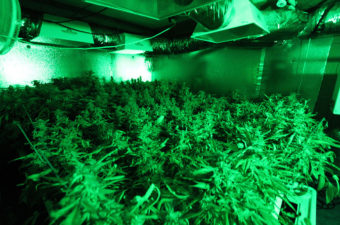
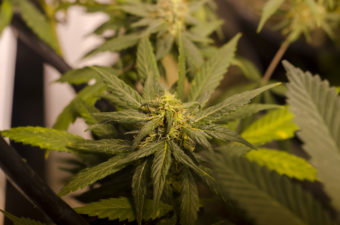
It allows marijuana cultivation in D-1 residential areas, zoned for one house per acre.

Rural reserve areas would be zoned for pot cultivation, manufacturing and retail. That’s basically everything off of the road system, plus parts of North Douglas and out the road.

On Monday, a couple of members from the public weighed in at a worksession meeting. James Barrett, who’s interested in marijuana business, said the more the market is restricted, the less opportunity there is for economic growth.

“So  I feel like maybe there’s some things we can do. Maybe we can take some risks. Maybe we say, ‘Hey, let’s give it a try,’” he said. “Let’s let the cannabis people, the responsible ones, give them a shot. Maybe they can do a little part for our economy.”

Barrett said it was also a way the city could attract young entrepreneurs.

But for Marjorie Menzi the issue hit close to home. Menzi lives on Thane Road in a D1 area. She said she was concerned about the pungent smell and glare from greenhouse grow lights.

“We should not be discriminated against because we have lower density or we’re outside the urban service area. We have people with children living in our areas,” Menzi said.

The state is proposing a 500-foot buffer around schools, day cares and childcare facilities.

Assemblymember Karen Crane agreed with Menzi’s points. She said the idea that the assembly treats neighborhoods differently is accurate, and the problem wasn’t going to go away.

“As we have more and more development outside the urban service area, we are going to come up against this area more and more and I think it’s one we need to take a look at,” Crane said.

Crane attempted to get the ordinance sent back to city planners, but the motion failed. The city is trying to figure out zoning before a moratorium expires at the end of the year. After that, pot entrepreneurs will be able to apply for conditional use permits.

The public will get another to chance testify at the next assembly meeting Nov. 9.

Plans for Juneau Ocean Center unveiled

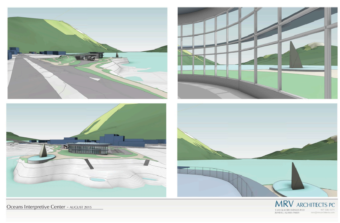
Tentative design courtesy of MRV Architects.
Tentative design plans of Juneau Ocean Center courtesy of MRV Architects.

Plans for a whale park were suspended recently after contractor bids came in millions of dollars over budget. Now a new project called the Juneau Ocean Center wants to offer the whale a different home and provide a hub for marine science.

The Juneau Ocean Center could be a space to hear lectures on marine mammals and climate change, relax and eat lunch or take in an IMAX movie on whales.

In the design plans, the glossy 7,000-square-foot building overlooks the Gastineau Channel from Egan Drive.

“The front is two stories of windows looking out at the channel and roof is actually a sod roof, a green roof rather, that’s a park,” said Linda Nicklin. She’s one of the organizers for the $12 million project proposed on Alaska Mental Health Trust land.

The bronze, life-size whale statue at a workshop. (Photo courtesy City and Borough of Juneau)

The center will be open year-round and geared toward “citizen scientists” and tourists.

“We’re going to have an electric powered boat … (to bring) people in the summer to the cruise ship piers so that we’re reducing congestion and bus traffic in downtown,” she said

Not too far away from Nicklin’s proposed center is the future site of Bridge Park. The park recently hit a development snag. The contractor bids came back way over budget — more than 25 percent over the city engineer’s estimate.

That park, near the Douglas Bridge, is supposed to be the home to a lifesize bronze whale statue. Bids are slated to go back out, but Nicklin says the ocean center might be a better spot for the whale.

“The sculpture and the ocean center are a great pairing. I think that both would benefit for being in the same location,” she said.

Nicklin and other organizers presented the plan to the Juneau Assembly Monday.

Assemblymember Mary Becker asked why the ocean center couldn’t be built at Bridge Park, where the permitting is already complete. Organizer Bob Janes said it comes down to location.

“I’ve looked at that property right on the edge of the water, looked down the channel,” Janes said. “Unfortunately it does not have all the stuff and that’s why we’re not interested in that property. And I think that will be a failure with the whale placed down there as well.”

Organizers hope to fund the ocean center with a national campaign kicking off in the spring, when the humpback whale comes off the endangered species list. Cruise ships passenger fees could supply another source of funding.

As for the whale statue, they say they want to move forward with or without it.

Tentative design plans of Juneau Ocean Center courtesy of MRV Architects.

Victory for Sealaska Heritage underscores weakness in the law

Federal investigators have found that the country’s oldest theological college broke the law regarding its Native art. Andover Newton Theological School planned to sell off 80 pieces in its collection, including a sacred Tlingit halibut hook. Now some tribal leaders are wondering if repatriation laws should be tougher.

Rosita Worl has been fighting against the school’s Native art liquidation since June. She’s the president of Sealaska Heritage Institute and also served on the Native American Graves Protection and Repatriation Act (NAGPRA) review committee.

Worl said the feds’ decision was bittersweet. It reaffirms the private college is subject to the law because it receives federal student loans.

“We were happy that the federal government did find that they were obligated to comply with NAGPRA, but I was also saddened that we had to spend all of that time and effort to force them to comply with NAGPRA,” Worl said.

Back in July, the school’s president Martin Copenhaver claimed that the items in the collection weren’t sacred. Turns out, that’s wrong. David Katzeek, a Tlingit tribal member, identified the halibut hook as a sacred object that was used in religious ceremonies.

Copenhaver couldn’t be reached for comment, but the college has 45 days to contest the decision.

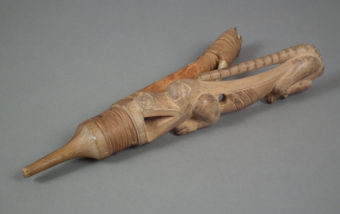
This Tlingit halibut hook with a wolf spirit was slated for auction. (Photo courtesy of Karen Kramer/Peabody Essex Museum)
This Tlingit halibut hook, Gooch Kuyéik Náxw, was slated for auction. (Photo courtesy of Karen Kramer/Peabody Essex Museum)

“To the best of my knowledge, we haven’t received any request for informal discussion and there has been no request for hearing at this time,” said David Tarler.

Tarler works at the NAGPRA office in Washington D.C. He said the college has reached out for “technical assistance,” but it should have filed a summary of its Native art years ago, which allows the tribes to see what’s in the collection.

Andover Newton might not be the only institution skipping this step. Worl says the process can lead to oversights.

“There’s no real teeth to the law,” she said. “If I didn’t file my income tax, you could be certain I would be hearing from the federal government and there would be immediate action to comply with the law. In the case of NAGPRA, we don’t have similar kinds of requirements.”

Because of this, the Alaska Federation of Natives recently passed a resolution. A group will work on proposing amendments to NAGPRA. They’ve already reached out to the congressional delegation.

Worl says the changes are necessary. Repatriation can be a long and costly endeavor for the tribes.

“In one case, I would say that we expended over a hundred thousand dollars in just direct expenses. With lawyers, other anthropologists compiling evidence,” she said.

And she says the NAGPRA laws are more than 20 years old.

“When museums and scientists were less sympathetic to Native American beliefs.”

Worl thinks there’s been a cultural shift. Recently, the Northern Light United Church sent a letter to Andover Newton Theological asking the school to return the sacred items. And with the advancements, she says the law should adapt, too.

“I do believe that we have a younger group of scientists and museum professionals with a greater understanding of Native American beliefs. I’ve seen this happen all around the country,” she said.

Worl hopes this case will encourage other schools and museums to step forward with their Native collections.

She says there are more legal hoops, but the Tlingit halibut hook is one step closer to coming home.

Updated: Juneau police investigate murder

Update | Oct. 21, 2015 3:25 pm

Juneau police have identified Christopher D. Strawn, 32, as the shooter. Strawn was arrested for first degree murder and transported to Lemon Creek Correctional Center.

Update | Oct. 21, 2015 2:48 pm

Juneau police have identified the victim in Tuesday night’s shooting as 30-year-old Brandon C. Cook.
Cook was fatally shot at Kodzoff Acres Mobile Home Park around 10:30 p.m. Police responded to a 911 call about a disturbance and found Cook on the ground. He was pronounced dead by Capital City Fire/Rescue.

Police spokesperson Erann Kalwara said officers sprang into action to find the shooter.

“Conducted a search of the residence for the suspect and then started searching other areas for the suspect,” she said.

Police have yet to name the 32-year-old suspect who fled the scene. Kalwara said he was located just a few blocks away at his residence on Stephen Richards Memorial Drive.

A SWAT team was organized to take him into custody.

“They waited until 8:30 to execute the plan because we wanted to make sure morning’s traffic, kids on their way to school, those kinds of things were taken into the consideration,” Kalwara said. “When they did make entry, he was taken without much further ado and then brought back to the police department.”

Kalwara said the motive for the shooting is under investigation. The suspect’s name is expected to be released later today.

Original story | Oct. 21, 2015 10:59 am 

Juneau police are investigating the murder of a 30-year-old man, whose identity has not been released. Police responded to a call Tuesday night that a male shot another male at the 2800 block of Mendenhall Loop Road.

When officers arrived, they found the victim severely injured on the floor. The suspect had fled the scene.

Police detained the 32-year-old suspect on Wednesday morning but have not released his identity. The investigation is ongoing.

This is a developing story. Check back for updates.

Local marijuana regs set for public hearing

The Juneau Assembly wants public comment on an ordinance that will define the marijuana business in the capital city. It specifies where marijuana can be grown, processed and sold.

Assemblymember Karen Crane said the Juneau Planning Commission spoke about wanting to preserve neighborhoods.

“But they only preserve neighborhoods inside the urban service area,” Crane said. “They have left open action in neighborhoods outside urban service area, and I think there needs to be more discussion about this.”

The city has a moratorium that expires at the end of the year on marijuana businesses. After that, pot entrepreneurs will be able to apply for conditional use permits. Crane said she’d like to hear more input before the deadline.

“I know there’s a lot of pressure to make these decisions but this decision, I’d like to have some more discussion on — instead of being pushed into making it right now,” Crane said.

The public gets a chance to weigh in at the next assembly meeting on Nov. 9.

Church fire causes $40,000 worth of damage

The kitchen at Faith Lutheran Church caught on fire Tuesday afternoon. It started after cooking oil was left unattended on the stove.

By the time Glacier Fire Station crew arrived, Assistant Chief Ed Quinto discovered that the fire had been put out but smoke was still wafting through the doors.

“The flames had gone up to the tongue and groove ceiling, so the ceiling itself is all charred up. There are holes in the walls where we had to check for extension and there’s dried chem — not only in the kitchen itself but the adjacent rooms because it got all over the place,” Quinto said.

That’s dried chemical, the solution that comes out of a fire extinguisher. No one was hurt during the fire. The Head Start program that meets at the church had just let out.

Quinto said the program will have to relocate as the church is cleaned up and repaired. Damages are estimated to be around $40,000.

Editor’s note: Ed Quinto’s title has been corrected. Quinto is assistant chief, not chief. 

Site notifications
Update notification options
Subscribe to notifications