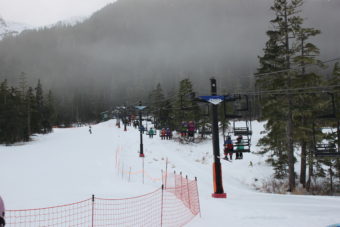
Black Bear Chairlift at Eaglecrest Ski Area in April 2013. (Photo by Matt Miller/KTOO)
Eaglecrest Ski Area is opening this year ahead of schedule. Skiers and snowboarders will be able to the ride chair lift up the mountain this weekend.
Eaglecrest’s general manager, Matt Lillard, said the snow is about 50″ deep at the summit and 20″ at the base.
“It’s certainly still early season conditions. It’s thin in spots and there are some bare areas where water is flowing,” Lillard said. “But overall we’re going to be able to open the hooter and black bear chairlift for skiing … the conditions for skiing are actually really nice and we’re looking forward to a fun opening weekend.”
Lillard said last year’s snow was the worst on record. The upper mountain was only open for five days.
To celebrate the early start, Eaglecrest is having a season pass sale. It starts Nov. 27 and ends Dec. 6. Unlimited season passes are $519 for adults and $469 for seniors.
After this weekend, the ski area opens back up on Dec. 5 with regular business hours.
Construction workers move concrete blocks to create a buffer area around the Gastineau Apartments. (Photo by Elizabeth Jenkins/KTOO)
A worker gives a man watching nearby a winter jacket. (Photo by Elizabeth Jenkins/KTOO)
Roads won't be closed until after the holiday season. (Photo by Elizabeth Jenkins/KTOO)
Parts of the park's decorative fence will be salvaged. (Photo by Elizabeth Jenkins/KTOO)
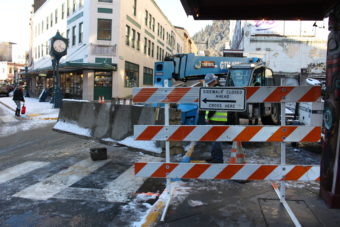
Juneau’s Gunakadeit Park will soon be torn down. The park will serve as the staging area for the larger demolition of the Gastineau Apartments. Rorie Watt, the city’s engineering director, said the contractors should have the park dissembled within a couple of weeks.

“They’re going to be moving pieces of art and the decorative fence, and setting up barriers and traffic control signs,” Watt said.
The decorative metal pieces would be salvaged, but the city hasn’t identified a use for them yet.
The flow of traffic isn’t expected to be interrupted until after the holiday season. That’s when some of the riskier demolition will take place, and the front facing wall of the Gastineau Apartments will be torn down.
The Gastineau Apartments burned in November 2012. The city and owners James Barrett and Camilla Barrett have been in a long dispute over the maintenance of the building. The Barretts were served numerous times over the years with notices to clean up or secure the site.
The project is supposed to be completed by the end of April.
In Alaska, the number of fluent Haida speakers has dwindled down into the single digits. It’s been called an endangered language. But in Juneau, one group is trying to change that. Haida Language Learners is using YouTube, Snapchat and Instagram to reach a wider audience.
Emily Rose Edenshaw-Chafin shows me her phone. She’s been using a flashcard app to practice Haida. It’s totally customizable. She can create the cards and share them with teachers and friends. On one of the cards is a picture of a horse grazing in a field, and it’s broken down into cuts of meat — labeled Gyuudáan Kiʼíi eehl Hl ʼwáadaagang.
Haida Language Learners use the app Snapchat to connect with others. The app deletes shared videos after a few seconds, which they say is perfect for practicing the language.
“And then the second one is a cartoon, the one in English that says ‘I have horse meat for sale.’ It’s a picture of a horse head inside a burger,” Edenshaw says.
Not a real horse head, part of a costume.
“For me, it makes it funny and it makes it more interesting,” she says.
The Haida arrived in Southeast a few hundred years ago. Some left their ancestral home of Haida Gwaii, which is now part of Canada. They settled in villages on Prince of Wales Island. Edenshaw says the Haida language’s grammar structure is similar to Spanish. And like Spanish, it can sound like a foreign language.
“And being Native you’re disappointed that you don’t know your own heritage and language. It’s hard to work past that sometimes,” she says.
Edenshaw has practiced Haida for over a decade. Her family moved to Hydaburg when she was a kid, and she started picking words up.
“You know, like thank you: Háw’aa. Hágwsdaa: hurry up. You hear that one a lot.”
But she says it was hard to learn more complex phrases. In college, she was able to take a free class taught by a linguist.
“I really fell in love with the language. I wanted to write poetry in Haida. I wanted to dream in Haida, so I continued to practice with it.”
She says part of that meant finding someone to speak Haida with, to use words and phrases that are relevant in conversation today. Edenshaw met Susie Lee Edwardson in Haida class.
In their YouTube video, a picture of Grumpy Cat flashes on the screen. You know, Grumpy cat. The feline celebrity meme. Edwardson repeats the word híndaa or “go away.”
It has more than 200 views. Their YouTube Channel has about 145 subscribers, which may not seem like a lot. But remember, Alaska’s fluent Haida speakers are in the single digits. Edwardson has only been studying it for about three years, and says she didn’t grow up speaking the language. Her parents spoke a word here and there.
“It didn’t really connect with me as it was a part of me,” Edwardson says. “But when I got into college and I started learning the language with my family, it felt really good and it felt like you were going into a community that you were a part of all your life.”
The number of fluent Haida speakers has been declining for the past 100 years. Many boarding schools run by the federal government and missionaries enforced strict bans on Native languages. Edwardson says it’s a serious topic, but they’re trying to make learning Haida fun. It’s involved some compromise.
She took down one of their YouTube videos because some found it offensive. In that video, she says the Haida word for penis. OK, maybe they went a little farther and said “tiny penis.” But Edwardson says they don’t want to offend anyone.
Emily Rose Edenshaw-Chafin and Susie Lee Edwardson plan out their next YouTube video. (Photo by Elizabeth Jenkins/KTOO)
“Like the little radical in me is like, ‘it’s the language,'” Edwardson says. “But at the same time we want it to be accessible. And if families are going through the YouTube videos and there’s something they don’t want them to learn yet, I don’t want them to stay away from the language.”
Then there’s also the issue of finding ways to express modern notions. But Edenshaw says that’s totally doable.
“We ask the elders what would make this work. What can we do to translate this into Haida?” Edenshaw says. “So we’ll all understand it and then we can use just Haida vocabulary and our thoughts and what we’re doing nowadays.”
The Haida phrase for computer literally means “the box that knows everything.” A cellphone is a “purse phone” or “wallet phone.” Spinach is “iron leaf.”
And she says having the web to connect with others has been huge. Haida Language Learners has received messages from a teenage fan in New York. They’ve helped people in remote communities say goodbye to a loved one at a funeral in Haida.
Edenshaw recently quit her day job to focus on language revitalization full-time. She wants people to know Haida isn’t dead.
“We can bring back the language. We can’t bring back every single part of the culture but we can bring back the important parts that will make us feel whole and make us feel right in the world.”
She hasn’t dreamed in Haida yet. But she is writing poetry.
Correction: A previous version of this story said that Edwardson had been studying the language for about one year. She’s actually been studying it for three years. We regret the error.
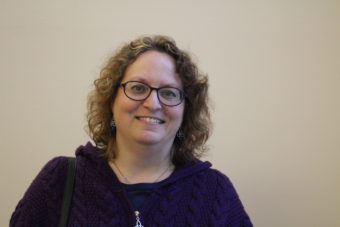
Deputy city clerk, Beth McEwen, said she wasn’t expecting to be named municipal employee of the year. (Photo by Elizabeth Jenkins)
Juneau picked up four of six awards at the Alaska Municipal League ceremony Thursday in Anchorage, including Municipal Employee of the Year. Beth McEwen, deputy city clerk, said she wasn’t expecting to win. The presenter started listing off McEwen’s achievements, and that’s when she realized.
“I’m sure my face was just as shocked as could be because I was blindsided and had absolutely no idea this was something I had even been nominated for,” she said.
McEwen works with about three dozen local boards and commissions. She’s active with the statewide municipal clerk’s association. Juneau Assembly member Jesse Kiehl called her one of the most knowledgeable people regarding the state’s liquor laws.
He presented the award to McEwen. Kiehl also serves on the league’s board.
“As a board member, you would present an award to whoever won it,” Kiehl said. “But for it to be someone you work with so closely is really an extra honor.”
The public works award went to the Juneau airport runway rehabilitation. The Juneau Police Department picked up one for their bicycle safety project. And the Zach Gordon Youth Center won in the spirit category for a kitchen remodel.
Ketchikan and Dutch Harbor were also recognized for people and projects in their communities.
McEwen says there are about 35,000 municipal employees in Alaska.
“It does take a village of public servants to be able to accomplish all the work of a government,” she said. “And I’m just honored to be one of those public servants.
This is the second year in a row someone from Juneau has won Municipal Employee of the Year.
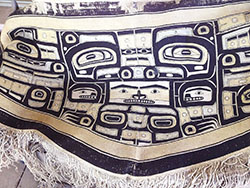
Sealaska Heritage Institute has acquired a Chilkat robe that was to be auctioned off on eBay on Wednesday. After the seller learned the robe was a sacred item, he allowed SHI to purchase it at the reserve price of $14,500. There were already multiple bids.

The Chilkat robe is a Raven design and measures just over five feet wide. (Photo by George Blucker)
Typically, these objects can fetch upwards of $30,000.
The seller, George Blucker, bought the robe at an Illinois flea market 25 years ago. He thought it was a fake, but that seller told him it was purchased at an estate sale and had been brought back sometime after the Yukon gold rush.
The clan of origin is unknown. The robe is a Raven design and appears to be funerary object.
In a statement, Blucker said when he learned the robe had “religious significance” and a “spiritual presence,” he knew it needed to return home.
SHI expects the robe to arrive in Juneau later next week.
The Juneau Police Department recently received an anonymous tip that a dangerous form of heroin has entered the city. Lt. Kris Sell said it’s called “China white,” and the police have been told it may be laced with fentanyl, a prescription drug used for pain management.
“The fentanyl being mixed with the heroin could be a game changer,” she said. “They might misestimate what their dosage would be. What people have been telling known users in the community is to have a friend around, use lightly.”
Five heroin overdoses occurred over the weekend. One of the cases also involved meth. Emergency responders found that China white was involved in two of the overdoses, Sell said.
Sell said typically this type of heroin isn’t found in the city.
“Usually in Juneau we see a black tar heroin that is a more crudely processed form of heroin and usually comes from Mexico,” Sell said.
China white is in powder form and comes from Asia. Sell said the police haven’t been able to confiscate the drug yet. Capital City Fire/Rescue was able to administer lifesaving Narcan to three of the overdose patients.
This year, seven people have died in heroin-involved deaths.
Close
Update notification options
Subscribe to notifications
Subscribe
Get notifications about news related to the topics you care about. You can unsubscribe anytime.