Elizabeth Jenkins, Alaska's Energy Desk - Juneau
Walker announces new restrictions on state hiring and travel

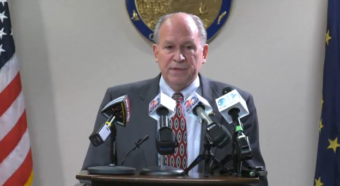
Gov. Bill Walker speaks Jan 5 at a press conference about new restrictions on state employee hiring and travel. (Screenshot)

New restrictions on state hiring and employee travel were announced Tuesday. Gov. Bill Walker said the restrictions formalize what many state agencies and departments are already doing to cut costs.

“The travel is for restrictions on nonessential. An example would be a conference someplace that has to go through a process to get approval,” Walker said. “There is a waiver process for that, but it has to be associated with the travel, has to be associated with what you do.”

For example, Walker said essential travel would include a district attorney flying to a location for a trial. Essential travel also still includes employees who need out-of-state training to maintain job credentials, although there will be a review process.

Boards and commissions are being asked to limit in-person meetings to once a year.

Walker called this the “second wave of hiring restrictions,” noting there are 600 fewer state employees than a year ago. Many of those positions were cut through attrition as employees retired. Now, no new full or part-time state positions will be added without approval.

The new restrictions are effective immediately.

Alaska Fred Meyers could start carrying overdose medication

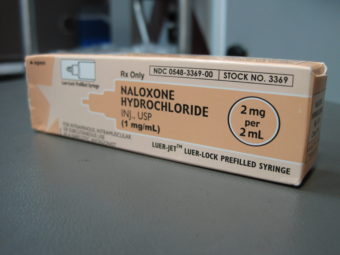
Naloxone HCl preparation, pre-filled Luer-Jet package for intravenous administration. (Creative Commons photo by Intropin)

A naloxone pilot project at Fred Meyer pharmacies down south could be expanding to Alaska. Eight stores in Washington have quietly rolled out access to a drug that stops opiate overdoses. The chain plans to eventually expand to all its locations. In Alaska, this largely depends on the outcome of Senate Bill 23.
Taelyn Coffee started using opiates about seven years ago. She says it started with OxyContin, after seeing her boyfriend and a family member become addicted to the drug. Then she switched to heroin when oxys became harder to find.

One night, she was hanging out with her friends in Juneau.

“We were laughing. We were high of course,” Coffee said.

She remembers one those friends had just finished shooting up and the girl’s lips turned blue. Coffee says they all panicked.

“Trying to shake her trying to get some kind of notion that she was still breathing or alive at this point. Nothing. We got nothing,” Coffee said.

She says they were afraid of being arrested if they took the girl to the hospital. Still, they knew they had to get their friend help. She was overdosing.

With the changes happening in Alaska that night could have gone differently. For starters, the good Samaritan law passed last year, could have protected Coffee and her friends when they called for help. And now, Fred Meyer pharmacies want to make it possible for people to have access to a drug that stops the overdose.

“We see naloxone as a fire extinguisher. We hope you never have to use it but it’s great to have just in case,” said Melissa Hansen, a pharmacy sales manager at Fred Meyer.

The Fred Meyer naloxone pilot project rolled out in October at some Washington stores, but it’s still getting off the ground. Other pharmacies that carry naloxone in Washington include Bartell Drugs, QFC and several independents. Hansen said people wanting to get their hands on the drug don’t have to go to a doctor.

“So they can just walk into any of our pharmacies and say, you know, I’d like to get some naloxone. Even if we know that they’re not the end user,” Hansen said.

Fred Meyer can’t prescribe naloxone sometimes called Narcan under its own pharmacy license. So they rely on something called a collaborative drug therapy agreement.

For people who need it, Hansen says this reduces some of the barriers to getting the drug. After a short consultation with a pharmacist, the person is given an injection kit or nasal spray. Medicaid and some insurance providers cover the expense in Washington. The out-of-pocket cost for the nasal spray is only $40.

Hansen thinks naloxone isn’t just for heroin users.

“The other thing we’re really working on is convincing the medical community that they’re not having risky prescribing habits but that these are risky medications,” Hansen said.

For example, cancer patients sometimes take high doses of opiates for pain. Hansen says it makes sense for them to also have naloxone and someone to administer it nearby.

Fred Meyer Pharmacies plan to start advertising the program at their Washington stores soon. The program expands to Idaho in February and eventually it could come Alaska. Whether Alaska Fred Meyers pharmacies will carry naloxone depends on if the state passes SB 23.

“As soon as this law passes in Alaska, they’re already on our radar to go up there,” Hansen said.

The law gives protections for people administering naloxone.

That night that Taelyn Coffee’s friend OD’d, the group got lucky. They were driving the girl to the hospital and performing CPR.

“Halfway through the trip we were just getting past the intersection from McDonalds and she came to,” Coffee said. “That first breath, I can’t even tell you how that made me feel, and everyone else was just so relieved.”

That was five years ago. Since then, Coffee has kicked her opiate addiction. She now works in an organization that helps women in domestic violence situations. She says naloxone isn’t going to stop heroin use in Juneau but it could save lives. She wouldn’t hesitate to have some on hand.

“I’ll be the first in line to buy some,” Coffee said. “I’m not an addict anymore but I know tons of people who are still.”

Fred Meyer representatives say the program could expand to their 11 pharmacies in Alaska by summer.


Alaska’s Pot Cafes Will Give Patrons A Taste Of Cannabis

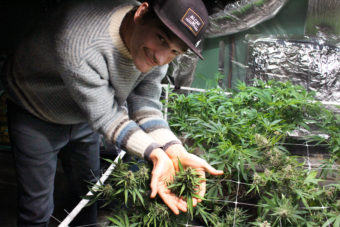
James Barrett. (Photo by by Elizabeth Jenkins/KTOO)

Alaska is about to become the first state to have pot cafes where people can buy and consume marijuana, similar to Amsterdam.

Right now, that’s not legal in other states that have recreational marijuana.

Brothers James and Giono Barrett, who own a marijuana business, Rainforest Farms, in Juneau, also plan to produce a line of chocolate bars infused with pot. They’ll be an alternative to the sugary, processed edibles Giono says he has eaten recently in Colorado.

“Man, when I was down there there was just a lot of products I didn’t want to put in my body at all — not because of the cannabis,” he says. “I actually got sick off one of them. I got nauseous.”

Unlike Colorado, Rainforest Farms can have a cafe for its customers to eat their pot-infused treats. In November, the Alaska state marijuana control board approved on-site consumption at retail stores. Those businesses could start popping up as early as summer. Each municipality has to give the ultimate OK.
“I am not thinking, ‘Oh, goody, goody, we’re going to get rich because of pot.’ That is not in my thought process at all,” says Mary Becker, Juneau’s mayor.

She’s a retired middle school teacher. Drug aversion programs, she says, were a regular staple in her classroom.

“I have grandchildren and I’ve taught school and I want to see these young people have good jobs. They can’t even get a job in the mine if they test with a drug in their system,” she says.

Pot cafes in Alaska give people a legal place to consume marijuana, but some municipalities have anti-smoking laws. Juneau has a strict clean air ordinance that prohibits smoking tobacco and marijuana in public places, in businesses like restaurants and even in private clubs like an Elks Lodge.

Becker says while she’s not excited her state would be the first to have marijuana cafes, a pot brownie doesn’t bother her as much as a joint.

“I mean, I’d rather people didn’t put their calories in their bodies with edibles of drugs, but it does not damage the smoking ordinance and that’s been one of my real concerns,” she says.

Attorney Kevin Higgins says he smokes marijuana at his home to relieve job stress but would consider going to pot cafes.

He says the number of local pot enthusiasts like himself probably isn’t big enough to sustain businesses. But there is another possibility.

“Tourists are obviously willing to pay a premium on a lot of things just to be part of the experience of floating up the Inside Passage,” he says.

And with close to a million cruise ship passengers each year, marijuana cafes could mean an added attraction in Juneau.

But Becker says pot pales in comparison to the city’s other attractions.

“Have we looked at the Mendenhall Glacier? Have we gone out on the water and seen the whales? I have a hard time thinking people are going to come to Juneau to get their pot,” Becker says.

Read Original Article – December 24, 2015 4:55 AM ET

Beneath the beard with a nearly 30-year Santa Claus veteran

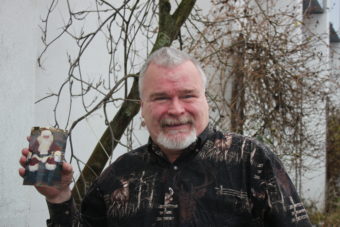
In the Santa off-season, Helms works as a special needs teacher and commercial fisherman.(Photo by Elizabeth Jenkins/KTOO)

Every year during the holiday, a few people in Juneau don the red suit. There’s been a decades-long tradition of Santas at Nugget Mall and other places in the community.

Rick Helms got his start playing Santa about 30 years ago when a friend asked if he would dress up for his family.

“I says, ‘Not in this lifetime,'” Helms said. “We were having beers, Monday Night Football. He says, ‘My nieces know me. I need a friend to fill in for me.’ So I says, OK.”

Helms has a short white beard. He just so happens to be wearing a shirt with deer on it. And he has a kind, twinkle in his eye that reminds you of Santa Claus. Imagine recognizing an old high school acquaintance and doing a double take. Helms is like that, except he’s playing a childhood icon.

But he said he was nervous about becoming Santa for the first time.

“Getting around new people I get tongue tied and sweaty palms, like today, right now,” he said.

When he puts on the red suit and fake beard though, he says some of those fears melt away.

“Kind of like Halloween. ‘Cause, you know, you dress up in costumes. … And now it’s old hat. I just get my game face on, and I just love it,” he said.

Helms is in high demand this time of year. There are typically three Santas that rotate at Nugget Mall but one just had back surgery. So lately, Helms has been listening to a lot of children’s wish lists. He says Legos and Star Wars toys have been popular requests. But sometimes kids ask for gadgets he hasn’t heard of.

He has a planned response: “I let Mrs. Claus take care of that.”
Then there are things children ask for that Santa Helms can’t promise.

“Bring mommy, daddy back from Afghanistan or Kuwait. Stuff like that. Santa sometimes just has to have a break after that, you know?” Helms said.

Juneau’s chapter of Epsilon Sigma Alpha puts on the photo session with Santa at the mall. The earnings go to nonprofits, like St. Jude’s Children’s Hospital and the Salvation Army.

Sharon Lowe is one of the organizers. And in the past, she’s put on the red suit to help out.

“I wear the whole getup, beard and everything! I try to lower my voice several octaves,” she said.

She also plays the Easter Bunny in the spring. The time she had to dress up as Santa, the other Santa had gotten his calendar mixed up. She said among the crowd of kids, one sticks out: A special needs girl who only wanted to sit in her lap.

“And she just cuddled and cuddled and that year we were giving away books about the Night Before Christmas and she got off my lap, and I handed her a book. And she looked at it and she looked at me and pointed at the Santa on the book and said, ‘That’s you,'” Lowe said. “You know their reaction to you as the Easter Bunny or you as the Santa Claus, it’s just precious. … They believe and they want to believe so badly.”

Both Lowe and Helms said playing Santa is more difficult than strapping on a fake beard and calling it good. It takes patience, empathy and the ability to really listen. That’s what being Santa is all about.

Helms said what began as something he was reluctant to do has turned into an annual event he’ll be doing his whole life.

“Until I’m looking down at, or up at, the dirt. Cause I don’t plan on giving it up,” Helms said.

He even invested in his own Santa suit, which cost about $500. He donates his $15 an hour earnings playing Santa to organizations like the Wounded Warrior Project and The Salvation Army.

He’s committed to the wardrobe and spirit of St. Nick, but he’s in no rush to grow out his white beard just yet.

“Halibut slime and jellyfish doesn’t mix with beards,” he said.

That’s right. Santa Helms works as a commercial fisherman in the off-season.

Juneau assembly reenvisions local government at annual retreat

assembly retreat
Samantha Dye helps the assembly see the opportunities in the obstacles. (Photo by Elizabeth Jenkins/KTOO)

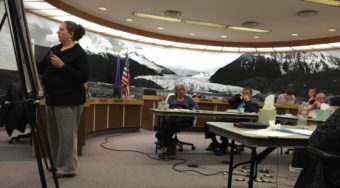
The Juneau Assembly gathered Monday to discuss a strategic action plan for the upcoming year. The late mayor hoped this retreat would spark conversation and help refine the city’s goals.

Samantha Dye of Dynamic Consulting helped the assembly brainstorm a list of Juneau’s opportunities. Things like the natural environment, recreation, and short commutes. She asked the assembly to list obstacles. And then the opportunities for Juneau within those obstacles.

“The shift there is that often we start with the problems and work our way in the other direction where he wanted to start with why are why doing this?” Dye said. “What’s our reason and then work backward.”

assembly retreat
The assembly revises Juneau’s vision statement. (Photo by Elizabeth Jenkins/KTOO)

The assembly noted that a seasonal workforce is problematic for the local economy, but that could mean more young people are coming to Juneau. Child care is scarce.

“But that brings in an opportunity to better support young families, so that both parents can work. How to have new businesses that could be creative,” Dye said.

Dye said the exercise is “potential-based.”

Mary Becker, Juneau’s interim mayor, said the retreat was more “open-ended” than the previous year, which led to some frustration at the beginning.

“We have to push past the wall of what are we doing, why are we redoing this? Haven’t we done this before? And look at it in a different way,” Becker said.

Becker said this method helps the assembly reevaluate issues that might be familiar. The six-hour retreat cost the city $2,600. Dynamic Consulting plans to issue a report within a week. 

Juneau keeps conversation going on heroin

On Thursday, Lt. Kris Sell with the Juneau Police Department spoke to a packed chamber lunch about heroin. Chief Bryce Johnson is attending Sunday's Stop Heroin, Start Talking event. (Photo by Elizabeth Jenkins/KTOO)
On Thursday, Lt. Kris Sell with the Juneau Police Department spoke to a packed chamber of commerce lunch about heroin. Chief Bryce Johnson is attending Sunday’s Stop Heroin, Start Talking event. (Photo by Elizabeth Jenkins/KTOO)

Legislators, police officers and behavioral health specialists will gather this weekend in Juneau for a townhall discussion on heroin. They’ll be focused on finding local solutions to help people suffering with addiction.

Michele Morgan started Stop Heroin, Start Talking as a grassroots initiative — a homespun way to get the word out about what she saw happening in her community. After throwing events and printing our flyers on her own dime, Morgan is now the one getting help.

Her organization recently partnered with the Juneau branch of the National Coalition on Alcohol and Drug Dependence.

“We realized that what Juneau Stop Heroin was doing is exactly what NCADD wanted to start doing more of,” Morgan said.

NCADD provides advocacy, education, and some clinical services. Being under the umbrella of the nonprofit means donations to Stop Heroin, Start Talking will be tax deductible. It also connects the organization to a slew of other agencies that NCADD has developed partnerships with, such as the California-based Harm Reduction Coalition.

Katie Chapman, executive director of the Juneau’s NCADD, said her organization saw the work Morgan was doing and thought it would be a good fit.

“It’s amazing. It’s really inspiring to see that. I think a lot of change happens from individuals, community members that have the passion,” Chapman said.

For Sunday’s community meeting, Morgan invited Juneau representatives Sam Kito and Cathy Muñoz to weigh in on the Good Samaritan law and Senate Bill 23.

“All I did was email these people and they responded and said, ‘yes I will do this.’ That is a testament to how forward thinking Juneau is getting to be. It’s great,” Morgan said.

The Good Samaritan law passed last year. It protects people who report an overdose from criminal prosecution. SB 23 could prevent deaths by holding harmless those who administer a drug called Naloxone in an attempt to save someone who has overdosed

Another topic at the meeting will be the lack of treatment options for people who want to get clean. There’s practically nowhere to clinically detox in Juneau.

“I hope it’s not adversarial, but it is something that sticks in your head. We can arrest someone for using drugs and put them in jail immediately. But if we want to put them in treatment, which I think is fiscally and for our future more responsible, we don’t have beds.”

City Manager Kim Kiefer has been looking into a program in Gloucester, Massachusetts that helps people get into treatment. She learned that it costs about $50 to connect someone with services and about $230 to incarcerate them.

Like Juneau, Gloucester is a small town of about 30,000. The town is about an hour outside of Boston, and people suffering with an addiction there can go to a police department and ask for help. Then they can get into a detox program and long-term treatment.

“In the six months they’ve been doing this, they’ve had over 300 people that say, ‘I want to get clean,’” Kiefer said.

Kiefer says she doesn’t know much about heroin addiction, but she’s trying to learn more. That means reaching out to people in and outside of Juneau to find what’s working.

More than $800,000 of the city’s social service funds are funneled through the Juneau Community Foundation. The Hope Foundation is pitching in $1 million for grants to look into these issues.

For Morgan — the woman who started the Stop Heroin, Start Talking program — the biggest hurdle has been changing attitudes about addiction, including her own. Three years ago, her sister died of a heroin overdose. She wrote in the obituary she died of cancer.

“My sister would have died this year, I would have said the truth. I would have said my sister Eva died after a long battle of addiction and I would feel fine. But three years ago we were ashamed. We didn’t want anyone to know or smudge her reputation,” Morgan said. “But now people are looking at it as it is a health crisis and in that sense, that’s the big change.”

The Community of Compassion will hold an open dialogue about addiction Saturday at 4 p.m. at the @360 studio. The Stop Heroin, Start Talking panel begins at 2 p.m. Sunday at the Mendenhall Valley Public Library.

Site notifications
Update notification options
Subscribe to notifications