
If you’re heading downtown this week, you might have your car or bus rerouted. That’s because the demolition of the Gastineau apartments began Monday.
At the site, a backhoe will punch holes in the concrete walls of the building and an excavator will peel the front structure away piece by piece.
Richard Ritter, the city’s chief architect, said North Franklin Street will be closed to keep the public safe.
“At that point they will start removing the front wall. That’s the trickiest part,” Ritter said. “They don’t want parts of the front wall to fall into the street. We do have it all restrained with cables and a demolition screen, but it’s a public safety thing.”
North Franklin will reopen tomorrow evening. But the street will be continuously closed Wednesday through 6 p.m. Sunday.
Ritter expects the initial demolition of the front of the apartments to be completed this week. The back structure will be torn down in the following weeks. The finish date is set for the end of April.
For the second time in about a month, the Juneau Assembly must appoint a new member. The filing period opens Tuesday for an assembly seat left vacant by Karen Crane.
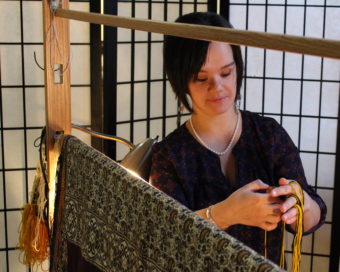
Crane resigned last week from her District 2 seat after announcing she was running for mayor. Crane and Ken Koelsch are the only two candidates running for mayor in the March 15 special election. Filing closed Monday.
Keeping with tradition, Lily Hope covers her weaving. She won’t publicly share photos until the blanket is finished. (Photo by Elizabeth Jenkins/KTOO)
The Portland Art Museum in Oregon has commissioned a Tlingit Chilkat robe from a Juneau weaver — adding a fourth generation to a lineage of weaving students and teachers.
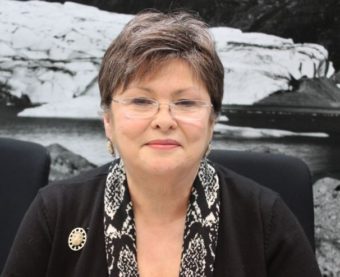
In a shop downtown, Lily Hope is weaving her first Chilkat blanket.
She sits in front of a 5-foot-long wooden loom carved by her father. It’s the second week of a year-long project, but the Chilkat robe is already taking shape. Chunky stripes of black and yellow.
Hope weaves across the loom. A motion she describes as jumping jacks for her fingers. She says this is the first time in years she’s had regular hours away from her children.
“I don’t know about other moms who’ve gone back to work, but it’s pretty emotionally challenging,” Hope says. “Ultimately it’s gratifying, satisfying to be here to weave. But it’s a constant opportunity-cost of what am I giving up to be able to weave?”
Hope says Chilkat blankets are one of the most prestigious ceremonial dance robes.
The warp hangs free, vertically on the loom. This warp is made of merino wool twined with strips of cedar. At the bottom, several strings are clumped together in a row of tiny socks. Actually, Hope’s kids socks. And her own from when she was a kid.
“I love having all of the generations, you know, sitting here. Hanging out. Little feet hanging out,” she says.
When Hope was about 6 years old, she remembers her mother learned to weave from Jennie Thlanaut.
“I don’t know if you’ve been in an elderly Native household, but it smelled like seal oil or like fibers. If I could go back in time and smell that again, I know that’d be so vivid in my mind.”
Her mom tried to teach her, but she says she thought it was dull as a teenager. In her 20s, she picked up Ravenstail weaving and later, Chilkat.
“It was interesting to return to it and to feel that similar time passing but not be bored by it,” Hope says.
Lily Hope dyed the yellow yarn herself. She was worried about it turning out orange, but it transformed into the “perfect Chilkat yellow.” (Photo by Elizabeth Jenkins/KTOO)
The Portland Art Museum has Chilkat robes from three generations of weavers, including Hope’s mom–Clarissa Rizal. Museum curator Deana Dartt says the blankets will be part of a traveling exhibit next year called The Art of Resilience: The Continuum of Tlingit Art.
“In showing the continuum, in this big exhibition, it made sense to me to commission a robe by one of Clarissa’s students and extend that genealogy to a fourth generation,” Dartt said.
That fourth generation being Hope. Dartt thinks no other museum in the country has a lineage of Chilkat robes like this. But she says the blankets don’t just belong to the museum. They belong to the tribes, too. That’s why the museum loans the items for ceremonial events.
“One of the things we’re really working on here, at the Portland Art Museum, is having those important objects be a part of the living culture.”
Dartt says she’d like to see Hope and her mom’s robe danced together someday.
Lily Hope holds up her pattern to the loom. The Portland Art Museum has a lineage of three Chilkat blankets weaved by Cora Benson, Jennie Thlanaut, and Clarissa Rizal. Hope’s blanket will become the fourth. (Photo by Elizabeth Jenkins/KTOO)
Back at the loom, Hope’s finishing up the border on the Chilkat robe. Soon, she’ll start the process of weaving Tlingit moieties in the design.
“So we’ve got the Raven teaching the Eagle, teaching the Raven, teaching the Raven,” she says. “So it’s a lineage robe honoring our teachers.”
Hope isn’t posting photos on Facebook or Instagram of her progress with the weaving. She’s keeping with tradition. The blanket won’t be seen by the masses until it’s finished.
Hope says she won’t weave when she’s angry. When she’s at the loom, she only weaves with a feeling of gratitude.
“How lucky am I to sit here in front of this piece, in front of this ancient art form and have my hands in this warp and be like, wow!” Hope says. “It’s a little overwhelming and kind of leaks into the rest of life to have gratitude to be able to do this but gratitude to go home and see my kids.”
At first she was afraid to spend the thousand hours it takes to weave the Chilkat blanket alone.
“What do you do with yourself all day with your thoughts? It hasn’t scared me as much as I thought it would. It’s not that scary.”
The Chilkat robes will travel with the exhibit around the country next year. Then possibly to Paris and back to Juneau in 2019 for a 10,000-square-foot exhibition.
Juneau Assemblymember Karen Crane has decided to run for mayor.
Crane has been on the assembly for nearly six years. She is the former president of the Alaska League of Women Voters and a member of the Juneau branch. She’s also active in Southeast’s United Way and served in the Alaska Municipal League. She is a retired library, archives and museum director for the state.
Crane said she hopes to bring leadership and experience to position.
“I really want to be an activist mayor. Really out and promoting and supporting Juneau,” Crane said. “I think the mayor is going to have to be really, really visible. Not only in the community but across the state.”
So far, Ken Koelsch is the only other candidate who has filed to run. Candidates have until Jan. 25 to file. The special election is March 15.

When Mayor Greg Fisk died in November, he was replaced by Deputy Mayor Mary Becker. In December, the assembly voted in 5-3 to hold a special election. Crane voted yes.
Delta Airlines is temporarily cutting two weekly flights to Juneau.
Anthony Black, a Delta spokesperson, says effective immediately Delta will no longer fly to Juneau on Tuesday or Saturday. There will be no southbound flights on Sundays or Wednesdays. Sometime in March, Sundays will be added back to the schedule. In May, Delta will revert back to offering seven flights per week in May.

The company started flying year-round to the capital city in the summer of 2015. The airlines scaled up to a Boeing 737 during the summer, which can accommodate 160 passengers, but demand slowed as tourist season ended.
Black said Delta passengers who have already scheduled flights can be reimbursed or rerouted through Alaska Airlines.
The Juneau Wal-Mart was previously a K-Mart store. It’s unknown what will happen to the building. (Photo by Elizabeth Jenkins/KTOO)
Update | 5:45 p.m. Jan. 15, 2016
Editor’s note: We’ve updated and recast the story. Our original story follows below.
Wal-Mart announced that it’s closing its Juneau location, along with 154 other stores across the country. Locally, that means about 180 people could potentially lose their jobs when the store closes next month.
Some Wal-Mart associates found out the news as abruptly as everyone else Friday morning. Ted Guthrie has worked at the Juneau store for about seven months.
“Mostly pushing carts, sweeping up, janitorial type work,” Guthrie said.
He saw rumors circulating around on Facebook before he came into work.
“Somebody just asked me if I heard. I don’t believe it until I started reading notes around the store and seeing the vendors pulling out,” he said.
Guthrie has two kids, and he calls Wal-Mart a good employer.
Juneau Mayor Mary Becker said that closure could cause a “less than secure feeling in the community.” The chain has 13 stores in Alaska but the Juneau location is the only one that’s slated to close. Becker said a regional manager called on Friday to explain why.
“He did tell me that the freight was one of the driving forces for the closure but he also said that they were doing an evaluation of their stores nationwide,” Becker said.
The chain is a major contributor to city taxes—especially sales tax.
Wal-Mart reps say the company decided to close the stores based on financial performance, the cost of doing business and plans for strategic growth. Despite the potential layoffs, Wal-Mart still plans to open 240 new stores in the U.S.
Becker thinks better transportation could help incentivize private sector jobs in Juneau.
“My personal opinion is we need to put the road in so that we do have a method of getting freight up on trucks and maybe less expensive to get to Juneau,” Becker said.
Delia Garcia, a Wal-Mart corporate rep, said associates who have been employed for at least a year could qualify for a 60-day severance package. First, the company will try to find transfer opportunities.
“Juneau is in a unique circumstance in that there aren’t other Wal-Marts relatively close by as you might find in other locations that are being closed,” Garcia said. “That’s why we want to make sure our employees are prepared for other opportunities elsewhere in working with them on preparing for that and being aware what options are available.”
Ted Guthrie said transferring to another Wal-Mart store isn’t something he can do.
“No, ’cause my family is established here in Juneau we don’t plan on moving anywhere. I’ll just be looking for another job, I guess,” Guthrie said.
Nationally, the Wal-Mart closures could affect about 10,000 employees. The Juneau store will close its doors by Feb. 5.
Wal-Mart announced today that it’s closing its Juneau location, along with 154 other stores across the country. The store will operate with limited hours for the rest of the month and shutdown Feb. 5.
The Juneau Wal-Mart employs about 180 people full- and part-time. Delia Garcia, a Wal-Mart corporate rep, said the company decided to close the stores based on financial performance, the cost of doing business and plans for strategic growth.
“That’s really, as we look at all of the stores, the criteria that we assigned. Juneau just resulted on the list of closures,” said Garcia.
Garcia said Wal-Mart associates who have been employed for at least a year could qualify for a 60-day severance package. First, the company will try to find transfer opportunities.
“Juneau is in a unique circumstance in that there aren’t other Wal-Marts relatively close by as you might find in other locations that are being closed,” Garcia said. “That’s why we want to make sure our employees are prepared for potential opportunities elsewhere in working with them on preparing for that and being aware what options are available for them.”
There are 12 Wal-Marts in Alaska that will remain open. Nationally, the closings could affect about 10,000 employees.
Despite the potential layoffs, Wal-Mart plans to open around 240 new stores in the U.S.
Close
Update notification options
Subscribe to notifications
Subscribe
Get notifications about news related to the topics you care about. You can unsubscribe anytime.