White claimed Karen Crane’s use of an old assembly photo violated state campaign law, and that its use misleadingly suggested the other assembly members’ endorsement.
Crane said she was happy with the commission’s swift response.
“The matter is removed from the table. I did not believe there was anything either implied or directly stated that showed (it) was an endorsement,” Crane said.
White said rejection of the complaint doesn’t make Crane’s use of the photo ethical.
Crane is running against Ken Koelsch in the March 15 special election.
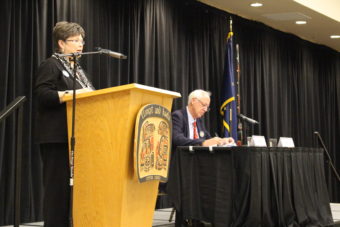
Mayoral candidate Karen Crane and Ken Koelsch spoke at the Native Issues Forum. (Photo by Elizabeth Jenkins/KTOO)
Juneau’s mayoral candidates attended the Native Issues Forum Tuesday. Spaghetti was on the menu, but so were questions about past assembly decisions and racial diversity.
Karen Crane and Ken Koelsch were welcomed by a full house at the Elizabeth Peratrovich Hall. Both candidates opened up with information about themselves before taking questions from the audience.
President of Sealaska Heritage Institute Rosita Worl said the gathering Celebration, which happens every two years, brings in more than $200 million to Juneau. She asked if the candidates would support the city being labeled as the “Northwest Coast Arts Capital” — an idea Worl introduced at the Innovation Summit.
“We see that we can celebrate cultural diversity and cultural diversity brings in economic benefits,” Worl said.
Both candidates seemed to like the concept. Crane said the borough provides financial support for Celebration and the assembly should work with Sealaska Heritage to help brand Juneau.
“This is an area where there is great potential for innovation and for an individual artist to grow and for growing the economy and its area we should be paying attention to and supporting in whatever way we can,” Crane.
Others in the audience wondered how the candidates felt about raising the city’s minimum wage to help offset the high cost of living in Juneau.
Koelsch said he was a firm a believer that the market should dictate wages.
“We have some jobs that are worth $100,000. We have some jobs that are worth $50,000,” Koelsch said. “And we have some jobs that have minimum wage attached to them because of the learning situation.”
Crane said she supported raising the minimum wage.
“I would disagree with Mr. Koelsch on the fact that not all minimum wage jobs are entry and learning jobs,” Crane said. “There are many jobs in the community with people who have been working for a long time and are still paid at a minimum wage.”
The candidates also answered questions from people who weren’t happy with past assembly decisions, like selecting a $16 million dryer to deal with city waste and amending the senior sales tax exemption. Crane — who was on the assembly at the time — stood behind those decisions.
Later, Goldbelt board member Ben Coronell asked how the candidates would address the assembly’s diversity problem.
“My concern is that we’re losing the Native voice and nobody really hears us,” Coronell said. “If we have just one race on the assembly and in all the key positions in the city management, my concern is growing.”
Crane used the Juneau Police Department as an example of an organization that’s trying to diversify and do better. She said there should be more interaction between the city and the tribes.
Koelsch said his philosophy on diversity was informed by a class taught by Walter Soboloff: a person doesn’t always assert themselves into the conversation.
“I will be expecting to come to you and asking what you feel is the need and the want,” Koelsch said.
Voters will elect a new mayor March 15.
If you’d like to learn more about the mayoral hopefuls, Juneau’s League of Women Voters will host a municipal candidate debate at 7:00 p.m. Wednesday in assembly chambers. KTOO will also broadcast the debate.
In a news release Monday, Juneau Assembly member Debbie White condemned mayoral candidate Karen Crane’s use of an old assembly photo on campaign materials.
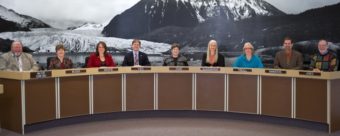
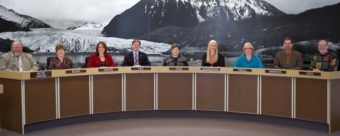
The photo was from the city’s homepage and shows the nine-person assembly — which included Crane at the time — seated and smiling. White said she found out when a friend mistook it as her endorsement of Crane.
The photo used on Karen Crane’s campaign brochure. (Photo courtesy City and Borough of Juneau)
“I guess my biggest concern is that wasn’t hers photo to use. She didn’t have the permission of the people in that photo to use that photo and it’s very deceiving,” White said.
White’s press release says then-Mayor Merrill Sanford, current Mayor Mary Becker, and Assemblymember Jerry Nankervis also oppose the use of the image.
White endorses Crane’s opponent Ken Koelsch, and she feels like the use of her image, along with the other assembly members, could mislead voters. But Crane said that wasn’t her intention.
“There is absolutely nothing in my brochure that indicates that I am receiving any support from any person in that photograph,” Crane said. “It was just a photo of me at work.”
Crane using the image doesn’t violate city codes, according to city attorney Amy Mead. But White believes it could be a campaign violation under state law if it was paid for by public funds.
White said she plans to consult the Alaska Public Office Commission on the matter. At deadline, the commission didn’t have a complaint on record.
Correction: A previous version of this story misspelled Ken Koelsch’s name. We regret the error.
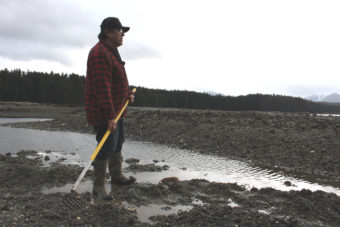
Alan Zuboff comes to these Angoon tidal flats almost every day to dig for cockles. (Photo by Elizabeth Jenkins/KTOO)
Angoon’s mayor asked for help earlier this month after a high concentration of mercury was found in a seal harvested for food. With only one grocery store in town, the small Southeast village is dependent on what’s in the water and, according to a tissue sample test, it might include contaminants from a nearby mine.
Alan Zuboff, a Tlingit elder, drags a rake across a pebbly surface on Angoon’s tidal flats. He’s been coming to this spot his whole life.
“Where we’re digging is an old site,” Zuboff said. “It used to be a fish weir back 300 or 500 years ago.”
Today, he’s digging for cockles — a saltwater clam with a grooved, brown shell. Zuboff visits here almost every day at low tide.
“Because if you want to pay $10 for a gallon of milk at the store, it gets pretty pricey to buy stuff from the store,” Zuboff said. “It’s best to live off the land and besides everything is going organic. And we’ve been doing it for 10,000 years. Why not keep it up?”
After digging a few minutes, Alan Zuboff has a sizable pile of the saltwater clams. (Photo by Elizabeth Jenkins/KTOO)
The reason not to keep it up: the possibility of toxic metals. Angoon’s tribal council has warned people about collecting traditional foods, like seaweed, clams, mussels, crab, cockles and seal.
Back in May, Edward Kookesh, an Angoon hunter, harvested a seal near the shores of Hawk Inlet, and K.J. Metcalf, a Juneau resident who was boating nearby, asked to take a sample. Metcalf was the first ranger of Admiralty Island National Monument and now oversees the environmental advocacy nonprofit, Friends of Admiralty Island.
When the independent lab tests were analyzed months later, he was alarmed to find elevated levels of mercury.
“As high as they’ve ever been in an Alaska seal …” Metcalf said. “I called Edward Kookesh and said, ‘Do you still have that seal?’ and he said, ‘No, it’s been divided up in the community and it’s eaten.’”
“We’re all still alive, you know,” Kookesh said. “But we’re just wondering how bad it’s going to get … (and) if we’re going to be able to fix it.”
Kookesh split the seal among 10 people — mostly family and friends from Angoon.
“We make seal grease out of the seal fat and use it with our eggs and our fish,” Kookesh said. “It’s a big part of what we do in subsistence life.”
Thankfully, he says, no one felt sick, but he worries about long-term health issues. Exposure to mercury can impact the nervous system. It can impair vision, speech, hearing and cause trembling of the hands.
Given the risks, Kookesh says he won’t be going back to Hawk Inlet to harvest seal.
“I don’t think I’ll be going up there to harvest anything,” Kookesh said. “I don’t even want to make a chance and feed my family or anyone else’s family anything that’s contaminated.”
The location in question is the home to Hecla’s Greens Creek Mine, which has been operating since the 1980s. It’s one of the largest producers of silver in the country. and the only mine to operate on a national monument.
The mine is subject to regular water quality and sediment testing that gets rolled into a monthly and annual report. It’s submitted to the state’s Department of Environmental Conservation. Then there’s biomonitoring — the testing of sea life, like mussels and sea worms, but not seal.
“It’s difficult for us to see direct evidence or a link between Greens Creeks discharges to what was found in that particular seal species,” says Allan Nakanishi. He oversees wastewater discharge permitting for mining facilities for the state’s water division.
Nakanishi says seals are considered a high order life-form, meaning they’re migratory. The biomonitoring program selects the lowest order on the food chain because they stay put. In other words, a shellfish is easier to pinpoint and use as a basis for analysis to see if anything’s changed in a particular area.
And Nakanishi said when it comes to mercury levels their tests show nothing has.
“I guess it’s in the ocean but we can’t pinpoint it to Green’s Creek’s operations or their discharges based on what we’re seeing in their effluent monitoring results,” Nakanishi said.
Back in 1989, Greens Creek spilled an unknown amount of ore into the water of Hawk Inlet and went through the steps to clean it up. Since then, Nakanishi says the water quality has returned to pre-mining levels. The seal could have traveled from somewhere else.
“You know, the DEC is correct,” K.J. Metcalf of The Friends of Admiralty Island said. “There is that possibility, I would say. But when it’s that high and that dangerous that you’ve got to take some action to determine if it is the mine that’s causing it. If it comes from someplace else and you can prove that we outta know where it came from because that place is bad. ”
The small village of Angoon is home to about 400 people. (Photo by Elizabeth Jenkins/KTOO)
Angoon’s mayor and tribal president, Albert Howard, showed me around a neighborhood on Angoon’s seven and a half miles of road. Many of the homes have smokehouses for fish in the backyard.
A little more 400 people live here, and Howard thinks a good 80 percent of Angoon’s residents are not employed. A lot of families rely on subsistence foods to live.
“The hardest part is when community members ask if it’s safe to go out and get what they’ve always gotten to feed their families and you don’t have an answer,” Howard said. “Nothing is happening quick enough to give them that answer. And it weighs heavy on you that, as a leader, it’s part of your responsibility to make sure everything is safe.
Howard wrote a letter to the state Department of Health and Social Services outlining his concerns. The department says it will issue a formal response, with the Department of Environmental Conservation, this week.
On the beach in Angoon, Alan Zuboff has already collected a sizable pile of cockles to fill his blue bucket. He says when goes home at night to eat his dinner, the sweet, briny taste of shellfish is on his mind. But so are the toxic metals.
“I am worried about it,” Zuboff said. “But it’s the little person in the back of my mind or that’s sitting on my shoulder, little devil saying, ‘Yeah worry.’”
He wonders about the whole big ocean beyond his community that is both a grocery store and a way of life.
The Bridge in Juneau is one of two formalized adult day programs in Southeast. The program costs $180 a day and accepts Medicaid waivers. (Photo by Elizabeth Jenkins/KTOO)
Health care and housing options are limited for seniors in Southeast, but a few adult day programs are offering relief for care providers, families and friends. They’re often a stop-gap solution until space opens up in a home.
At Juneau’s Bridge Adult Day Program, it isn’t all bingo and reruns of Lawrence Welk. Kelsey Wood, the program supervisor, says the aging adults go on field trips. They play Nintendo Wii –virtual bowling is a favorite. And they do what some might describe as contemporary exercises. The seniors recently learned a pop-culture dance phenomenon known as the Nae Nae.
“There’s some leg movements that go to it. There’s like a stanky leg thing or something like that. … They’re like, ‘This how people dance right now?’ And they’re like, ‘Oh, we remember when the twist was popular,’” Wood said.
Like a lot of things at The Bridge, Wood says the exercises can be adapted for seniors with limited mobility. And that same thoughtfulness is given to people with memory loss, which most of The Bridge’s clients experience.
This morning, Wood is playing 7-up with some of The Bridge’s clients.
“It helps if you put all of the suits together,” Wood explains.
Later there’s a party planned in celebration of Wood’s upcoming wedding. But for now, she’s helping Beth Fletcher play her best game. And after a few minutes playing cards, Fletcher is throwing down winning hands. It’s an activity she’s nostalgic for. She grew up playing Buck Euchre with her siblings in Minnesota and says she loves the attention she gets from Wood.
“Boy, my memory isn’t very good you know, I’m 90 something. So I can’t remember a lot of what I did when I retired,” Fletcher said. “When I was young, I rode horseback. Before I could walk, I rode horseback. … My mind doesn’t hold things very well. But anyway, I had a great life.”
Fletcher comes to The Bridge four times a week. The difference between a program like this and a nursing home or assisted living facility is she goes home tofamily at the end of the day. For some seniors, it’s the best option.
“For folks that are waiting to get into a (Pioneer Home), are waiting to get into nursing-level care, it fills that gap,” Wood said.
Depending on the location, state-run Pioneer Homes screen applicants on application date and other criteria. In Juneau, it’s first-come-first-serve. In Sitka, it’s based on date and level of care. Still, the wait can sometimes be years before a space becomes available. And Juneau’s Wildflower Court, which is a nursing home, doesn’t admit clients–based on memory loss alone. So are there enough adult day programs to help fill the gap in Southeast?
“No, there are not,” says Maryanne Mills, the director of Southeast Senior Services.
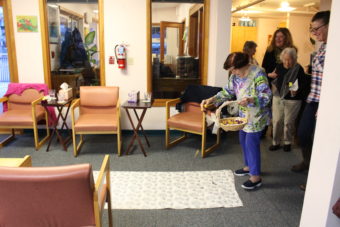
Kelsey Wood’s “flower girl” tosses petals down the aisle. The pretend wedding was organized so clients of The Bridge could celebrate Wood’s upcoming nuptials. (Photo by Elizabeth Jenkins/KTOO)
“In fact, a couple of years ago, we worked with Centers for Community to submit a proposal to Alaska Department of Health and Social Services for a program in Sitka,” Mills said.
There are only a few formalized adult day programs in the region, like Ketchikan’s Rendezvous Senior Day Services. The grant intended for Sitka wound up going to the Matanuska-Susitna Valley.
“And of course right now, with Alaska’s fiscal crisis, getting state general funds to start such a program is probably not going to happen in the immediate future. We trying to hold on to what we have.”
Mills says keeping the doors open for adult day programs saves money when you consider the alternative. Remember, most of the people at The Bridge have some form of memory loss, which could mean expensive full-time care.
So for those who do stay at home, Mills thinks the time to socialize is important.
“It’s sometimes not the natural way to be,” Mills said. “A lot of people tend to isolate when they get older, but that’s not what they should be doing if they want to live a long independent life for as long as possible.”
Back at The Bridge, the cozy living room atmosphere has been transformed into a pretend wedding. The seniors wear frilly corsages and sip sparkling grape juice.
“People aren’t always going to remember your name, but they remember if you do something nice for them and treat them kindly,” said Kelsey Wood. (Photo by Elizabeth Jenkins/KTOO)
And after a while, Wood and her fiance are ready to walk down the aisle. She’s wearing jeans, clutching a bouquet made out of sparkling brooches — the one she’ll carry on her actual wedding day.
DeeAnn Grummett and her 78-year-old husband are looking on. Grummett brings him to The Bridge four days a week.
“You know I pop in and out at different times and they’re always engaged in an activity. They’re not just sitting around staring at the walls,” Grummett said. “They seem to enjoy each other’s company, and the staff is wonderful.”
Both Grummett and her spouse are on the waitlist for the Pioneers’ Home, but she wants to keep him with her as long as she can. She says The Bridge plays a crucial role in helping her do that.
“At this point for us, it’s much better than even in-home services because what we need is a social experience. My husband has reached the point where he can’t plan and carry out his own social life, and he needs a social life,” Grummett said.
She says when she drops her husband off in the morning, and if he’s in a not-so-great-mood, he’s always feeling better by the end of the day.
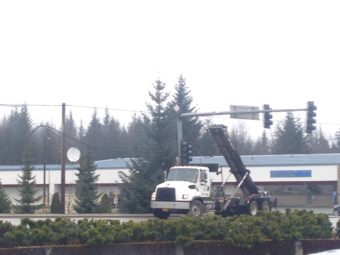
This Arrow Refuse truck damaged an Alaska Communications line along Riverside Drive, Feb. 10, 2016. (Photo courtesy Lori Mikkelsen)
If you’re heading home to the valley, you may not be able to make a phone call on a landline or check your Facebook page. That’s because a commercial truck ripped through telephone lines near the Mendenhall Mall on Wednesday afternoon.
Sgt. David Wrightson with the Juneau Police Department said the vehicle was an Arrow Refuse truck that transports long Dumpsters.
“When it dropped the Dumpster off, it left the area of the business that it was delivering the dumpster to with that lift in the air, and so it came through the intersection and caught a telephone line,” Wrightson said.
No one was hurt, but some Alaska Communications services are down. Spokesperson Hannah Blankenship said the interruptions are primarily in neighborhoods in the valley.
“We’ve made it our top priority and we have all folks on deck who can fix the situation and we’ll be updating our customers as we know more,” Blankenship said.
Blankenship didn’t know when the issue would be fixed. She said updates about the repairs will be posted on Facebook and Twitter.
For our Juneau customers– a commercial vehicle damaged one of our phone lines this afternoon, causing voice and Internet…